Longevity asks how long we live.
Healthspan asks how long we avoid major disease.
Peakspan asks how long we stay close to our personal best.
Peakspan is the stretch of life in which you remain at or above 90% of your best-ever function in a specific domain. The point of Peakspan is that you can still be “healthy” while no longer operating anywhere near your best cognition, aerobic fitness, strength, immunity, or fertility.
The authors of a new paper argue that this “healthy but clearly declined” state is common and worth naming. They even quantify it, showing that different systems reach their Peakspan at very different times and decline at different rates.
Fluid cognitive abilities like processing speed and working memory peak early, around ages 20–30, while crystallized intelligence doesn’t peak until the late 40s or early 50s and can remain stable into the 70s. Cardiorespiratory fitness peaks from adolescence to the mid-20s and then declines steadily, while muscle strength peaks in early adulthood and falls more sharply after 60. Bone density, kidney function, hormone levels, sensory function, immunity, digestion, and reproductive capacity all follow their own trajectories too—some peaking in the 20s, others in the 40s or 50s.
In other words, human aging is asynchronous. We don’t simply age “overall,” but instead age system by system.
In today's newsletter, you'll learn what Peakspan is, why it matters, and how to improve it.
|
The paper aimed to formally define "Peakspan" and quantify it across cognitive, cardiorespiratory, musculoskeletal, renal (kidney), endocrine, sensory, immune, digestive, and reproductive systems. The authors mapped when the functions of these systems tend to peak in humans, when they begin to decline, and their rate of decline across life.
This is best understood as a conceptual synthesis, not a brand-new long-term cohort study. The authors "stitched together" literature across systems from cross-sectional studies, shorter cohorts, and system-specific proxies—ideally, mapping Peakspan accurately would mean having longitudinal data from the same cohort. But that's not the case here.
They define "Peakspan" as the period of life during which we sustain at least 90% of our peak functional performance in a given domain, for example, VO2 max or muscle strength—it's the stretch of life when one stays above 90% of their "best-ever self."
Peakspan begins when we reach our maximal function and ends when it declines below the 90% threshold. To use a concrete example, if your highest VO2 max is 50 and happens at age 35, your "Peakspan" in cardiorespiratory fitness is the period from age 35 until your VO2 max drops below 45.
This is NOT the point where we reach a state of frailty or poor performance. Just when we exit "peak physical function."
Peakspan is distinct from longevity (how long one lives) and healthspan (how long one lives without major disease or disability). Healthspan is limited because it focuses on the absence of disease rather than the optimization of function, overlooking more gradual declines in performance. In the paper’s framework, you can still be well inside healthspan while already being outside Peakspan—and that “Peakspan–healthspan gap” is where slower thinking, lower endurance, weaker immunity, and other early signs of decline start to accumulate. Even though someone is "healthy" (i.e., free of disease), they might be operating far below their physical or cognitive peak.
For health optimizers, disease-free is not a lofty enough goal. Most of us would prefer to think about longevity in terms of Peakspan rather than healthspan—that's what will allow us to maximize our high-functioning years, not just our "disease-free" ones.
You just missed this in your inbox
Every week, Dr. Rhonda Patrick and the FoundMyFitness team distill the latest research into clear, actionable insights on health, longevity, and performance, delivered free to your inbox.
Peakspan varies across biological systems
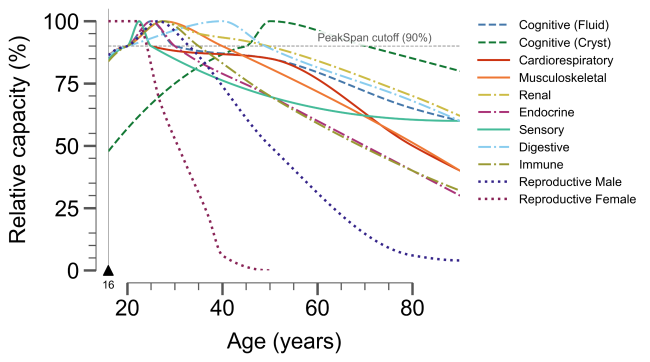
Using the 90% rule, the authors synthesized Peakspans across several biological systems. And one thing is clear—the decline is asynchronous. Different systems peak at different times, and they do not all deteriorate at the same rate.
In other words, aging is not one smooth universal slope. It's a staggered loss of reserve across systems. That becomes important when we start to talk about strategies for extending Peakspan later.
|
|
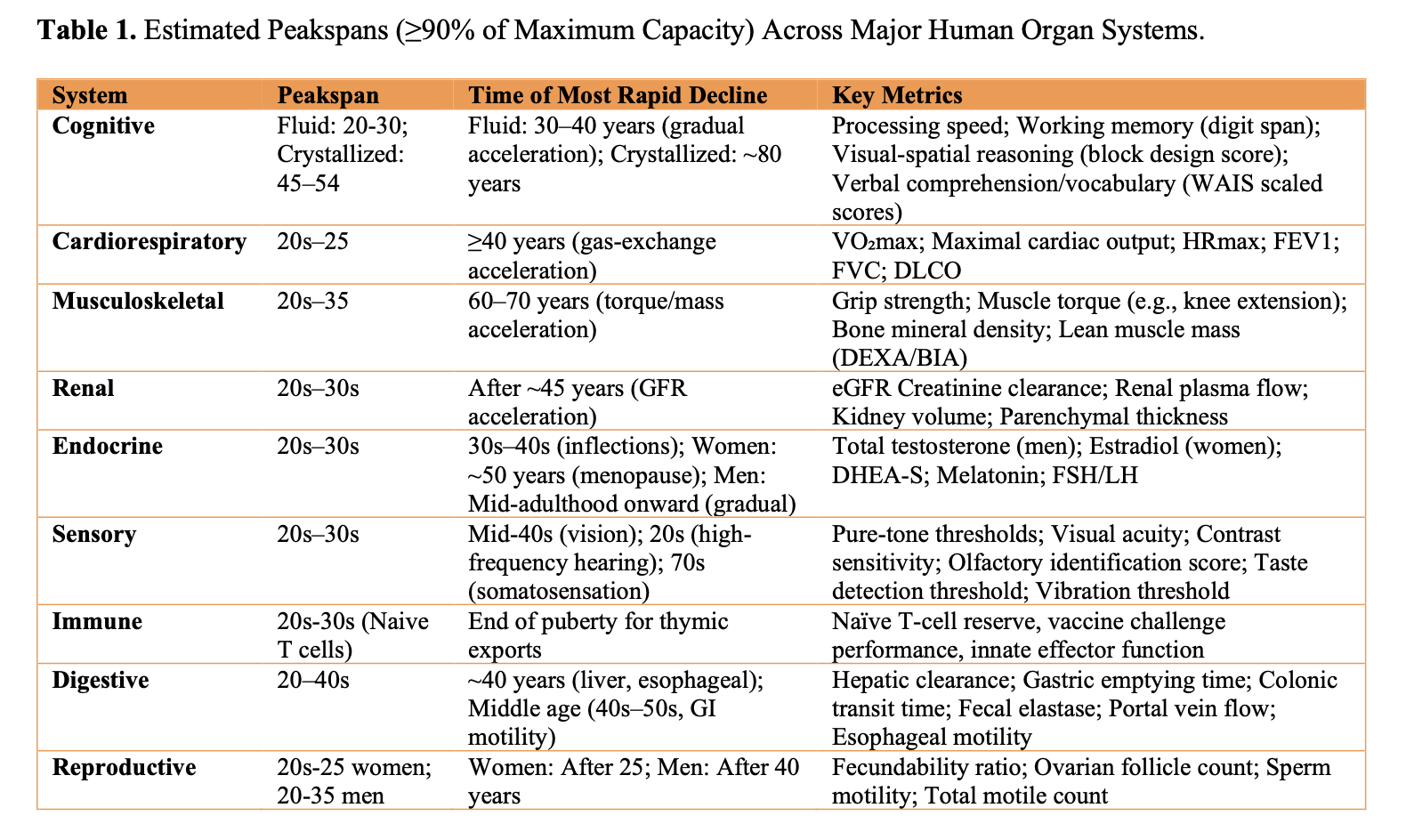
Cognitive Peakspan was divided into two categories: fluid intelligence (processing speed, reasoning, working memory) and crystallized intelligence (verbal comprehension and vocabulary). These showed strikingly different trajectories. Fluid intelligence peaks early—between ages 20 and 30—before gradually declining. In contrast, crystallized intelligence peaks much later, between ages 45 and 54, remains relatively stable through the 70s, and typically does not begin declining until around age 80. Cardiorespiratory Peakspan—including VO₂ max, maximal heart rate, and lung function—occurs between early adolescence and the mid-20s. After this point, it declines steadily at roughly 10% per decade, with the steepest declines occurring after age 40. Muscle strength typically peaks between ages 20 and 25, plateaus between ages 35 and 55, and begins declining after age 65. However, measurable declines can start earlier—around age 30 in men and age 40–50 in women. The most rapid losses in strength occur between ages 60 and 70. Peak bone density occurs in the mid-30s in women and between ages 20 and 30 in men. Kidney function—estimated using measures such as creatinine clearance and glomerular filtration rate—peaks between ages 20 and 30. After age 30, kidney function declines modestly each decade until about age 45, after which the rate of decline accelerates. Endocrine system function peaks in early adulthood. By ages 30–40, noticeable hormonal changes occur in both men and women. In men, total testosterone declines about 1% per year, while free testosterone declines roughly 2% per year, beginning around age 40. In women, estradiol declines rapidly during perimenopause and drops sharply around age 50, the median age of menopause. Sensory Peakspan occurs in early to mid-adulthood, but each sense follows a distinct trajectory. Hearing peaks in the 20s. Vision typically begins declining in the mid-40s. Smell peaks between ages 20 and 30. Touch and proprioception peak in the 20s and 30s and generally do not decline significantly until around age 70. Taste shows a modest decline but is typically 2–5 times worse in older adults compared with younger adults. Digestive Peakspan occurs around ages 40–50 and reflects the function of the liver, gastrointestinal tract, and esophagus. The immune system peaks from puberty through early adulthood. Thymic output declines substantially with age—falling to about 20% of its peak by age 25 and 5% by age 55. Naïve and memory T cells peak between ages 18 and 29, while central and effector memory T cells continue increasing until about age 64, after which they stabilize. Reproductive Peakspan occurs in the 20s to early 30s. In women, the probability of achieving pregnancy is 14% lower at age 35 compared with age 30, declining further until menopause. Women in their 30s have about 12% of their peak non-growing follicles, and by age 40 only 3% remain. In men, reproductive decline is more gradual—semen quality peaks between ages 18 and 39 and declines more sharply after age 40. |
|
The effect of diet composition on sleep. |
A playbook for preserving Peakspan
At face value, the idea that our major organ systems peak at different ages and decline at distinct rates poses a challenge—how are we supposed to intervene on "aging" when the process seems so complex and heterogeneous?
But I think we should look at this problem differently. We don't need a separate protocol for every organ system because we know that there are a handful of repeated levers that defend multiple systems at once! So let's take a look at what really works when it comes to preserving Peakspan and how you can use it to stay at "90% of your best self" for longer.
Cognition
Targeting cognitive Peakspan requires strategies that preserve processing speed, executive function, and learning capacity before cognitive disease (e.g., dementia or cognitive impairment) appears.
My most consistent recommendation for cognitive health is exercise first. It's the number one tool to improve memory in the short term and protect neuronal resilience and plasticity (via BDNF elevations) in the long-term. You should emphasize a mix of training intensities—not just "zone 2 cardio." Performing at least one weekly session of high-intensity intervals effectively increases your aerobic capacity, which is one of the strongest ways to protect the brain systems that decline earliest (higher aerobic fitness is linked in longitudinal studies to a larger brain).
Nutritionally, omega-3s and creatine are the strongest brain-leaning supplements. An omega-3 index of 8–11% is a great target, and people with an omega-3 index of 4–5% typically need a daily dose of 1.7–2.5 grams of EPA/DHA to move into that range. For creatine, a daily dose of 10 grams or more per day seems necessary to elevate brain creatine levels, which some emerging evidence suggests may be effective for improving cognitive function among adults with Alzheimer's disease.
The optional add-on is sauna—observational studies link regular sauna use to lower dementia risk and broader mood and brain benefits.
In Aliquot episode #133, I talk about the surprising effects of creatine on the brain.
Cardiorespiratory fitness
The goal when it comes to cardiorespiratory Peakspan is to preserve your aerobic ceiling and cardiac compliance—to keep the engine powerful, not merely disease-free. And VO2 max is a nearly perfect Peakspan biomarker because it reflects how much of that "ceiling" you still have.
Relying solely on "zone 2 training" is not sufficient to preserve VO2 max throughout life. High-intensity interval training (e.g., the Norwegian 4x4, 1-minute on/1-minute off, Tabata training) performed at least once weekly are practical ways to improve and maintain cardiorespiratory fitness, and for some, might be necessary—about 40% of people who meet the standard "moderate-intensity targets" don't improve their cardiorespiratory fitness until higher intensity work is added.
I don't think there's a better framework for cardiorespiratory Peakspan than what I'll refer to as the "Levine protocol," introduced to me by Dr. Benjamin Levine. It involves:
4–5 days of aerobic exercise per week totaling about 5–6 hours of training One weekly Norwegian 4x4 session (or similar) One hour-long base session ("zone 2") Another 30-minute base session One light recovery day Two days of strength training
The sauna fits here too as an adjunct to aerobic exercise (not a replacement). The sauna can effectively "extend" the cardiovascular benefits of a workout and increase VO2 max more than training alone—15–20 minutes immediately after a workout seems to work best when done 2–3 times per week.
|
 |
Muscle
Maintaining muscle Peakspan means preserving your ability to generate force and retain lean mass while you are still active and capable long before sarcopenia or frailty creep in.
Preserving peak muscle function is straightforward (but not easy): resistance train 2–3 times per week minimum and pair that with 1.2–1.6 grams of protein per kilogram of bodyweight per day (aim for the higher end of that range if you're older or training a lot). Studies show that, while training is the most important factor determining strength/size gains, pairing it with adequate protein results in greater improvements.
Creatine is another pillar—5–10 grams per day is a practical way to modestly increase muscle size and strength during resistance training because it lets you train harder. A few extra reps here and there can add up.
As for what to avoid, cold water immersion immediately after strength training appears to blunt some hypertrophy gains. So if maintaining Peakspan is truly your goal and you do like to cold plunge, just make sure it's pushed far enough away from your workout to avoid this potential interference.
Aliquot episode #120 discusses strategies for maximizing and maintaining muscle mass according to the experts.
Fertility
Maintaining reproductive Peakspan calls for strategies that target reproductive quality and capacity and avoiding common causes of infertility.
Maintaining a healthy body weight, adequate micronutrient status, and regularly exercising are the three preconception behaviors that matter most for women. For men, it's ensuring adequate levels of zinc, selenium, and omega-3s, along with other micronutrients like vitamins C and E which reduce DNA damage to sperm); reducing or avoiding alcohol intake; avoiding hot tubs or sauna; and losing weight if overweight. Women should also pay attention to folate/folic acid, vitamin B12, riboflavin, niacin, zinc, vitamin D, and choline, in addition to ensuring DHA sufficiency, which can be achieved with 500–1,000 mg/day from low-mercury fish or a quality omega-3 supplement.
There's also toxicant avoidance—BPA, microplastics, and PFAS (so-called "forever chemicals") are major threats to male and female fertility and pose risks to viable eggs, implantation, sperm, and estrogen/testosterone. Complete avoidance is virtually impossible, but you can limit your exposure by minimizing plastic food contact (especially canned foods and plastic storage) and filtering your water, which can be a major source of microplastic-associated chemicals.
|
 |
Immunity
Avoiding severe illness is falls into the realm of healthspan, but immune Peakspan has a different goal: to preserve immune responsiveness, adaptability, and performance.
Sleep is not optional in my immune Peakspan model. Both short- and long-term sleep deprivation impairs immune function and shifts immune cells to a state that is less able to clear viral infections. A stable immune system rests on a foundation of good sleep.
Other factors I've discussed previously include vitamin D, omega-3s, exercise, and heat. Maintaining adequate vitamin D levels (many people are deficient or insufficient) reduces acute respiratory infection risk; and omega-3s support immune function by dampening inflammation and enhancing the body's antiviral response. The sauna (my personal favorite) has been shown to increase white blood cells/monocytes, and regular sauna use is linked to reduced pneumonia risk.
Maintaining a healthy weight is also crucial—obesity is a risk factor for infection-related hospitalizations and mortality across diverse pathogen types, populations, and baseline clinical profiles, with evidence suggesting that approximately one in ten infection-related deaths worldwide might be attributable to obesity.
In Q&A Mashup #2, I discuss the immune benefits of regular sauna use.
Digestion
Because digestive function is not something that waits until old age to change, a microbiome-forward approach works best here as an early preservation strategy. It helps preserve a more diverse, lower-inflammation gut ecosystem with a higher-function digestive and immune state.
A food-focused approach is strongly recommended. That means eating fermented foods like sauerkraut and kimchi; a diverse array of micronutrient-rich foods; and fiber, which feeds short-chain fatty acid-producing bacteria in the gut. Targeted probiotics and glutamine may also be useful.
|
 |
Final thoughts
The idea of Peakspan—the period of life when we are functioning near our physical and cognitive best—is an interesting way to think about aging. In many ways, it’s simply a reframing of concepts we already talk about, like healthspan or longevity. After all, most of us intuitively want to maintain our highest level of function for as long as possible, regardless of what we call it.
Still, the term can be useful. Rather than focusing solely on preventing disease or extending life at the margins, Peakspan emphasizes maintaining the years when we feel capable, energetic, and resilient. It shifts the conversation away from merely avoiding decline and toward preserving our highest levels of performance.
Importantly, this framing doesn’t dramatically change what the science tells us to do. The same core lifestyle pillars still apply: regular physical activity, maintaining cardiorespiratory fitness, prioritizing sleep, and consuming a nutrient-dense diet that supports metabolic and brain health. These habits are the foundation of longevity science and remain the most powerful tools we have whether our goal is extending healthspan or Peakspan.
Where the concept does add value is in how it encourages us to think about measurement. If the goal is to maintain something close to our physiological peak, perhaps within ~90% of our lifetime best, then having a sense of where we stand becomes important. That might include tracking metrics such as VO₂ max, strength benchmarks like a one-repetition maximum, or even simpler indicators like how many push-ups or pull-ups we can perform.
Without some reference points, it’s difficult to know whether we’re maintaining our capabilities or slowly drifting away from them.
At the same time, don't let measurement become a source of stress. Not everyone needs to quantify every aspect of their health, and for some people excessive tracking can create unnecessary anxiety. The goal is awareness. Having a few meaningful benchmarks can help us course-correct if needed, while still allowing us to focus on the bigger picture of living well.
But perhaps the most important takeaway is that Peakspan isn't necessarily about chasing extreme performance or obsessively optimizing every variable. It's about building and maintaining the biological reserve that allows us to stay capable, independent, and mentally sharp for as long as possible.
In the end, whether we call it healthspan, longevity, or Peakspan, the goal is the same—to extend the years in which we are not just alive, but truly thriving.
|
Warm regards
— Rhonda and the FoundMyFitness team
|
|
|
|
|
 Mitochondrial bioenergetics
Yamanaka factors
Exercise intensity
Cell reprogramming
Blood-brain barrier
Epigenetic age deceleration
Stress resistance
Cardiorespiratory fitness
Nutritional ketosis
Compression of morbidity
CpG Islands
Lactate shuttle
Whole-body hyperthermia
Psychology of grit
Telomerase reverse transcriptase (TRT)
Chronic inflammation
Disease prevention
Therapeutic hyperthermia
Pathogen-host defense theory
Cell signaling
Proteostasis
Cellular senescence
CRISPR-Cas9
Aging
PGC1α
Overcoming adversity
Increased healthspan
Gene–diet interaction
Biology of resilience
Immune-brain interaction
Neuroendocrine effects
Heat Shock Proteins (HSPs)
Oxidative stress
Vitamin D
Omega-3 fatty acids
β-Hydroxybutyrate (BHB)
GLUT4
Pregnancy optimization
Mitochondrial bioenergetics
Yamanaka factors
Exercise intensity
Cell reprogramming
Blood-brain barrier
Epigenetic age deceleration
Stress resistance
Cardiorespiratory fitness
Nutritional ketosis
Compression of morbidity
CpG Islands
Lactate shuttle
Whole-body hyperthermia
Psychology of grit
Telomerase reverse transcriptase (TRT)
Chronic inflammation
Disease prevention
Therapeutic hyperthermia
Pathogen-host defense theory
Cell signaling
Proteostasis
Cellular senescence
CRISPR-Cas9
Aging
PGC1α
Overcoming adversity
Increased healthspan
Gene–diet interaction
Biology of resilience
Immune-brain interaction
Neuroendocrine effects
Heat Shock Proteins (HSPs)
Oxidative stress
Vitamin D
Omega-3 fatty acids
β-Hydroxybutyrate (BHB)
GLUT4
Pregnancy optimization