Every so often, my Apple Watch taps me on the wrist and reminds me to stand.
I usually interpret that little (and somewhat annoying) nudge as a reminder that I have been sitting too long. So I change positions, stretch my legs, and give my back and hips a break.
But I have often wondered whether there is more to it than that. Could stepping away from the desk for a few minutes actually help preserve how well my brain works during a long stretch of focused work? I know I subjectively feel more alert, but is my brain functioning better after a break?
A new meta-analysis found that briefly interrupting prolonged sitting with standing or physical activity was associated with better executive-function and working-memory-related performance than remaining seated continuously.
The effects were modest, acute, and supported by low-certainty evidence. The study does not show that movement breaks are some sort of cognitive enhancer but, rather, more like a way to prevent some of the drop in mental performance that can happen after several uninterrupted hours at a desk.
That may not seem overwhelming, but I find it incredibly practical, and in today's newsletter, we'll discuss how you can apply this information.
|
| |
These weekly science deep dives are made possible by FoundMyFitness Premium Members like you. I share a few more segments related to movement and cognition at the end of this email! |
| |
|
You just missed this in your inbox
Every week, Dr. Rhonda Patrick and the FoundMyFitness team distill the latest research into clear, actionable insights on health, longevity, and performance, delivered free to your inbox.
Activity breaks benefit cognition
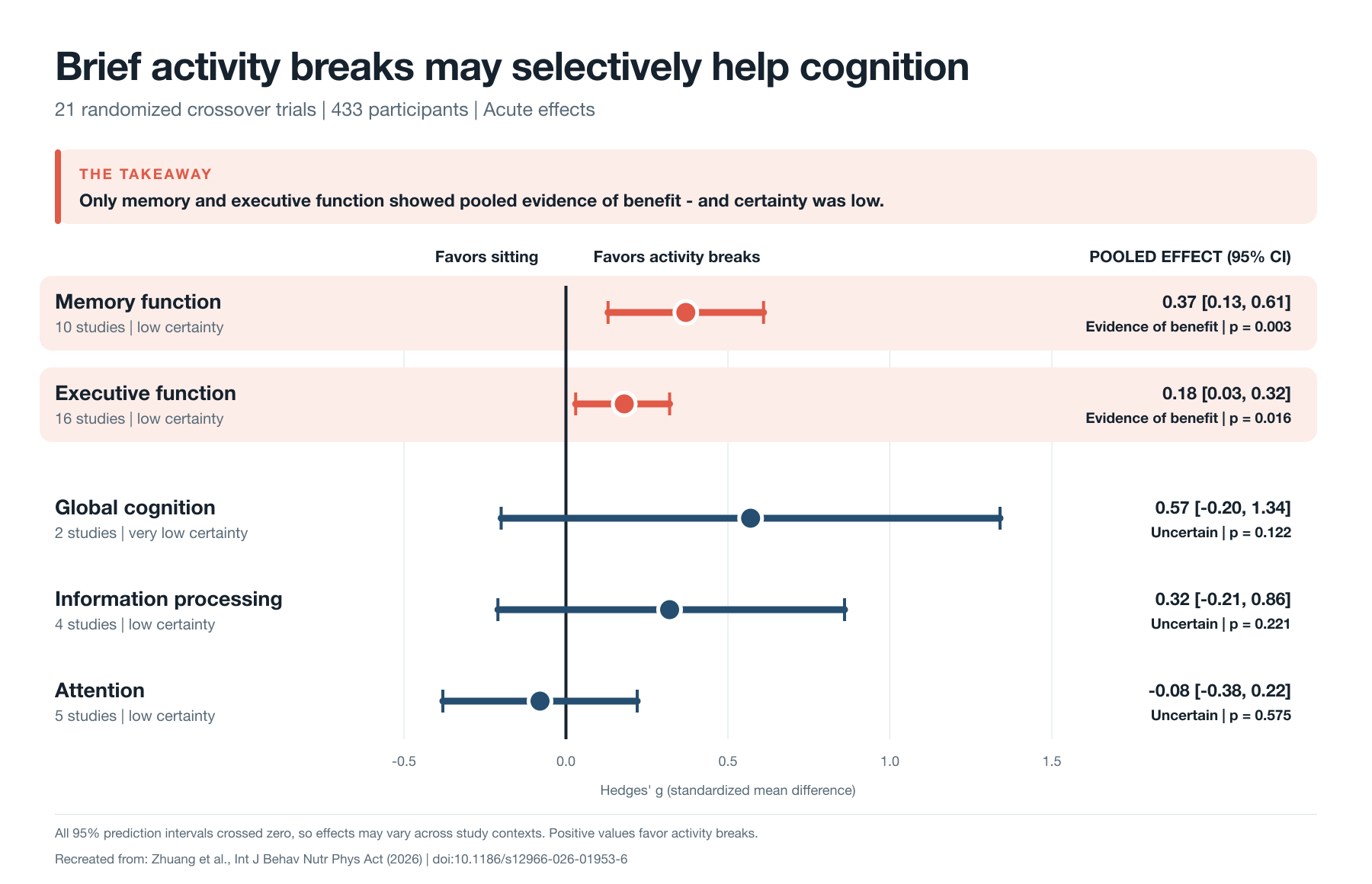
The meta-analysis included 21 randomized controlled trials involving 433 participants across a wide range of ages, from adolescents to older adults.
During one condition, participants remained seated for an extended period. During the other, that sitting was repeatedly interrupted by some form of movement, including:
Walking, which was used in roughly two-thirds of the studies Resistance exercise Standing Cycling Stair climbing And, in one particularly unusual protocol, repeated leg jiggling
The breaks ranged from approximately 30 seconds to 15 minutes, although two to five minutes was much more typical. Most were performed every 20 to 30 minutes, but some protocols used shorter or longer intervals.
The researchers separated cognitive performance into several domains, including executive function, memory, attention, information processing, and overall—or global—cognition.
The clearest benefits appeared in executive function and working-memory-related performance.
Executive function improved by a statistically significant, but very small amount. The benefit for memory was larger, although it was still considered small. The researchers did not find reliable improvements in attention, information-processing speed, or global cognition.
Executive function includes the higher-order control processes that allow us to inhibit distractions, switch between tasks, resolve conflicting information, remain cognitively flexible, and regulate goal-directed behavior. These are precisely the abilities we rely on during demanding desk work.
“Memory” requires some clarification here. Most of the included tests assessed working memory, which is our ability to briefly maintain information, update it, manipulate it, and retrieve it in the moment. Think of holding a number in mind while performing another calculation, remembering the beginning of a sentence while reading the end, or keeping track of several pieces of information while making a decision. This is different from preserving long-term memories or protecting against the progressive memory deficits we associate with conditions such as dementia.
The finding that attention, information processing, and global cognition didn't improve isn't proof that movement breaks have no effect on these outcomes. Far fewer studies assessed them—we just don't have enough evidence to say one way or the other.
|
|
| |
What type of movement worked best?
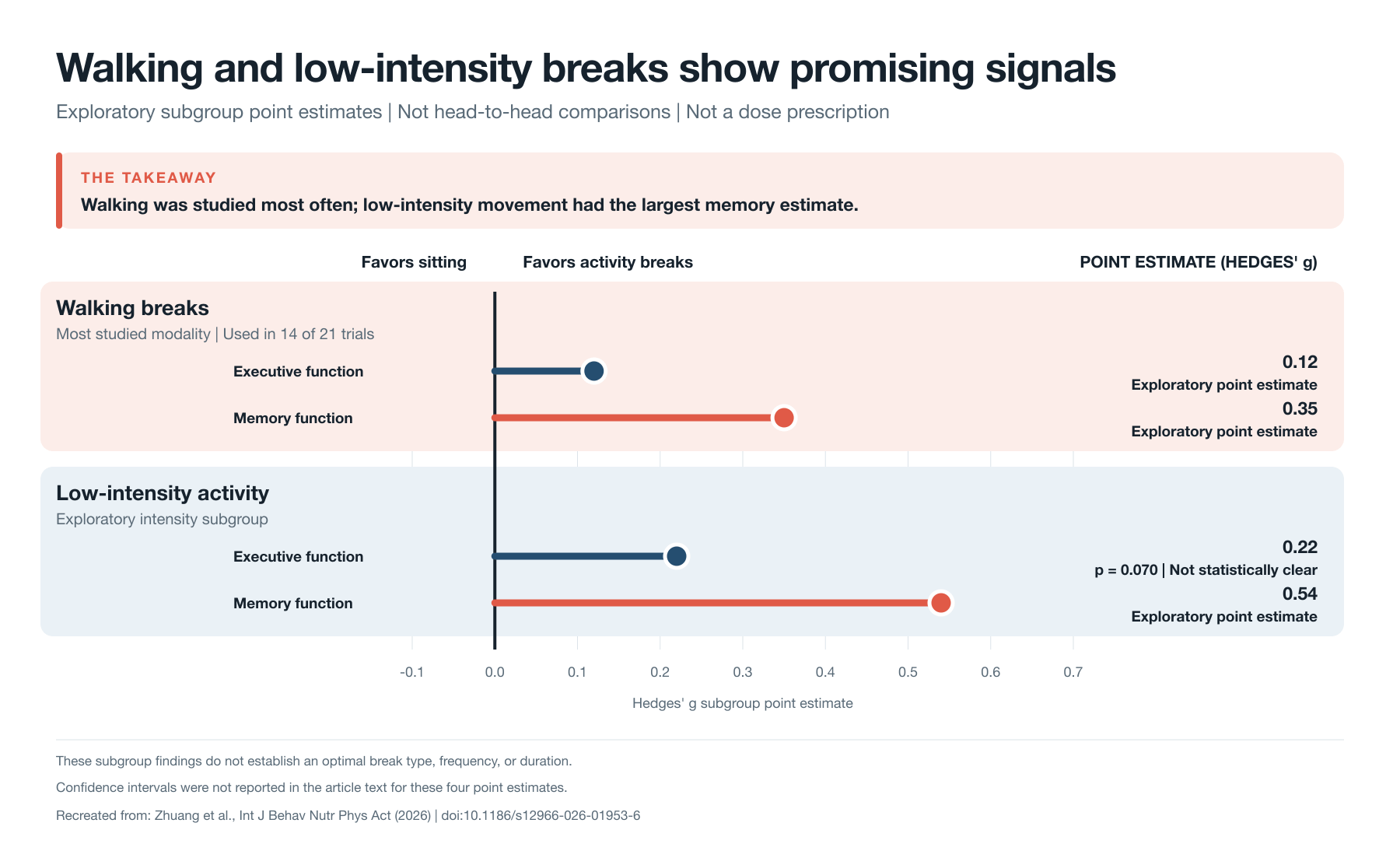
The protocols varied so widely that it is difficult to declare one form of movement superior. Still, walking produced the most consistent positive signal for both executive function and working memory. Low-intensity activity also appeared particularly promising for memory.
That is encouraging from a feasibility standpoint. Preserving cognitive performance during the workday may not require turning every break into a miniature workout. A gentle walk may provide enough muscular activity, cardiovascular stimulation, and change in arousal to interrupt the physiological effects of sitting without adding fatigue or disrupting focused work.
In fact, harder exercise may not always be ideal when the immediate goal is cognitive performance. Vigorous movement creates a larger metabolic and cardiovascular stimulus, which can be valuable when the goal is improving fitness, glucose regulation, or cardiovascular health. But it can also leave us temporarily breathless, fatigued, or overstimulated—none of which is necessarily conducive to sitting back down and immediately resuming a complex task. I'm not saying that light activity is cognitively superior to vigorous activity. Rather, the evidence simply suggests that gentle movement may be sufficient, which makes this strategy easier to integrate into a real workday.
How often should we move?
More frequent interruptions were associated with greater improvements in executive function. That makes intuitive sense because regularly restoring movement, circulation, and arousal may help sustain the brain networks responsible for cognitive control.
Memory showed the opposite pattern. Studies using longer intervals between breaks tended to report larger working-memory effects.
One possibility is that these two cognitive domains respond differently to interruption.
Executive control may benefit from frequent physiological “resets.” Memory-related tasks, however, may be more vulnerable to task switching. When we are actively learning, encoding information, or holding something in mind, being pulled away every 20 minutes could disrupt the very process we are trying to support.
Sometimes staying seated and immersed in the information really does help us remember it.
The authors make a point of saying that the current evidence is not sufficient to prescribe a precise dose, frequency, or intensity of movement breaks.
Depending on how you look at it, that is both bad and good news.
The bad news is that I cannot tell you that walking for precisely two minutes and 30 seconds every half hour is the scientifically optimized protocol for improving cognition.
The good news is that the intervention does not appear to require sophisticated equipment, high intensity, or much time. Periodically doing something to interrupt several hours of continuous sitting may be more important than following a perfectly timed protocol.
The next question is why such a small amount of movement might affect the brain at all.
|
|
|
| |
How movement reaches the brain
The brain does not operate independently from the heart, blood vessels, skeletal muscle, and metabolic system. What affects the delivery and regulation of blood and energy throughout the body also changes the environment in which the brain must function.
In that sense, some apparently “brain-specific” benefits of movement may actually arise through vascular and metabolic pathways (I discussed many of these systemic effects in a recent FoundMyFitness episode with Brady Holmer on The Best Type of Exercise for Longevity).
Preserving cerebral blood flow
Prior experimental research has shown that three to four hours of uninterrupted sitting can reduce cerebral blood-flow velocity by approximately 5% to 6%.
The lower legs contain large muscles that normally help pump blood back toward the heart. When we walk, repeated muscular contractions compress the veins, reduce lower-limb pooling, and increase venous return. Heart rate and cardiac output also rise modestly. Together, these changes help sustain circulation and generate the pulsatile blood-flow signals that support blood flow to the brain.
Shear stress and nitric oxide
As blood flow increases, it produces a frictional force—known as shear stress—along the endothelial cells lining the vessel wall. Those cells sense the increase in flow and respond by activating endothelial nitric oxide synthase, an enzyme that produces nitric oxide.
Nitric oxide helps blood vessels relax and dilate. It is one of the central signals through which exercise supports vascular responsiveness and endothelial function. When we remain still for hours, those flow-dependent signals diminish. Getting up and walking reintroduces them, even if the increase is far smaller than what occurs during a structured workout.
Glucose regulation connects movement and cognition
The brain relies on a stable supply of metabolic fuel, and prolonged sitting—particularly after a meal—can impair the body’s ability to clear glucose from the bloodstream. Brief activity recruits skeletal muscle, increases glucose uptake, and reduces the metabolic burden of remaining inactive after eating.
This may be especially relevant during the hours after lunch, when several factors can converge, including the post-meal rise in glucose, circadian changes in alertness, accumulated mental fatigue, and the monotony of spending several hours in the same environment (leading to the dreaded mid-afternoon "crash").
That's why I recommend a brief walk after lunch. It accomplishes several things at once. It interrupts sitting, recruits skeletal muscle, improves glucose disposal, increases circulation, and provides a temporary mental reset.
What about BDNF?
I would love to attribute some of these benefits to one of my favorite molecules—brain-derived neurotrophic factor, or BDNF. It supports synaptic plasticity, learning, memory, and the survival and growth of neurons.
Exercise can increase circulating BDNF, and this is one pathway through which regular physical activity may support long-term brain health.
But I am less convinced that BDNF is the primary explanation here. Most of the activity breaks in this review were brief and low intensity. BDNF responses generally become more pronounced as exercise intensity and duration increase. A two- or three-minute comfortable walk may simply be too small a stimulus to produce a meaningful increase.
(For more on BDNF, see our BDNF topic page).
When it comes down to it, the explanation may not be entirely molecular.
Getting up changes the sensory environment. It increases alertness, relieves physical discomfort, reduces monotony, and creates a clear boundary between one period of work and the next.
A short walk may help us disengage from a stale cognitive state and return to the task with renewed attention. It's a brief physiological and psychological "reset."
|
|
 |
| |
Designing a brain-friendly desk day
Movement breaks should not replace exercise. I think of them as a second layer of protection.
Structured aerobic and resistance training build fitness and physiological reserve.
Movement breaks prevent the rest of the day from becoming one continuous period of muscular inactivity.
So the solution is not to replace eight hours of sitting with eight hours of standing. That would be neither practical nor necessarily better. In my recent conversation with Dr. Kelly Starrett on episode #111 of the FoundMyFitness podcast, he made the distinction that sitting is not inherently bad, and standing is not inherently good. The larger problem is spending marathon stretches in a single position with very few opportunities to move. He describes this as a loss of movement choice.
A stool, foot support, standing desk, and enough open space to change positions can transform a static workstation into a more dynamic environment without making it less conducive to productive work.
I have a standing desk that, before our conversation, I (regrettably) was not using nearly as much as I could have. Since then, I have been making much greater use of it, not because standing itself is magical, but because raising the desk gives me more ways to position and move my body.
Here is how I would structure a desk day to support productivity:
1. Walk between focused work blocks
Walking was the most frequently studied interruption in the review and produced the most consistent signal for executive function and working memory.
A practical starting point is to organize work into blocks of approximately 30 to 60 minutes, followed by two to five minutes of comfortable walking.
That walk could involve:
Taking a short lap around the office or house Refilling a water bottle Walking outside for a few minutes Pacing during a phone call Taking the stairs at an easy pace Walking briefly after lunch
2. Move at natural task boundaries
I would not allow a timer to pull me away in the middle of a complex thought.
That may be particularly important when reading, studying, writing, or trying to encode new information. The review’s divergent findings for executive function and working memory raise the possibility that very frequent interruptions can sometimes create task-switching costs.
Instead, move at natural transition points: after finishing a paragraph or section, at the end of a meeting, after completing a phone call, between two parts of a project, before opening a new document, or after sending an email or completing a focused work interval.
We already have enough artificial distractions. A movement break should help restore focus, not become another source of fragmentation (I discuss why context switching erodes focus in episode #125 of The Aliquot).
3. Change positions between walks
Walking is useful, but it does not need to be the only form of movement throughout the workday.
Alternate between sitting, standing, leaning, perching on a stool, placing one foot on a support, or shifting into a split stance. At home, certain phone calls, reading tasks, or low-intensity work could even be done while sitting on the floor and rotating among several positions.
4. Use "micromovements" when walking is not practical
Some situations make it difficult to step away from the desk. During those periods, small lower-limb movements can still interrupt complete muscular inactivity. I would view micromovements as useful backups rather than proven equivalents to walking.
Options include:
Calf raises Moving or lightly fidgeting the legs A few bodyweight squats Standing during part of a call Reaching the arms overhead Rotating the trunk Shifting weight between the legs
5. Add vigorous exercise snacks separately
A hard stair climb, brief cycling interval, set of bodyweight squats, or fast calisthenics circuit can produce a stronger cardiovascular and metabolic stimulus. That is an exercise snack, and it serves a somewhat different purpose from the low-intensity movement breaks examined in most of these cognition studies.
Intensity should match the immediate goal.
When the goal is fitness, metabolic health, or a burst of arousal, a vigorous exercise snack may be ideal. When the goal is returning calmly to detailed cognitive work, comfortable walking may be the better choice. Mix and match to suit your needs.
Final thoughts
Many of us think about movement in narrow terms. We exercise for an hour, check the box, and return to a day dominated by chairs and screens. Structured exercise remains essential, but it does not follow that the rest of the day should contain almost no movement.
This is why I have become increasingly interested in both exercise snacks and movement breaks. Exercise snacks are vigorous, last only a few minutes, and are useful when I want something resembling a "micro workout." But during focused work, an easy walk may serve a different, and perhaps more appropriate, purpose.
Instead of an adaptation stimulus, I see movement breaks as routine maintenance. They may not push you out of the comfort zone, but they can help prevent your bodily state from becoming too stale.
I do not think we need to optimize this down to the second. Finish a thought, complete a task, and then—literally—move on.
I spend a lot of time sitting, so I have been trying to apply this distinction in my own workday by using my standing desk more often, shifting positions, and looking for natural opportunities to step away from the screen. I am not trying to avoid sitting. I just want to avoid becoming stuck in one position for too long.
Change your physiological state periodically. It may help you return to your desk a little sharper, and it is probably closer to how the human body was meant to move throughout the day.
|
|
| |
Go deeper on movement and cognition
This week's newsletter suggests that breaking up long periods of sitting with brief standing or physical activity may produce small, immediate improvements in executive function and memory.
I've gone deeper across several Premium episodes, including strategically timed exercise, exercise-induced BDNF, and lactate's role in cognition, focus, brain plasticity, and memory.
Q&A #24
Q&A #6
Aliquot #117: The Science of Lactate in Brain Performance
|
|
Warm regards,
— Rhonda and the FoundMyFitness team
|
|
|
|
|
|
 Mitochondrial bioenergetics
Yamanaka factors
Exercise intensity
Cell reprogramming
Blood-brain barrier
Epigenetic age deceleration
Stress resistance
Cardiorespiratory fitness
Nutritional ketosis
Compression of morbidity
CpG Islands
Lactate shuttle
Whole-body hyperthermia
Psychology of grit
Telomerase reverse transcriptase (TRT)
Chronic inflammation
Disease prevention
Therapeutic hyperthermia
Pathogen-host defense theory
Cell signaling
Proteostasis
Cellular senescence
CRISPR-Cas9
Aging
PGC1α
Overcoming adversity
Increased healthspan
Gene–diet interaction
Biology of resilience
Immune-brain interaction
Neuroendocrine effects
Heat Shock Proteins (HSPs)
Oxidative stress
Vitamin D
Omega-3 fatty acids
β-Hydroxybutyrate (BHB)
GLUT4
Pregnancy optimization
Mitochondrial bioenergetics
Yamanaka factors
Exercise intensity
Cell reprogramming
Blood-brain barrier
Epigenetic age deceleration
Stress resistance
Cardiorespiratory fitness
Nutritional ketosis
Compression of morbidity
CpG Islands
Lactate shuttle
Whole-body hyperthermia
Psychology of grit
Telomerase reverse transcriptase (TRT)
Chronic inflammation
Disease prevention
Therapeutic hyperthermia
Pathogen-host defense theory
Cell signaling
Proteostasis
Cellular senescence
CRISPR-Cas9
Aging
PGC1α
Overcoming adversity
Increased healthspan
Gene–diet interaction
Biology of resilience
Immune-brain interaction
Neuroendocrine effects
Heat Shock Proteins (HSPs)
Oxidative stress
Vitamin D
Omega-3 fatty acids
β-Hydroxybutyrate (BHB)
GLUT4
Pregnancy optimization