If two meals contain almost identical calories, carbohydrates, protein, fat, and fiber, it would be easy to assume your body handles them in much the same way.
A new study shows why that assumption isn't entirely correct.
After an ultraprocessed meal, people had a greater insulin response but a smaller shift toward burning carbohydrates for energy than after a less-processed meal. Looking at blood glucose alone, which wasn't different between the meals, would have missed both differences!
That second finding gets at something called metabolic flexibility, which is our ability to adjust which fuels we use as circumstances change. That shift was blunted after the ultraprocessed meal, suggesting that understanding a food’s metabolic effects requires looking beyond its nutrient totals or even the glucose response it produces.
As the evidence linking higher UPF consumption to chronic disease keeps accumulating, studies like this can help us understand what might contribute to those relationships, including differences that emerge before we even consider overeating or weight gain.
Today, we’ll look at the findings from this study and explore their possible connection to the brain’s response to food. I'll also answer a few common audience questions about ultraprocessed foods.
|
| |
These weekly research deep dives are made possible by our Premium Members. Your support helps us examine the evidence closely and keep sharing it with others. At the end of this email, I provide some extra resources on ultraprocessed foods for those who want to learn more. |
| |
|
You just missed this in your inbox
Every week, Dr. Rhonda Patrick and the FoundMyFitness team distill the latest research into clear, actionable insights on health, longevity, and performance, delivered free to your inbox.
Same nutrition, different foods
The study involved healthy-weight adults between ages 18 and 45, with an average age of about 26. Thirty-two completed the metabolic portion of the experiment, eating each of two meals on separate days in a randomly assigned order.
One meal contained foods such as a hard-boiled egg, banana, dried cranberries, and cheese. The ultraprocessed meal included deli-style turkey, instant mashed potatoes, a cookie, frosted wheat cereal, veggie chips, and small portions of bread, peanut butter, and jelly.
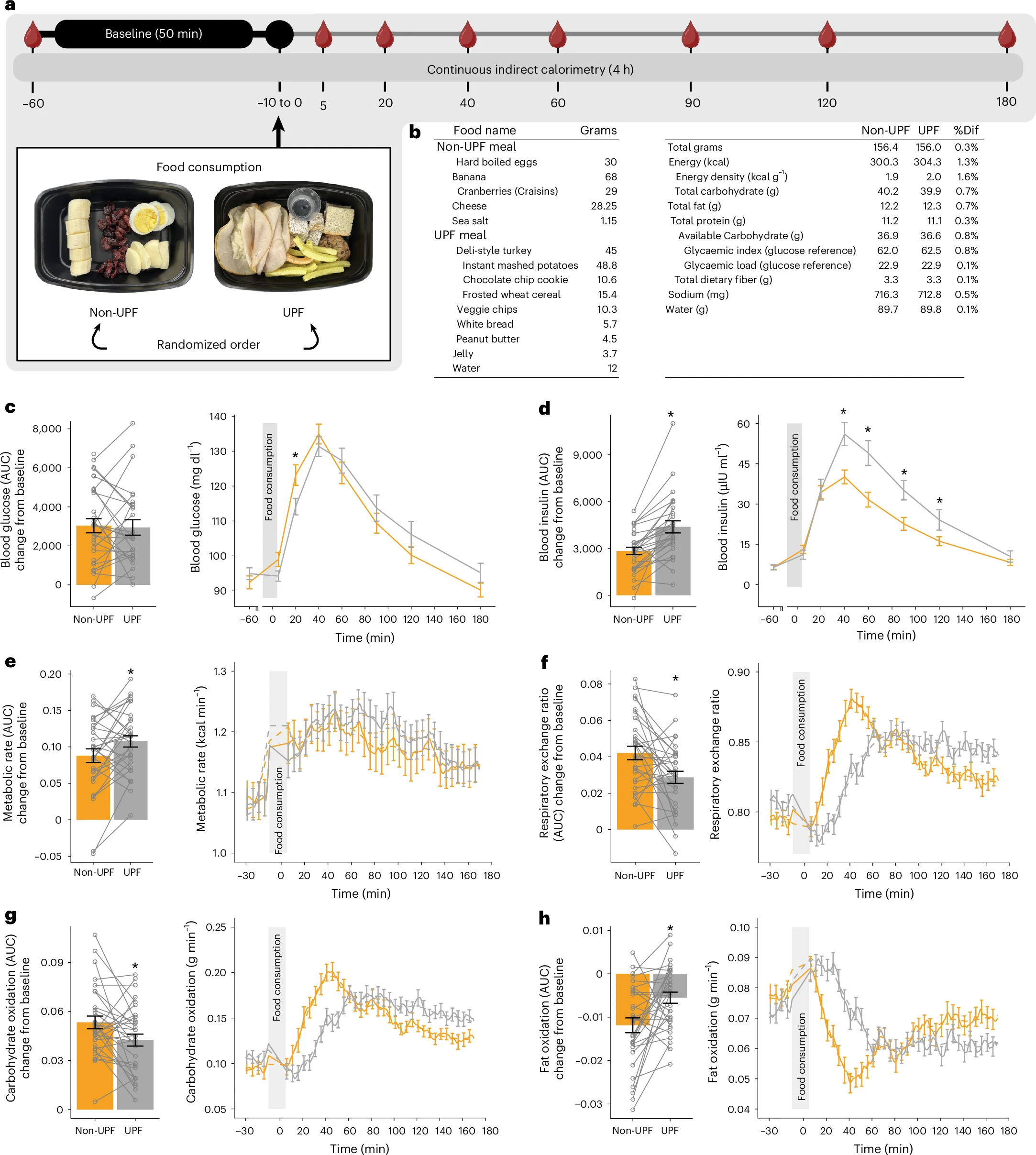
Both provided about 300 calories, 40 grams of carbohydrates, 11 grams of protein, 12 grams of fat, and 3.3 grams of fiber. The researchers also closely matched meal weight, energy density, sodium, water, and estimated glycemic index and glycemic load. By all accounts, these meals were "nutritionally identical."
Across the three-hour post-meal measurement period, total blood glucose exposure (the magnitude and duration of the glucose rise together, also known as area-under-the-curve) did not differ significantly between the meals.
|
|
| |
Study design and the changes in blood glucose, insulin, metabolic rate, and fat and carbohydrate utilization after each meal. |
|
| |
Insulin told a different story…
The ultraprocessed meal produced a greater total insulin response, with higher concentrations at 40, 60, 90, and 120 minutes. By three hours, insulin had returned toward baseline in both conditions. That similar glucose exposure alongside different insulin responses tells us that the two meals were handled differently by the body.
This doesn’t establish that the UPF meal caused insulin resistance (although there is a strong association between UPF intake and metabolic dysregulation). But it does illustrate a limitation of judging food by glucose alone.
The fuel-use measurements make that point even more interesting.
When you eat a meal containing a substantial amount of carbohydrates, rising nutrient availability and insulin help shift metabolism toward using more carbohydrate and away from fat burning. That ability to adjust fuel use to the circumstances is part of metabolic flexibility. Being able to burn fat is useful during fasting, and being able to increase carbohydrate use after a carbohydrate-containing meal is useful, too!
- After the non-UPF meal, participants made a stronger shift toward burning carbohydrates.
- After the UPF meal, that increase was smaller, while fat oxidation remained relatively higher, even though the meals supplied almost identical amounts of carbohydrates and fat.
Put another way, the ultraprocessed meal blunted the expected shift toward carbohydrate use after eating. The body received a similar quantity of nutrients, but its response to those nutrients differed. It's a short-term example of reduced metabolic flexibility.
|
|
|
| |
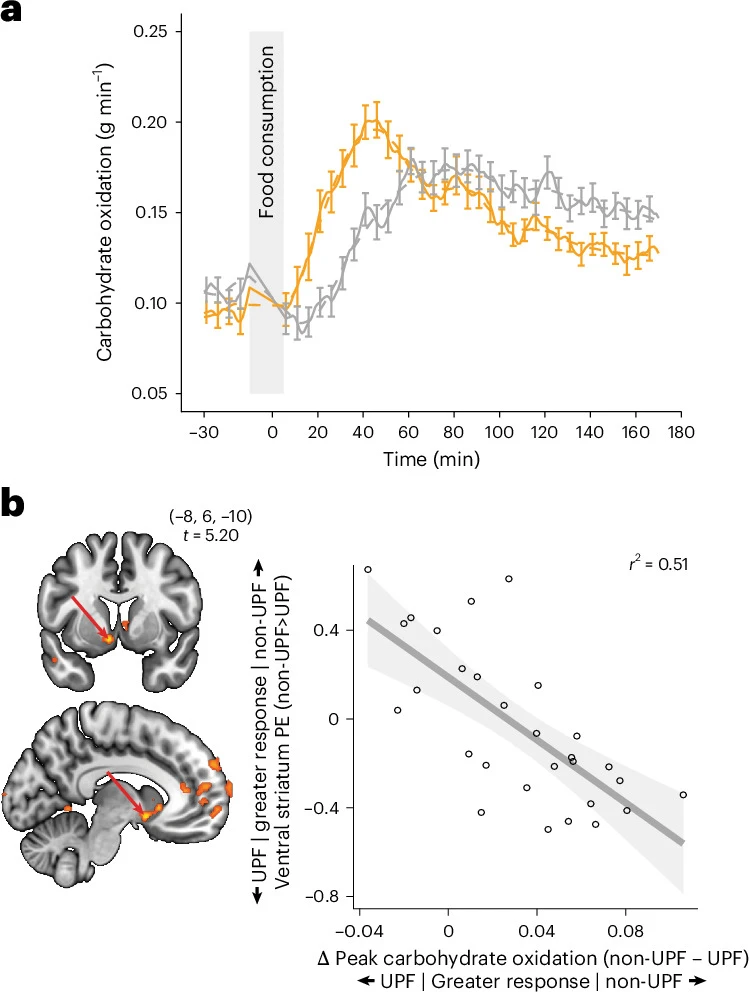
The metabolic response to UPFs and non-UPFs was associated with the brain's response to viewing those foods. |
|
| |
Does the brain value UPFs more?
The consequences of eating can help the brain learn about a food’s value. When we consume something frequently, the food’s appearance and flavor become associated with what happens after we swallow it. This is something that the authors refer to as "flavor-nutrient learning."
On a separate day, participants viewed pictures of 14 ultraprocessed and 14 non-ultraprocessed foods while undergoing functional MRI, or fMRI. They indicated how much they would be willing to pay for each food, giving researchers a behavioral measure of its value.
How differently a person’s body used carbohydrates after the two meals was related to how their brain—specifically parts of the striatum, a group of structures involved in learning, motivation, and evaluating rewards—responded when they later looked at foods from those categories. People whose carbohydrate burning was more blunted (those demonstrating worse "metabolic flexibility") after the ultraprocessed meal tended to show a stronger brain response when they were shown pictures of UPFs relative to pictures of less-processed foods.
I find this simply fascinating. The body’s handling of nutrients could contribute to what the brain learns about food. However, it's worth noting that participants were not willing to pay more for the ultraprocessed foods overall.
This study gives us a physiological observation—closely matched nutrient totals can coexist with different insulin responses, different fuel use, and related differences in responses to food images. It tells us that what's on a nutrition label cannot fully inform how our body will respond to a particular food.
So how do we apply this when choosing everyday foods? Let’s look at a few common questions about processing, protein supplements, additives, and the limits of judging a food by its glucose response.
|
|
 |
| |
What actually counts as ultraprocessed?
You don’t need to eliminate a food simply because it has been processed.
Fermenting milk into cheese, freezing vegetables, and baking bread all involve processing. We have to distinguish what that processing does to the food and how the final product is formulated. Under NOVA (the classification used in this study) a bread made from flour, water, yeast, and salt is generally considered processed, as are many traditional cheeses. Products formulated with ingredients such as protein isolates, flavorings, emulsifiers, or modified starches can fall into the ultraprocessed category. Bread and plant milk can therefore land in different categories depending on their formulation.
My approach would be to read the ingredient list alongside the nutrition label. For bread, consider whole-grain content and fiber. For plant milk, compare protein, added sugar, and fortification. Then consider how often you consume the product and what it replaces. We can't answer every nutritional question about a food simply by asking whether it's "processed" or not.
Do protein powders and bars belong in the same category as snack foods?
Many protein powders and bars qualify as ultraprocessed, but that doesn’t establish that they have the same health effects as cookies or candy.
I’ve discussed using protein bars to help meet protein needs when preparing another whole-food meal isn’t practical. I’ve also emphasized that whole foods should provide the foundation of your protein intake, and that a powder with fewer unnecessary ingredients is generally where I would start. Those positions are compatible. A convenient protein source can serve a useful purpose, but the details of the product deserve attention.
For a powder, I’d look at the protein source, ingredient list, and independent quality testing. For a bar, I’d also consider how much protein it actually provides, its added sugar and fiber content, and how well you tolerate it. A “high-protein” label doesn’t tell you everything about the food.
It also matters what you're replacing. Using a supplement to fill a protein gap is a different decision from routinely replacing varied, nutritious meals with bars and shakes, which I don't advocate.
Are all emulsifiers harmful?
We should distinguish them. “Emulsifier” describes a function—helping ingredients such as oil and water stay mixed. It doesn’t mean that every substance performing that function has the same biological effects.
There are legitimate reasons to investigate certain additives. In one small study, consuming 15 grams of an emulsifier known as carboxymethylcellulose daily for 11 days altered the gut microbiome and reduced some bacterial metabolites, including short-chain fatty acids. That experiment tested just one additive at a particular dose. So while it's informative, it does not establish that every emulsifier, at every exposure, causes the same effects.[1]
In my discussion of emulsifiers in member Q&A #65, I specifically cautioned against demonizing lecithin. It also occurs naturally in foods such as egg yolks and sunflower seeds. That doesn’t prove every added dose is harmless, but evidence about another emulsifier cannot simply be transferred to lecithin.
The observational studies are also difficult to interpret because emulsifier intake often accompanies greater consumption of UPFs overall. My priority would be reducing habitual reliance on those foods. I would be much less concerned about occasional exposure to an emulsifier than about a dietary pattern dominated by ultraprocessed meals and snacks.
If a food barely raises my glucose, does that mean it is metabolically healthy?
No. Glucose is an important measurement, but it captures only part of the response to food.
When I spoke with Dr. Ben Bikman, we discussed how someone can maintain normal glucose levels while producing more insulin to keep those levels in range. A continuous glucose monitor cannot show you that insulin response.
This week’s study illustrates that clearly—overall glucose exposure across three hours was similar after the two meals, but insulin exposure was greater after the UPF meal. Looking only at glucose would have missed a meaningful physiological difference!
I would use glucose data as one piece of information alongside the food’s nutrient content, structure, and role in the overall diet. Spreading cookies across the day just to avoid a large glucose peak doesn’t change their ingredients or improve the nutrition they provide (a silly example, but it gets the point across). A flatter glucose curve cannot, and should not, serve as a complete health score for a food.
|
|
 |
| |
Final thoughts
I understand the appeal of convenience. I’ve talked about reaching for a protein bar when I’m traveling or sitting at my desk working. Preparing another whole-food meal isn’t always practical, even if you spend your days thinking about nutrition. I don’t want the takeaway from this newsletter to be that every packaged food deserves suspicion.
But I do think the properties of many ultraprocessed foods help explain why our modern food environment makes metabolic health so difficult to maintain. Concentrated calories, easy-to-eat textures, and highly appealing combinations of sugar and fat can make it remarkably easy to keep eating.
That’s one reason I frequently come back to Kevin Hall’s 2019 study. When participants could eat as much as they wanted, they consumed approximately 500 additional calories per day on the ultraprocessed diet and gained about two pounds in two weeks. Changing the foods available changed how much people ate, without anyone instructing them to eat more.
We’re seeing long-term health associations alongside experimental evidence that these foods can influence both how much we eat and (thanks to studies like the one covered today) how we handle incoming nutrients.
That’s why I find the mechanisms so useful. Understanding how food structure, nutrient delivery, and gut–brain communication influence our responses gives us something actionable—certainly more actionable than “just eat less.” It helps explain why changing the foods we routinely eat can change how difficult, or how easy, it feels to manage our intake.
When I’ve shared my own meal routine, it’s been fairly simple: eggs, a smoothie, a turkey burger, vegetables, a salad, some meat. There’s a practical advantage to having familiar meals you can repeat. You don’t have to solve nutrition from scratch every time you’re hungry, and even meals that are “convenient” can comprise mostly whole foods.
For someone trying to reduce UPFs, I’d start with making a few satisfying meals with adequate protein and fiber easy to prepare, and keep convenient options available that help you eat the way you intend to.
We can take these foods’ effects seriously without making every food choice a moral judgment. That’s not my goal here, nor has it ever been.
Understanding the biology gives us more ways to push back against an environment that encourages overeating.
Plus, it’s just incredibly interesting... at least I think so.
|
|
| |
Go Deeper on Ultraprocessing and Food Additives
For more on the questions this study raises, revisit these Premium conversations on food processing, emulsifiers, and flavor additives.
|
|
Warm regards,
— Rhonda and the FoundMyFitness team
|
|
|
|
|
|
 Mitochondrial bioenergetics
Yamanaka factors
Exercise intensity
Cell reprogramming
Blood-brain barrier
Epigenetic age deceleration
Stress resistance
Cardiorespiratory fitness
Nutritional ketosis
Compression of morbidity
CpG Islands
Lactate shuttle
Whole-body hyperthermia
Psychology of grit
Telomerase reverse transcriptase (TRT)
Chronic inflammation
Disease prevention
Therapeutic hyperthermia
Pathogen-host defense theory
Cell signaling
Proteostasis
Cellular senescence
CRISPR-Cas9
Aging
PGC1α
Overcoming adversity
Increased healthspan
Gene–diet interaction
Biology of resilience
Immune-brain interaction
Neuroendocrine effects
Heat Shock Proteins (HSPs)
Oxidative stress
Vitamin D
Omega-3 fatty acids
β-Hydroxybutyrate (BHB)
GLUT4
Pregnancy optimization