For years, the obesity epidemic has been blamed on declining physical activity. Modern conveniences have made us sedentary, and we’re burning fewer calories than our ancestors.
But a new study spanning 34 populations across six continents upends this narrative. Researchers found that people in economically developed nations (like the United States and many European countries) actually burn more calories overall, largely because of larger body size. When body size is accounted for, physical activity levels and energy expenditure remain remarkably consistent across populations.
So if reduced activity isn’t the culprit, what is? The data point decisively to diet. Increased caloric intake—especially from ultraprocessed foods—was estimated to be ten times more important than changes in energy expenditure in driving modern obesity. Ultraprocessed foods, with their hyperpalatability and disruption of satiety, were strongly correlated with body fat percentage across populations, even after adjusting for age, sex, and activity levels.
The results present a compelling counter-narrative that the obesity crisis is not primarily the result of reduced physical activity but rather the consequence of increased dietary intake, particularly in the form of ultraprocessed foods. It's a finding that challenges many of our assumptions about the causes of obesity. In today's email, we'll analyze what this study means for public and individual health and explore why ultraprocessed foods might be driving overconsumption.
You just missed this in your inbox
Every week, Dr. Rhonda Patrick and the FoundMyFitness team distill the latest research into clear, actionable insights on health, longevity, and performance, delivered free to your inbox.
Are Modern Societies Really Less Active?
Using the doubly labeled water method—the gold standard for measuring total energy expenditure—researchers examined 4,213 adults from 34 populations spanning hunter-gatherers to highly industrialized societies.[1]
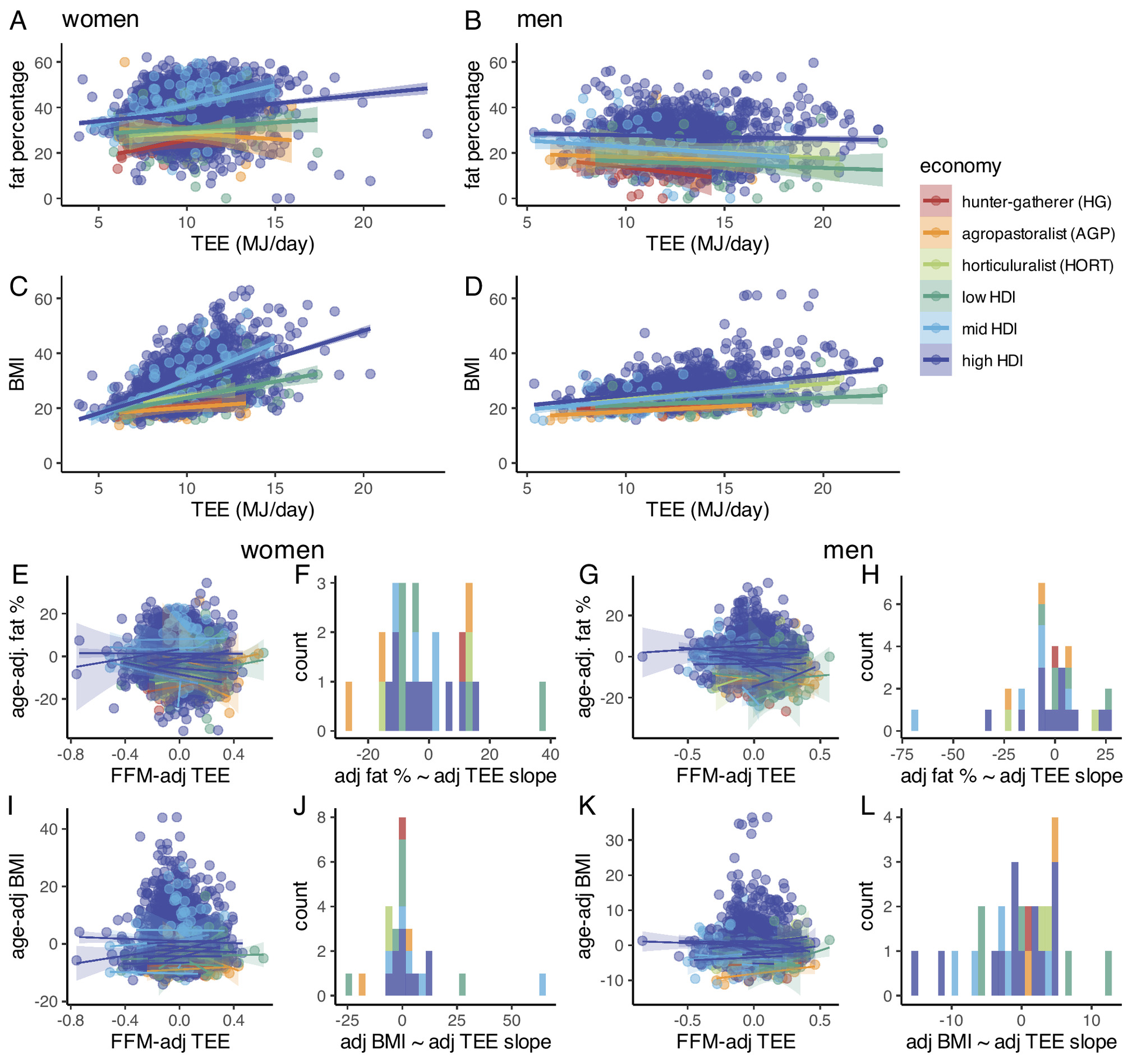
They found that absolute total energy expenditure (TEE), basal energy expenditure (BEE), and activity energy expenditure (AEE) were all higher in more economically developed settings—largely because bodies are bigger there. Once you account for body size (free-fat mass and fat mass), total energy expenditure dipped only modestly—about 6% from the least to most developed economies, driven by a ~11% decline in basal energy expenditure. Importantly, activity energy expenditure and physical activity levels did not significantly change with development. In other words, the common narrative that modern populations burn fewer calories because they move less does not hold up when expenditure is measured with doubly labeled water and appropriately adjusted for important confounding factors.
How much does that small, size-adjusted drop in energy expenditure matter for obesity? Not much. The variation in total energy expenditure explained only ~one-tenth of the higher body fat percentage and BMI associated with economic development. The authors point instead to greater energy intake as the primary driver of higher adiposity with development. Put differently, if total energy expenditure accounts for ~10% of the development-related rise in adiposity, then intake likely contributes the other ~90%—an order-of-magnitude larger role.
|
|
|
| |
These cross-sectional findings also dovetail with time-trend analyses in the U.S. and Europe, which show that over recent decades, body-size–adjusted energy expenditure has declined mainly because basal energy expenditure fell, while activity energy expenditure actually increased—again undermining the notion that declining physical activity explains rising obesity.[2]
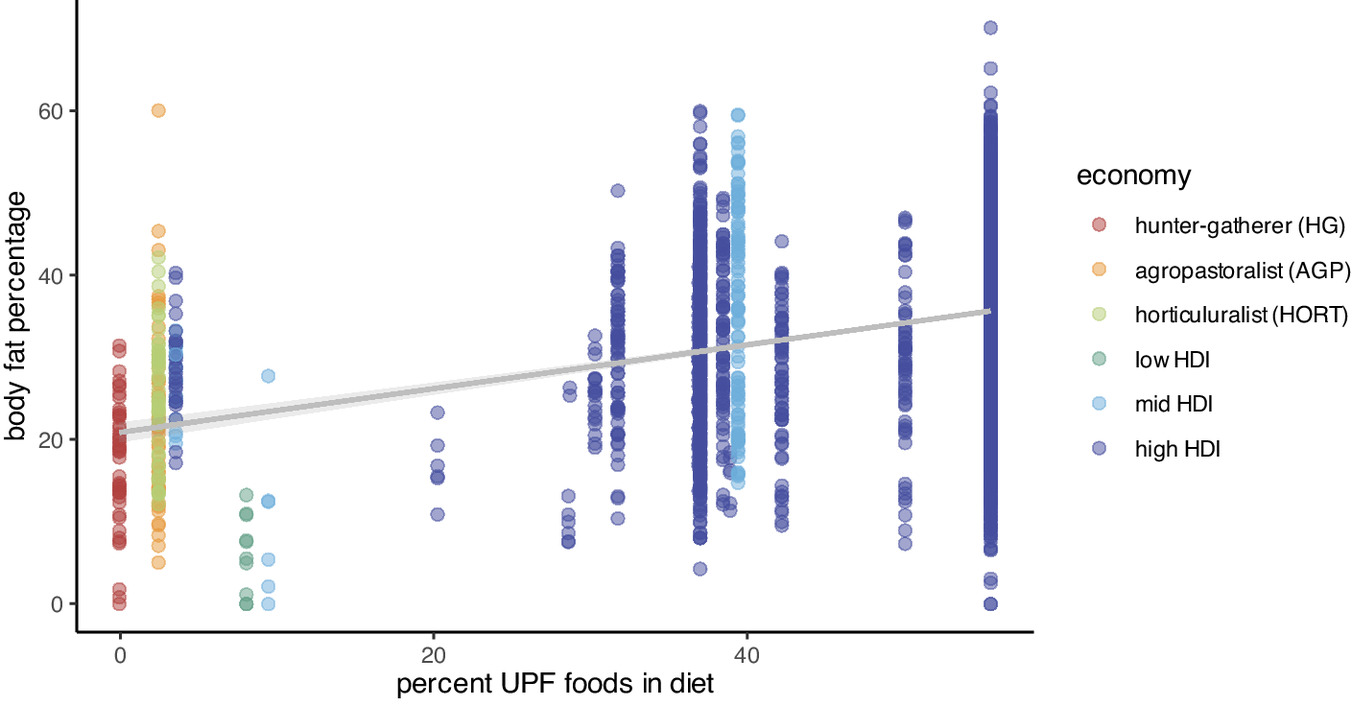
Importantly, this new study linked obesity to diet quality. In the 25 populations with dietary data, the percentage of ultraprocessed foods (UPFs) in the diet was positively associated with body fat percentage, even after adjusting for age, sex, expenditure, and development rank. That association is consistent with the intake-first interpretation and points toward features of modern food environments—especially UPFs—as key levers.
|
|
|
|
The broader links between economic development and body composition were also examined. Higher levels of development were consistently associated with greater body mass, BMI, and body fat percentage. Interestingly, increases in BMI with economic growth were largely explained by greater fat-free mass, which may reflect the increased stature and lean mass in industrialized societies.
What might explain the 11% decline in basal energy expenditure among industrialized societies? While the precise mechanisms remain uncertain, the authors propose that reduced pathogen burden in developed countries may lower immune system activity and, in turn, basal energy demands. Alternatively, dietary shifts, such as changes in fat and fiber composition, may influence resting metabolic rates. Regardless of the cause, the decline in basal energy expenditure represents a subtle but noteworthy metabolic trend accompanying economic modernization.
These findings suggest—but don't solidify—that diet is the dominant factor driving obesity and highlight the unique role of UPFs in promoting excessive energy intake. The challenge for public health lies in creating food environments that preserve the benefits of abundant calorie availability without promoting nutrient-poor, obesogenic diets. (If you want to learn more about ultraprocessed foods and their impact on health and longevity, check out our new Ultra-processed Foods topic page).
This begs the question, what is it about ultraprocessed foods that leads to overeating anyway?
Why Ultra-Processed Foods Drive Overconsumption
Ultra-processed foods now account for the majority of calories consumed in industrialized nations—nearly 60% of daily intake in the United States alone—and their link to obesity is becoming undeniable. There are several explanations why.
When people eat a diet dominated by ultra-processed food (as suggested by one from Kevin Hall and colleagues, which I've discussed at length) they consume ~500 extra calories per day compared to an unprocessed diet, despite the two diets being matched for calories, sugar, sodium, and fiber. In just two weeks, this led to an average of 2 pounds of weight gain whereas an unprocessed diet produced an equivalent amount of weight loss. Importantly, faster consumption of the UPF diet (participants ate about 17 calories more per minute) was strongly correlated with the excess energy intake. Even short exposures can trigger rapid metabolic changes. Just five days of eating a high-calorie, ultra-processed diet can increase liver fat by 63% and impair insulin signaling in the brain, changes that may predispose individuals to further overeating and fat gain.
There are several other reasons why UPFs have such powerful effects on intake and adiposity:
-
They're hyper-palatable and highly rewarding. Foods that combine refined fats and carbohydrates (hallmarks of UPFs) hijack the brain’s reward systems in ways greater than the sum of their parts. This “engineered” appeal can drive persistent overconsumption.
-
They're energy-dense and come in large portions. UPFs are high in calories and sold in larger default portions, which amplifies the natural human tendency toward “unit bias,” where we finish the package or portion presented. Reducing portion size alone can lower daily intake by ~140–230 calories.
-
We eat them faster and feel less satiety. Soft textures, minimal chewing requirements, and liquid forms allow calories to be consumed quickly, delaying satiety signals. Beverages are particularly worrisome in this regard, and high intake of sugar-sweetened beverages is consistently associated with weight gain. "Don't drink your calories" is sound advice.
-
They're protein-poor. Many UPFs are protein-poor but rich in refined carbs and fats. To reach a biological protein “target,” people unconsciously eat more total calories, a concept known as the protein leverage hypothesis.
-
Their fiber and micronutrient density is low. UPFs systematically displace foods rich in fiber and essential nutrients. In the U.S., UPFs supply ~90% of added sugars, with added sugar content ~five- to eight-fold higher than in minimally processed foods.
-
They contain additives that alter the gut microbiome. Emulsifiers such as carboxymethylcellulose, widely used in UPFs, have been shown to alter the gut microbiota, deplete short-chain fatty acids, and increase gastrointestinal discomfort—changes that may disrupt appetite regulation and metabolism.
-
They're cheap and convenient. On a per-calorie basis, UPFs are cheaper and more accessible than whole foods, reflecting a structural incentive toward UPF consumption, especially for lower-income families.
|
 |
|
|
Final Thoughts
It is important to remember that averages and population-level trends don't always capture individual biology. When it comes to weight loss or improving body composition, the most effective approach will be the one that aligns with your physiology, preferences, and lifestyle.
For some people, exercise is the easier lever to pull. Increasing calorie burn while maintaining a stable diet can be a sustainable and enjoyable path. Although critics often claim that exercise simply fuels greater hunger and compensatory eating, this is not universally true. In fact, research shows that high-intensity exercise—through mechanisms such as lactate production—can suppress appetite in the short term, meaning some individuals may actually eat less, not more, after a hard workout.
Others may find that dietary manipulation is more feasible. It is, after all, often easier to avoid consuming 500 extra calories than to burn the same amount through physical activity. Adjusting macronutrient balance—shifting the proportions of carbohydrates, fats, and proteins—not only influences total caloric intake but also impacts satiety, nutrient partitioning, and even energy expenditure itself. Protein intake, for instance, enhances satiety and carries a higher thermic cost, while the quality of carbohydrates and fats can dramatically influence downstream metabolic effects.
The reality is that neither diet nor physical activity is more important than the other. Both are indispensable, not just for weight management, but for optimizing longevity, metabolic resilience, and overall well-being. Obesity may be driven primarily by excess dietary intake at the population level, but for the individual, sustainable health will always require a partnership between movement and nutrition.
As with any large cross-population study, these findings should be interpreted with some caution. While energy expenditure was measured using the doubly labeled water method—the gold standard for total energy expenditure—the study did not include direct measures of physical activity, either objective (e.g., accelerometry) or self-reported. This means we cannot directly assess changes in the types, duration, or patterns of movement across populations, only their energetic consequences. Second, comprehensive measures of energy intake and macronutrient distribution were lacking for most groups. As a result, the role of diet was inferred from energy balance and UPF correlations rather than quantified caloric or nutrient intakes.
These gaps don't invalidate the study’s conclusions, but they do warrant a cautious interpretation. It's clear to anyone observing that in industrialized societies such as the United States, the lived reality often suggests reduced activity levels—sedentary jobs, reliance on cars, and declining participation in manual labor (combined with inadequate structured exercise). Moreover, a large body of evidence consistently links lower physical activity with higher body fat percentage and increased risk of cardiometabolic disease.
Declining activity alone may not explain rising obesity, but this doesn't diminish the established role of physical activity as a determinant of health and body composition.
|
As a premium member, you get exclusive access to live AMA sessions and the full-length recordings once they're released. Here's a look at topics that were covered in my most recent Q&A session (#73) last week, just in case you missed it!
- Does creatine increase creatinine levels?
- Is HRT still beneficial 10 years after menopause?
- Is it necessary to take vitamin K2 with vitamin D3?
- What is the optimal daily amount of broccoli sprouts?
- Is there an optimal fish oil dose for APOE4 carriers?
- What are the benefits and risks of urolithin A?
- Can restoring NAD+ slow aging?
|
|
|
|
Warm regards
— Rhonda and the FoundMyFitness team
|
|
|
|
|
|
 Mitochondrial bioenergetics
Yamanaka factors
Exercise intensity
Cell reprogramming
Blood-brain barrier
Epigenetic age deceleration
Stress resistance
Cardiorespiratory fitness
Nutritional ketosis
Compression of morbidity
CpG Islands
Lactate shuttle
Whole-body hyperthermia
Psychology of grit
Telomerase reverse transcriptase (TRT)
Chronic inflammation
Disease prevention
Therapeutic hyperthermia
Pathogen-host defense theory
Cell signaling
Proteostasis
Cellular senescence
CRISPR-Cas9
Aging
PGC1α
Overcoming adversity
Increased healthspan
Gene–diet interaction
Biology of resilience
Immune-brain interaction
Neuroendocrine effects
Heat Shock Proteins (HSPs)
Oxidative stress
Vitamin D
Omega-3 fatty acids
β-Hydroxybutyrate (BHB)
GLUT4
Pregnancy optimization
Mitochondrial bioenergetics
Yamanaka factors
Exercise intensity
Cell reprogramming
Blood-brain barrier
Epigenetic age deceleration
Stress resistance
Cardiorespiratory fitness
Nutritional ketosis
Compression of morbidity
CpG Islands
Lactate shuttle
Whole-body hyperthermia
Psychology of grit
Telomerase reverse transcriptase (TRT)
Chronic inflammation
Disease prevention
Therapeutic hyperthermia
Pathogen-host defense theory
Cell signaling
Proteostasis
Cellular senescence
CRISPR-Cas9
Aging
PGC1α
Overcoming adversity
Increased healthspan
Gene–diet interaction
Biology of resilience
Immune-brain interaction
Neuroendocrine effects
Heat Shock Proteins (HSPs)
Oxidative stress
Vitamin D
Omega-3 fatty acids
β-Hydroxybutyrate (BHB)
GLUT4
Pregnancy optimization