Aerobic exercise gets most of the credit for longevity.
A new 30-year study of nearly 150,000 adults suggests that resistance training also deserves a spot in the conversation.
Doing just 1–29 minutes per week of resistance training was associated with a 5% lower all-cause mortality risk. That increased to a 13% lower risk among people doing between 90 minutes and 2 hours per week.
The lowest risks generally appeared among people combining resistance training and aerobic exercise—doing up to 2 hours of resistance training with progressively greater aerobic volumes was associated with roughly 30% to 45% lower mortality.
The two-hour signal is very encouraging to me, and it should be to you—it's not a magic number, but it is evidence that resistance training need not consume your week to matter.
And even though aerobic exercise appeared to exert a greater benefit in this study, this should not become another cardio-versus-weights debate. The practical advice is to do both.
Today, we’ll explore why muscle is a bona fide organ of longevity.
|
| |
These weekly science deep dives are made possible by FoundMyFitness Premium Members like you. At the end of this email, I share a few additional segments related to resistance training and muscle building. |
| |
|
Two hours is the "sweet spot"
The research hasn't been very clear on how much resistance training is associated with lower mortality—and whether lifting provides meaningful benefits beyond those associated with aerobic exercise alone.
This new study addressed that question using data from three large, long-running cohorts that altogether included nearly 150,000 adults. Participants had a median baseline age of 54 and were followed for as long as 30 years.
Every two to four years, participants reported how much time they spent performing resistance exercise each week. Rather than assuming their activity at baseline remained unchanged for several decades, the researchers calculated a cumulative average of their reported training over time. Aerobic exercise—including walking, running, cycling, swimming, tennis, other aerobic activities, heavy outdoor work, and stair climbing—was measured separately.
Based on their average resistance-training time, participants were divided into six categories: no resistance training, 1–29 minutes per week, 30–59 minutes per week, 60–89 minutes per week, 90–119 minutes per week, and 120 minutes per week or more
Even modest amounts of resistance exercise were associated with a lower risk of dying during follow-up.
Compared with doing none, all-cause mortality was:
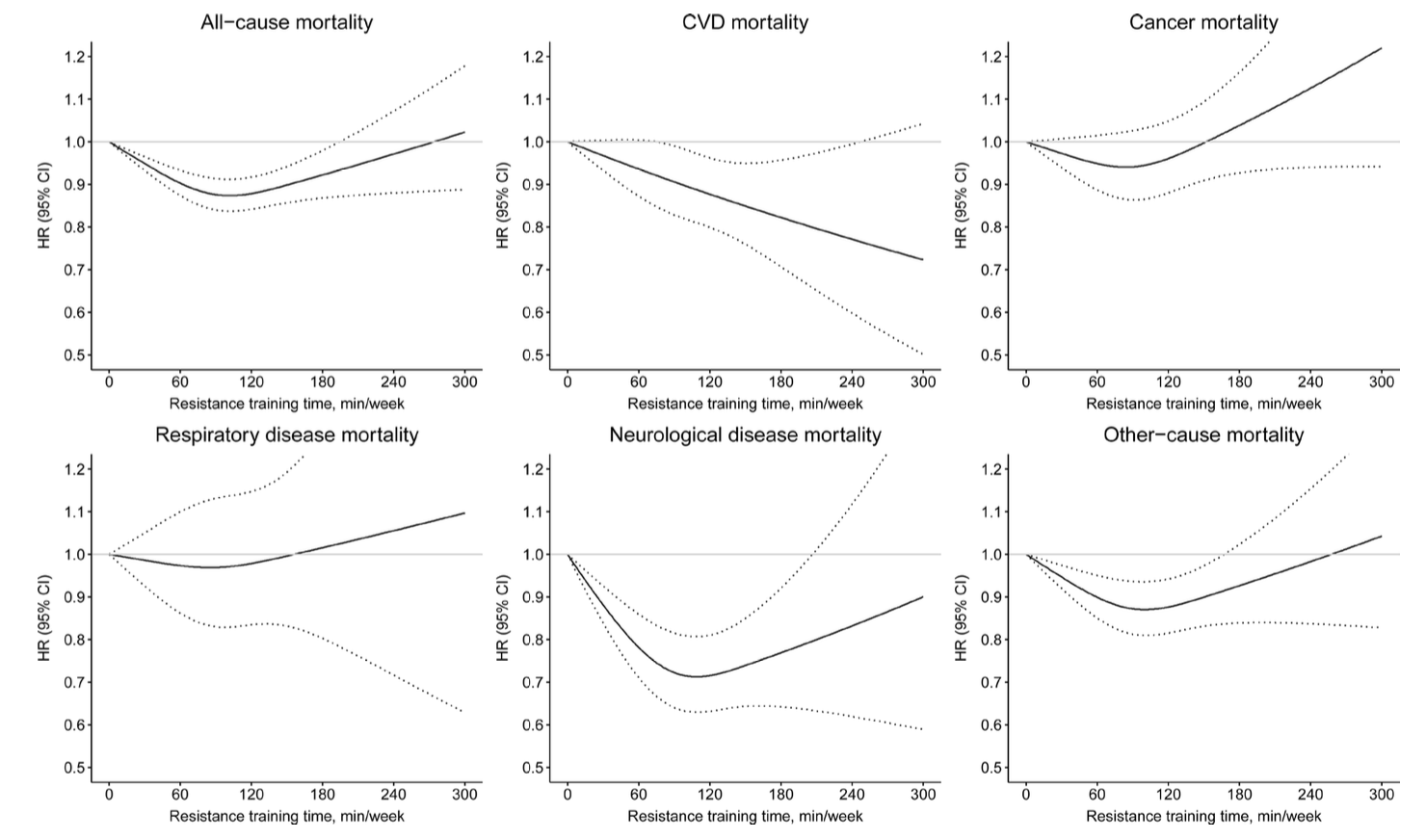
5% lower with 1–29 minutes per week 9% lower with 30–59 minutes per week 9% lower with 60–89 minutes per week 13% lower with 90–119 minutes per week 8% lower with 120 minutes per week or more
As you can see, the lowest observed mortality risk occurred at approximately 90–119 minutes per week. The benefit curve flattened out after that. I would not interpret this to mean that more than two hours of resistance training is harmful—or even that two hours represents the precise “optimal” dose.
A more reasonable interpretation is that the mortality association appeared to reach a plateau at a relatively modest amount of weekly resistance training. That should be reassuring, if anything!
Findings for other disease-specific outcomes followed a similar pattern.
Participants performing 90–119 minutes of resistance training per week had a 19% lower risk of cardiovascular mortality and a 27% lower risk of neurological disease mortality than people performing none. Even lower amounts of resistance training—from 1 to 89 minutes per week—were associated with a 14% to 23% lower risk of dying from a neurological disease (most neurological deaths in these cohorts involved dementia). For cancer mortality, only lower amounts of resistance training were associated with a benefit: a 9% lower risk with 1–29 minutes per week and a 12% lower risk with 30–59 minutes. At 60 minutes or more, resistance training was not clearly associated with either higher or lower overall cancer mortality.
|
|
The dose-response relationship between weekly resistance training and all-cause and cause-specific mortality. |
| |
Aerobic exercise adds benefits
Here is an interesting question (or two): Can resistance training still be beneficial if you perform very little aerobic exercise?
Alternatively, does aerobic exercise reduce mortality risk even if you do no resistance training?
According to this study, the answer to both questions was yes.
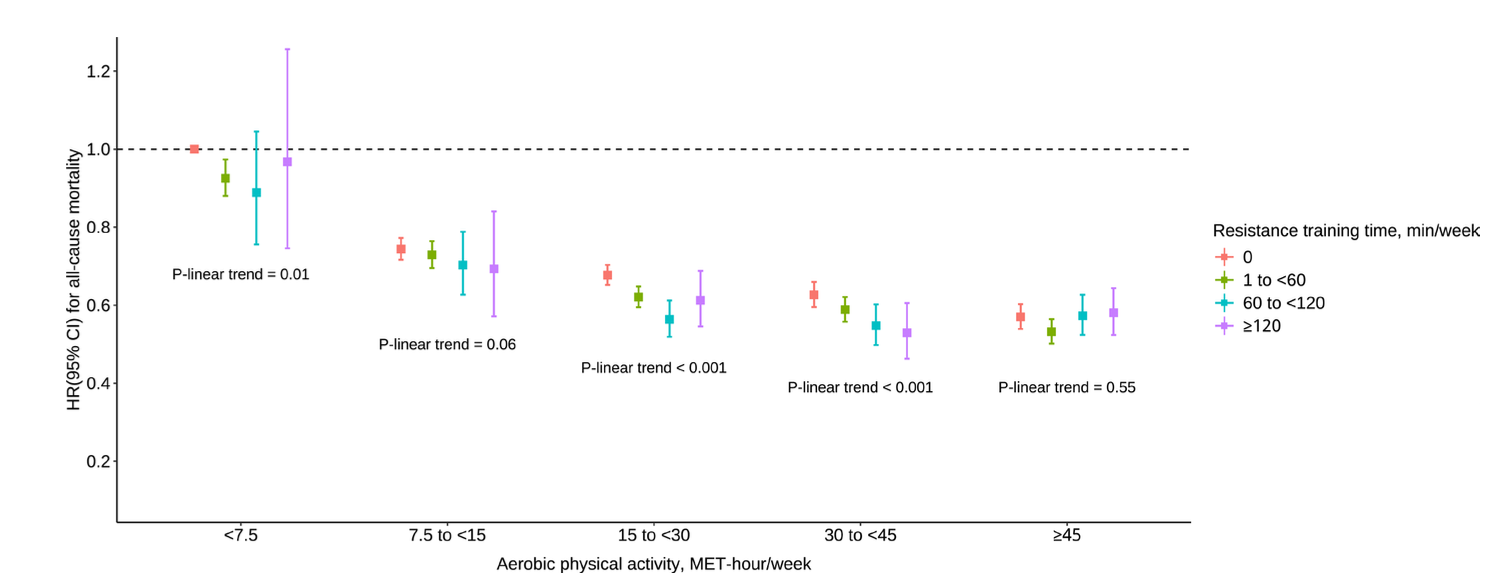
Among people performing less than the minimum recommended amount of aerobic activity, 1–59 minutes of resistance training per week was associated with a 7% lower risk of mortality. Performing 60–119 minutes was associated with an 11% lower risk.
A stronger association was seen for aerobic exercise.
Among people who performed no resistance training, meeting or exceeding the minimum aerobic guideline was associated with a 26% to 43% lower mortality risk, depending on how much aerobic activity they performed.
This tells us two things:
Resistance training and aerobic exercise were each independently associated with lower mortality, even among people performing only one type of exercise regularly. Aerobic exercise appeared to have a stronger mortality association than resistance training.
But for me, one of the most useful parts of the study was the analysis of aerobic and resistance exercise together because, as you know, we should all be doing both.
The lowest mortality risks generally appeared among people who performed substantial amounts of both types of exercise.
At approximately 45 minutes to 2.5 hours of aerobic activity, adding 60–119 minutes of resistance training was associated with a 30% lower mortality risk. At approximately 1.5–5 hours of aerobic activity per week, the same amount of resistance training was associated with a 44% lower risk. Participants accumulating about 3 to 7.5 hours of aerobic activity per week plus 60–119 minutes of resistance training (the most active people) had a 45% lower mortality risk than the least-active participants.
That last, largest range of aerobic activity is four to six times greater than the minimum recommended dose. So this was clearly a highly active group. But the association was also substantial at lower aerobic volumes, even those right around the minimum recommended dose according to the guidelines (~150 minutes per week).
There is one important nuance here, which the authors were careful to point out. The combination of resistance and aerobic exercise did not show "statistical evidence of synergy."
Although people who performed both forms of exercise generally had the lowest mortality, the study found no evidence that the combination was more beneficial than would be expected from the independent effects of each.
This result doesn't mean we can (or should) perform just one type of exercise. We should not choose one form of exercise simply because it statistically improves our odds of living longer. We should perform both because they support different aspects of cardiovascular, metabolic, and musculoskeletal health—all of which are essential not only for lifespan, but also for healthspan and, as I have discussed in a previous newsletter, peakspan.
Because the main focus today was on resistance training, I want to talk about why doing it seems to protect against major causes of death and disease, even at such a modest weekly volume.
|
|
|
The combined association of weekly resistance training and aerobic exercise on all-cause mortality risk. |
| |
Muscle as a "longevity organ"
One way I think about muscle is as a form of biological reserve—metabolic, functional, and structural capacity that we build while we are healthy and draw upon when aging, illness, injury, or inactivity begin pushing us in the opposite direction.
To be clear, the mortality study we just discussed did not measure muscle mass, strength, or power. It measured the amount of time people reported spending on resistance training, so it cannot tell us whether greater muscle reserve actually mediated the lower mortality risk.
But reserve capacity provides a useful framework for understanding why resistance training might be associated with mortality from several different causes rather than protecting against one disease through one isolated pathway.
We often picture age-related muscle loss as a gradual, predictable downward slope. In reality, the trajectory is often punctuated by sudden, much steeper declines brought on by hospitalization, surgery, injury, illness, or prolonged inactivity—events that muscle-protein researcher Dr. Stuart Phillips refers to as "catabolic crises."
This is one reason to emphasize building muscle earlier in life. It allows us to begin the "inevitable" age-related decline from a higher starting point.
The value of that higher starting point becomes most apparent when a catabolic crisis occurs. Even something as ordinary as the flu can become a meaningful disuse event in an older adult. A few days in the hospital followed by several weeks sitting at home may produce a rapid loss of muscle mass and function. A younger person will often regain much of what was lost. An older person—already experiencing age-related muscle loss and a reduced anabolic response to exercise and protein—may recover more slowly or incompletely, leaving them on a new and lower functional trajectory.
Muscle is protection against disuse
A useful way to think about muscle reserve is as the distance between your current physical capacity and the minimum capacity required to function independently.
This is similar to how I think about cardiorespiratory fitness, or VO₂ max. A person with greater aerobic capacity has more room to lose fitness before ordinary activities become physiologically demanding. Muscle provides a comparable buffer for strength and physical function. The illness or period of inactivity may be temporary; the disability it precipitates may not be.
In that sense, muscle protects us partly by giving us more capacity to lose. This is why I view resistance training partly as a form of prehabilitation.
Yes, adequate protein helps maintain this reserve, particularly as anabolic resistance develops with age, but resistance training remains the primary stimulus for preserving and building muscle. In my conversation with Dr. Brad Schoenfeld, he emphasized that older adults remain responsive to training. Even people in their eighties and nineties can gain muscle and make substantial relative improvements in strength!
Muscle is metabolic reserve
Skeletal muscle is also one of our most important metabolic tissues.
More metabolically active muscle provides greater capacity to clear glucose from the circulation, store it as glycogen, and maintain insulin sensitivity. In my deep dive on protein and longevity, I discussed how preserving muscle supports glucose regulation and may help defend against insulin resistance and type 2 diabetes.
That metabolic buffer may become especially important during aging. Physical inactivity, inflammation, illness, and periods of bed rest can all worsen glucose regulation at the same time that the muscle available to dispose of glucose is declining.
This does not mean that simply accumulating as much muscle mass as possible guarantees metabolic health. Muscle quality, cardiorespiratory fitness, body composition, and regular physical activity are also important. But maintaining a larger amount of functional, regularly exercised muscle lets the body manage glucose and energy better.
Muscle is functional reserve
Ultimately, muscle has to produce force—and often produce it quickly enough to prevent a fall or respond to an unexpected challenge.
This is why I have increasingly emphasized muscle power, the ability to generate force rapidly. Power tends to decline even faster with aging than muscle mass or maximal strength, and it may be more closely related to mobility, fall prevention, and the ability to remain physically independent.
Getting up from a chair, climbing a staircase without using the railing, stepping quickly over an obstacle, and catching yourself after a trip are all expressions of functional reserve. Admittedly, these tasks may appear trivial when we are young, but later in life they can determine whether a minor misstep remains a near fall or becomes a fracture, which can initiate a cascade of events leading to a loss of independence and, in some cases, death (one-year mortality following a hip fracture ranges from 22% to 58%).
Resistance training addresses several parts of that cascade at once. It can increase force production, preserve bone, improve balance and coordination, and create a larger functional buffer before a person reaches the threshold at which ordinary activities become difficult.
|
|
 |
| |
Final thoughts
For much of my life, I thought about exercise primarily through an endurance lens. I ran, I did cardio, and I assumed that if I was aerobically fit, I had largely checked the exercise box.
My podcast conversations over the years have changed that framework.
Aerobic exercise is exceptionally powerful, but it does not replace the stimulus that resistance training provides for muscle mass, strength, power, and bone—a distinction that became apparent to me especially as I began thinking less about near-term performance and more about preserving physical capacity.
My own routine reflects that broader view. I generally combine zone 2 training (lately that's been in the form of a run) and higher-intensity aerobic exercise (usually intervals on my Peloton bike) with resistance training several times per week. CrossFit workouts have become something I genuinely enjoy (yet still feel slightly intimidated by).
I emphasize compound movements that train multiple muscle groups efficiently, and I don't believe every set needs to end in failure. The larger priorities are sufficient effort, progressive overload, good form, recovery, and—most importantly—consistency.
That emphasis on consistency is also one reason this study stands out to me. Participants were followed for as long as 30 years, and they were not simply categorized according to what they reported doing at the beginning of the study and then assumed to have maintained those habits for several decades.
That does not prove that everyone trained consistently from week to week, but it does mean the findings reflect long-term exercise patterns more closely than a single snapshot would. In a study about longevity, that's so important. We don't want to know whether someone completed a few months of resistance training, but whether strength training became a behavior they returned to across years and decades.
That's also why I find the approximately two-hour signal in this study so encouraging.
It fits remarkably well with previous conversations I have had about the minimum effective dose of resistance training. When I spoke with Brad Schoenfeld, he emphasized that people can make meaningful gains in muscle and strength with a minimalist routine—sometimes with as little as one hour per week divided into two focused, half-hour sessions, provided the training is sufficiently challenging.
At the same time, I want to be cautious about turning 90–119 minutes into a magic number or an optimal "upper limit."
Mortality is only one outcome (though an important one). Even if the association with mortality appeared to plateau around two hours, additional training may still provide further benefits for muscle growth, maximal strength, power, bone density, glucose regulation, physical function, or athletic performance. This does not identify the optimal program for every other aspect of health or performance.
Most importantly, I do not think these results should become another reason to debate cardio versus weights.
Aerobic exercise had the stronger mortality association in this study, but that does not necessarily make it “more important.” The fact that the researchers did not find statistical evidence of synergy does not change the practical value of combining aerobic and resistance exercise. We do not need the benefits to multiply one another mathematically for both forms of training to belong in the same longevity framework.
Train the heart and lungs. Train muscle and bone. Preserve strength and power. Recover well enough to keep doing it.
And when time is limited, remember that you probably do not need bodybuilding-level volumes to make resistance training matter.
A couple of focused hours each week may go a surprisingly long way.
|
|
| |
Go Deeper on Strength Training and Longevity
This week's study adds to the case that resistance training belongs in the longevity conversation.
I've covered the practical questions this raises in several episodes of The Aliquot.
|
|
Warm regards,
— Rhonda and the FoundMyFitness team
|
|
|
|
|
|