Reading the label feels like the responsible move when we’re choosing products for ourselves and our families.
But an ingredient list does not necessarily describe every chemical in the finished product. A new study makes that gap especially apparent.
Researchers tested 113 personal-care and cleaning products using a high-resolution analytical method designed to look beyond a short, predefined list of chemicals.
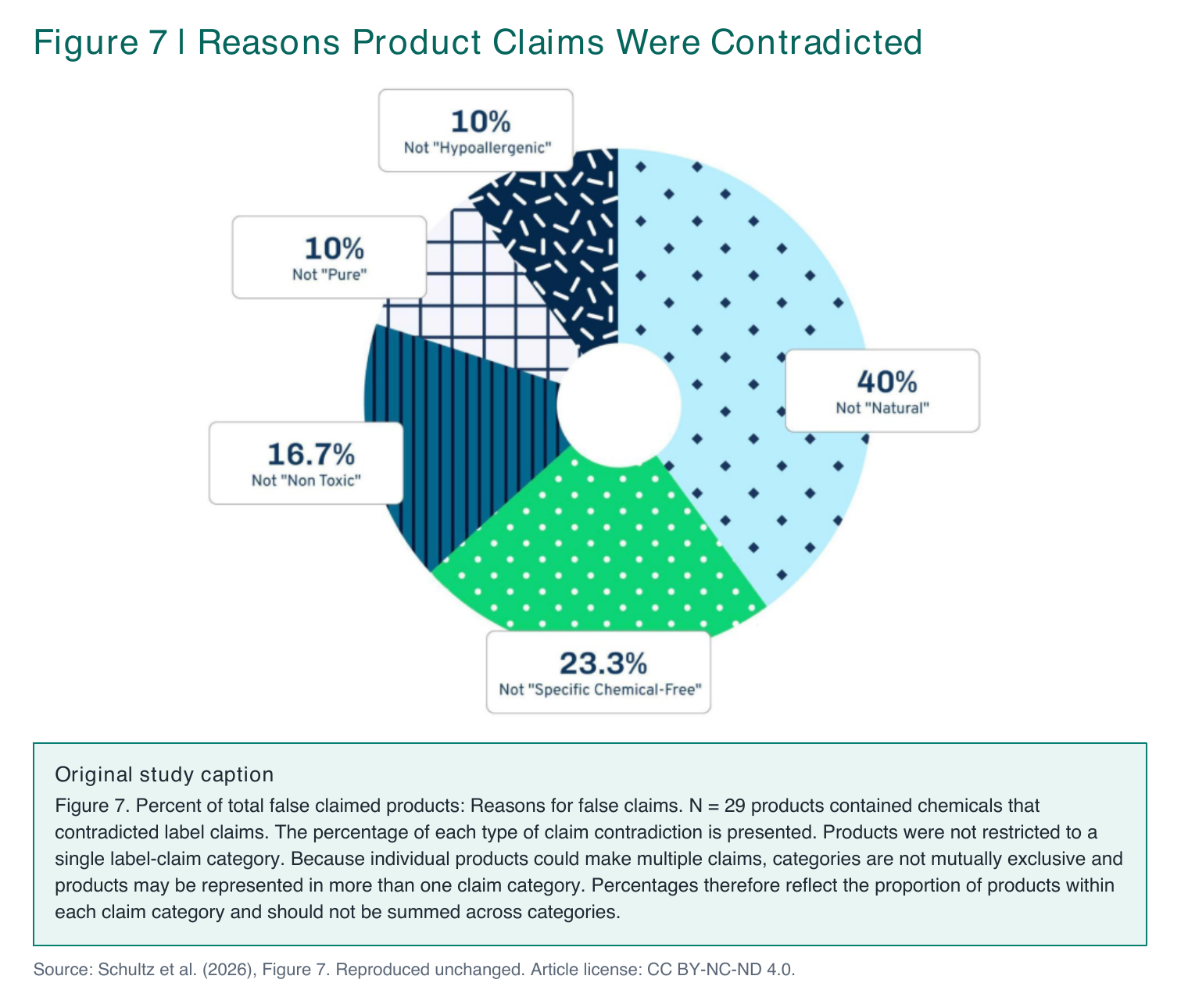
The average label listed 16 ingredients, but the laboratory detected an average of 51 compounds, and nearly every product contained at least one chemical that was not explicitly listed. Many contained chemicals the authors classified as known or suspected health hazards. And some contradicted claims such as fragrance-free, phthalate-free, natural, non-toxic, or hypoallergenic.
Those findings deserve attention. Today, I want to look at what the researchers found, and what we can realistically do when the package tells only part of the story. I’ll also answer common audience questions about chemical exposure from personal-care products and other everyday items.
|
| |
These weekly science deep dives are made possible by FoundMyFitness Premium Members like you. At the end of this email, I share a few extra resources on how to limit or reduce exposure to everyday chemicals. |
| |
|
You just missed this in your inbox
Every week, Dr. Rhonda Patrick and the FoundMyFitness team distill the latest research into clear, actionable insights on health, longevity, and performance, delivered free to your inbox.
Labels and lab testing disagree
Before the researchers tested bottles and tubes in the laboratory, they tried showing people which endocrine-disrupting chemicals were turning up in their bodies and helping them reduce the likely sources.
In a 2024 pilot study, adults submitted urine samples that were analyzed for 13 biomarkers of exposure to bisphenols, phthalates, parabens, and oxybenzone. Participants could also record the foods, personal-care products, and household products they had used during the preceding 24 hours. They then received their results, an audit of the ingredients disclosed in those products, and personalized suggestions such as changing personal-care products, reducing canned or packaged foods, and limiting plastic contact.
The feedback appeared to help people act: 48% said they were reading labels more, 40% were using less plastic, and 32% were eating less packaged food.
Although most measured metabolites moved downward on average, monobutyl phthalate was the only reduction that was statistically reliable. Parabens, oxybenzone, and several other phthalate markers did not show clear reductions.
That mismatch exposed an important problem. The personalized recommendations were built from the ingredients manufacturers disclosed. What if people changed their behavior and chose better-rated products, yet some of those products contained chemicals that were missing from—or even contradicted—the label?
That question led directly to the present study.
Using nontargeted analysis to look beyond a predefined list of expected ingredients, researchers analyzed 113 products across 12 categories, including shampoo, lotion and moisturizer, hand and body wash, sunscreen, deodorant and lip balm, baby-care products, intimate-care products, fragrance and body oils, oral-care products, and household cleaners and laundry products. The products were deliberately selected to span those that looked favorable, questionable, or unfavorable based on their ingredient labels.
The study produced four headline results:
98% of the products contained at least one chemical that was not explicitly listed on the label. 85% contained at least one chemical with a known or suspected health hazard classification. 57.5% failed the authors’ hazard-based contamination screen. 26% contradicted at least one label claim.
These percentages should not be automatically collapsed into a claim that “98% of products were toxic.” An unlisted chemical can be present without being harmful at the measured concentration, and a claim contradiction simply means that laboratory testing did not agree with a specific marketing claim. For example, a product marketed as “paraben-free” that contained parabens was marked as contradicting its label claim. And in this study, failing the contamination screen referred to the authors’ precautionary framework, not a regulatory finding.
|
|
| |
The clean-label paradox
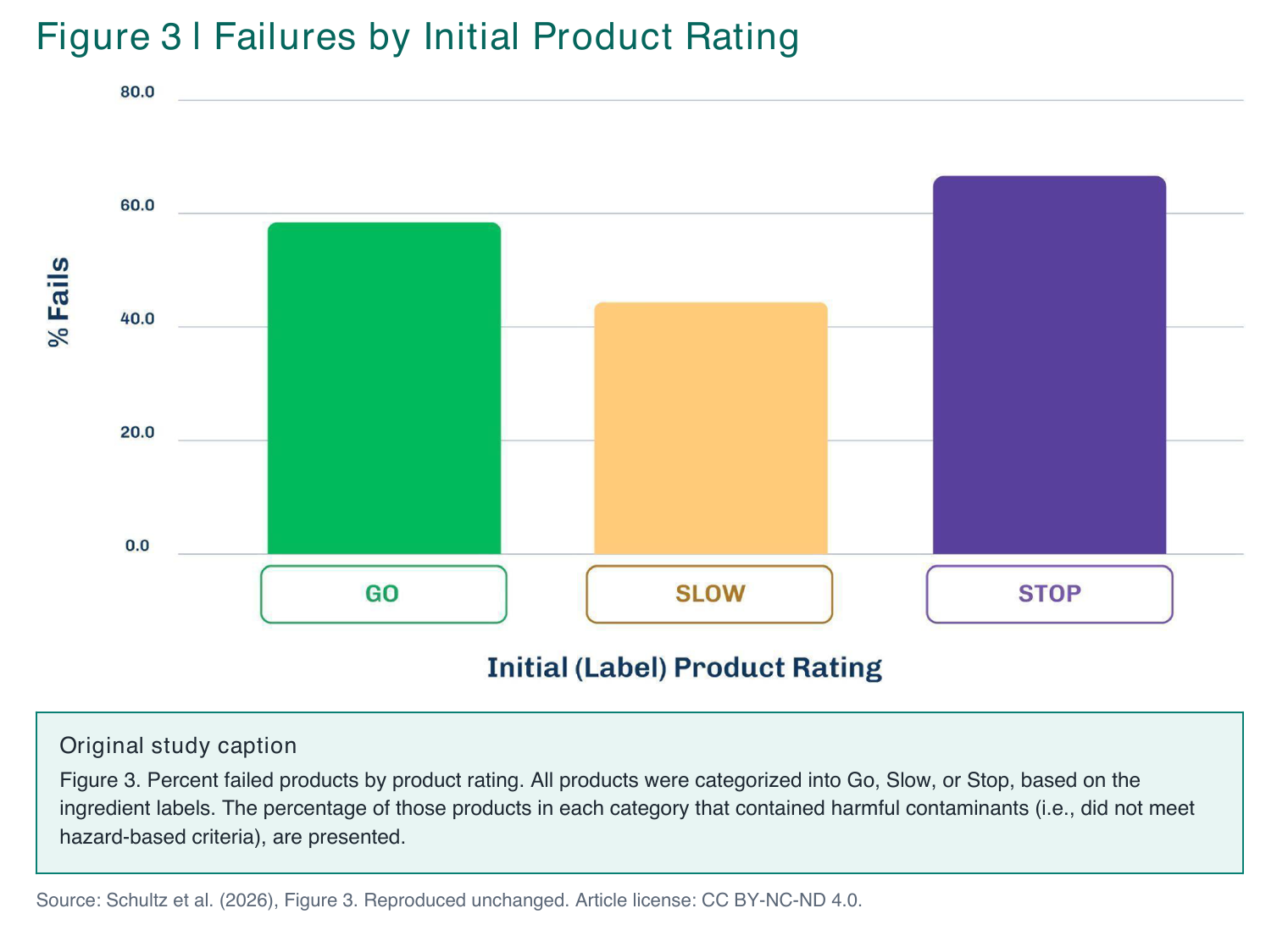
Before testing, the researchers rated products as Go (best choice), Slow (use sparingly), or Stop (not recommended) based on their disclosed ingredients.
Twenty-seven products initially received the favorable Go rating. After laboratory testing, 59% of them failed the contamination screen. Failure rates were also similar across company sizes. Smaller brands were more likely to have favorable-looking ingredient lists, but their finished products were not reliably less likely to fail than those of larger brands.
What kinds of chemicals were detected?
The detected compounds included fragrance-related chemicals, plasticizers and phthalates, siloxanes, antioxidants and preservatives such as BHT, botanical constituents, and other synthetic contaminants.
Some are relevant because of their endocrine, reproductive, developmental, carcinogenic, sensitizing, or organ-toxicity classifications. Others may be irritating or allergenic. Many product failures were driven by the combined presence of several moderate- or high-concern compounds rather than one chemical that appeared in every failed product.
This is consistent with a broader theme I have discussed in my microplastics and plastic-associated chemical coverage, which is that our exposure rarely comes from one product, one route, or one molecule. We encounter chemicals daily through food and water, indoor air and dust, packaging, cookware, clothing, receipts, personal-care products, and cleaning products.
Taken together, these findings challenge a common consumer assumption: that carefully reading the label allows us to identify the chemically “cleanest” product.
Labels can still be useful. They can tell us whether a company intentionally includes an ingredient we may want to avoid. But they cannot reveal every raw-material impurity, manufacturing contaminant, degradation product, packaging-related chemical, or constituent hidden within a broad ingredient category.
|
|
|
| |
Why product-label literacy has limits
One reason this study matters is that we are all trying to make healthier choices. We read ingredient lists, look for products labeled BPA-free, fragrance-free, phthalate-free, organic, natural, hypoallergenic, or non-toxic, scan products with apps, compare scores, and sometimes pay more for a cleaner-looking alternative.
That is a form of health literacy—finding information, trying to understand it, and using it to change behavior. It’s one of my primary goals with the content I create and share.
But health literacy only works when the available information is accurate and sufficiently complete. Consumers cannot identify an unlisted impurity, a compound introduced during manufacturing, or something that migrated from the package simply by reading more carefully. This tension has appeared repeatedly in my previous coverage of consumer products.
Take the phrase BPA-free.
Manufacturers often replaced BPA with structurally related chemicals such as BPS. Those products may truthfully contain no BPA, but the label can encourage the inference that the replacement material is free of similar endocrine activity. Meanwhile, evidence suggests that BPS and some other BPA substitutes can act through many of the same hormone-related pathways. BPA-free is not the same as bisphenol-free, and neither phrase automatically means hormone-neutral. I discussed this substitution problem here.
The word organic creates a similar shortcut.
Organic production can reduce exposure to many synthetic pesticides, and recent controlled data suggest that switching to an organic diet can substantially lower urinary pesticide residues. But organic does not mean pesticide-free, nutritionally superior in every case, or inherently safe simply because an input is natural. In an earlier member Q&A session, I separated those questions rather than treating organic as a verdict about a food's health properties.
The same principle applies to "microwave-safe."
A plastic container may tolerate microwave use without visibly melting or deforming, but that does not establish that nothing migrates from the material into food. Heat, fat, acidity, contact time, abrasion, and the condition of the container can all matter. For that reason, I move food into glass or another appropriate nonplastic container before heating it when practical. I answered the microwave-plastic question directly in Q&A #47.
Even apparently simple material swaps require context. Glass is useful because it avoids many plastic-contact concerns, yet one recent survey found more measured microplastic particles in certain glass-bottled beverages than in comparable plastic bottles. Likewise, not every black-plastic utensil contains recycled flame retardants, and not every plastic product contains BPA or phthalates. Migration depends on the specific polymer, additives, temperature, food, contact time, and degree of wear. My recent kitchen audit with Steven Bartlett on The Diary of a CEO podcast walks through these distinctions.
These examples point to a larger lesson: a label is a clue, not a complete risk assessment.
Labels can help us avoid a disclosed ingredient, help someone with a known allergy recognize a specific trigger, and provide evidence that a product met a defined standard. But a marketing phrase cannot, by itself, tell us the complete chemistry of the finished product, how much reaches the body, or whether the resulting exposure is large enough to affect our health.
|
|
 |
| |
What members are asking
When I look across years of member questions, the same underlying problem appears in several forms.
You’re asking which shampoo, sunscreen, moisturizer, deodorant, detergent, cookware, water filter, food container, or baby product is safest; whether apps such as Yuka or online databases can reliably identify harmful ingredients; whether clean beauty, natural, organic, or non-toxic means anything consistent; and whether a BPA-free can, PET bottle, plastic water-filter housing, or “chemical-free” nonstick pan is actually safer.
My most useful answer is not a permanent list of approved brands. I wish I could provide that, but I can't. Product formulations, suppliers, and packaging change. And as this study demonstrated, an ingredient-based score can disagree with the chemical profile of the finished product.
The better answer, I think, is a repeatable decision process we can use not only for personal-care products, but also for food and the items we use to store and prepare it.
1. Ask what the label actually promises
The narrower the claim, the less we should generalize from it.
BPA-free addresses BPA—not every bisphenol or every endocrine-active compound. PFOA-free addresses one member of the much larger PFAS family. Unscented may mean that a product has no perceptible odor, not that no masking fragrance was used. Hypoallergenic does not guarantee that a product cannot cause an allergic reaction. Non-toxic is an extremely broad conclusion unless the company explains what was evaluated, under which exposure conditions, and with what evidence.
2. Separate an ingredient claim from finished-product testing
A restricted-ingredient list tells us what a company intends not to add. That is useful, but it is not the same as analyzing the product that comes out of the package.
When a product category raises a meaningful concern, ask:
Was the finished, packaged product tested? Was testing performed by an independent laboratory? Which chemicals or contaminants were included? Was the test tied to the current formulation or production batch? Does the company publish a certificate or only state that the product “passes”?
3. Consider how the product is actually used
Exposure is shaped by more than the ingredient name.
A leave-on lotion used over a large area every day creates a different exposure opportunity than a rinse-off product used occasionally. Heat, acidity, fat, abrasion, and long contact times can increase migration from some food-contact materials. This is why a simple label score cannot substitute for context: how and where we use products can interact with their ingredients and components to create different exposures.
4. Preserve the benefit–risk comparison
Sunscreen is the clearest example. Concerns about a particular UV filter, contaminant, or formulation should lead us toward a suitable alternative like more protective clothing, shade, or a mineral product we will actually use—not toward repeated unprotected ultraviolet exposure. The same logic applies when nutritious food is sold only in plastic. Compare the realistic alternatives, not an imperfect product with an imaginary zero-exposure option.
5. Prioritize repeated exposures and changes you can sustain
Which recurring exposure can you reduce without creating a larger problem?
That may mean carrying a reusable mug, transferring food before heating it, replacing a badly worn utensil, choosing a simpler fragrance-free routine, improving ventilation while cleaning, or selecting a filter certified for the contaminant in your water.
These are not guarantees of zero exposure. They are ways to reduce avoidable exposure while the science, testing, and regulation continue to improve.
If I had to reduce all of your questions to one answer, it would be this:
Use labels to screen products, not to certify them. Look for independent evidence that matches the finished product and the claim you care about. Then prioritize the exposures that are frequent, heated, inhaled, or left on the body—and make substitutions that preserve the product’s health benefit.
|
|
 |
| |
Final thoughts
You cannot eliminate every chemical from your life. That is impossible—and trying to do it can become expensive, stressful, and counterproductive.
My approach is to focus on frequent, high-contact, and high-heat exposures, make reasonable substitutions, and ask for or seek out meaningful testing data when available. Terms such as clean, natural, non-toxic, and free from should not be mistaken for independent laboratory results.
The burden cannot (and should not) rest entirely on you as a consumer. Nobody should need a chemistry degree, several databases, and an afternoon of research to buy shampoo or laundry detergent. Manufacturers have a responsibility to control their raw materials, production, storage, and packaging, and to make claims that reflect what is actually in the package.
What we can do is make thoughtful substitutions, simplify routines, reduce high-contact exposures, and choose companies that provide useful testing data. Health literacy should help us turn reliable information into better decisions. And at the end of the day, each of us has to make the best choice possible with the knowledge and information available.
I hope this email makes that process a bit smoother for you.
|
|
| |
Go deeper on everyday sources of "hidden" chemicals
I've gone deeper in Premium episodes on the practical questions today's study raises, like where plastic-associated chemicals enter food, water, air, clothing, cookware, packaging, and personal-care products... and the best swaps to limit your exposure.
Aliquot #122: Microplastics—How to Reduce Your Exposure
08:02—How heat and acidity change plastic-associated chemical exposure 13:11—Reverse-osmosis filtration 15:59—Food storage and the limits of “microwave-safe”
Member Q&As
-
Q&A #63—Water filters that reduce microplastic exposure
Q&A #64—Coffee systems and plastic contact Q&A #50—Why “BPA-free” may not mean endocrine-disruptor-free Q&A #82—Sunscreen, pesticides, and reverse osmosis filtration
|
|
Warm regards,
— Rhonda and the FoundMyFitness team
|
|
|
|
|
|
 Mitochondrial bioenergetics
Yamanaka factors
Exercise intensity
Cell reprogramming
Blood-brain barrier
Epigenetic age deceleration
Stress resistance
Cardiorespiratory fitness
Nutritional ketosis
Compression of morbidity
CpG Islands
Lactate shuttle
Whole-body hyperthermia
Psychology of grit
Telomerase reverse transcriptase (TRT)
Chronic inflammation
Disease prevention
Therapeutic hyperthermia
Pathogen-host defense theory
Cell signaling
Proteostasis
Cellular senescence
CRISPR-Cas9
Aging
PGC1α
Overcoming adversity
Increased healthspan
Gene–diet interaction
Biology of resilience
Immune-brain interaction
Neuroendocrine effects
Heat Shock Proteins (HSPs)
Oxidative stress
Vitamin D
Omega-3 fatty acids
β-Hydroxybutyrate (BHB)
GLUT4
Pregnancy optimization
Mitochondrial bioenergetics
Yamanaka factors
Exercise intensity
Cell reprogramming
Blood-brain barrier
Epigenetic age deceleration
Stress resistance
Cardiorespiratory fitness
Nutritional ketosis
Compression of morbidity
CpG Islands
Lactate shuttle
Whole-body hyperthermia
Psychology of grit
Telomerase reverse transcriptase (TRT)
Chronic inflammation
Disease prevention
Therapeutic hyperthermia
Pathogen-host defense theory
Cell signaling
Proteostasis
Cellular senescence
CRISPR-Cas9
Aging
PGC1α
Overcoming adversity
Increased healthspan
Gene–diet interaction
Biology of resilience
Immune-brain interaction
Neuroendocrine effects
Heat Shock Proteins (HSPs)
Oxidative stress
Vitamin D
Omega-3 fatty acids
β-Hydroxybutyrate (BHB)
GLUT4
Pregnancy optimization