I often describe the sauna and other forms of heat exposure as “exercise mimetics.”
There is real physiology behind that phrase. Heat redirects blood flow toward the skin, raises cardiovascular strain, and increases shear stress, the friction of blood moving along artery walls. These are some of the same acute signals produced by aerobic exercise.
But sharing a signal is not the same as reproducing an adaptation—that's why I say they "mimic" exercise rather than replace it.
I just read two new papers that help define that boundary. In one trial, hot-water immersion improved a measure of blood-vessel function, and the improvement was smaller than, but in the same general range as, that produced by moderate-intensity aerobic exercise.
A separate meta-analysis concluded that heat applied shortly after resistance training may produce greater muscle growth but no clear improvement in strength, compared to training without heat.
Together, these studies suggest that we should think about heat not as a substitute for exercise but as a targeted stressor that may overlap with—and perhaps complement—specific training adaptations.
In this newsletter, I'll explain what each paper found, discuss how to apply the findings, and answer a few common audience questions about the overlap and potential synergy between heat and exercise (plus one question about cold-water immersion).
|
| |
These weekly science deep dives are made possible by FoundMyFitness Premium Members like you. At the end of this email, I share some extra resources on heat exposure for those who want to continue learning. |
| |
|
You just missed this in your inbox
Every week, Dr. Rhonda Patrick and the FoundMyFitness team distill the latest research into clear, actionable insights on health, longevity, and performance, delivered free to your inbox.
Is a Hot Bath "Exercise" for the Vascular System?
The new randomized trial included 31 inactive adults with an average age of 58 and an average body mass index of 30 who were assigned to one of three groups:
Aerobic exercise involved stationary cycling three times per week, progressing from 30 minutes at 55–65% of their maximum heart rate to 40 minutes at 75–85%. Hot-water immersion involved sitting in 40°C (104°F) water three times per week, immersed to the lower chest with the arms submerged. Sessions progressed from 30 minutes during the first two weeks to 40 minutes thereafter. The inactive control group maintained their usual diet and activity without starting exercise or heat therapy.
The researchers assessed vascular function before and after the intervention. The main measure was flow-mediated dilation, or FMD—the amount an artery widens in response to a temporary increase in blood flow. FMD is a useful marker of endothelium-dependent vascular function, and the researchers measured FMD in both the brachial artery of the arm and the femoral artery of the leg. They also assessed resting blood pressure and central arterial stiffness.
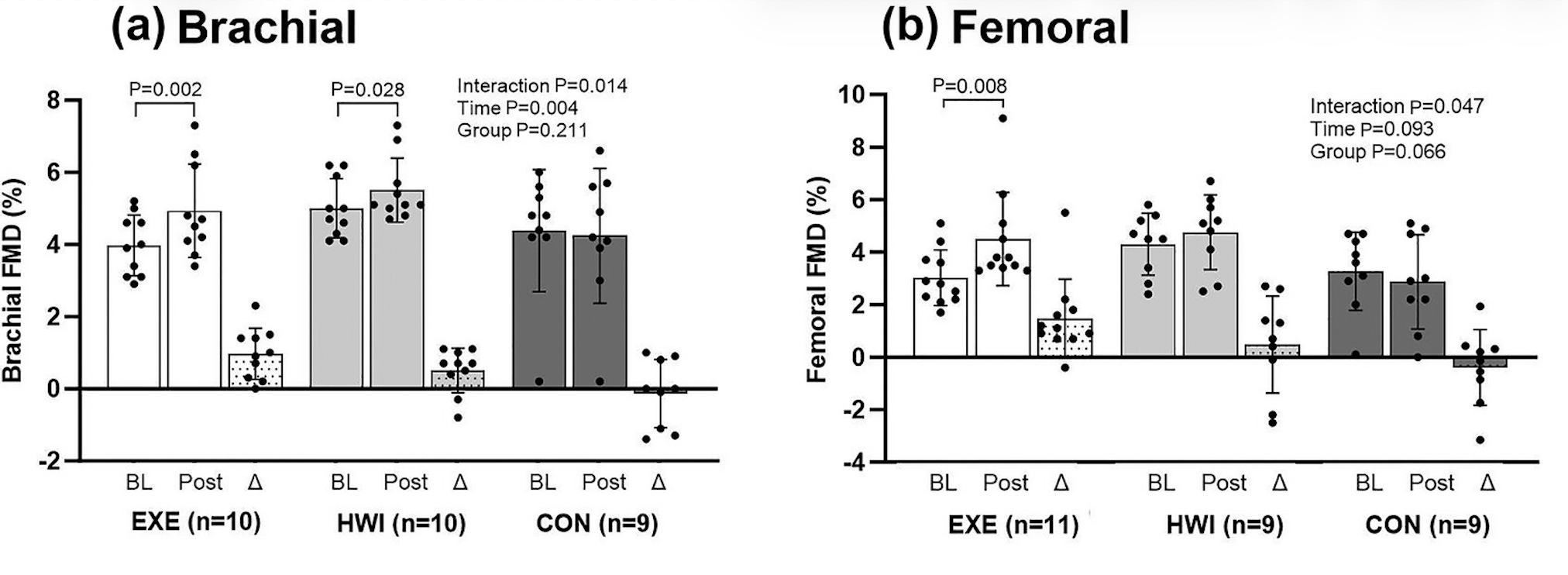
After 12 weeks, brachial-artery FMD—the amount an artery widens in response to a temporary increase in blood flow—changed by 1% in the exercise group, 0.5% with hot-water immersion, and essentially zero in the inactive control group. The improvement with cycling clearly exceeded the control group. Hot-water immersion improved brachial FMD compared with its own baseline, and its change did not statistically differ from the cycling group.
That sounds like heat “worked as well as exercise,” but the statistics do not support that conclusion. Hot-water immersion produced a promising improvement in upper-limb FMD, but exercise produced the clearer, more robust effect.
Femoral FMD changed by 1.5% after exercise, 0.5% after hot-water immersion, and decreased by 0.4% in the inactive control group.
This time, only the exercise group improved significantly from baseline, and only exercise clearly outperformed the control group. Hot-water immersion did not significantly improve femoral FMD. The other outcomes were also important because they did not change. Neither intervention produced a specific improvement in resting blood pressure or central arterial stiffness.
The study cannot tell us exactly why the responses differed, but several explanations are plausible. The most likely one is that exercise produces systemic signals that heat may not reproduce to the same degree, including changes in energy sensing, vascular growth factors, and tissue-specific signaling triggered by mechanical work.
This does not make the response to heat unimportant, but it does not suggest that hot-water immersion can deliver the full-body benefits of aerobic exercise.
|
|
| |
Brachial and femoral FMD at baseline, post-intervention, and the overall change after exercise, hot-water immersion, and the control group. |
|
| |
Does Heat After Lifting Build More Muscle?
The second paper (co-authored by previous FoundMyFitness guest Dr. Brad Schoenfeld and colleagues) examined another popular claim: that adding sauna or another form of heat after resistance training can amplify muscle growth.
The systematic review and meta-analysis combined six interventions involving 125 healthy young adults.
The training programs lasted four to 12 weeks and involved resistance exercise two or three times per week. The heat protocols included sauna in two studies, hot-water immersion in three studies, and an electric heating pad in one study. Exposure lasted 10–40 minutes and temperatures ranged from 38°C to 100°C (100°F to 212°F). Perhaps most important was the timing of the heat exposure. Most commonly, it happened immediately after training, and the latest it occurred was 15 minutes after training.
Overall, the evidence pointed toward a small advantage for heat plus resistance training for muscle growth—participants gained more lean mass when they added heat to training compared to the same training without heat.
Strength showed no advantage at all. Both groups became stronger from resistance training, but adding heat did not meaningfully improve the result.
The signal is interesting, but it is not ready to become a muscle-building prescription. The important distinction is that resistance training was highly effective for both strength and hypertrophy, and adding heat did not appear harmful in any way. Heat simply added little, if anything, beyond training alone. That contrasts with immediate post-exercise cold exposure, which may dampen gains in muscle mass over time (something I address briefly near the end of this email).
One more thing to mention. While the evidence may not strongly support a hypertrophic effect of heat, there is evidence that passive heat exposure may have anti-catabolic effects, helping limit the loss of muscle mass and strength, particularly during disuse or in older age, when dietary and environmental factors drive catabolic processes (something I discussed with Dr. Stuart Phillips in the clip below, from episode #76 of the FoundMyFitness podcast).
|
|
 |
| |
Answering Your Questions About Heat and Exercise
Over the years, I've received literally hundreds of audience member questions about heat exposure, particularly how it overlaps with or complements exercise. To end this email, I thought I'd answer a few that have popped up most often.
Can sauna or hot-water immersion count toward my weekly exercise target?
No. I would count heat exposure separately from exercise.
If time is limited and you can exercise, choose exercise. If injury, disability, or poor exercise tolerance temporarily limits what you can do, heat may offer a useful cardiovascular stimulus or bridge toward greater activity—but it is not a substitute for the recommended aerobic and resistance-training targets. This FoundMyFitness clip explains where sauna overlaps with cardiovascular exercise.
Does exercising in the heat provide the same benefits as sauna?
It can reproduce some of the thermal adaptations, but I would not assume the two are equivalent.
Exercise already raises core body temperature. A hot room, direct sun, or insulating clothing makes it harder to dissipate that heat, increasing the thermal strain. If that stimulus is sufficient and repeated, it can activate heat-shock proteins and promote heat acclimation.
I have previously said that hot yoga may produce some sauna-like effects. Studies have reported improvements in outcomes such as arterial function and stamina, and core temperature during a class can rise substantially. But there are no good head-to-head trials showing that hot yoga, outdoor labor, or working out with layers reproduces the full effect of a defined sauna protocol. With hot yoga in particular, it is difficult to separate the contribution of heat from the contribution of exercise.
Sweating is also not a reliable dose marker. Two people can sweat very different amounts at the same core temperature, and humidity can limit evaporative cooling even when sweat production is high. The long-term Finnish data on cardiovascular and dementia risk came from traditional sauna use, so we cannot transfer those exact associations to working outdoors or exercising in a hot environment.
My practical answer is to count hot yoga or training in the heat as exercise with an added heat stimulus, not as a separately validated sauna or hot-water immersion session. The FoundMyFitness sauna topic page explains how natural heat acclimatization and controlled heat acclimation overlap.
Is heat best before training, after training, or on rest days—and how much should I use?
There is no universally validated protocol, but after training or in a separate session is the most practical default.
That is not because pre-exercise sauna has been proven harmful. It is because the workout is the foundational stimulus, and I would not let added heat, dehydration, or fatigue reduce training quality. Post-exercise heat is also the timing used by the muscle studies in the new meta-analysis and by trials examining whether sauna can add to aerobic training.
In my own routine, I often place sauna after cycling, shorten the session when the workout was especially demanding, and sometimes use heat by itself on non-training days. My full routine and its limits are discussed here.
Does cold exposure after training or sauna blunt the adaptation?
Cold after sauna by itself does not appear to erase every benefit of heat.
Contrast bathing is common in Finland, and some studies combining sauna and cold still report favorable physiological adaptations. That's because most of the benefits of sauna occur during the actual exposure when body temperature and blood flow are elevated. Cooling the body afterward is unlikely to dampen most of those effects. But when sauna follows resistance training, the final cold exposure becomes the more important concern.
Repeated cold-water immersion immediately after lifting can reduce muscle blood flow, blunt muscle-protein synthesis, and modestly reduce long-term hypertrophy. There is no evidence that placing sauna between the workout and the cold plunge eliminates this interference, either.
If muscle growth or strength is the priority: complete the resistance session, use heat afterward if desired, and move the cold plunge at least six to eight hours later—or to a non-training day. A brief cold shower is unlikely to create the same muscle-level cooling as 10–15 minutes of whole-body cold-water immersion, so I would not treat them as equivalent.
There are times when rapid recovery matters more than maximizing adaptation—for example, during competition or a demanding event schedule. In that setting, the soreness and recovery benefits of cold may be worth the tradeoff. But for ordinary resistance training, avoid immediate cold immersion if gaining muscle is the goal. This FoundMyFitness newsletter covers the timing evidence in detail.
|
|
 |
| |
Final thoughts
“Exercise mimetic” is useful shorthand only if we remember what it describes.
Heat can imitate some of the signals created by exercise, and those signals can produce real biological responses. But exercise is a coordinated challenge involving the heart, lungs, blood vessels, skeletal muscle, bone, nervous system, and metabolism.
To me, the vascular trial is interesting precisely because the result was partial. Heat was effective. Exercise provided a more convincing adaptation.
The applications here are two-fold. The already-optimized person or high-level athlete looking for an extra fraction of a percent can probably use heat to reliably make more of their training.
The most useful case may be for the middle-aged or older adult, someone with limited mobility, or someone managing an illness or injury who cannot currently exercise enough to produce a meaningful cardiovascular adaptation. Heat could help limit losses in fitness or muscle—and perhaps even preserve some adaptation—when training volume and intensity fall.
“Exercise more” is not simply an option for everyone, but heat exposure might be. I view it as one more way to add “good stress” on a daily basis—one that may help build resilience over time.
Heat is not exercise—but in the right context, it may complement it.
|
|
| |
Go Deeper on Heat, Exercise, and Adaptation
These three Premium episodes go deeper on the questions raised in this issue—from how heat mimics exercise to the practical timing of sauna, strength training, and cold exposure.
Q&A #77: What’s the Best Time to Exercise?—Morning vs. Evening and How to Sequence Sauna and Cold
56:06 – Sauna after resistance training 58:45 – Sequencing training, sauna, and cold 1:12:16 – Hot tubs versus saunas for raising core temperature
Aliquot #96: Thermal Stress, Part I: The Science Behind Heat Stress and its Positive Effects on Health — A broad primer on heat hormesis, heat-shock proteins, safety, hot baths, and the physiological overlap between sauna and exercise.
Aliquot #35: Sauna use mimics the physiological effects of exercise — Drs. Jari Laukkanen and Charles Raison discuss cardiovascular effects, exercise-like physiology, and the timing of sauna around lifting.
You can also explore the public FoundMyFitness sauna topic page and my previous newsletter on why hot baths and sauna share some features with moderate-intensity exercise.
|
|
Warm regards,
— Rhonda and the FoundMyFitness team
|
|
|
|
|
|
 Mitochondrial bioenergetics
Yamanaka factors
Exercise intensity
Cell reprogramming
Blood-brain barrier
Epigenetic age deceleration
Stress resistance
Cardiorespiratory fitness
Nutritional ketosis
Compression of morbidity
CpG Islands
Lactate shuttle
Whole-body hyperthermia
Psychology of grit
Telomerase reverse transcriptase (TRT)
Chronic inflammation
Disease prevention
Therapeutic hyperthermia
Pathogen-host defense theory
Cell signaling
Proteostasis
Cellular senescence
CRISPR-Cas9
Aging
PGC1α
Overcoming adversity
Increased healthspan
Gene–diet interaction
Biology of resilience
Immune-brain interaction
Neuroendocrine effects
Heat Shock Proteins (HSPs)
Oxidative stress
Vitamin D
Omega-3 fatty acids
β-Hydroxybutyrate (BHB)
GLUT4
Pregnancy optimization