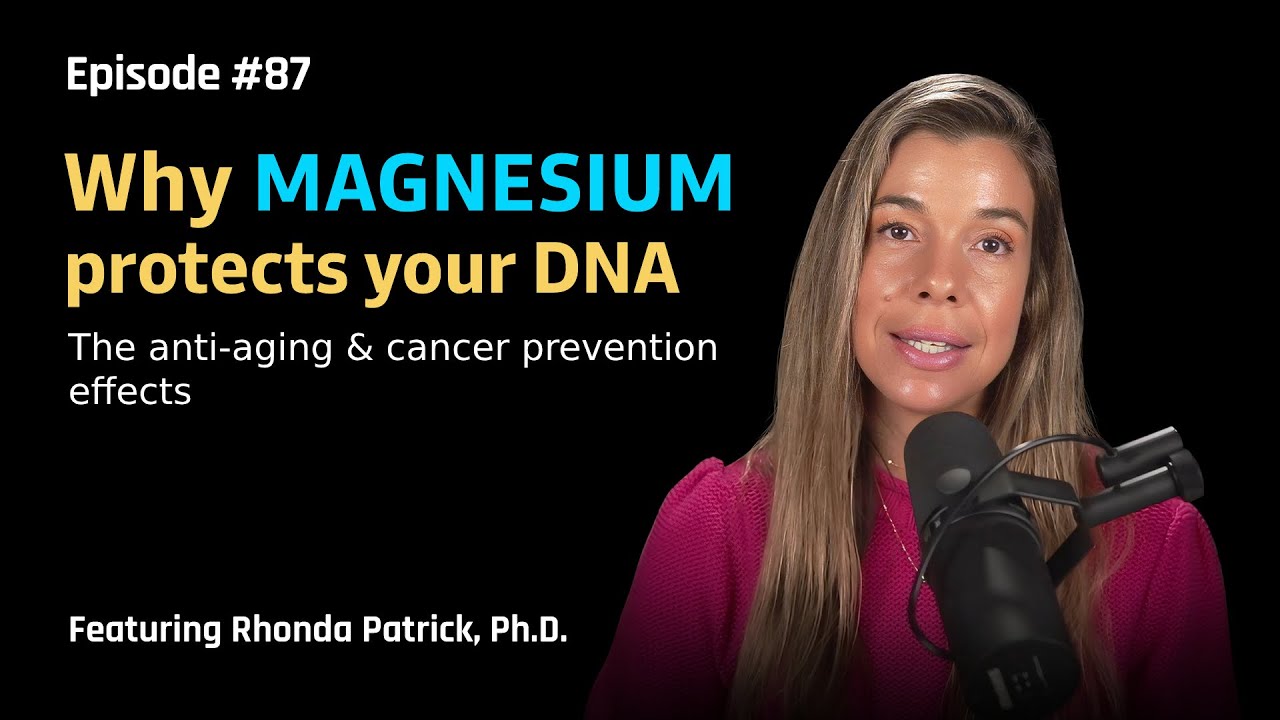
How Magnesium Supports DNA Repair
The BDNF Protocol Guide
An essential checklist for cognitive longevity — filled with specific exercise, heat stress, and omega-3 protocols for boosting BDNF. Enter your email, and we'll deliver it straight to your inbox.
You'll also receive updates from Rhonda & FoundMyFitness
In this clip from Dr. Rhonda Patrick's appearance on Katie Couric's Next Question, she explains why magnesium supports both immediate energy needs and long-term cellular maintenance. Magnesium serves as a cofactor for more than 300 enzymes and helps maintain DNA structure, replication, and repair systems. These roles provide the biological basis for Dr. Patrick's discussion of micronutrient triage, in which limited nutrients may be directed toward processes needed for immediate survival. [1]
Many Americans consume less magnesium than the estimated requirement. Leafy greens, legumes, nuts, seeds, and whole grains can help close this intake gap. Current adult targets are 310 to 320 milligrams per day for women and 400 to 420 milligrams for men, with needs varying by age and life stage. Food-first intake also supplies magnesium alongside fiber and other micronutrients.
A supplement can help fill the remaining gap when food intake is insufficient. Comparative studies suggest that soluble organic forms tend to be absorbed better than magnesium oxide, although individual products and study methods vary. Sweat also contains magnesium, so physical activity and heat exposure can contribute to losses, but the amount varies with sweat rate, duration, acclimation, diet, and collection method. Supplemental intake should account for elemental magnesium, kidney function, and medicine interactions. [2] [3]
This clip is excerpted, with permission, from Dr. Rhonda Patrick's appearance on Katie Couric's Next Question. Thank you to Katie Couric and Next Question for allowing us to share it.
- ^ 11295157
- ^ Pardo MR; Garicano Vilar E; San Mauro Martín I; Camina Martín MA (2021). Bioavailability of magnesium food supplements: A systematic review. Nutrition 89, .
- ^ Hoshi A; Watanabe H; Kobayashi M; Chiba M; Inaba Y; Kimura N, et al. (2001). Concentrations of trace elements in sweat during sauna bathing. Tohoku J Exp Med 195, 3.
Dr. Rhonda Patrick: At least 60 percent of the U.S. population does not get enough magnesium in the diet. Magnesium is at the center of a chlorophyll molecule. Chlorophyll gives plants their green color, so magnesium is high in dark leafy greens. That means most people are not eating enough dark leafy greens.
Why is magnesium important? Magnesium is an essential cofactor for more than 300 biological processes in the body. These range from using and making energy to repairing DNA after damage so that the damage does not become a mutation that can cause cancer.
My mentor proposed something called the triage theory. The idea is that the body has strategically found a way to ration micronutrients during an insufficient state. Biological processes that are important for short-term survival get their share before processes that are important for long-term survival.
Magnesium is needed to make energy. If you cannot make energy, you cannot survive. This is not an age-related disease that might appear in your 80s; it is something you need now.
Cancer, on the other hand, is not something that will happen right now. It might take five or six decades to emerge. Repairing DNA damage is important, but it is not as important for immediate survival. It is important for health 50 years from now.
Katie Couric: Right.
Dr. Rhonda Patrick: Magnesium is required for repairing DNA damage. DNA damage happens every second. It is happening now as we talk. Every time we eat food, metabolism produces reactive oxygen species, or oxidation, that can damage DNA. Sometimes damage occurs in an area that is not important, and sometimes it occurs in an area that may contribute to cancer. You want to repair that damage, so you want to make sure you have enough magnesium.
Katie Couric: Can I ask a question? Should I—or should people, because this is not all about me—take magnesium supplements if they are not getting enough leafy green vegetables?
Dr. Rhonda Patrick: Yes, I do think people should, because it can be hard to meet magnesium requirements. Women need about 300 to 350 milligrams per day, and men need about 400 to 450 milligrams per day.
If you are physically active, your needs may be higher because magnesium is lost through sweat. To get enough from food, you need to eat plenty of leafy greens. Almonds and oats are also high in magnesium. You need a balanced diet and must estimate how much of those foods you need to meet the requirement.
I think magnesium can be good insurance. The main side effect is that a high dose can have a laxative effect. Some people like that, but not everyone does.
If you take 150 to 200 milligrams per day, that provides about half of the daily requirement. You may be able to meet the other half through foods such as salads, almonds, and oats.
The best forms to take are organic salts, such as magnesium malate, citrate, taurate, or glycinate. These are more bioavailable than magnesium oxide, which is not very bioavailable.
Again, 150 to 200 milligrams per day can be a starting amount. You may be able to take more, especially if you are physically active and sweat a lot. If you use a sauna on top of that, you may need 10 to 20 percent more because magnesium is lost through sweat.
Hear new content from Rhonda on The Aliquot, our member's only podcast

Listen in on our regularly curated interview segments called "Aliquots" released every week on our premium podcast The Aliquot. Aliquots come in two flavors: features and mashups.
- Hours of deep dive on topics like fasting, sauna, child development surfaced from our enormous collection of members-only Q&A episodes.
- Important conversational highlights from our interviews with extra commentary and value. Short but salient.
Magnesium News
- Magnesium and potassium supplementation may ease insomnia severity in people with diabetes.
- Nearly half of people with type 2 diabetes have multiple micronutrient deficiencies—the most common being vitamin D.
- Low magnesium levels drive DNA damage, especially among people with high homocysteine.
- Magnesium supplementation reduces post-workout muscle soreness and enhances recovery in both recreational runners and elite athletes.
- Intensive lifestyle modification that includes diet, exercise, and stress management improves cognitive function and slows disease progression in older adults with mild cognitive impairment while also reversing biomarkers of Alzheimer's disease.