How Dr. Rhonda Patrick Reduces Everyday Microplastic Exposure
The BDNF Protocol Guide
An essential checklist for cognitive longevity — filled with specific exercise, heat stress, and omega-3 protocols for boosting BDNF. Enter your email, and we'll deliver it straight to your inbox.
You'll also receive updates from Rhonda & FoundMyFitness
In this member Q&A clip, Dr. Rhonda Patrick separates micro- and nanoplastic particles from plastic-associated chemicals such as BPA, BPS, phthalates, and PFAS. These exposures have different sources, persistence, measurement methods, and evidence. Consumer tests for chemicals do not necessarily measure micro- or nanoplastic burden, and nanoplastic detection remains technically uncertain.
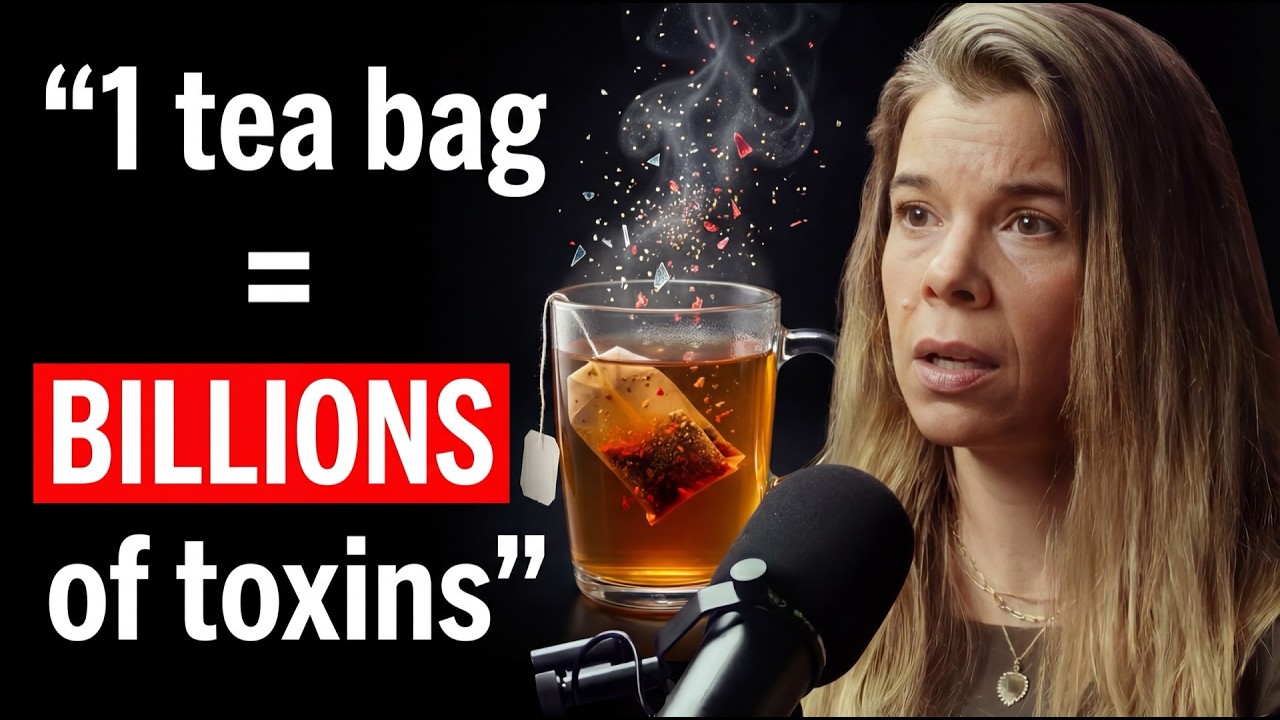
She prioritizes ingestion and inhalation. Bottled water and hot liquid in plastic-lined paper cups can contain large particle counts, while heat and prolonged contact can increase release. [1] [2] Acidic foods, vinegar, fruit juice, condiments, and spices can also increase migration from food-contact materials. Her practical choices include filtered water, stainless-steel mugs, glass storage, not heating food in plastic, avoiding PFAS-lined microwave-popcorn bags, and choosing uncoated stainless-steel cookware.
Clothing is a separate branch. Polyester can shed fibers, and moisture-wicking apparel may contain PFAS. Dr. Patrick favors cotton for sweaty, high-friction activity and takes extra caution with children because development is sensitive. This is her precautionary approach; the excerpt does not quantify absorbed dose from one shirt, underwear, or workout.
She discusses reverse-osmosis filtration, household dust, food packaging, and washing produce while acknowledging that exposure cannot be eliminated. She also describes limited sweat excretion of BPA and uncertainty about skin reabsorption after sauna. Sweat is not a proven treatment for PFAS or particle removal.
Sulforaphane activates NRF2-regulated enzymes. A randomized trial showed increased urinary metabolites of benzene and acrolein, not removal of microplastics, PFAS, or nanoplastics. [3] Product-specific consumer testing can inform chemical exposure, but before-and-after results require validated assays and do not establish clinical benefit.
For a product-selection companion to these exposure-reduction strategies, read Dr. Patrick's analysis of how reliably “clean” labels describe finished personal-care and cleaning products. A nontargeted laboratory study found far more compounds than labels disclosed, but it did not measure absorbed dose or show that the tested products caused disease. The practical framework explains how to screen claims, look for finished-product testing, consider how a product is used, preserve benefit–risk tradeoffs, and prioritize repeated exposures.
- ^ Qian N; Gao X; Lang X; Deng H; Bratu TM; Chen Q, et al. (2024). Rapid single-particle chemical imaging of nanoplastics by SRS microscopy. Proc Natl Acad Sci U S A 121, 3.
- ^ Ranjan VP; Joseph A; Goel S (2021). Microplastics and other harmful substances released from disposable paper cups into hot water. J Hazard Mater 404, Pt B.
- ^ Egner PA; Chen JG; Zarth AT; Ng DK; Wang JB; Kensler KH, et al. (2014). Rapid and sustainable detoxication of airborne pollutants by broccoli sprout beverage: results of a randomized clinical trial in China. Cancer Prev Res (Phila) 7, 8.
Okay, so we're going to talk a little bit about microplastics. I released a big episode on that a couple of weeks ago. I've really gone deep into trying to make a lot of changes in my family's household products and everything from clothing to food packaging, just being extremely aware of the plastic in our lives. And so there's quite a few questions that were related to plastic. Steve asked one about Microplastics and BPA and what the relative risks are on clothing. So remember, polyester clothing is made of microplastics. And what's the risk with shirts versus things like boxers versus canned foods? So cans have aluminum in them. Cans have— aluminum cans have plastic lining that has BPA. And even if it doesn't have BPA, it's still plastic and has other chemicals like BPS.
Which are just as harmful in terms of their health effects. I think from a very high level, the things that I have decided to focus on, I think that's what I'll share with you because it's so hard to know, like, what's the risk of using polyester boxer shorts versus shirts? My take on the clothing part, okay, the clothing part, my take is, really, if you're going to be working out and sweating and your clothing is going to be moving, there's a lot of friction against your skin. Unfortunately, workout clothes is the time that you're probably most likely to wear the type— this rayon and polyester and anything that's moisture-wicking probably has PFAS in it, unfortunately. So I've now sort of moved toward more cotton shirts as much as possible.
I would say that I'm not going to change all of my fashion, but I certainly have decided that I'm not going to buy a lot of the activewear clothing, particularly for my son. It's just not necessary. He can sweat in a cotton shirt and be fine. So what, right? So I think you kind of just have to choose. Like, I think, okay, well, during development, very sensitive time. So maybe we should be a little more cautious with our children's clothing. Okay. When it comes to ours, yeah, I do think again, if something's going to be— you're going to be sweating, I would avoid the really the moisture-wicking clothing because those have PFAS in it and PFAS are the worst because They are really hard to excrete. They're in our bodies for 2 to 5 years. There's just— it accumulates.
The more we're exposed, it's accumulating. So I think avoiding the moisture-wicking kind of clothing as much as possible is probably the way to go. And also, you know, switch it out with some cotton shirts. Like, you know, it's okay if you're going to work out in a cotton shirt, you know. So that's the clothing. I will say that the biggest offender in terms of microplastics and their associated chemicals, whether we're talking about BPA, BPS, PFAS, phthalates, is consumption and breathing it in. So consumption, some of the big things to focus on are, one would be water and water filters. And we're going to get to another question on this as well. Like some people were asking about water filters.
You want to have a filter on your sink, whether it's a tabletop, whether it's a one under-the-sink, one-faucet filter, or it's a whole house system. Reverse osmosis is the way to go. It will filter out microplastics and nanoplastics and many of the chemicals. In fact, all these chemicals, PFAS, the BPA, BPS, and phthalates. So that is a priority. And we will talk about some brands in a little bit. Number 2, really try to avoid— and again, this is kind of my strategy that I'm trying to adopt. Try to avoid drinking water out of plastic bottles as much as possible.
Obviously, there's going to be times when it's unavoidable, particularly when you're traveling and There's options now in airports that are like, you see these bottles that are made of aluminum, but it's like, well, are they lined with plastic? You have to call the company and ask. I don't know. So I wouldn't sweat it so much. There's only so much you can do, right? The other thing that's a big offender is heating any type of plastic, whether that is a to-go coffee cup, which is made of paper, which has a plastic lining, I just recently traveled the last 2 weekends and I brought this, my travel mug. So whether it's a Yeti brand or whatever your favorite brand is, I brought it with me everywhere.
And when I went to a coffee shop, when I was at an event, I gave them my mug and I said, can you fill this up with tea? Can you fill this up with coffee? I am not— that's one of the things that I really think should be avoided is those to-go coffee mugs because the heat really does make the microplastics And their chemicals break down at a much, much higher rate, like up to 55 times. It's a lot. So that's really important. And that goes with microwaving, anything that's heat, right? So obviously, getting rid of plastic Tupperware, easy to do, right? Like replace it with Pyrex, glass. Things that you're heating up that have any plastic in it, like just make sure that you're not doing that because that's one of the big offenders.
Like I said, microwave popcorn bags unfortunately are lined with the worst chemical of all, PFAS, the forever chemical. I don't know how many bags of popcorn I've microwaved for my family. It's tragic to think about, but there's always room for change, and moving forward, there will be no microwave popcorn in my house. So that's another big offender. When it comes to things like Food packaging. Okay. I think the strategy that I've sort of adopted is things that are acidic, things that have spices and certainly vinegar or fruit juice, like the fruit that's cut up and has a fruit juice, it's acidic. It has malic acid. It has citric acid. That stuff breaks down plastic. And so, it's all leaching into your food. It's leaching into the juice. Do not— try to avoid doing anything that's acidic.
Balsamic vinegar, you know, you get a to-go salad and there's balsamic vinegar in a plastic little container. I would, you know, obviously there's times it's not like you can always avoid it, but like that's going to put a lot of microplastics and chemicals into the salad dressing. Same goes for condiments, right? So you want to look for more glass containers. Your olive oil, your balsamic vinegar, you want them all to be in a glass container. Those sorts of acidic foods are kind of like heat. They do the same thing that heat does. They break down the plastic and accelerate them leaching into your beverages and food. So that's another thing to consider. I try to really avoid a lot of the packaging, obviously. You know, I'm getting fruits and vegetables. It's like I just put it in.
I'm not getting the plastic bag to put on top of it. If something comes in a plastic bag, I rinse it off, wash it off, wipe it off. And so I really try to avoid the food packaging as much as possible. When it comes to frozen things, I mean, I'm still going to get my frozen blueberries at a certain point. Like you can't eliminate everything. So unless you're like growing your own blueberries at home, in which case that's wonderful. You're very lucky. I don't know that you're going to just cut out every single thing, right? So like the frozen stuff in the bags, it is what it is, and I'm going to continue to use frozen blueberries. A related question was from Alvin about, okay, well, how— is there anything that we can do to measure our microplastic, BPA, PFAS phthalate levels.
And there is— I just— I have a couple of tests sitting on my counter from Vibrant Health, and they do measure these chemicals. So— and I think they're a very good company just by and large. In fact, I'm going to get their cardiovascular panel done. I went and gave a talk for them 2 weeks ago in San Jose. They have a wonderful facility there. I met the founders. Very good scientists, have a lot of scientific integrity, very interested in science. They have a very evidence-based approach to testing, to their innovation, and so I'm quite happy with their testing kits. I do think that there is a potential for sulforaphane to help excrete some of these chemicals. Unfortunately, not the PFAS, I don't think, unless there's something crazy that we don't know about.
The only way to know is to really get the test done before and after you're taking sulforaphane, which is kind of what I've been doing. sulforaphane, I think, is one way to really excrete BPA and BPS and phthalates because it hasn't been directly shown to do that, but it does dramatically activate the very enzymes that do make BPA from being— turn it from being more fat soluble to water soluble so that you excrete it through the urine. We know for a fact that people taking sulforaphane excrete other toxic compounds that go through that same pathway, such as acrolein and benzene.
So with that said, I am— I've really started to kind of up my sulforaphane game again, and I do think it is a good detoxification type of supplement that is broadly applicable to a variety of air pollution pollutants and plastic pollutants as well. Another related question regarding microplastics and their associated chemicals had to do with the sauna. So you do excrete some compounds from sweat, including BPA. It's a not— it's not a very high amount. So BPA is predominantly Okay. Detoxified from the body through urine. A little bit comes out through sweat. Now, there are other chemicals like heavy metals that are predominantly excreted through sweat. So for example, mercury, cadmium.
So there's a lot of reason why you want to sweat, and some BPA is also excreted, but if you're really wanting to get BPA out of the body, it's coming out through urine. That's the major The question was, if you get in the sauna and you're sweating a lot and there's a lot of perhaps heavy metals, a little bit of these chemicals that are coming out and now on your skin, and then you take a hot shower, does it get reabsorbed into your skin? I don't know the answer to that. There's really no empirical data. It's certainly theoretically possible. It's not very easy to absorb things transdermally. I'll say that. Okay? You really have to like get in a sauna almost and open up the pores and just really, really, really open those pores to really get even anything transdermally absorbed.
So I would say if it is, it's probably a very small amount. With that said, it does make sense to kind of wash your skin with some soap after a big sweat session. I mean, there's no reason not to do that. And then I mentioned that we're going to talk about some brands. Deborah asked about what I'm doing to limit my exposure. This is all the stuff I've been talking about that I'm doing. I also am getting a— so I've been using a Berkey filter, as you know. Berkey does filter out these chemicals like BPA and PFAS and phthalates and also some microplastics as well. I don't know if it goes as far as the nanoplastics. But it's not a whole house system. So I am now getting a whole house system reverse osmosis filtration system.
After a bunch of research I've done, I've come to the conclusion that I'm going with Crystal Quest reverse osmosis whole house system. They have these stainless steel tanks, which I like, and also instead of plastic tanks, and they have a remineralization filter as well. So it remineralizes the water so that you actually can have the minerals put back into the water. And then I think Avmacol is my other biggest tool that I'm using in addition to sweat, sauna. I'm doing hot yoga occasionally as well, but also just trying to get, you know, avoid using as much plastic as I possibly can. Certainly when I'm traveling and I'm doing things like drinking coffee on the go, I bring my mug. I'm just done with using any to-go coffee mugs.
Oh, and the other thing that I've done— sorry, last thing, and I think there's some questions related to this— is my cookware. So I don't think silicone is okay. Gary's asking. I think silicone needs to— I think that needs to be shifted out, unfortunately. So if you're going to do any baking with muffins, don't use the silicone muffin container trays. So I have gone through and I use— I'm using— All-Clad. They do a lot of titanium stainless steel cookware. So that's what I'm using. You can find your favorite brand, but I'm just, I'm actually moving away from even the ones that are like, oh, this is nonstick, but it doesn't have any chemicals. I don't even want anything nonstick. Like, I don't even care. I don't care if it's cleaner or greener or whatever.
I've just decided I just want the basic. I want the basic cooking because the heat is just so much of a catalyst for breaking down any of those potential plastic chemicals or, you know, whatever it is it's lined with that I've decided that I just don't want anything nonstick.
Hear new content from Rhonda on The Aliquot, our member's only podcast
Listen in on our regularly curated interview segments called "Aliquots" released every week on our premium podcast The Aliquot. Aliquots come in two flavors: features and mashups.
- Hours of deep dive on topics like fasting, sauna, child development surfaced from our enormous collection of members-only Q&A episodes.
- Important conversational highlights from our interviews with extra commentary and value. Short but salient.
Pollution News
- Microplastics in the bloodstream may obstruct tiny blood vessels in the brain, impairing blood flow and causing neurological disorders, according to a recent study in mice.
- Particulate matter in wildfires harms the brain.
- Increased blood vessel damage found in people on days with bad air quality shows damage occurs on even on 1 bad day.
- High exposure to plastics, such as those in disposable takeout containers, is associated with a 13% greater risk of heart disease, potentially through changes to gut bacteria and increased inflammation.
- Prenatal exposure to a common pesticide is linked to widespread brain changes and slower fine‑motor skills in school‑age children.