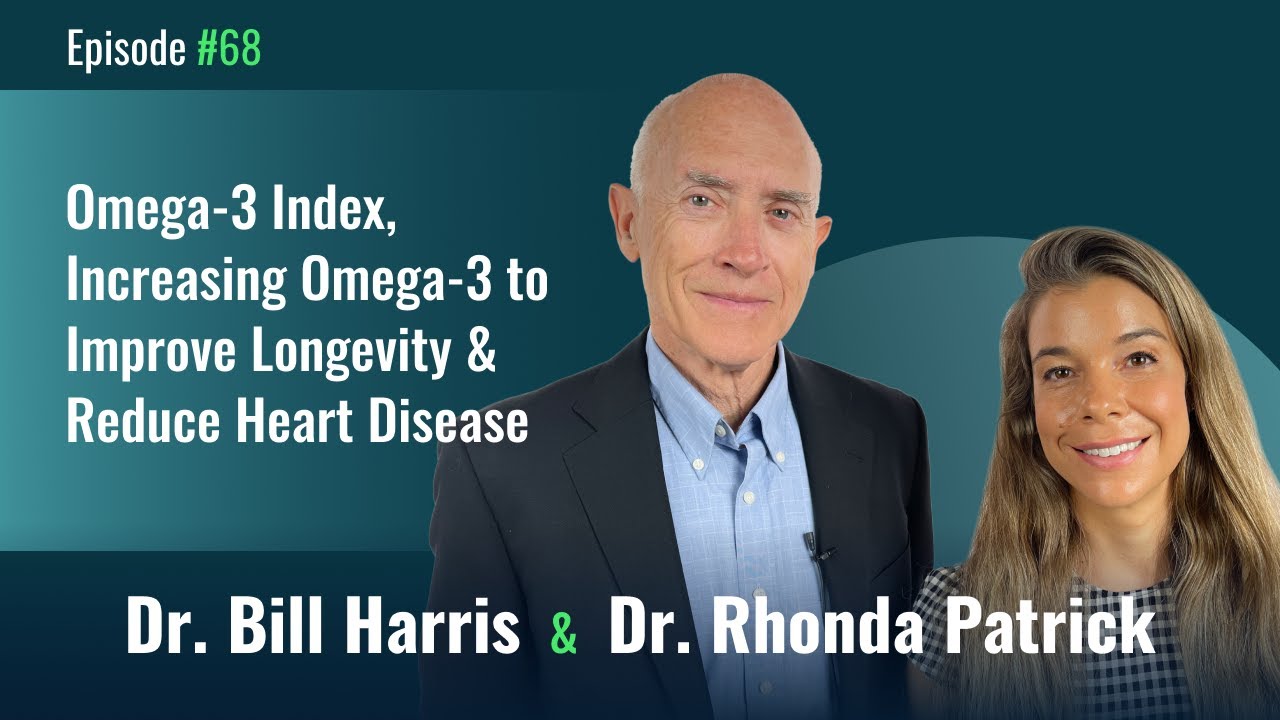
How Omega-3 Status Relates to Longevity
The BDNF Protocol Guide
An essential checklist for cognitive longevity — filled with specific exercise, heat stress, and omega-3 protocols for boosting BDNF. Enter your email, and we'll deliver it straight to your inbox.
You'll also receive updates from Rhonda & FoundMyFitness
In this clip from Dr. Rhonda Patrick's appearance on The Dr. Hyman Show, Dr. Patrick explains the Omega-3 Index as the percentage of EPA and DHA in red-blood-cell membranes. Because red blood cells turn over slowly, the test provides a longer-term view of marine omega-3 status than a recent meal and gives people a measurable way to evaluate diet or supplementation.
In the Framingham Offspring cohort, a higher fatty-acid profile that included the Omega-3 Index was associated with lower all-cause mortality. The modeled difference between low and high profiles translated to roughly five years of life expectancy, and the paper also compared the mortality contribution of omega-3 status with smoking. These are observational associations, but they make omega-3 status a useful risk marker. [1]
Dr. Patrick and Dr. Mark Hyman connect that marker with seafood, triglyceride management, cell membranes, and inflammatory signaling. Salmon, sardines, mackerel, and algae-derived products can provide EPA and DHA while avoiding the highest-mercury fish. When supplements are used, the relevant label value is the combined EPA and DHA dose, not simply the total weight of fish oil.
This clip is excerpted, with permission, from Dr. Rhonda Patrick's appearance on The Dr. Hyman Show. Thank you to Dr. Mark Hyman for allowing us to share it.
- ^ Tintle, Nathan; Harris, William; Vasan, Ramachandran S; Sala-Vila, Aleix; McBurney, M I (2021). Using An Erythrocyte Fatty Acid Fingerprint To Predict Risk Of All-Cause Mortality: The Framingham Offspring Cohort The American Journal Of Clinical Nutrition 114, 4.
Dr. Rhonda Patrick: So, you asked about deficiencies and what are some of the common ones? Well, omega-3. Okay, so about 80% of the world's population and 90% of the US population does not meet the requirements for omega-3 fatty acids.
Dr. Mark Hyman: That's a lot. Which is basically what your body's made of, the cell membranes, your brain, nervous tissue, it runs regulatory inflammation. I mean, it's critical to everything.
Dr. Rhonda Patrick: Exactly, and there's been a lot of work by Dr. Bill Harris. I am an associate professor at the Fatty Acid Research Institute with Bill Harris, and so I'm involved in a lot of research on omega-3, and he's published just an array of studies that are quite convincing.
So, looking at the Omega-3 Index, so this is the omega-3 levels in red blood cells, which is sort of like a long-term marker for omega-3, because they take about, whatever—
Dr. Mark Hyman: What does the index actually measure?
Dr. Rhonda Patrick: It measures the EPA and DHA levels, along with a bunch of other fatty acids, if you're interested in that. But it's really the EPA and DHA level in the red blood cell membrane, which—
Dr. Mark Hyman: Which gives you the index, and you want a certain number.
Dr. Rhonda Patrick: Exactly. So, he's published studies using, like, the Framingham cohort. So, these are large cohort studies with a lot of people, and he's looked at the Omega-3 Index and correlated it with all-cause mortality, so dying from a variety of different causes.
And what he's found is that people that have what is defined as a high Omega-3 Index, so this would be 8% or more, have a five-year difference in life expectancy compared to people that have a 4% Omega-3 Index, which is low. And actually, the average Omega-3 Index of the US population is about 5%, pretty close to that 4%.
Dr. Mark Hyman: Yeah, yeah. Well, that's why we actually measure that in the Function Health Labs. So, it's great to see when we see that.
Dr. Rhonda Patrick: five-year difference in life expectancy. If you think about Japan, Japan, who eat— they eat a lot of seafood in Japan.
Dr. Mark Hyman: Yeah, their Omega-3 Index on average is like 10%, so they're above the high, the 8%.
Dr. Rhonda Patrick: Yeah, yeah,
Dr. Mark Hyman: but their mercury levels are probably also very high.
Dr. Rhonda Patrick: What's funny, it's funny that you say that, Mark.
Um, there's been studies like in pregnant women.
Dr. Mark Hyman: Yeah, you probably remember this,
Dr. Rhonda Patrick: that decades ago women were advised to stop eating fish because of the high mercury, and, um, that actually had a detrimental sort of effect because omega-3 fatty acids, as you mentioned, they're so important for the brain, very important for neurodevelopment. And there have now been a whole host of studies that have come out showing that omega-3 fatty acids actually protect from any potential mercury toxicity in the developing fetus. And in fact, there's been studies looking at children that were born to mothers that had a high level of omega-3 and high mercury, those children scored higher on intelligence tests, so IQ scores, even like, even if so, so high mercury was actually a biomarker of intelligence.
It wasn't actually the mercury, it was high omega-3.
Dr. Mark Hyman: Wow, that's crazy.
Dr. Rhonda Patrick: But yes, you get the point.
Dr. Mark Hyman: Although in Japan, they eat a lot of seaweed, which, and seaweed is a chelator for heavy metals, so.
Dr. Rhonda Patrick: Oh, is it?
Dr. Mark Hyman: So is green tea, by the way.
Dr. Rhonda Patrick: I think garlic.
Dr. Mark Hyman: Yeah, garlic. Garlic, the beta-mercaptans in garlic as well.
Dr. Rhonda Patrick: But back to the omega-3, and this study I was talking about from, Bill Harris is so interesting because he also— this is a huge cohort of people, the Framingham cohort. There are people that have all sorts of lifestyles, including smoking. And so, he did a sub-analysis looking at smokers and nonsmokers and their Omega-3 Index.
And what Bill and his associates and colleagues found was that smokers with a high level of omega-3, so they had a high Omega-3 Index of 8%, they had the same mortality as nonsmokers with a low Omega-3 Index.
Dr. Mark Hyman: Okay, everybody, this does not mean you can smoke and take your own fish oil pills. So don't get any ideas.
Dr. Rhonda Patrick: Or if you're not getting enough omega-3, it's like smoking, right? I mean, if you look—
Dr. Mark Hyman: That's another way to look at it, right?
Dr. Rhonda Patrick: If you look at the graph of this, I mean, it's incredible. The overlay is perfect. Yeah.
Dr. Mark Hyman: Perfect. Fascinating.
Dr. Rhonda Patrick: So having a low Omega-3 Index had the same mortality risk as smoking.
Dr. Mark Hyman: Okay, so we're talking about 90% of the American population is in that category.
Dr. Rhonda Patrick: Yes, yes.
And, you know, there's also been a whole host of randomized controlled trials looking at omega-3s being cardioprotective, right? So they're very important for cardiovascular health, triglycerides.
Dr. Mark Hyman: Yeah, there's actually prescription omega-3s, which you can pay much, much more than you would if you go get a basic omega-3 for lowering triglycerides as a therapy.
Dr. Rhonda Patrick: Right, yeah. And you mentioned inflammation, you know, so this is another thing they do. They play a major role in lowering inflammation. And so, that's a driver of aging in many ways, brain aging, cardiovascular aging. So, omega-3s are, I would say, one of the most profound lifestyle factors that can play a role in negating inflammation aside from exercise.
Attend Monthly Q&As with Rhonda
Support our work

The FoundMyFitness Q&A happens monthly for premium members. Attend live or listen in our exclusive member-only podcast The Aliquot.
Omega-3 News
- Omega-3 fatty acid supplementation benefits people with depression.
- Adding omega-3s to statin therapy significantly reduces the residual risk of major cardiovascular events.
- Omega-3s show promise in easing oral mucositis symptoms during head and neck cancer radiation therapy.
- Omega-3 fatty acids protect the brain from the harms of air pollution.