How Magnesium Supports DNA Repair and Genomic Stability
Get the full length version of this episode as a podcast.
This episode will make a great companion for a long drive.

The BDNF Protocol Guide
An essential checklist for cognitive longevity — filled with specific exercise, heat stress, and omega-3 protocols for boosting BDNF. Enter your email, and we'll deliver it straight to your inbox.
You'll also receive updates from Rhonda & FoundMyFitness
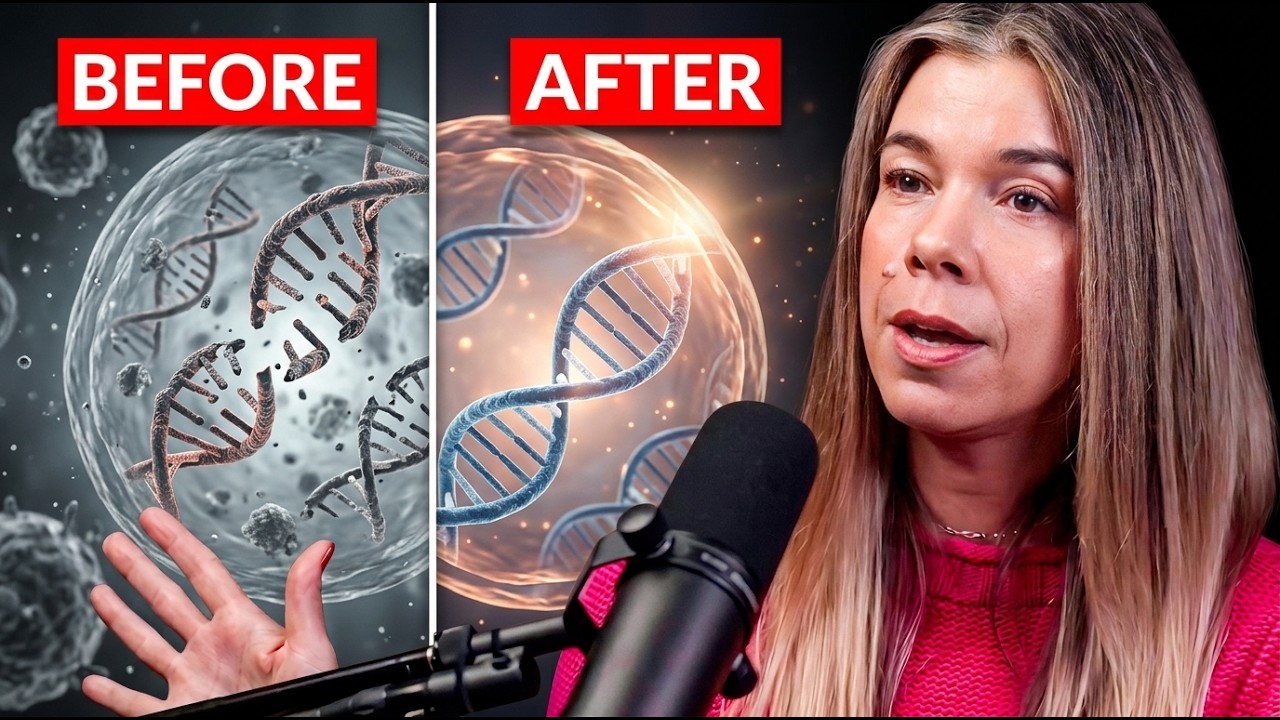
In this FoundMyFitness solo episode excerpt, Dr. Rhonda Patrick uses Dr. Bruce Ames's triage theory to explain why marginal magnesium intake may matter long before a classic deficiency appears. The body can preserve magnesium-dependent processes needed for immediate survival while underfunding long-term maintenance tasks. Magnesium is required by enzymes involved in DNA replication and repair, so chronic inadequacy could allow cellular damage to accumulate over time. [1]
Dr. Patrick also discusses matrix metalloproteinases, or MMPs, which help remodel the extracellular matrix. MMPs are zinc-dependent enzymes that are stabilized by calcium; they are not magnesium-dependent enzymes. Magnesium deficiency may still alter MMP activity, which could affect tissue remodeling and cancer-cell invasion. This mechanism does not show that magnesium supplementation prevents or treats cancer.
The clip closes with human observational evidence. In the prospective VITamins And Lifestyle cohort, intake below the recommended dietary allowance was associated with higher pancreatic cancer incidence, including a 24% increase per 100-milligram daily decrement. The study cannot establish causation, and Dr. Patrick notes that food sources bring other nutrients and dietary patterns that may contribute to the association. [2]
- ^ 11295157
- ^ Dibaba, Daniel; Xun, Pengcheng; He, Ka; Yokota, Kuninobu; White, Emily (2015). Magnesium Intake And Incidence Of Pancreatic Cancer: The VITamins And Lifestyle Study British Journal Of Cancer 113, 11.
Let's move on to aging. Magnesium depletion is a slow process, so marginally low intake would likely take years to manifest, but it would still take a toll. It's likely a factor in aging and the development of chronic disease. So I want to take a moment to discuss a concept that has been a significant focus in the field of nutrition, particularly a theory put forth by my mentor, Dr. Bruce Ames, who has introduced what is known as the triage theory and published several studies on it. It's really a fascinating way to understand how our bodies deal with micronutrient scarcity. Magnesium is one example.
So Dr. Ames has published several papers on this topic highlighting how nature has possibly evolved a mechanism to prioritize certain biological processes over others when micronutrient resources are limited. So magnesium, for example, is a key player in numerous biological functions. Some of these are critical for immediate survival and preventing diseases that could lead to acute life-threatening conditions. However, magnesium is also pivotal for long-term health processes like DNA repair. So deficiencies in DNA repair might not cause immediate harm, but they can lead to a gradual accumulation of DNA damage, mutations that over time can then become oncogenic or cancer-causing.
So the triage theory posits that in the face of limited magnesium, the body will prioritize its use for enzymes involved in essential short-term survival. Examples include enzymes involved in energy production. This means that other processes that are vital for long-term health, like DNA repair, might get less of this magnesium. What's the end result? Well, we might not be getting enough magnesium. We might be getting enough to avoid acute deficiency, even pulling it from our bones to maintain levels in our muscles and other tissues. We could be setting the stage for chronic health issues like osteoporosis down the line. So I think this inadequate intake of magnesium and micronutrients in general can accumulate insidious damage over time.
In the context of magnesium, when DNA repair and replication, both of which require magnesium, are not functioning optimally due to those inadequate levels, the accumulation of this damage can lead to these mutations, cell dysfunction, and potentially cancer development. And it's a clear example of how, you know, subtle long-term effects of micronutrient inadequacy or magnesium inadequacy in this case can contribute to the aging process and the development of chronic disease. So we're talking about cancer. Let's dive in a little bit more into that topic. Magnesium does play a crucial role in DNA repair, and this has implications for cancer prevention.
So every day our DNA is facing damage from both internal sources like metabolism, and external forces, things like UV radiation, pollution, things like that. As we age, our DNA repair mechanisms naturally slow down like everything else. But when we're also low in magnesium, it's kind of like throwing gasoline on a fire. The risk of DNA damage escalates. Magnesium is essential for the proper functioning of DNA repair enzymes. Consider the sheer frequency of cell division in our bodies. Millions of cells divide daily. Some tissues, like our skin and intestinal lining, have exceptionally high turnover rates. So DNA replication, which is necessary to make a new cell, is really vital for that process of making a new cell. And magnesium plays a role in DNA replication as well.
It's essential for the proper functioning of those enzymes, called DNA polymerases. These are essentially the workhorses of cell division. Without adequate magnesium, these processes can be compromised, and this could lead to potential errors and mutations when you are making new DNA. Now let's dive a little bit into the role of magnesium in what's called matrix metalloproteinases, or MMPs. These enzymes act more like agents of extracellular matrix breakdown. They're involved in critical processes like tissue remodeling and wound healing. Magnesium deficiency can upset the delicate balance here with the activity of these MMP enzymes. That also could potentially aid in cancer cell invasion and progression.
So it plays a little downstream role in cancer progression and cell invasion. But again, I think it highlights the broader impact of magnesium on cellular health, cancer prevention, and it's really an important micronutrient that is just— it's fundamentally intertwined with our body's ability to maintain what's called genetic integrity and to prevent the formation of oncogenic cells, which are cancer cells. So let's talk about a study that followed over 66,000 men and women aged 50 to 76 years old. So this was part of the Vitamins and Lifestyle Study, or the VITAL Study. It was from the year 2000 to 2008. Among the 151 participants who ended up developing pancreatic cancer, those with magnesium intake below the RDA had a significantly higher risk of pancreatic cancer.
Specifically, those getting 75 to 99% of the RDA, the risk was increased by 42%. And for those with less than 75% of the RDA, that risk jumped to 76%. But what was even more striking about that study was that for every 100-milligram-per-day decrease in magnesium intake, there was a 24% increase in pancreatic cancer incidence. And so this was in a dose-dependent manner, every 100-milligram decrease was associated with a 24% increase in pancreatic cancer incidence. What's particularly interesting here is also the role of magnesium supplementation. The inverse association between magnesium intake and pancreatic cancer risk seemed to be more pronounced among those who took magnesium supplements, either from a multivitamin or even as an individual supplement.
In other words, what I'm saying is that within that cohort, it wasn't just dietary intake, it was also supplemental intake. And magnesium supplementation was associated with a greater decrease in pancreatic cancer risk. Obviously, it's important to approach findings with a very nuanced understanding, right? This is still observational data, still means correlation, can't really establish causation. There could be a variety of other factors that could influence this as well. So it's always important to keep in mind when we're talking about observational data. There was another study. This was the Paris Prospective Study II, which followed about 4,000 men aged 30 to 60, for over 18 years.
And that study found that the highest magnesium levels were associated with a 40% lower all-cause mortality and a 50% decrease in cancer mortality compared to the lowest magnesium levels. Yet again, all the caveats I just mentioned, this was also an observational study. So, you know, I think the beauty of observational studies honestly is in their ability to reveal these patterns, these associations in large populations over extended periods. So that is really the beauty of observational data. And then, you know, once you get that observational data, you kind of need to approach it with a little bit more of a critical eye and sort of also try to turn to some interventional studies as well.
With respect to cancer incidence, that's going to be very challenging because cancer takes decades to develop. So having a randomized controlled trial with a supplement like magnesium is going to be challenging, if not impossible, to do. So that's also something to keep in mind. But let's dive a little deeper into a meta-analysis that examined both dietary and supplemental magnesium intake and their effects on mortality risks. So dietary magnesium intake was linked to a significantly lower risk of both all-cause mortality and cancer mortality. So specifically, for every additional 100 milligrams per day of dietary magnesium, there was a 6% reduction in all-cause mortality and a 5% reduction in cancer mortality. And again, this was in a dose-dependent manner.
So for each 100-milligram increase per day, that was— you got those reductions. So I do want to point out that this was from dietary sources and not from supplemental sources. So it really could be that there's just a barrage of things going on because you're talking about getting magnesium from, you know, sources of healthy foods. So what I'm trying to say is that foods that are high in magnesium like leafy greens come packed with a plethora of other vital micronutrients and phytonutrients. So these components collectively contribute to overall health. They're also a part of a food matrix that enhances their benefits. The analysis also looked at supplemental magnesium intake, and here's where things get intriguing.
The supplemental magnesium intake showed a non-significant positive association with cancer mortality risk based on 3 studies. It's important to note that non-significant doesn't mean that there was no effect. In fact, the threshold used to determine statistical significance can be somewhat arbitrary, but that's a whole other tangent. But I do think it highlights the complexity of interpreting data. Similarly, there was a total magnesium intake, which looked at both dietary and supplemental sources, and that really didn't show any significant association with cancer mortality or all-cause mortality. But there was a lot of what's called heterogeneity between studies. In other words, some studies did see an effect; other studies saw no effect. And so, again, it comes down to that mixed data.
Really, those sorts of things, those sorts of differences come down to differences in study design, population, other factors that can just add all these layers of complexity to our understanding. I think these findings reinforce the idea that getting magnesium from dietary sources might be the most beneficial approach. They also underscore the nuanced nature of nutritional research, right? The variation in these studies, the arbitrary nature of statistical significance, the heterogeneity between studies, they all really point to this careful interpretation, a deeper understanding of how nutrients like magnesium are impacting our health. And again, this shows how complex nutrition trials are and the need to standardize some of these trials so that we can get better data.
Hear new content from Rhonda on The Aliquot, our member's only podcast

Listen in on our regularly curated interview segments called "Aliquots" released every week on our premium podcast The Aliquot. Aliquots come in two flavors: features and mashups.
- Hours of deep dive on topics like fasting, sauna, child development surfaced from our enormous collection of members-only Q&A episodes.
- Important conversational highlights from our interviews with extra commentary and value. Short but salient.