How to Measure and Estimate VO2 Max
Get the full length version of this episode as a podcast.
This episode will make a great companion for a long drive.
The BDNF Protocol Guide
An essential checklist for cognitive longevity — filled with specific exercise, heat stress, and omega-3 protocols for boosting BDNF. Enter your email, and we'll deliver it straight to your inbox.
You'll also receive updates from Rhonda & FoundMyFitness
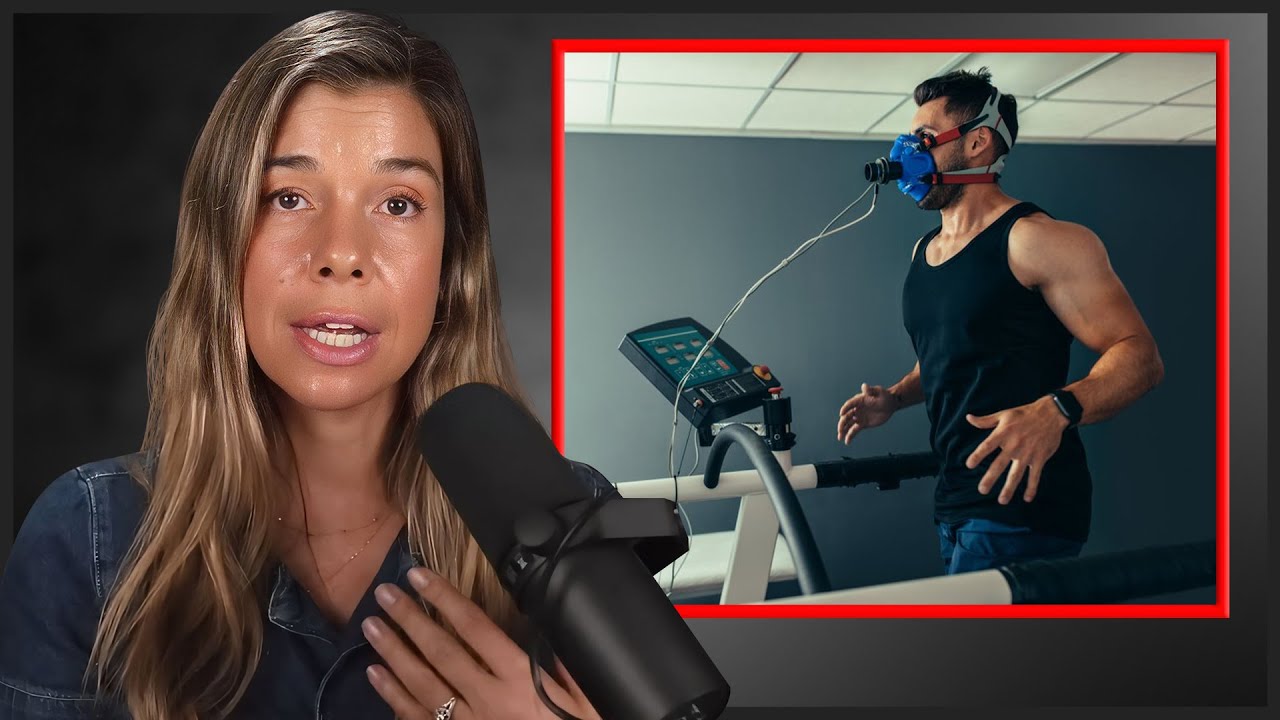
In this FoundMyFitness interview clip, Dr. Rhonda Patrick asks Dr. Martin Gibala how people can assess VO2 max without an exercise laboratory. He gives a measurement hierarchy. Direct graded exercise testing in an accredited lab is the reference method because it measures oxygen uptake and also reports heart rate, power, lactate, and training-zone data.
Dr. Gibala describes submaximal tests as the middle tier. They combine staged work or pace with heart-rate response and extrapolate to an estimated maximal capacity. He names staged exercise tests and shuttle or beep tests. They remain estimates, but they include individual performance data and, in his view, are more informative than a questionnaire alone. The named field protocols have not all received independent validation.
Dr. Gibala describes the World Fitness Calculator as a useful population-derived questionnaire estimate. It uses age, sex, activity, resting heart rate, and body-size measures, but its activity input is subjective and its output does not directly measure oxygen uptake. He recommends repeating the same method under similar conditions to track direction of change even when the absolute value is imprecise. The cited mortality cohort establishes the importance of measured fitness, not the validation of this calculator. [1]
- ^ Mandsager, Kyle; Harb, Serge; Cremer, Paul; Phelan, Dermot; Nissen, Steven E.; Jaber, Wael (2018). Association Of Cardiorespiratory Fitness With Long-term Mortality Among Adults Undergoing Exercise Treadmill Testing JAMA Network Open 1, 6.
Dr. Rhonda Patrick: For the VO2 max, like measuring the maximal amount of oxygen you're taking in during, I guess, maximal exercise, there's— you mentioned to me most people are very interested in that, and they're not going to get that measured directly. They're not going to a lab like yours or to their, you know, physician doing it. But they want to know, should I do it? Or is there an estimator I can do that's good enough? Or how do I decide if I should or shouldn't? Like what—you know, like athletes, probably, maybe they should. But, you know, so this online calculator, the World Fitness Level you mentioned, maybe you could talk just briefly about the science behind that and how people can decide.
Dr. Martin Gibala: Sure.
Dr. Martin Gibala: So, you know, I'm not associated with this at all, but World Fitness Calculator is— it's a valid calculator for estimating VO2 max. And so what I mean by that is it's based largely on a lot of research that's been conducted in Norway, in particular, Norwegian University of Science and Technology, that they've been real pioneers in a lot of interval training research. And so the bottom line is they have a lot of data on measuring things and seeing how they correlate or are related to or can predict VO2 max. And so of all of the calculators that are out there, I think this is the one that people could trust the most in terms of answering a few questions about their age, their sex, their typical activity levels, and it will give them a reasonable estimate of their VO2 max.
Dr. Martin Gibala: But it's still just an estimate because it's saying you're that typical 40-year-old. It's not going to be able to dial in any better individually, but at least it's going to give you a marker in the sand, a reasonable marker. And even if it's not precisely accurate, you can rest assured that it's gonna allow you to track changes over time. So you plug your answers into the online calculator, it spits out a value and says your VO2 max is 38 or 45. And then you engage in some sort of training program for 3 or 6 months, and then you do it again. And if you see a directional change up or down, hopefully up, you can be reasonably confident that, you know, your training program has been effective at increasing your VO2 max, even if the precise number is not 100% accurate.
Dr. Rhonda Patrick: Yeah, that makes sense.
Dr. Rhonda Patrick: You know, there's a few factors in there that were a little more on the personalized level, like your resting heart rate and your max heart rate and BMI and waist-to-hip ratio and— or waist circumference, I think it was. So, you know, there are definitely some features aside from your age and everything like that, but also the estimation of, like, how intense are you going with your exercise, you know, that's— there's a subjective component to it where I was like, oh, I go hard, you know. So, you know, again, it's kind of good to know that you can use that online calculator. People are interested in probably doing that, but for the average person... Do you think measuring it directly is really—
Dr. Martin Gibala: The other way, as an in-between, is a submaximal exercise test.
Dr. Martin Gibala: And there's a number of validated tests that are out there. We could drop those in the show notes, but where you basically are performing a couple of levels of submaximal exercise, measuring your heart rate, and then essentially plugging it into an equation that's going to extrapolate and say, okay, well, if this is your rate of increase in heart rate, once you get up to your maximum, this is what your VO2 max value would be. Or there's, you know, I don't know if you have these here, but the shuttle run test or a beep test, where basically you're running back and forth between a set measured distance. And after a point, you're not able to keep up. But it's called a shuttle run test or a beep test.
Dr. Martin Gibala: And basically, the more power you're able to exert—or the longer you can keep up as you have to run faster and faster between the two markers—the more closely that result correlates with your VO2 max. So, bottom line is all of these are submaximal exercise tests. They're better than just an online questionnaire, even that validated one that I mentioned, because at least it's providing some data about you. You know, so you can't just say, oh, I'm engaging in vigorous activity. It's going to actually measure your heart rate a little bit. So that would sort of be an in-between. But yeah, the gold standard is having a VO2 max done in an accredited laboratory. And that's going to give you your VO2 max value directly, and it's also going to give you a lot of data on your power outputs, your heart rate, even your lactate, in order to try and look at training zones, for example.
Hear new content from Rhonda on The Aliquot, our member's only podcast
Listen in on our regularly curated interview segments called "Aliquots" released every week on our premium podcast The Aliquot. Aliquots come in two flavors: features and mashups.
- Hours of deep dive on topics like fasting, sauna, child development surfaced from our enormous collection of members-only Q&A episodes.
- Important conversational highlights from our interviews with extra commentary and value. Short but salient.
Aerobic News
- Cardiorespiratory fitness may be a far greater predictor of gut microbiota diversity than either body fat percentage or general physical activity
- A combined aerobic-resistance training regimen proves equally effective for cardiovascular health as aerobic alone.
- 30 minutes of moderate-intensity aerobic exercise (64.9% of VO2 max) three times a week stabilized choline concentrations in the brain.