How Diet Soda Can Help Replace Sugary Drinks for Weight Loss
Get the full length version of this episode as a podcast.
This episode will make a great companion for a long drive.
The Omega-3 Supplementation Guide
A blueprint for choosing the right fish oil supplement — filled with specific recommendations, guidelines for interpreting testing data, and dosage protocols.
You'll also receive updates from Rhonda & FoundMyFitness
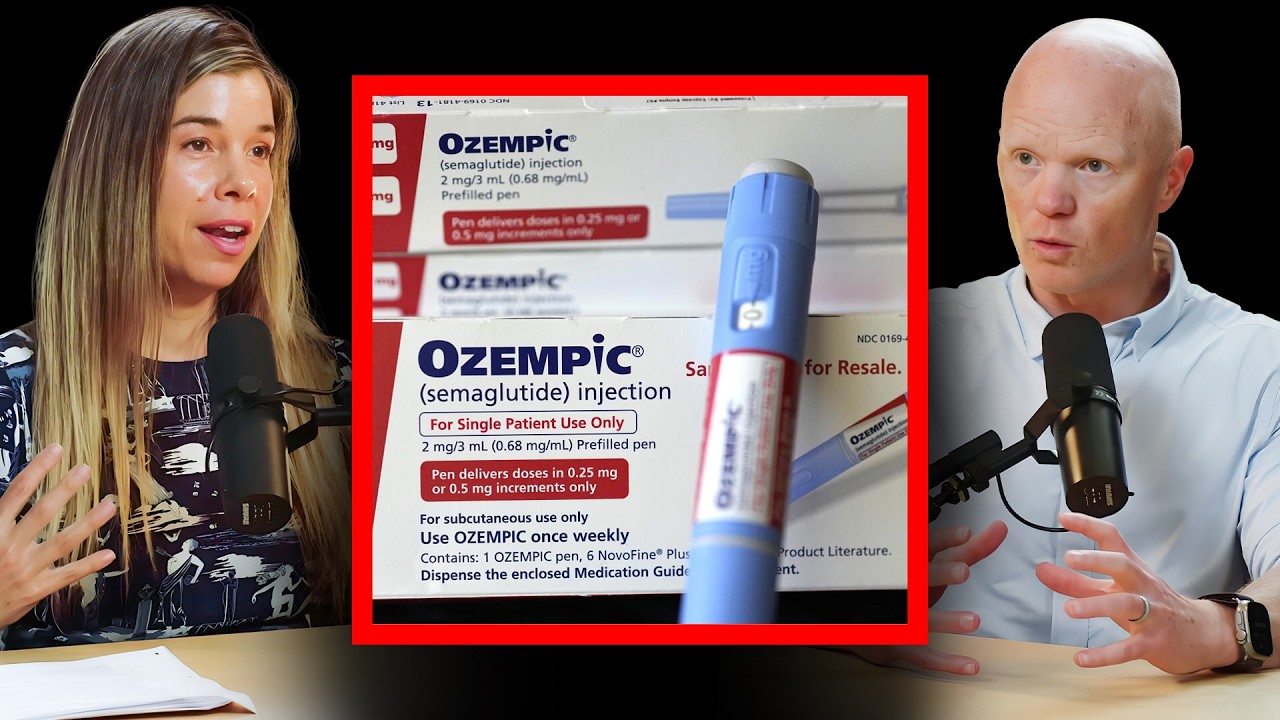
In this clip from his FoundMyFitness interview with Dr. Rhonda Patrick, Dr. Layne Norton explains why replacing sugar-sweetened soda with a non-nutritive sweetened drink can be a useful transition. In randomized weight-management trials, non-nutritive beverages supported at least as much weight loss as water, but both groups received a broader behavioral program. [1] [2] Diet soda is a substitution tool, not a fat burner.
Dr. Patrick asks about insulin and the gut microbiome. Controlled work has found person-specific glycemic responses and microbiome changes during short exposures to some sweeteners. [3] A microbiome change is not automatically harmful, and findings for one sweetener should not be generalized to all non-nutritive sweeteners.
They also discuss aspartame and cancer. A large French cohort associated higher intake of artificial sweeteners, including aspartame, with modestly higher cancer incidence, but an observational association cannot establish causation and dose-response patterns were not uniform. [4] Some positive animal findings used long-term or high-dose exposures that do not map directly to typical human intake. The French cohort reported an association, while a separate systematic review concluded that the available human, animal, and mechanistic evidence did not establish human carcinogenicity. Neither source alone resolves causation. [5] Water remains a good default; diet soda can still reduce sugar and calories for people replacing regular soda.
- ^ Peters JC; Wyatt HR; Foster GD; Pan Z; Wojtanowski AC; Vander Veur SS, et al. (2014). The effects of water and non-nutritive sweetened beverages on weight loss during a 12-week weight loss treatment program. Obesity (Silver Spring) 22, 6.
- ^ Peters, John C.; Beck, Jimikaye; Cardel, Michelle; Wyatt, Holly R.; Foster, Gary D.; Pan, Zhaoxing, et al. (2015). The Effects Of Water And Non-Nutritive Sweetened Beverages On Weight Loss And Weight Maintenance: A Randomized Clinical Trial Psycho-Oncology 24, 2.
- ^ Suez J; Cohen Y; Valdés-Mas R; Mor U; Dori-Bachash M; Federici S, et al. (2022). Personalized microbiome-driven effects of non-nutritive sweeteners on human glucose tolerance. Cell 185, 18.
- ^ Debras C; Chazelas E; Srour B; Druesne-Pecollo N; Esseddik Y; Szabo de Edelenyi F, et al. (2022). Artificial sweeteners and cancer risk: Results from the NutriNet-Santé population-based cohort study. PLoS Med 19, 3.
- ^ Borghoff SJ; Cohen SS; Jiang X; Lea IA; Klaren WD; Chappell GA, et al. (2023). Updated systematic assessment of human, animal and mechanistic evidence demonstrates lack of human carcinogenicity with consumption of aspartame. Food Chem Toxicol 172, .
Dr. Layne Norton: And here's where, again, messaging can have unintended consequences. People say, well, you don't want to have artificial or diet sodas because they're just as bad as regular sodas. And they come up with a bunch of different mechanisms to try to validate that. No, objectively not. Like, in the human randomized controlled trials where they have people say either drink soda or use diet soda, very consistently people lose weight, and like actually a pretty good amount of weight. There was a year-long randomized controlled trial, I think, where people lost like 7.5 kilograms just by substituting diet soda for regular soda.
And I mean, when I do, uh, content on this, I'll get people all the time comment like, all I did was stop drinking regular soda and substitute in diet soda and I lost 50 pounds right now. But usually the next thing that people say is, well, why don't they just drink water? Okay, again, I'm trying to meet people where they're at. Okay, some people have developed a habit, behavior, whatever it is, of drinking a soda. Water's great. If I can get them to drink water, fantastic. But you're gonna have a hard time convincing me they're not better off being 15 pounds, 20 pounds, 50 pounds lighter by using diet soda compared with regular soda. And in several randomized controlled trials and meta-analyses now, where they compare substituting regular soda with either water or diet soda, they actually see diet soda produce more weight loss than water.
Now, it's not because diet soda is a fat burner or anything like that. It's probably because people are seeking out that sweet taste somewhere else when they have water, right? They still lost weight with the water group. And it wasn't a big difference between the water and diet soda group, but you can't really say, like you can make all the arguments you want about brain signaling and whatever, but obviously it doesn't matter enough because these people are losing weight. And the other thing I've heard is, well, it causes an insulin response. Okay, there's several meta-analyses now to show that that doesn't happen with any of the sweeteners that we know of.
There was one study where they gave sucralose alone, sucralose plus carbohydrate, or carbohydrate alone, and saw sucralose plus carbohydrate caused a greater insulin response. But in my opinion, that study was not an appropriate control group because they were matching sweet taste between the sucralose plus carbohydrate group and the carbohydrate group, because I think their primary measure was actually like sweet taste in the brain, looking at that. And then this other stuff was secondary measures. So they did the right thing by trying to match taste or sweetness level.
But the problem is, I believe, I don't think they, I think they used sucrose for the carbohydrate-only group and they used maltodextrin for carbohydrate plus sucralose because maltodextrin is not as sweet as sucrose, but it has a much greater glycemic response than sucrose does. And so I don't think you can really say it's like a— saying it's carbohydrate plus sucralose, no, it's maltodextrin plus sucralose. And so if we look at the meta-analyses, they just don't support like any kind of insulin response. And what I would say is, okay, if you're getting a significant insulin response, why don't we have people just passing out left and right who are having diet sodas from hypoglycemia? Because if you're having increased insulin with no glucose coming in, your blood sugar is going to drop.
Or the other explanation is, well, maybe there— if there is an increase in insulin, there must also be a corresponding increase in glucagon to offset that, which means all that stuff is going to be washed out since those 2 counteract each other. But again, there's no real data suggesting it increases insulin. And then the other thing that gets tossed around is the gut microbiome, which I am interested in. Most of the studies show no effect, but sucralose in particular does appear to have an impact on the gut microbiome. Dr. Suzanne Devkota came out of the same lab that I did my PhD in, and she's a microbiome expert. I've talked to a few other experts and looked at the research data, and my take was pretty similar to their take, which was, hey, we know the gut microbiome changes.
We don't really— we only have a rough idea of what a good, bad, or neutral change is. And like, for example, in one of the studies looking at sucralose, they actually saw an increase in the proportion of a bacteria, and I'll probably butcher the name, um, um, Blautia coccoides, I want to say it is, something like that. You know how these Latin names are. But that species of bacteria is actually associated with better insulin sensitivity, less fat mass, and better overall blood glucose regulation. And so, okay, well, I could kind of make the argument that maybe sucralose has a positive effect on overall health based on that. Now, I don't know, and I'm not ready to say anything like that. My point being is we don't really know.
Now, if you're worried, use something different than sucralose. I know you like stevia. You know, there's, aspartame is actually very safe, and people say, what about cancer? Okay, so here's the thing. Again, negative news selection bias. You are much more likely to hear about a study where something causes cancer than has no effect. How often do you hear a study of like, X showed no effect on cancer? I can't think of like the last time I heard a study get propagated in the news about that. Like the null hypothesis just doesn't pop up that much. So, um, 80% of the studies on aspartame show no effect on cancer. Uh, like, I think something like 11% are like a possibly, and 9% are a yes.
Dr. Rhonda Patrick: You’re talking about animal studies?
Dr. Layne Norton: But the ones in— and it's all the ones that say yes are all the ones in animals at high doses. Or, you know, you have some of these cohort studies where it kind of like pops up here and there. Um, but for me, to feel confident that something— for me to feel confident of something with cohort data, I want to see it like really consistently. Like fiber, very confident that fiber is good for health, cardiovascular disease, cancer mortality, because I am not aware of a single study looking at fiber intake in a cohort that did not show protective effects and in a dose-response manner. So I'm pretty confident in that data. But if you look at like, for example, aspartame in a study of the— you familiar with the NutriNet-Santé cohort?
It's a 100,000-person study out of France from like probably 3, 4, or 5 years ago. And I think it was a— I want to say it was a 20-year cohort. And they— one of the big headlines was aspartame increased the risk of cancer. So I went into the data and looked at it. So what the headline left out was from non-consumers of it to low moderate consumers, it increased cancer by, I think, a relative risk of like 15%, which was significant. And then the high consumers were not significantly increased risk of cancer. The high consumers were like a relative risk increase of like a non-statistical, like 4 or 5%. I'm not aware of anything that's actually carcinogenic that is carcinogenic at a low level and then not at a high level.
Dr. Rhonda Patrick: No, that doesn't make any sense.
Dr. Layne Norton: Right.
And so I think Again, for me to be convinced by some of this stuff, it would need to be— it's just not consistent. And it's coming back to aspartame, diet soda, wrapping this all together. Um, I view diet soda as you have to be careful, like, people demonizing it, because what they think will happen— okay, well, people will just drink water. No, people just keep drinking soda. And so why not give them this tool It appears to really be a pretty big lever for not much cost.
Dr. Rhonda Patrick: What about non-nutritive sweeteners? There's definitely the artificial sweeteners that you're talking about, the sucralose, the aspartame, saccharin, right? And there's the more natural ones, monk fruit, stevia.
What I'm getting from you, and I just want to make sure it's clear, is that people that are consuming these sugar-sweetened beverages, if they substitute them with a diet soda which has aspartame, is that right?
Dr. Layne Norton: Usually aspartame. Some have sucralose.
Dr. Rhonda Patrick: Okay.
Dr. Layne Norton: They have Acesulfame K as well, like that sort of thing.
Dr. Rhonda Patrick: Okay, then it's clearly a benefit. Studies show it, they're losing weight. I mean, you know—
Dr. Layne Norton: Getting more metabolically healthy.
Dr. Rhonda Patrick: More metabolically healthy. Let's talk about someone who doesn't drink sodas that are sugar sweetened and they're lean and they kind of just like— there's some people out there that like Diet Coke a day, like not because they are getting off of their Coke habit, but because they— like Diet Coke for whatever reason.
Maybe it's the caffeine, maybe something about the taste. I don't know what it is, but those people exist.
Dr. Layne Norton: Sure.
Dr. Rhonda Patrick: So Diet Coke a day, you know, what is that? Do you feel confident that— you talked a lot about the aspartame data and it definitely seems a little bit all over the place. Cancer does take, of course, decades to occur and there's cumulative damage and dose may matter, maybe one a day, but like, is there an uncertainty there that you might say, well, maybe we don't really know at the end of the day? Or do you feel like one a day is—
Dr. Layne Norton: Well, now I'm gonna get meta on you and say, I don't believe anything for certain.
Dr. Rhonda Patrick: Okay, all right.
Dr. Layne Norton: But I have data I'd bet my life on, bet my leg on, bet my foot on, bet my toe on.
Dr. Rhonda Patrick: Would you drink a Diet Coke a day?
Dr. Layne Norton: Yeah, I drink Diet Coke.
Dr. Rhonda Patrick: You drink a Diet Coke a day and not feel like you're increasing your mortality or cancer risk?
Dr. Layne Norton: I don't present it to my kids. My kids drink water because that's what they ask for, but I wouldn't feel worried about them having one diet soda a day. I mean, if we look at, you know, take aspartame for example— by the way, I'm sure that comment's gonna get me in trouble. If we take aspartame for—
Dr. Rhonda Patrick: Nothing worse than parent shaming.
Dr. Layne Norton: Uh, we take aspartame for example. I mean, we know what it's metabolized into. It's 2 amino acids, and it gets metabolized into phenylalanine and aspartate. And then, um, methanol, whichever, right?
Well, it's a very, very— like, the amount of diet soda you'd have to drink to get up to a level of methanol that would cause problems is— you would die from electrolyte depletion first, right? From like basically drowning yourself. And people say, what about bioaccumulation? Well, as far as I know, methanol doesn't really do that. There's a way to process it out of your body unless you're consuming so much consistently that your body never starts getting rid of it. You know, just like ethanol, there's a way to process it out of your body unless you're exceeding your body's rate of capacity to eliminate it. So yeah, for small— for like those levels of diet soda, I'm just not worried about it.
Supporting our work
If you enjoy the fruits of
 , you can participate in helping us to keep improving it. Creating a premium subscription does just that! Plus, we throw in occasional member perks and, more importantly, churn out the best possible content without concerning ourselves with the wishes of any dark overlords.
Weight loss News
- Alpha-lipoic acid supplements promote weight loss in obese people who are otherwise healthy.
- Consuming diet drinks along with carbohydrates may have negative effects on the brain and metabolic health.
- Caloric restriction caused epigenetic changes decreasing metastasis in a mouse model of aggressive breast cancer.
- Every 1 percent drop in body weight slows brain aging by nearly nine months, highlighting the substantial, and often overlooked, neuroprotective benef