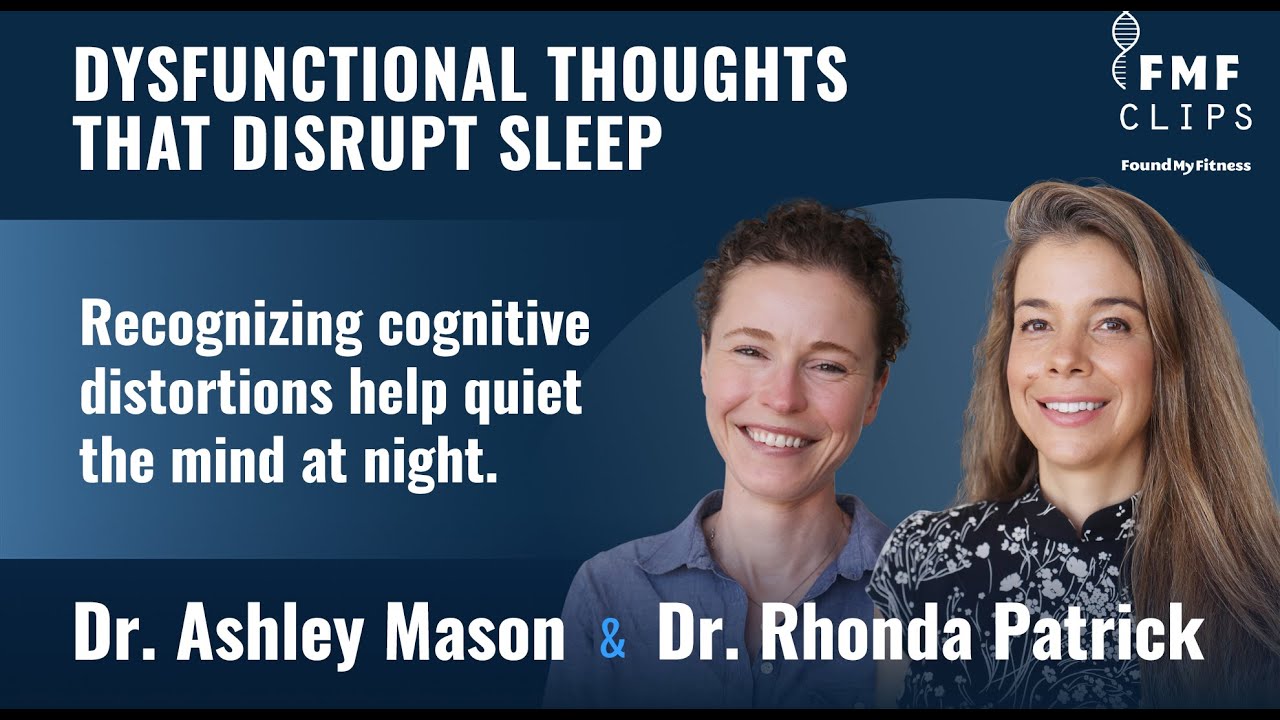
Why THC and Alcohol Are Unreliable Sleep Aids
Get the full length version of this episode as a podcast.
This episode will make a great companion for a long drive.
The BDNF Protocol Guide
An essential checklist for cognitive longevity — filled with specific exercise, heat stress, and omega-3 protocols for boosting BDNF. Enter your email, and we'll deliver it straight to your inbox.
You'll also receive updates from Rhonda & FoundMyFitness
Cannabinoids can make sleep feel easier in the short term, but the result depends on the formulation and measure. In a 29-person randomized crossover trial, two weeks of an oil containing both THC and CBD improved self-reported insomnia measures and some wearable-derived sleep outcomes compared with placebo. Because the product combined both cannabinoids and the trial was small, it does not isolate THC's effects or establish durable benefit. [1]
Objective sleep architecture can tell a different story. In a pilot randomized trial of 20 adults with insomnia, a single THC-CBD dose reduced REM sleep by 33.9 minutes, delayed REM onset, and reduced total sleep time by 24.5 minutes compared with placebo. A separate study of 17 recently abstinent heavy cannabis users found poorer sleep efficiency, longer sleep onset, and less slow-wave sleep than in 14 drug-free controls, consistent with withdrawal-related sleep disruption. [2] [3]
Alcohol can shorten sleep onset while degrading later sleep. In a placebo-controlled study of 93 healthy young adults, alcohol reduced REM sleep and sleep efficiency, consolidated sleep early in the night, and disrupted it in the second half. Real-world recordings from 4,098 adults also linked alcohol intake with dose-dependent reductions in heart-rate-variability-derived recovery during the first three hours of sleep. [4] [5]
- ^ Ried K; Tamanna T; Matthews S; Sali A (2023). Medicinal cannabis improves sleep in adults with insomnia: a randomised double-blind placebo-controlled crossover study. J Sleep Res 32, 3.
- ^ Suraev A; McGregor IS; McCartney D; Marshall NS; Kao CH; Wassing R, et al. (2026). Acute Effects of Oral Cannabinoids on Sleep and High-Density EEG in Insomnia: A Pilot Randomised Controlled Trial. J Sleep Res 35, 1.
- ^ Bolla KI; Lesage SR; Gamaldo CE; Neubauer DN; Funderburk FR; Cadet JL, et al. (2008). Sleep disturbance in heavy marijuana users. Sleep 31, 6.
- ^ Arnedt JT; Rohsenow DJ; Almeida AB; Hunt SK; Gokhale M; Gottlieb DJ, et al. (2011). Sleep following alcohol intoxication in healthy, young adults: effects of sex and family history of alcoholism. Alcohol Clin Exp Res 35, 5.
- ^ Pietilä J; Helander E; Korhonen I; Myllymäki T; Kujala UM; Lindholm H (2018). Acute Effect of Alcohol Intake on Cardiovascular Autonomic Regulation During the First Hours of Sleep in a Large Real-World Sample of Finnish Employees: Observational Study. JMIR Ment Health 5, 1.
Dr. Rhonda Patrick: Okay, let's talk about substances that affect sleep. We will get into CBD because that is the biggest thing now. I hear about it in peer groups, on the internet, and everywhere in the audience. A step ahead of that was marijuana, which has CBD and THC. They are two separate compounds. I want to start with THC.
Dr. Michael Grandner: THC is a good place to start because it seems to have fairly reliable effects on sleep. That surprises nobody who has used it. It can help you fall asleep, stay asleep, and feel more refreshed.
However, there are three downsides of THC, or four if you are an athlete. The first is that the sleep-promoting effects fade over time. It often works well for a few weeks, but then people notice that it stops working in the same way, so they start escalating doses. Its short-term and long-term benefits may differ.
Second, THC can be a potent REM-sleep suppressor in many people, although that does not seem to happen to everybody. Many people do not realize that most antidepressants are also potent REM suppressors. A person can eliminate 50 to 75 percent of their REM sleep by taking an SSRI such as Lexapro, or by taking THC.
Dr. Rhonda Patrick: Does that affect memory? Isn't REM important for incorporating memories?
Dr. Michael Grandner: It is weird. If REM sleep is so critically important for what it seems to do, why are all the people taking antidepressants not falling down and unable to remember things? We do not know. My hypothesis is that these processes are much more complicated than we realize.
When we see a decrease in REM sleep, perhaps we are not seeing a decrease in the process itself. We may be seeing a decrease in an effect of the process. What we call REM sleep consists of physiologic signals and brain-wave patterns, and those may be downstream of what is happening under the hood. Not hearing the downstream signal anymore does not mean the process was not still happening to some degree.
In people with depression, their ability to process information may be fundamentally altered. A neutral stimulus can feel negative and make life more miserable. Coming to neutral and blunting emotional processing could be better. Who knows? Is that a benefit? Is it affecting memory? Could it be part of THC's effects on brain neurochemistry and some of its negative effects? Maybe. I do not think anyone has studied that pathway closely.
The third downside is that when you stop using THC, you can get an insomnia rebound, just as with other sedating medications. Because it suppressed REM sleep, you can also get REM rebound. That can include vivid nightmares, unpleasant dreams, and severe insomnia. A person may think, “I need to take this or my insomnia comes back,” when the insomnia is a withdrawal symptom.
Dr. Rhonda Patrick: So you could become dependent on it?
Dr. Michael Grandner: Psychologically, yes. You develop tolerance. You take it and sleep more or less normally. When you take it away, your insomnia ramps up, but it will usually fade back to baseline. It was a reaction, but you do not know that. You think you are using THC to keep bad insomnia away, when really pulling that Band-Aid off will hurt for a little while and then be fine.
The other issue for athletes is increased injury risk associated with THC because of reduced motivation and impaired coordination. Whatever your sleep problem is, if you are thinking of using THC for it, there is probably a less harmful option.
Dr. Rhonda Patrick: If they use THC at night, is it directly affecting coordination, or is that an indirect effect of REM sleep?
Dr. Michael Grandner: All I know is that people who use it more seem to have more injuries. We do not have great data on the timing of use. That would be a good study. There can be daytime amotivation. I do not mean only the stereotype of someone sitting around and not wanting to do anything. An athlete on the field needs every split second to make choices, pay attention, and think ahead. If there is even a fraction of a cloud there, it gets in the way. One wrong step could twist something. There is probably a better option.
THC does affect sleep. The effects could be relatively short term. It could produce a rebound when you stop, and it could affect REM sleep.
Dr. Rhonda Patrick: Having effects on REM does not sound like a good thing.
Dr. Michael Grandner: Maybe not. Is it the same REM effect that occurs with antidepressants? That is not clear. The literature is murky. Until recently, researchers were almost not allowed to study THC because it was a scheduled substance and federally illegal. Anyone taking federal research money was essentially forbidden from studying it. Now that work can start. Canada began earlier because it legalized cannabis first, so researchers there are doing good THC research. Watch this space over the next 10 years. I think more will come out.
Dr. Rhonda Patrick: Another substance people use to help themselves fall asleep is alcohol.
Dr. Michael Grandner: Alcohol is probably the most used sleep drug in the world.
Dr. Rhonda Patrick: Right.
Dr. Michael Grandner: It surprises nobody that alcohol can make you fall asleep faster and sleep a little deeper at the very beginning of the night. Apart from not being good for you for many reasons, alcohol leaves your system relatively quickly. When it leaves your system, it often creates activation and a rebound. People drinking to fall asleep can fall asleep fast, then wake in the middle of the night and be unable to get back to sleep.
Anyone who has had too much to drink and fallen asleep may have experienced waking up and not wanting to be awake but being unable to fall back asleep. Alcohol creates that reaction. One reason is that, as alcohol is metabolized into acetaldehyde and then acetate, those metabolites can be neurally stimulating. As the liver processes alcohol, it can also create a glutamine rebound that can be activating. Several things can become activating a few hours after drinking.
That is why alcohol is not a good sleep aid. For almost everybody, a glass of wine after dinner is not going to be a large issue. But if you drink enough to make yourself sleepy, that amount will probably wake you up later.
Dr. Rhonda Patrick: Do you think having it earlier helps?
Dr. Michael Grandner: If you have wine at dinner and still have a few hours before bed, the alcohol is probably out of your system by bedtime. You do not want the activating phase, when alcohol is leaving your system, to coincide with bedtime.
That is tricky, too. For the amount most people drink, that is not usually the main issue. What is useful is that newer wearables can pick up the effect when you drink before bed. You can see it in heart-rate data and the lack of recovery. Your body is still processing a toxin.
Several patients have told me they used to drink wine before bed because they thought it mellowed them out. Then they looked at their wearable data and realized it made their sleep terrible, so they stopped.
Hear new content from Rhonda on The Aliquot, our member's only podcast

Listen in on our regularly curated interview segments called "Aliquots" released every week on our premium podcast The Aliquot. Aliquots come in two flavors: features and mashups.
- Hours of deep dive on topics like fasting, sauna, child development surfaced from our enormous collection of members-only Q&A episodes.
- Important conversational highlights from our interviews with extra commentary and value. Short but salient.
Sleep News
- A week of urolithin A injections improved memory and reduced brain inflammation after sleep loss in mice.
- Keeping everyday activities on a regular schedule was linked to less pain and fewer depressive symptoms in older adults.
- Cutting sleep by 80 minutes per night increased body weight and waist circumference in adults with cardiometabolic risk factors.
- Regular sleep timing may be just as important as sleep duration for long-term health.
- A single 14-gram dose of creatine helped preserve cognitive performance after a sleepless night.