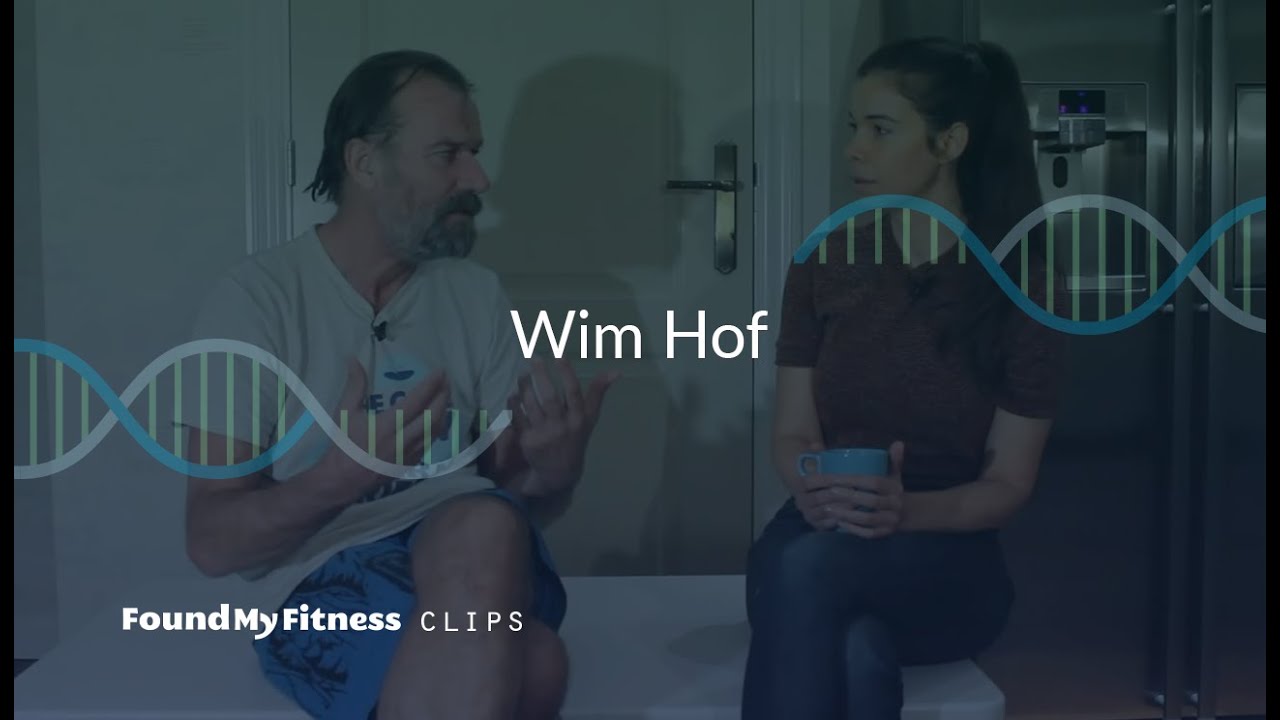
How Cold Exposure Activates Dopamine and Alertness
Get the full length version of this episode as a podcast.
This episode will make a great companion for a long drive.
The BDNF Protocol Guide
An essential checklist for cognitive longevity — filled with specific exercise, heat stress, and omega-3 protocols for boosting BDNF. Enter your email, and we'll deliver it straight to your inbox.
You'll also receive updates from Rhonda & FoundMyFitness
In this FoundMyFitness interview clip, Dr. Andrew Huberman describes deliberate cold as a rapid state-change tool that engages dopamine, norepinephrine, and epinephrine. Dr. Rhonda Patrick asks how temperature and duration affect the response. Dr. Huberman explains that the ideal dose is individual: the water must feel uncomfortably cold while remaining safe, and the relevant challenge changes with stress, fatigue, time of day, and acclimation.
The human study behind the discussion used much longer exposures than a one-minute plunge. In healthy young men, immersion in 14°C water for one hour increased plasma norepinephrine by about fivefold and dopamine by about 250 percent, while warmer immersion produced a smaller response. That experiment supports a catecholamine effect but does not define the minimum effective temperature or duration for a brief home protocol. [1]
Dr. Huberman therefore uses a subjective ‘wall’ model rather than a rigid prescription: enter safely, notice the first strong urge to leave, and practice staying calm long enough to complete the planned exposure. For people without a plunge, he discusses a cold shower or brief high-intensity intervals as other ways to create alertness. The goal is a measured state shift, not maximal cold or prolonged distress.
Dr. Andrew Huberman: I'm just fascinated by this. I've never seen anything else, no drug, prescription or otherwise, no supplement, no workout that I'm aware of, but I haven't explored every single one, that creates that long arc of dopamine, epinephrine and norepinephrine release that one minute, one minute of being uncomfortably cold can create. Now, in that study, it was a longer exposure. They used warmer temperatures and it was much longer. But I think based on my understanding of things you presented, and as I understand it, shorter, colder exposure no doubt creates similar subjective experience.
Dr. Rhonda Patrick: Yeah, well, I was going to ask you about that because there's a lot more papers looking at norepinephrine release with respect to cold exposure. And that can be even 20 seconds, like 39 degrees or whatever Fahrenheit.
Dr. Andrew Huberman: Quickening of the breath. Adrenaline is an incredible molecule.
Dr. Rhonda Patrick: But I'm wondering with the dopamine, what you think, and this can be, some of your opinion, is the minimum duration and what the temperature should be to get an increase in the dopamine peak above what you're at, like you're talking about.
Dr. Andrew Huberman: Yeah. So unfortunately, there hasn't been a lot of exploration of this, and there needs to be. And at one point, my colleague at Stanford, Craig Heller – who's done a lot on cold exposure and in particular palmar cooling for lowering core body temperature before exercise as a way to increase and prolong effort, a lot of Stanford athletes do this, other athletes, pro athletes do this as well, interesting topic – and I were considering doing some work on this, but we haven't gotten around to it. I guess we've both been busy with other things, but here's how I approach deliberate cold exposure. And people might scoff and say, well, that's completely subjective, but what I like about it, or what I'm about to say is that it's highly individual.
It doesn't say 40 degrees for three minutes because 40 degrees for three minutes at 8:00 a.m. is going to feel very different than 40 degrees for three minutes at 3:00 a.m. No one's doing cold plunge at 3:00 a.m. unless they're in SEAL Team training or something. But if you're tired, you're stressed. People have different levels of excitement about the cold or fear of the cold and so on. Here's how I approach it. I think of everything in life as it relates to the stress system as coming at you as like a wall, an event, right? You're not thinking temperature and duration. You're not thinking, oh, how intense is this difficult conversation on a scale of one to 10 and how long is it lasting? That's not how the stress system works.
We tend to be confronted with stressors that we either know are coming or are not coming. So the way I approach cold is I look at the cold plunge and I think, how resistant am I psychologically to getting in it? And usually it's very. I'm not excited to get in. I'm excited about the feeling I know will exist when I get out. So I think of getting in as the first wall. It's like climbing over a wall. Okay, this is the first wall. I get over that first wall, and then I get in. I like to lower myself to my neck. I like to put my hands in. I try and move my arms away from my body because I notice when the cold water gets to my armpits, that's when it really starts to be uncomfortable. And I pay attention to my breathing a bit or maybe I'll distract myself. I find it doesn't really matter.
And what I'm waiting for is the first impulse to get out. So that's the second wall. And then I force myself to get over that second wall again. This is assuming that the water isn't so cold that it's going to be damaging. And then what I start doing is I start counting walls. And most importantly, I start paying attention to how far apart in time those walls are. Now, eventually you just go numb and you're not going to feel any wall. You'll go hypothermic, so you don't want to do that. But what I generally try and do is five to 10 walls. And it's very interesting to notice how the waves of desire these… what I'm calling walls to… I want to get out now. Now I'm going to just go over this next wall and this next one, what that seems to do.
And I realize I'm not answering your question directly, but the reason I'm describing this is that so much has been put to the time and the temperature, but ultimately we are all highly individual in terms of how we react to stressors in a given moment. And what I find is that there's tremendous learning in noticing stress coming toward us, us confronting that stress, getting past that stress and then moving through it. And then when I get out, I always feel much better. It's like, okay, there's a relief there. You get that arc of dopamine release that's quite long lasting. There's no question. I mean, you can feel it in your body. Not trying to be too anecdotal about this, but everyone feels different after cold.
Maybe you're just relieved you got out and that's it, but you feel different. And then what I'm trying to do is attach the fact that there was a feeling of accomplishment in having gone over a certain number of walls and paying attention. So again, this is not answering your question. I acknowledge that, but the ability to notice how stress hits you and how you move through stress, and then how your adrenaline system is like it's trying to create agitation. So you get the hell out of the stressor, that's what it's doing. And your ability to stay calm and to ride through that in a safe way, that is a skill that I think is invaluable. Far more than sitting there and just watching the clock tick down, getting out, and then enjoying the feeling of being out.
Now, to directly answer your question, what are the different parameters that lead to different patterns of dopamine release? We don't know. Would 30 seconds at a very, very cold, but still safe temperature do it? My guess is it would.
My guess is that the catecholamines are released in a bolus in parallel from the locus coeruleus, norepinephrine from the adrenals, adrenaline from the various sources in the brain that can release dopamine, that they are just released in parallel and we know they have different time courses. Well that's even seen in that European Journal of Physiology paper. You see, they have different time courses, different amplitudes, they're not released as a little kit of Blue Angel planes flying right next to one another on those graphs. They have very different dynamics over time, but they are released in parallel. Would it be that five minutes at a 50 percent colder temperature would release X more dopamine? Very likely.
The problem is right now in 2024, we don't have great ways of measuring these things in real time. We just don't. We're just now getting to the point where you can measure things like insulin and blood glucose in real time, in really careful ways while people are moving about. So the short answer is we don't know. But I do think that there's great value in paying attention to how one encounters stress, moves through stress, and then when you get out of the cold plunge, I don't tend to spend too much effort thinking about how I feel in that time. I just know that it's a complete state shift. I also know, based on my reading of my sleep on my Eight Sleep and Whoop, that doing cold plunge in the morning dramatically increases the amount of rapid eye movement sleep I get at night.
And I don't know the exact reason for that. Not incidentally, certain forms of pharmacology, not drugs of abuse, but that I don't use regularly, but that I've used in the past, that increased dopamine and norepinephrine, like bupropion, will increase my rapid eye movement sleep dramatically. I currently don't take it. I took it years ago for a short bout of depression. I don't take it any longer, but I decided to take 50 milligrams of bupropion as a focus aid at one point doing an experiment there, it didn't work well for me, but I noticed that my rapid eye movement sleep that night just spiked like crazy. The duration increased by, I think it was about 15 percent. Then I stopped taking it and it went back to its previous value. So there's something about adrenaline release, perhaps even just early in the day, that seems to impact sleep at night.
Dr. Rhonda Patrick: For people that don't have a cold plunge and that are experiencing maybe a perhaps drop in their baseline dopamine, what are some other behaviors that can help to replenish the dopamine pool? We're talking about sleep. That would be one. And also, you were talking about just waiting too. How long do you have to wait to experience that?
Dr. Andrew Huberman: Yeah, well, cold shower is always great and it's not just zero cost, it'll save you on your heating bill. Cold shower sucks because it's almost like the fact that part of you can be out of the cold makes it worse. Like part of you can be slightly warmer, whereas with the cold plunge, you're all in up to the neck, hopefully. Sometimes people get their hands out and I don't judge. I think that's fine. People have different levels of vasoconstriction and pain from the cold. So you want to be fair. It is not a problem to keep your hands out. As I understand it, cold shower is great. I think the high-intensity interval training that I know you're a big fan of, that's a remarkable tool.
Not only is it brief, but it deploys all these systems, these neurochemical systems that create alertness. Also, because it's brief, and it does that, you're unlikely to fatigue yourself to the point where cognitive work is harder.
Attend Monthly Q&As with Rhonda
Support our work
The FoundMyFitness Q&A happens monthly for premium members. Attend live or listen in our exclusive member-only podcast The Aliquot.
Cold stress News
- Cold-water immersion reduces muscle protein synthesis by 30% post-exercise, potentially inhibiting the uptake of essential nutrients for muscle repair and growth.
- Hot or cold water immersion after intense exercise does not speed recovery in women, despite immediate physiological effects.
- Cold-water immersion may offer stress relief and immune benefits, but its effects are highly time dependent.
- Regular cold showers boost immune responses, increasing levels of immunoglobulins and cytokines critical in protecting against infections.
- Whole-body cryotherapy improves mood, reduces anxiety, and enhances sleep quality, with specific enhancement in slow-wave, restorative sleep seen in a recent study.