How Stimulus Control Retrains the Brain for Sleep
Get the full length version of this episode as a podcast.
This episode will make a great companion for a long drive.

The BDNF Protocol Guide
An essential checklist for cognitive longevity — filled with specific exercise, heat stress, and omega-3 protocols for boosting BDNF. Enter your email, and we'll deliver it straight to your inbox.
You'll also receive updates from Rhonda & FoundMyFitness
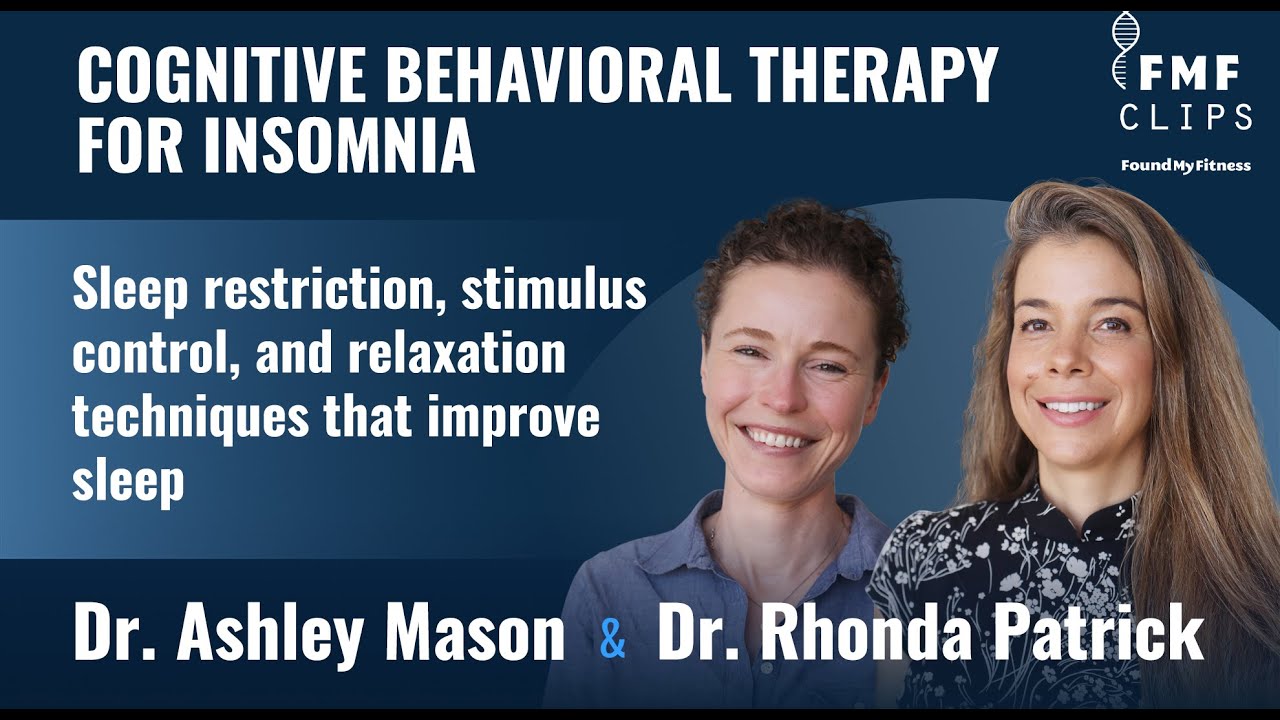
In this FoundMyFitness conversation, Dr. Michael Grandner explains stimulus control, a core component of cognitive behavioral therapy for insomnia, or CBT-I. The method strengthens the connection between bed and sleep by reserving the bed for sleep, going to bed when sleepy, and leaving the bed when wakefulness persists. The American Academy of Sleep Medicine strongly recommends multicomponent CBT-I for chronic insomnia and conditionally recommends stimulus control as a stand-alone therapy. [1]
Clinical trials support the technique's effects on sleep. A systematic review of 11 randomized and experimental studies found that stimulus control produced small to large improvements in sleep-onset latency and total sleep time compared with passive controls. Its effects were similar to those of active comparison treatments, although the authors noted methodological uncertainty and the need for stronger trials. [2]
A component network meta-analysis of 241 trials involving 31,452 adults also identified stimulus control as one of the beneficial components of CBT-I. It was associated with improved subjective sleep quality, sleep efficiency, and sleep latency. In practice, separating scrolling, worrying, and other wakeful activities from the bed reduces opportunities to rehearse wakefulness there, while getting up briefly removes the effort to force sleep. [3]
- ^ Edinger JD; Arnedt JT; Bertisch SM; Carney CE; Harrington JJ; Lichstein KL, et al. (2021). Behavioral and psychological treatments for chronic insomnia disorder in adults: an American Academy of Sleep Medicine clinical practice guideline. J Clin Sleep Med 17, 2.
- ^ Jansson-Fröjmark M; Nordenstam L; Alfonsson S; Bohman B; Rozental A; Norell-Clarke A (2024). Stimulus control for insomnia: A systematic review and meta-analysis. J Sleep Res 33, 1.
- ^ Furukawa Y; Sakata M; Yamamoto R; Nakajima S; Kikuchi S; Inoue M, et al. (2024). Components and Delivery Formats of Cognitive Behavioral Therapy for Chronic Insomnia in Adults: A Systematic Review and Component Network Meta-Analysis. JAMA Psychiatry 81, 4.
Dr. Michael Grandner: If being in bed is predictably tied to sleep, you can program that association. If being in bed is not predictably tied to sleep, you do not know what to predict. Here is an example. If I say, "Bed, sleep. Bed, sleep. Bed, sleep. Bed, sleep," what do you say when I say bed?
Dr. Rhonda Patrick: Sleep.
Dr. Michael Grandner: Correct. Now consider this sequence: "Bed, sleep. Bed, wake. Bed, think. Bed, wake. Bed, sleep. Bed, wake. Bed, sleep. Bed, think. Bed."
Dr. Rhonda Patrick: Surf, maybe scroll.
Dr. Michael Grandner: You have no idea what is coming next. You cannot predict the pattern. Human brains love patterns. If you cannot control the sleep side of the equation yet, at least you can control the bed side.
Stimulus control therapy, one of the core components of cognitive behavioral therapy for insomnia, or CBT-I, was built around that. CBT-I has emerged as a multicomponent toolbox. Stimulus control is one of its core components, but it also has other tools.
The word "therapy" makes it sound like psychotherapy, but it is more like physical therapy. We are teaching your body to do something it physically can do but does not know how to do anymore, forgot how to do, or needs to build back up. Everything is there inside you. When a patient says, "I am having trouble sleeping," it is like saying, "I am having trouble breathing." Someone who has trouble breathing does not simply lack a skill they never mastered. You were breathing when you were born. No one had to teach you. It is part of how your body works.
The question is why you cannot do something you were built to do. What is in the way? What prevents your body from working as it is supposed to? Insomnia treatment is often like that. You can probably sleep just fine. You were built with this ability. There may be something else going on, but most of the time, you have everything you need to sleep. Something is in the way. We have to remove it and clear the path.
Dr. Rhonda Patrick: Suppose someone has to work on stimulus control.
Dr. Michael Grandner: Yeah.
Dr. Rhonda Patrick: They like to get into bed, have trouble falling asleep, and pull out their phone. They scroll or look at social media.
Dr. Michael Grandner: And maybe they are ruminating.
Dr. Rhonda Patrick: Yeah. How would you approach that? What would be your two-week fix?
Dr. Michael Grandner: In addition to stimulus control, other tools within CBT-I focus on driving your natural sleep drive and putting that sleep drive in bed. When the bed is not going to be used for sleep, you get up.
If you are going to use your phone, first try to separate the phone from the bed. Make the bed the place where sleep occurs, not where sleep is predictably absent because you are using your phone. If you have to be in the bedroom while using your phone, you still want to create separation.
The best way to do that may be to stand next to the bed. It sounds silly, and very few people do it, but some do. If proximity to the bed is important for winding down, standing keeps you out of the bed and does something important. People in athletics know not to lose touch with the body's communication. When you stand, there will eventually come a point when you think, "I really want to sit down now." That is your body telling you that you are ready. You may instead stand there thinking, "Why am I standing here? I have been here for half an hour." That is your signal that you are not ready.
Sleep is not something you do. Sleep is something that happens to you when the situation allows it. I borrow that concept from my colleague Lindsay Shaw, a fantastic sleep specialist and sports psychophysiologist. It captures this well.
Sometimes your ability to sleep is not under your control. You are awake and need to wind down. Maybe you are just not ready. If you are not ready, lying in bed and scrolling will not help. Do it somewhere else. If you are getting ready, respond to your body's signals.
If standing next to the bed feels too silly, sit upright on the bed. Do not prop yourself up a little. Keep your head off the pillow and stay out from under the blanket. Sit up. You will stay in touch with your body's signals. In the worst case, you will get the head bob. The head bob is your friend. It is your body telling you that you are ready.
If you are watching television, sitting on the couch, or scrolling near bedtime, lean forward. You will get the head bob when leaning forward, but not when leaning back. That is your signal that you are ready.
Dr. Rhonda Patrick: What happens if someone wakes in the middle of the night and starts ruminating?
Dr. Michael Grandner: Yeah.
Dr. Rhonda Patrick: They cannot fall asleep.
Dr. Michael Grandner: Again, sleep is not something you do. It happens when the situation allows it. If the situation is not allowing sleep at that moment, get up. If you are sitting at a table with no appetite, you do not stare at your food until you become hungry and the food becomes more appetizing. That approach backfires.
When people wake in the middle of the night, something often caused the awakening. The most common reason is probably physical discomfort, such as pain, or sinking into the mattress and needing to wake up and move. Sometimes it is untreated sleep apnea, which is very common. You can have a respiratory event without knowing it. If you wake suddenly for no apparent reason and cannot get back to sleep, sleep apnea can cause that awakening.
When something inside you causes an awakening, it is not under your control. The physical activation escalates. It is like shaking a snow globe. It takes time for everything to settle. If your snow globe was shaken while you slept and you wake up, you cannot make it settle faster. You can poke at it and make it settle more slowly, but you cannot make it go faster. You have to wait.
It often does not take as long as people think. But while the snow globe settles, stress can rise. You think, "Why can I not sleep? What if I cannot fall asleep? What if I am awake for the rest of the night?" You start stressing about it. Now your body is ready, but your mind is not, and you have to wait for that to settle. You prolonged the awakening.
You do not have control over this part, so surrender that control. Recognize that you can get up, take a break, wait until you are ready, and try again. Do not prolong it more than necessary. Surrendering control sometimes shortens awakenings. Sometimes it does not.
People often fear being awake for the rest of the night. That is unlikely. Even if it happens, you will be fine the next day. If you lose your appetite halfway through dinner and stop eating, you do not die. You are a little hungrier the next day, you eat more, and the system corrects itself. Overcorrecting is the problem.
Dr. Rhonda Patrick: To make sure I understand stimulus control, for people who fear not sleeping and immediately feel anxiety, is surrendering the most important part? Is that the strongest part of stimulus control?
Dr. Michael Grandner: It addresses performance anxiety. Fear creates the activation that gets in your way. Recognize that sleep is not under your control. Trying to control it will not help. Nobody has fallen asleep faster by trying harder. The enemy of sleep is effort. Effort adds energy to the system.
Athletes are especially vulnerable because they are used to gaining control over their bodies and learning to control them in ways that most people have not trained to do. They expect a solvable problem. Sometimes this is like injury recovery. You cannot make it go faster. If you are injured, you have to do what is necessary and give recovery the time it needs. There is no dance you can do or book you can read that will accelerate it. Sleep is similarly a process outside your control. Trying to control it can make it slower.
Hear new content from Rhonda on The Aliquot, our member's only podcast

Listen in on our regularly curated interview segments called "Aliquots" released every week on our premium podcast The Aliquot. Aliquots come in two flavors: features and mashups.
- Hours of deep dive on topics like fasting, sauna, child development surfaced from our enormous collection of members-only Q&A episodes.
- Important conversational highlights from our interviews with extra commentary and value. Short but salient.
Sleep News
- A week of urolithin A injections improved memory and reduced brain inflammation after sleep loss in mice.
- Keeping everyday activities on a regular schedule was linked to less pain and fewer depressive symptoms in older adults.
- Cutting sleep by 80 minutes per night increased body weight and waist circumference in adults with cardiometabolic risk factors.
- Regular sleep timing may be just as important as sleep duration for long-term health.
- A single 14-gram dose of creatine helped preserve cognitive performance after a sleepless night.