How Micronutrients Shape a Practical Nutrition Framework
The Omega-3 Supplementation Guide
A blueprint for choosing the right fish oil supplement — filled with specific recommendations, guidelines for interpreting testing data, and dosage protocols.
You'll also receive updates from Rhonda & FoundMyFitness
In this clip from Dr. Rhonda Patrick’s appearance on The Knowledge Project, she starts nutrition decisions with the roughly 40 essential vitamins, minerals, fatty acids, and amino acids the body must obtain from food. She warns that an insufficiency may be easy to miss while small deficits accumulate over time. Leafy greens provide magnesium and vitamin K, while fatty fish provides EPA and DHA; the framework emphasizes supplying what the body needs rather than only listing foods to avoid.
Dr. Patrick uses the red-blood-cell omega-3 index as a longer-term marker than plasma omega-3. She describes a range from roughly 4% at the low end to 8% or more at the high end and contrasts typical U.S. and Japanese levels. A pooled analysis of 17 prospective cohorts associated higher circulating long-chain omega-3 levels with lower total mortality, but it does not prove that raising an individual’s index causes added years of life or offsets smoking. [1]
She also explains that magnesium supports energy production, repair enzymes, and bone. She cites adult targets of about 320 milligrams per day for women and 420 milligrams for men and suggests that physical activity and sweating can increase needs by roughly 10% to 20%. These are general estimates Dr. Patrick reports, not individualized prescriptions. A randomized trial found that magnesium changed vitamin D metabolites according to baseline vitamin D status, illustrating nutrient interaction rather than one universal dose. [2]
This clip is excerpted, with permission, from Dr. Rhonda Patrick's appearance on The Knowledge Project. Thank you to The Knowledge Project for allowing us to share it.
- ^ The Fatty Acids And Outcomes Research Consortium Force; Tintle, Nathan; Küpers, Leanne K; Laakso, Markku; Imamura, Fumiaki; Sun, Qi, et al. (2021). Blood N-3 Fatty Acid Levels And Total And Cause-Specific Mortality From 17 Prospective Studies Nature Communications 12, 1.
- ^ Dai, Qi; Zhu, Xiangzhu; Manson, JoAnn E; Song, Yiqing; Li, Xingnan; Franke, Adrian A, et al. (2018). Magnesium Status And Supplementation Influence Vitamin D Status And Metabolism: Results From A Randomized Trial The American Journal Of Clinical Nutrition 108, 6.
Shane Parrish: Why don't we start with a practical framework for approaching nutrition and decisions about the food that we consume?
Dr. Rhonda Patrick: I, you know, I kind of have my own framework for approaching nutrition, and it has a lot to do with, you know, I did my postdoc training in nutrition, and specifically looking at micronutrients. These are about 40 or so essential vitamins and minerals, fatty acids, and amino acids that we have to get from our diet. And those are in a variety of foods, and different foods have different levels and quantities of them. And these micronutrients are running our metabolism, they're running everything, our neurotransmitters that we're producing, so our cognition, just absolutely everything that is going on in our bodies. So it's important to get them because if we don't get them, we can have deficiencies or insufficiencies, which is quite worse because insufficiencies are kind of something that you don't notice every day, but there's like insidious types of damage just happening each and every day. And it accumulates over time and plays a role in age-related diseases like cancer and neurodegenerative disease. So these micronutrients are things like, you know, calcium, magnesium, vitamin K, vitamin D, which I'm sure we'll talk about is actually something you can mostly get from the sun, omega-3. And and so when you think about the this the the micronutrients that you need in your diet, it makes it a little bit easier to think about what you should be eating.
Dr. Rhonda Patrick: Okay, so well let's start with like some of the most common deficiencies in micronutrients. We have magnesium. So almost half of the U.S. population is deficient in, or I would say they get insufficient magnesium intake. And magnesium is, it's at the center of a chlorophyll molecule. So chlorophyll makes plants, gives plants their green color. So it's really easy to think about foods you should eat to get magnesium. You should be eating greens, particularly dark leafy greens. So that's something, you know, a framework where it's like, okay, well, I need to get my greens because they're high in magnesium. Well, greens are also very high in vitamin K and vitamin K1. There's 2 forms. Vitamin K1, you need it. It's essential when you, when you take in vitamin K1, and it's something like 35% of the US population is not getting enough of that. And I'm sure, you know, North America and Canada are very similar. I mean, we have very similar diets. So vitamin K1 is essential for all your blood clotting processes. So you like, in order to like, you know, have your blood clotting, which is important, you know, if you have a cut or something, you know, an injury, you want that clotting to happen so that you don't have like a hemorrhage, right? So vitamin K is also, you know, high in leafy greens. You can also get mag— sorry, calcium as well from greens, so that's really an easy way to kind of think about greens.
Dr. Rhonda Patrick: The other the other way, the other thing is omega threes, right? So omega threes are very high in fatty fish. So this would be things like wild Alaskan salmon or cod or mackerel, sardines. Like these are good forms of fish that have the marine types of omega three. So that would be DHA and EPA, and those are very important for a lot of functions, including brain health and cardiovascular health. And there's a lot of evidence. If you actually look at the evidence, a lot of work has been done by Bill Harris and his group at the Fatty Acid Research Institute. And they have— they look at omega— the omega-3 index, which is a way you can actually quantify your omega-3 levels. And that's really good to be able to quantify something. Because if you don't quantify it, you don't really know if you are getting enough of it, right? So the omega-3 index is high in red blood cells and— or sorry, it's in— they're characterizing it from red blood cells, which is different than a lot of other ways of measuring omega-3, like, for example, plasma omega-3, which is basically kind of reflective of your dietary intake the last week or so. The red blood cell or the omega-3 index is more of a long-term status. So it's like 120 days for a red blood cell to turn over. So the omega-3 index is a good marker of your omega-3 status. And people that have a high omega-3 index, and that would be 8% or more, have a 5-year increased life expectancy compared to people with a lower omega-3 index, which is more like 4%. Now, people in the United States on average have about an omega-3 index of about 5%. And you compare that to, for example, countries like Japan where they eat a lot of seafood, their omega-3 index is around 10%. So, and they also have a 5-year increased life expectancy compared to people in the United States. But there's been tons of studies looking at omega-3 index and life expectancy. And there's been also, like, data where they stratify, like, looking at, you know, for example, and this, I like talking about this because I think it really puts in perspective the framework of nutrition and thinking about instead of focusing on what to avoid, focusing on what you need. Because if you focus on what you need, then it's obvious what you don't need, right? There's no nutritional value in processed foods. You're not getting micronutrients. You're getting calories. You're not getting protein. You're not getting things that you need. So smoking is something that everyone knows is bad. You should avoid smoking, right? It's you know heart disease, cancer. You're going to have a decreased life expectancy, emphysema, all kinds of problems, right? Well, what Bill Harris's group had done has— they looked at life expectancy of smokers and nonsmokers, and then they categorized their omega-3 index. And if you look at this data, it's just mind-blowing. So obviously, nonsmokers that have a high omega-3 index, of 8% or more have the highest life expectancy. And the lowest life expectancy is smokers with a low omega-3 index. So there's like, that's the worst of the worst. But when you look at smokers with a high omega-3 index, they have the same life expectancy as nonsmokers with a low omega-3 index. In other words, smoking was like, having low omega-3 or having a low omega-3 index was like smoking. And when I say you look at the life expectancy, if you look at the graph in the publication, the curves like overlay perfectly. It's kind of freakish, where you're like, whoa, like the people that are smoking, but they're getting a lot of omega-3, have the same like life expectancy of these people that don't smoke but have very low omega-3. And that's kind of like, I like talking about that, because I feel like it puts it in perspective for people because, like I said, no one's really thinking about, I'm not eating my fish today. I'm not supplementing with an omega-3 supplement to get that those omega-3s, you know. But people are thinking about, oh, I shouldn't smoke because it's bad, right? So again, it goes back to that framework of thinking about what you need and and starting there, as opposed to like just like okay, what should I avoid? Because when you think about what should I avoid, then you're not— like, people aren't thinking about magnesium. They're not thinking about, you know, the vitamin K. They're not thinking about omega-3.
Dr. Rhonda Patrick: And by the way, magnesium, you know, I said about half the population in the United States doesn't get enough. They're not eating enough greens. And unfortunately, there's not a great test for magnesium because our body stores magnesium in our bones. And so anytime we're not getting enough in our diet, our body pulls magnesium out of our bones because it is needed. It's so important. You need it to make energy. Like, without magnesium, you can't make energy. So nothing's going to function. But you also— it's needed to repair damage. Like, every time you have, you know, like right now, you and I, we're having a conversation, you know, neurotransmitters are firing, we're thinking about things, like that's causing damage. Metabolism, all that stuff causes damage on a daily basis, but our body repairs that damage. But magnesium is a cofactor for these enzymes. These are proteins that are doing everything for that to function properly. And so if you don't get enough of that magnesium to do that, what happens is you don't repair that damage properly, and that can increase the risk of getting a mutation that can lead to cancer. And so there's all sorts of studies that have looked at magnesium intake in cancer, and you know it's been found that, for example, for every 100-milligram increase in magnesium intake, there's something like a 20% decrease in pancreatic cancer risk. And there's been lots of studies like this looking at magnesium intake and cancer risk. And so the higher the magnesium intake, the lower the cancer risk. So again, it's one of those things where you can't look in the mirror and go as you're brushing your teeth, "Oh, I don't have enough magnesium today," right? Like nothing's like showing you that, but it's happening. That damage is insidious. And I mentioned you pull it out of your bone, like it's pulled out of your bones. And that's another thing. It leads to osteoporosis over time. So, you know, investing in magnesium. So in other words, remembering to eat your leafy greens is getting your magnesium.
Dr. Rhonda Patrick: So women need about, I'd say about 320 milligrams a day. Adult women need about 320 milligrams a day of magnesium. Men need around 420 milligrams a day. And, you know, this can change based on your physical activity level as well. So, like, if you're physically active, if you're sweating, you sweat out magnesium. You also use it up for energy. So you might actually require anywhere between 10% and 20% more than what's called the recommended daily allowance in the United States. So, you know, again, and people aren't even meeting that. So investing in magnesium is like a way you can think about it like also for bone health because, you know, if you are getting enough magnesium on a daily basis, you're not going to be pulling it out of your bones. And therefore, you're not going to— magnesium is important for your bones. And so, as you keep doing that year after year after year, it dramatically increases osteoporosis risk, right? So, there's lots of reasons to invest in, you know, these micronutrients and to think about the foods that you need to eat.
Get email updates with the latest curated healthspan research
Support our work
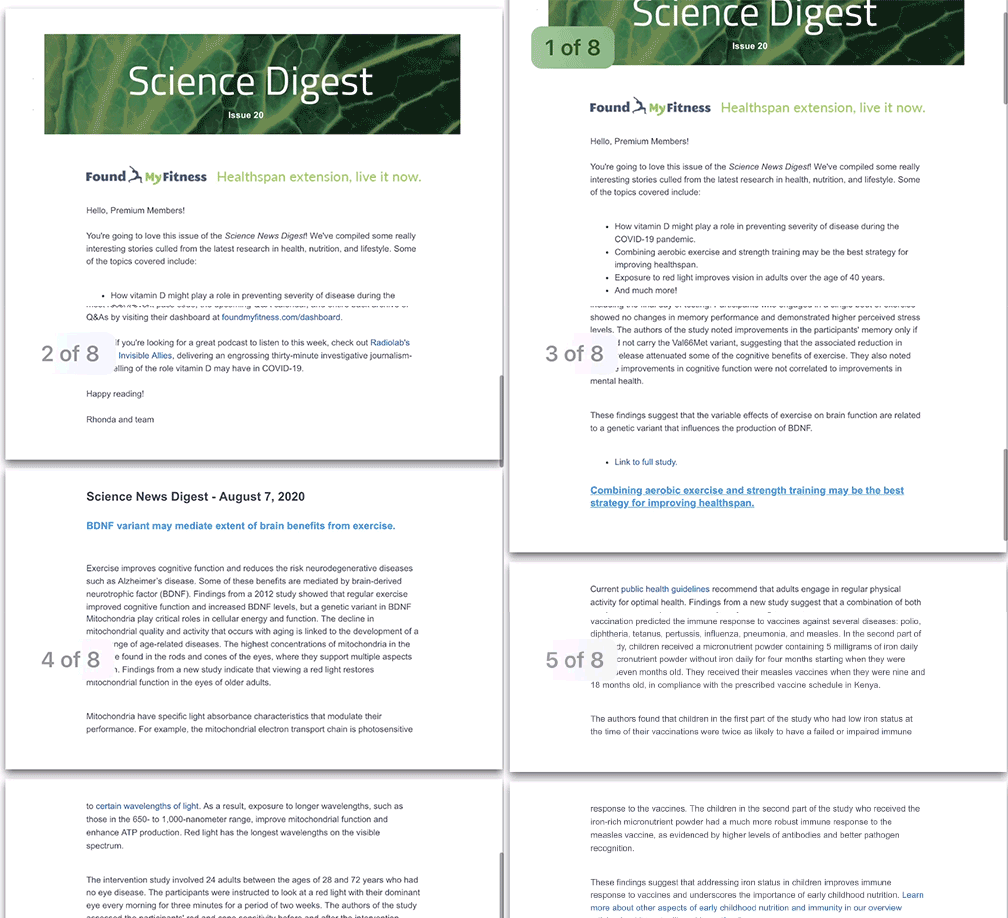
Every other week premium members receive a special edition newsletter that summarizes all of the latest healthspan research.
Diet News
- Tyrosine, found in things like fruit, spinach, and eggs improves mental speed in a "stopping" task
- Dietary AGEs linked to overeating and 30 percent shorter lifespan in worms.
- Animals fed meat from old animals had a 10% shorter lifespan compared to animals fed meat from young animals.
- Low medication use may promote longevity, according to a study in centenarians.