How to Reduce Microplastic Exposure in Everyday Life
The BDNF Protocol Guide
An essential checklist for cognitive longevity — filled with specific exercise, heat stress, and omega-3 protocols for boosting BDNF. Enter your email, and we'll deliver it straight to your inbox.
You'll also receive updates from Rhonda & FoundMyFitness
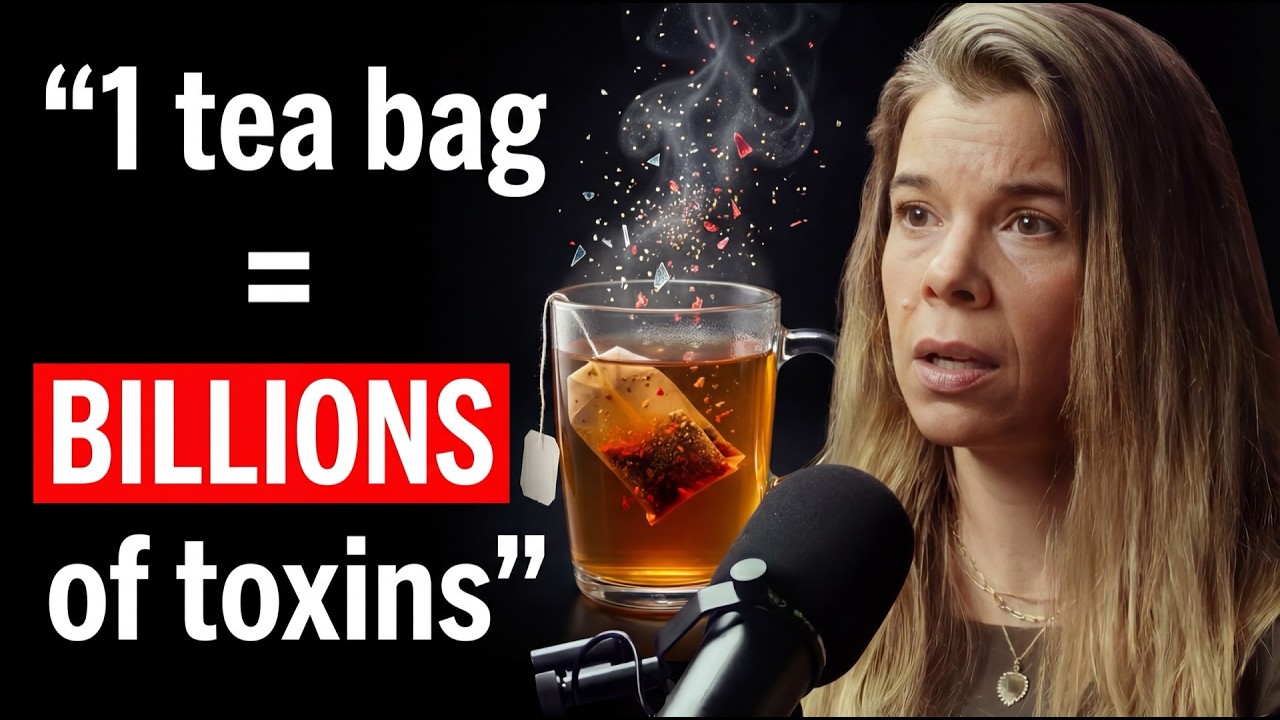
In this clip from Dr. Rhonda Patrick's appearance on The Tim Ferriss Show, she and Tim Ferriss identify common sources of microplastic exposure, including some tea bags, disposable hot-drink cups, bottled beverages, and chewing gum. Laboratory studies found that specific nylon or PET tea bags and polymer-lined paper cups released particles when exposed to hot water. [1] [2]
Drinking-water treatment can remove a substantial share of microplastics before water reaches the tap. Performance varies with particle size and treatment method, which makes a well-characterized and properly maintained home filter a practical additional step. Dr. Patrick also discusses a French beverage survey in which painted bottle caps appeared to shed particles into some glass-bottled drinks. [3] [4]
Practical exposure reduction can include using loose-leaf tea, avoiding unnecessary heat contact with plastic-containing materials, choosing suitable reusable containers, and reducing repeated use of damaged plastic. These measures address identifiable exposure sources while researchers continue to study how microplastic dose, particle size, and composition affect human health.
This clip is excerpted, with permission, from Dr. Rhonda Patrick's appearance on The Tim Ferriss Show. Thank you to The Tim Ferriss Show for allowing us to share it.
- ^ Hernandez LM; Xu EG; Larsson HCE; Tahara R; Maisuria VB; Tufenkji N (2019). Plastic Teabags Release Billions of Microparticles and Nanoparticles into Tea. Environ Sci Technol 53, 21.
- ^ Ranjan VP; Joseph A; Goel S (2021). Microplastics and other harmful substances released from disposable paper cups into hot water. J Hazard Mater 404, Pt B.
- ^ Negrete Velasco A; Ramseier Gentile S; Zimmermann S; Le Coustumer P; Stoll S (2023). Contamination and removal efficiency of microplastics and synthetic fibres in a conventional drinking water treatment plant in Geneva, Switzerland. Sci Total Environ 880, .
- ^ Chaïb, Iseline; Doyen, Perine; Merveillie, Pauline; Dehaut, Alexandre; Duflos, Guillaume (2025). Microplastic Contaminations In A Set Of Beverages Sold In France Journal Of Food Composition And Analysis 144, .
Tim Ferriss: Do you want to talk about microplastics and mitigation strategies?
Dr. Rhonda Patrick: It's really a big mess. And the microplastics are now it's not just okay well I'm not going to drink out of bottled water plastic bottled water. If you can get any kind of water filter any kind of water filter is great. Reverse osmosis is the best because it filters out the smallest smallest nanoplastics which are the kind that are actually crossing the blood-brain barrier and getting into the brain. In the brain, they're associated with Alzheimer's disease and all kinds of things. But we now know they're in chewing gum. So, anything with the word gum base is made of a plastic polymer. So, if you chew gum, it has to be plastic free gum. And it's not the same. I'll tell you that. Like, but it's in gum. It's tea bags. Tea bags. If you make tea with tea bags, all sorts of tea bags that are releasing just thousands of microplastic into your beverage. They're in essentially everything. And the problem is is that it's very hard to avoid. The best things that you can do to avoid them is reduce exposure, which would be the water filter. Try to avoid drinking out of any type of, you know, water that's in a plastic bottle. But it turns out a new study just came out showing it's also been found in glass bottles. I know. It's like, are you kidding me? Come on. Yeah. Apparently, the paint that's on the lid of the glass bottle is like shedding little particles into the beverage, and those are microplastics because the paint is got plastic in it. Essentially, my takehome from this is if you're traveling and you and you have to choose between a plastic water bottle with water in it and a glass one to buy, I would still buy the glass one because the particle size is higher. It's larger in the glass bottles.
Tim Ferriss: Yeah.
Dr. Rhonda Patrick: And that doesn't get absorbed in the gut very well at all, if any. You actually excrete it through feces. And so I think the next study that's going to be done will be show this essentially. I'm sort of speculating here, but because the size matters, the size of plastics and the plastic bottles are super small and that's really absorbed well by the gut epithelia and taken up into the bloodstream and gets to the other organs. Also, the plastic chemicals like BPA are in plastic. They're not in the glass. So, I still think that opting for glass is the best option. Even though that study came out, oh, glass has more plastic than plastic bottles. It's like a one of those sensational headlines.
Tim Ferriss: The devil's in the details, right? There's always like a nuance there. And in this case,
Dr. Rhonda Patrick: in this case, size matters. This size matters in this case for sure when it comes to, you know, people want to know, well, is there anything I can do to sort of detox these microplastics, right? That's the big concern that people have. If it's impossible to reduce my exposure because they're just absolutely everywhere, then can I sort of get rid of them? And unfortunately, there's not a lot of evidence right now out there that you can. Perhaps some this apheresis sort of thing where you kind of filter your blood.
Tim Ferriss: Yeah. But like, who's doing that? Maybe you'll do it.
Dr. Rhonda Patrick: That's not something that the public's generally going to do. Yeah. And I don't even know that I'm going to do it. It's also even if they were going to do it or willing to do it, it's not readily accessible or cost effective for people to use. Exactly. Your best strategy here is minimizing your exposure to them. And the way to do that for one would be obviously a water filter top of the list because the water that's coming through your tap through, you know, through your sink does have microplastics in it and that's a major major source of microplastic exposure for many many people. So if you can get any type of water filter, again, you can even get countertop reverse osmosis water filters.
Tim Ferriss: Those those are great for filtering out the majority of microplastics. Big big win. I wonder if the Big Berkey countertop filtration system is effective at filtering out microplastics. I don't know.
Dr. Rhonda Patrick: It is. It's effective at filtering out microplastics. It's not clear about like the nano nano like the super super small size ones. It might. It might not. I don't know. The micro size ones, it does filter out microplastics. So the the thing with reverse osmosis is it's really filtering out all like even the nanoplastics as well. Of course, you have to consider readding like certain minerals and trace elements that are found in water back to your water. And some reverse osmosis companies do that. You can have them put on a filter that'll just add it back in after it filters out all the microplastics. But you can also just buy mineral drops and put those in your water or you can take a mineral supplement that has some of these minerals that are taken out as well. Mhm. The other thing I do want to mention is that the plastic associated chemicals are another concern and that would be like the BPA, BPS. These chemicals are endocrine disruptors. They disrupt hormones. They're also associated with Alzheimer's disease. They're associated with cancer, all sorts of things, right? And those can actually I think this is a big speculation on my part just based on animal studies. I think sulforaphane plays a role in detoxing BPA from from our system and that's because of the whole situation where it activates the very same enzymes that do excrete BPA through urine. It does that and it's been shown in animal studies, animal studies that are given sulforaphane and then given a high dose of BPA, it completely blunts the toxicity of the BPA which is pretty interesting as well. The other thing to keep in mind is heat. And this I'll say this, all the to-go cups that you're out there buying when you go to a your favorite coffee shop, fill in the blank for the most part, with the exception of the blue bottle coffee. Phenomenal. Like they're they're great. All these paper cups are lined with plastic. And when you add a hot beverage into the plastic lining, it releases like all these microplastics into your beverage and it releases the chemicals like BPA into them like like 50fold. Blue Bottle Coffee, by the way, they apparently line their cups with sugarcane, polylactic acid, and so they don't have any plastic. I remember the other day I went into a Blue Bottle coffee shop and I was like, I really wanted to get a hot tea. And I was like, you know, do you do you guys line your cups with plastic? And she's like, no, we line them with sugarcane. I was like, yes. So, that's something to keep in mind. You see a lot of people drinking these to go cups everywhere and it's you're pouring a hot beverage into it. It's a really really major source of microplastic exposure because you're accelerating the breakdown of the plastic. Heat accelerates the breakdown of the plastic and essentially you're doing that in real time like in an instant, right?
Tim Ferriss: Ditto for the tea bags, right?
Dr. Rhonda Patrick: Bring your own cup and the tea bags. So you have to do loose leaf tea, which is what you know now I'm like always it's got to be loose leaf. I'll bring my own little I'll sometimes open the tea bag out and I have I bring my own little tea steeper thing with me.
Tim Ferriss: The half globes that connect together. Mine are the ones that you kind of like squeeze on it and opens up and then closes the clamps back together.
Dr. Rhonda Patrick: I use that because the tea bags again, you're getting the heat on top of the plastic, you know, polymers that are making up the tea bag and accelerating to break down the plastic. So, you're drinking, you know, plastic beverage, right?
Tim Ferriss: Yeah.
Dr. Rhonda Patrick: And all the there's all these health consequences now associated with microplastics. You mentioned the brain. It's been found to accumulate 20 times more in the brain than in other organs. And people with Alzheimer's disease have, you know, up to 20 times more microplastics in their brain than people that didn't have Alzheimer's disease. And then the same goes for like cardiovascular disease. There's been a study that was published in the New England Journal of Medicine about a year ago showing that people that had microplastics in their whatever aortic part that they were doing surgery on, those individuals like ended up dying of a heart attack like within the next three years versus ones that didn't have any microplastics. Anyways, all sorts of interesting stuff. We don't know enough about it, but I think enough said, we do know that they're not good and we want to try to avoid them as much as we can and that they are pervasive. They're everywhere, right? It's ubiquitous.
Tim Ferriss: Yeah. And there's some simple things people can do. I mean, this is not necessarily in the same category, but it's like look, the effects at least seem to be I don't know if they're well established. Maybe there are animal studies on this, but certainly there's a lot of seemingly compelling evidence pointing to the effects of say phthalates on as endocrine disruptors on male fertility. And it's it's like look, if if you have shampoo or soap with a really strong fragrance, just stay away from it. I mean, they're like very simple guidelines for some of these things that I I think can be can be very helpful. Yeah, the microplastic stuff is is kind of terrifying. I did not realize the gum. I knew about the tea bags, the water filtration. Did not realize the gum. I don't chew a lot of gum, but one of my relatives who has Alzheimer's has chewed like four packs of gum a day for 10 years, right? And I was like, "Oh I wonder if that's a contributor."
Dr. Rhonda Patrick: Wow, that's crazy. I started chewing gum when I learned about the research showing that xylitol could, you know, inhibit some of the Streptococcus mutans, bacteria that are involved in cavity formation.
Tim Ferriss: And then a few years later, you're like, god damn it. I'm
Dr. Rhonda Patrick: like, well, I was able to reverse cavities multiple times and my doctor was like, keep doing it. I'm like, yes, the xylitol. And then it was like this year I found this out, Tim. This this year the study came out with a gum and I was devastated. I mean, I've chewed so much gum. So much gum. And I've let my child chew it and it's like all I could think about was how great it was for the teeth. And and now it's like, oh my god, this has like been a source of microplastics that I had no idea. I did thankfully find an alternative xylitol source of gum that is microplastic free. But it's like chewing on bark.
Tim Ferriss: Yeah. Is it like chewing on
Dr. Rhonda Patrick: It's pretty much bark.
Tim Ferriss: Tasteless bark.
Dr. Rhonda Patrick: It's actually made from bark. No, it's made from like trees. Like some kind of sap or something from the bark.
Tim Ferriss: Like resin or something. Yeah.
Dr. Rhonda Patrick: Yeah.
Tim Ferriss: Sounds delicious. You can't just do xylitol mints. You have to chew it. I guess you have to get it up.
Dr. Rhonda Patrick: You can do xylitol mints.
Tim Ferriss: Okay.
Dr. Rhonda Patrick: Yeah, you can do xylitol mints. I have this as well.
Hear new content from Rhonda on The Aliquot, our member's only podcast
Listen in on our regularly curated interview segments called "Aliquots" released every week on our premium podcast The Aliquot. Aliquots come in two flavors: features and mashups.
- Hours of deep dive on topics like fasting, sauna, child development surfaced from our enormous collection of members-only Q&A episodes.
- Important conversational highlights from our interviews with extra commentary and value. Short but salient.
Pollution News
- Microplastics in the bloodstream may obstruct tiny blood vessels in the brain, impairing blood flow and causing neurological disorders, according to a recent study in mice.
- Particulate matter in wildfires harms the brain.
- Increased blood vessel damage found in people on days with bad air quality shows damage occurs on even on 1 bad day.
- High exposure to plastics, such as those in disposable takeout containers, is associated with a 13% greater risk of heart disease, potentially through changes to gut bacteria and increased inflammation.
- Prenatal exposure to a common pesticide is linked to widespread brain changes and slower fine‑motor skills in school‑age children.