Sulforaphane supplements vs. broccoli sprouting | Rhonda Patrick
Enter your email to get our 15-page guide to sprouting broccoli and learn about the science of chemoprotective compount sulforaphane.
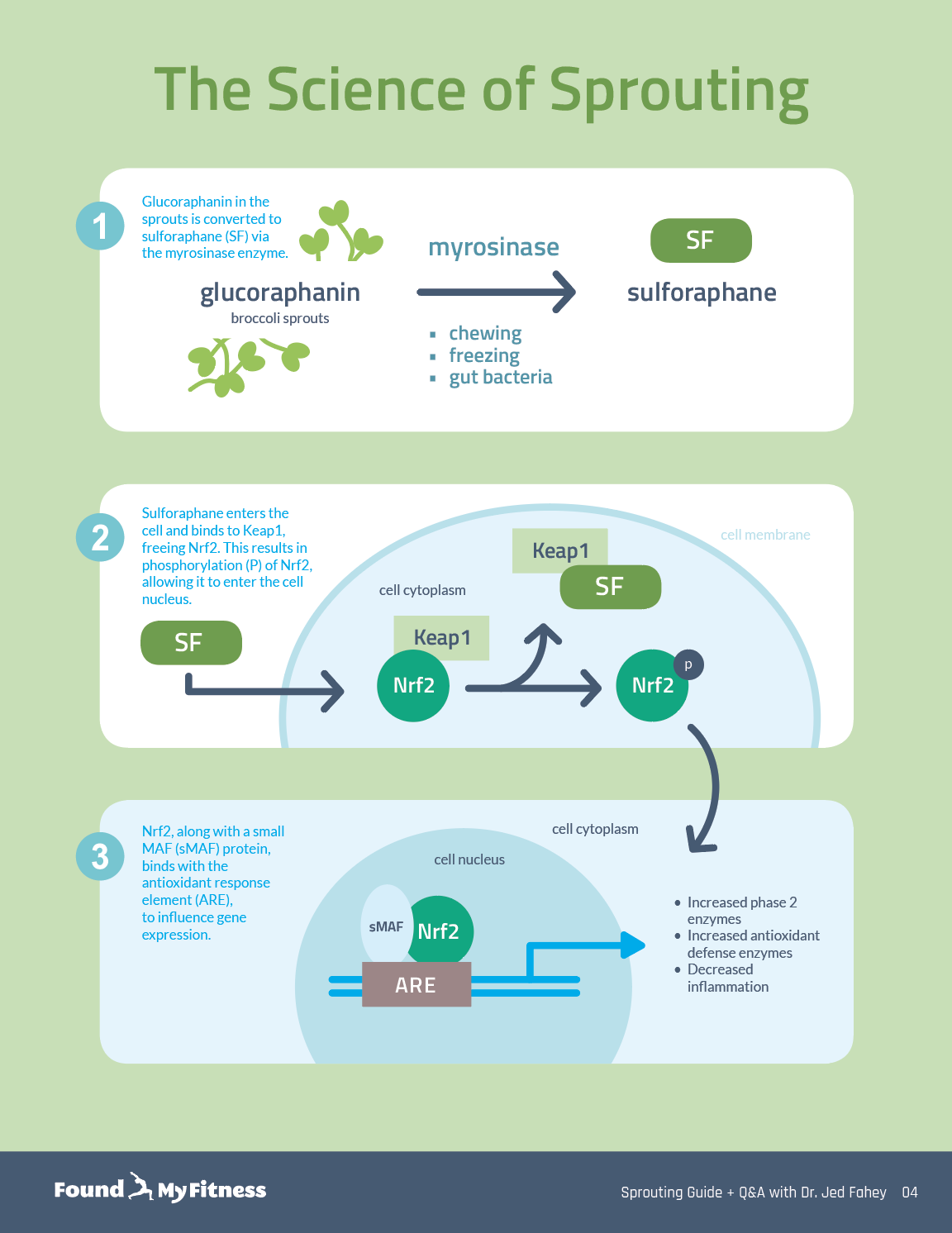
Broccoli sprouts are concentrated sources of sulforaphane, a type of isothiocyanate. Damaging broccoli sprouts – when chewing, chopping, or freezing – triggers an enzymatic reaction in the tiny plants that produces sulforaphane.
Get the full length version of this episode as a podcast.
This episode will make a great companion for a long drive.
Sulforaphane, an isothiocyanate compound, is the most potent naturally occurring inducer of the body's key detoxification enzymes. While sulforaphane is available in supplement form, it is derived naturally from a variety of cruciferous vegetables such as Brussels sprouts, kale, and mustard greens, with the highest quantities available from broccoli sprouts. Sprouting is labor-intensive, however, and prone to contamination, while purchasing supplements can be costly. In this clip, Dr. Rhonda Patrick describes the advantages and disadvantages of the various dietary and supplemental sources of sulforaphane.
I'd love to hear your latest thoughts on sulforaphane. I know that, you know, here, gosh, what, it's been a couple years now when you first started doing videos and posts about the benefits of sprouting broccoli seeds and this miracle compound called sulforaphane. And where are you now with all that? I'm still super excited about it. Sulforaphane is, it's something that is formed from a precursor called glucoraphanin, and glucoraphanin is found in a variety of what are called cruciferous vegetables, things like Broccoli, Brussels sprouts, cabbage, daikon, you know, watercress, all these things, cauliflower. These things are all from a cruciferous family of vegetables. So glucoraphanin is the precursor to it.
When the plant tissue is, you know, crushed, chewed, torn apart, it activates an enzyme called myrosinase, which turns glucoraphanin into sulforaphane. Sulforaphane has about 70% bioavailability if you orally ingest it. The precursor glucoraphanin only has about 10% bioavailability. ability to be converted into sulforaphane. So, there's been tons and tons of intervention trials where people are given either a broccoli sprout— broccoli sprouts, by the way, have about up to 100 times more of the precursor to sulforaphane called glucoraphanin than the mature broccoli plant, which is kind of why I've talked a lot about broccoli sprouts because that's a— I can't eat anymore, Rhonda. You had me eating so many of them. I was eating like cups of those a day and they don't taste good. Right.
And I'm like trying to add stuff to them and I just— I had to go to the supplements. Yeah, well, so here's the thing. The supplements— so there's only— there's a couple of supplements that have been, you know, scientifically validated to really have what they say they have. Sulforaphane is not— is not a very stable molecule. It's very unstable and it's difficult to get it, you know, in a supplement form. There's been 2 supplements that are really, I would say, have been clinically validated and been— have been used in randomized controlled trials. controlled trials that have been peer-reviewed and published. One is Avmacol. And Avmacol is— by the way, I have no affiliation with any of these supplements or supplement companies at all. You don't have any?
Yeah, I was gonna say you don't have any affiliation with any supplement companies. I don't, but you know, I just have to say that because people don't know that. So— No, I get it. I don't have affiliates marketing. Neither do I. Yeah, good to mention. I've been taking, you know, there's 2 supplements. One's called Avmacol. I think Avmacol has around 3.5 milligrams of sulforaphane. in each tablet and the recommended dose on their bottle is 2 tablets. So that would be about 7 milligrams of sulforaphane. The other supplement is called Prostaphane. Prostaphane is unfortunately not available in the US. It's in France, right? Yeah.
It's made in France and because sulforaphane is so unstable, like the company just didn't want to deal with like the whole shipping it to another country and all that and dealing with all that, right? But you can buy it. Like I buy Prostaphane. There's online pharmacies. You can have it shipped to you. Oh, really? Yeah. Like I'm having another shipment arriving tomorrow. Oh, so even you stopped with the broccoli sprouts. Well, so here's— here's the thing. Okay, let me answer your question. So, um, each prostaglandin tablet has around 10 milligrams of sulforaphane in it. There are trade-offs, you know, versus, you know, for doing broccoli sprouts versus supplements. I would say first and foremost, the supplements are expensive. Prostaglandin is really expensive. They're expensive.
And— What— what are we talking like $50 a pack or— Something like $90-something for a pack of 60 for prostaglandin. It's— it's quite expensive. But again, it has— How many are you taking a day? One. Oh, so that's not that bad. 60-day supply? We— each one has 10 milligrams of sulforaphane and I'll, you know, to get to that dose, maybe I should talk about some of the clinical— I mean, there's been some new clinical studies that have been really exciting in the past couple years. Cool. Yeah, please do. But let me just finish with the sprouts. They're cheaper and you get a ton of sulfur. So like for 100 grams of fresh sprouts, Uh-huh. You use something around like 40 milligrams of sulforaphane, you know, can be bio— you know, basically you can get something around 40 milligrams of sulfur.
That's a lot, right? For a lot cheaper. Now, the trade-off is it's a pain. You have to like work, right? You have to make them. I mean, they're not super, super hard, but there's a risk for contamination. They're very— they can easily be contaminated. And I've had them contaminated and it kind of gives you some, you know, It's not fun. So— Yeah. That's the risk and there's all sorts of, you know, people say you should bleach the seeds first and then— I don't personally feel comfortable bleaching the seeds and do it. I just don't wanna like ingest anything that's, you know, had bleach on it. I've been doing the prostaglandin for one simple reason.
I'm a mom now and I'm also running FoundMyFitness and trying to do all this research and stuff and also trying to like exercise and there's just— I just— there's too much. You know, there's just too much for me. So I found it easier for me to take the prostaglandin supplement. I would like to get back to the sprouts and I will probably mix that up again. But for now, I'm sort of taking the easy way. That's good. You're too busy. Like, seriously, my fridge looked like a little mini farm. Like, it was like FarmVille up in my fridge. It was like there was sprouts everywhere and some of them were going bad. Yeah, that was like me. And I was freezing some of them and it was just, yeah.
Supporting our work
If you enjoy the fruits of
 , you can participate in helping us to keep improving it. Creating a premium subscription does just that! Plus, we throw in occasional member perks and, more importantly, churn out the best possible content without concerning ourselves with the wishes of any dark overlords.
Sulforaphane News
- Another pilot clinical study finds sulforaphane increased blood glutathione levels and increased levels in brain.
- Sulforaphane (beneficial compound in broccoli) found to help with symptoms of autism. Improvements in various dimensions like social interaction.
- Sulforaphane extends lifespan and healthspan in worms via insulin and insulin-like growth factor-1 signaling.
- Consumption of broccoli sprouts during late gestation & lactation confers protection against developmental delay induced by maternal inflammation.
- Every 1 percent drop in body weight slows brain aging by nearly nine months, highlighting the substantial, and often overlooked, neuroprotective benef