STUDY: Increasing sulforaphane bioavailability from broccoli through exogenous myrosinase.
Enter your email to get our 15-page guide to sprouting broccoli and learn about the science of chemoprotective compount sulforaphane.
Broccoli sprouts are concentrated sources of sulforaphane, a type of isothiocyanate. Damaging broccoli sprouts – when chewing, chopping, or freezing – triggers an enzymatic reaction in the tiny plants that produces sulforaphane.
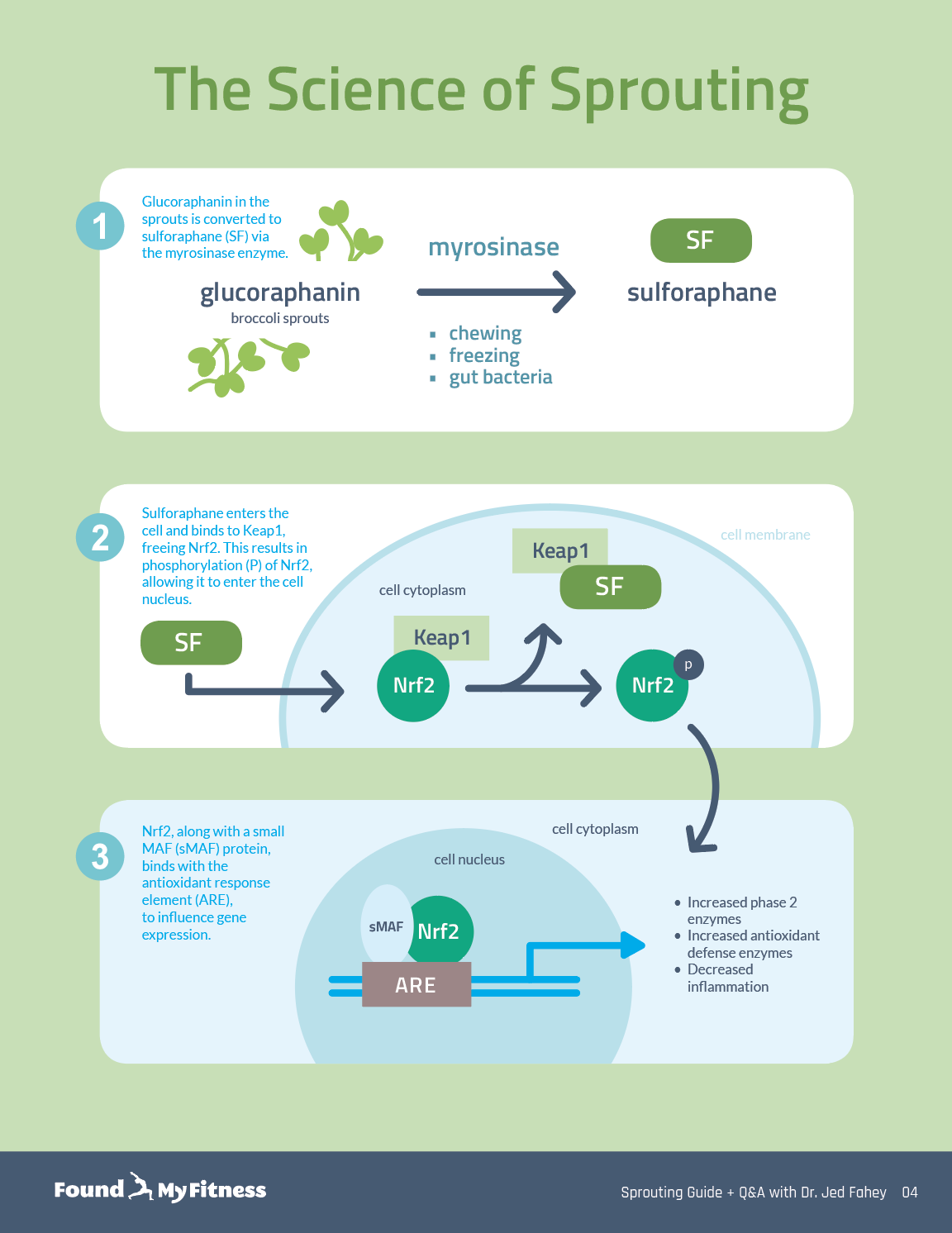
Sulforaphane – an isothiocyanate phytochemical derived from cruciferous vegetables like broccoli, cauliflower, and mustard – induces a wide array of protective mechanisms in cells. But sulforaphane isn’t normally present in these vegetables. Instead, it’s an end product of a chemical reaction between a precursor molecule (called glucoraphanin) and an enzyme (called myrosinase).
The chemical reaction occurs when you chop, chew, or otherwise damage the plant. Unfortunately, myrosinase is heat sensitive, so cooking inactivates it, preventing the reaction from occurring and reducing the amount of sulforaphane you get from your favorite cooked crucifers.
But findings from a new study show that adding myrosinase derived from ground raw mustard seeds to cooked crucifers increased the bioavailability of the veggies’ sulforaphane 4-fold in humans! (Although previous studies had shown similar results, they were in vitro studies.)
In this short video, Rhonda talks about the new study and suggests that if you prefer your cruciferous veggies steamed, sautéed, or roasted, this strategy might offer a way to have your cooked vegetables and get your sulforaphane, too. Just be sure the ground mustard seeds have the bitter, pungent flavor associated with isothiocyanates – a sign that the myrosinase in the mustard seed is active and working!
To learn more about sulforaphane, check out this comprehensive literature review video on isothiocyanates or this interview episode with Dr. Jed Fahey, an expert on sulforaphane and its many health benefits.
Hello, friends. Today I'm going to talk to you about a potential way to increase the bioavailability of sulforaphane from your favorite cooked cruciferous vegetable. Anybody that's been following me for a while knows that I love sulforaphane, which means I also love cruciferous vegetables. Cruciferous vegetables include things like broccoli, cauliflower, brussels sprouts, kale, collard greens, wasabi, watercress, and broccoli sprouts. The reason this family of vegetables is a great source of sulforaphane is because they contain the precursor to sulforaphane called glucoraphanin. Glucoraphanin gets converted into sulforaphane once the plant tissue becomes basically broken.
So crushed, chewed, chopped, etc. The enzyme responsible for converting glucoraphanin into sulforaphane is called myrosinase. Now, unfortunate for us, myrosinase is heat sensitive, which means during the heating process of the vegetable, it becomes inactive. When it becomes inactive, it is no longer able to perform the function of converting glucoraphanin into sulforaphane, which unfortunately decreases the bioavailability of sulforaphane. Many people like to probably eat cooked broccoli, sauteed kale, cooked cauliflower, compared to the raw broccoli. Cauliflower. Kale eating raw is good as well, but it's nice to find ways to increase sulforaphane levels if you're going to cook the vegetables.
So a recent study came out showing that men who ate cooked broccoli but also supplemented with one gram of mustard seed extract were able to increase sulforaphane levels bioavailability of sulforaphane by fourfold, which is quite significant. The reason for this is because the mustard mustard seed is also from the cruciferous family and it contains a viable enzyme, myrosinase enzyme. So if you add the mustard seed extract to the cruciferous vegetable after it's been cooked, then you're adding back a viable source of myrosinase, which can then convert all that glucoraphanin that's in the cruciferous vegetable, which is not sensitive to heat, it can convert it into sulforaphane. So I personally like to sprinkle mustard seed extract on top of my cooked broccoli or sauteed kale.
I also like to eat the raw cruciferous plants as well. But, you know, probably one of the easiest Litman test to do to see whether or not the mustard seed extract does contain viable myrosinase, aside from running an HPLC in mass spec and measuring it, which most of us aren't doing, is just to taste it and see if it has a little bit of a bitter taste. Because that should should suggest that there is viable myrosinase present in the mustard seed extract. So there you have it. Add some mustard seed extract to your cooked broccoli or sauteed kale or your cooked Brussels sprouts and increase your viability of sulforaphane.
And for anyone that's wondering why I want more sulforaphane in my life, you should definitely check out the comprehensive video that we put out on sulforaphane or the podcast episode with Dr. Jed Fahey from Johns Hopkins, who is an expert on sulforaphane and broccoli, sprouts and all things cruciferous to learn more about how sulforaphane has been shown to have a positive effect on glucose regulation, on inflammation, on glutathione levels, on brain function, cancer incidence and so much more in humans. So make sure you check those out if you haven't seen those videos or those episodes as well. Talk to you next time.
A class of edible plants from the Brassicaceae, Capparaceae, and Caricaceae families, so named for their cross-shaped flowers. Crucifers contain glucosinolates and myrosinase, which react to form isothiocyanates, a class of compounds with known beneficial health effects in humans. Cruciferous vegetables include arugula, broccoli, bok choy, Brussels sprouts, cabbage, capers, cauliflower, cress, collards, kale, kohlrabi, moringa, mustard, papaya, radish, rutabaga, turnips, wasabi, and watercress.
A glucosinolate (see definition) found in certain cruciferous vegetables, including broccoli, Brussels sprouts, and mustard. Glucoraphanin is hydrolyzed by the enzyme myrosinase to produce sulforaphane, an isothiocyanate compound that has many beneficial health effects in humans.
Plant secondary metabolites found primarily in cruciferous vegetables. Glucosinolates give rise to a variety of compounds that have been identified as potent chemoprotective agents in humans against the pathogenesis of many chronic diseases such as cancer, cardiovascular disease, and neurodegenerative disease, among others. These products are responsible for the pungent aroma, sharp flavor, and the “heat” commonly associated with some cruciferous vegetables such as wasabi and horseradish.
Byproduct of a reaction between two compounds (glucosinolates and myrosinase) that are found in cruciferous vegetables. Isothiocyanates inhibit phase I biotransformation enzymes, a class of enzymes that transform procarcinogens into their active carcinogenic state. Isothiocyanates activate phase II detoxification enzymes, a class of enzymes that play a protective role against DNA damage caused by reactive oxygen species and carcinogens. Examples of phase II enzymes include UDP-glucuronosyltransferases, sulfotransferases, N-acetyltransferases, glutathione S-transferases, and methyltransferases.
An isothiocyanate compound derived from cruciferous vegetables such as broccoli, cauliflower, and mustard. Sulforaphane is produced when the plant is damaged when attacked by insects or eaten by humans. It activates cytoprotective mechanisms within cells in a hormetic-type response. Sulforaphane has demonstrated beneficial effects against several chronic health conditions, including autism, cancer, cardiovascular disease, diabetes, and others.
Attend Monthly Q&As with Rhonda
Support our work
The FoundMyFitness Q&A happens monthly for premium members. Attend live or listen in our exclusive member-only podcast The Aliquot.
Sulforaphane News
- Another pilot clinical study finds sulforaphane increased blood glutathione levels and increased levels in brain.
- Sulforaphane (beneficial compound in broccoli) found to help with symptoms of autism. Improvements in various dimensions like social interaction.
- Sulforaphane extends lifespan and healthspan in worms via insulin and insulin-like growth factor-1 signaling.
- Consumption of broccoli sprouts during late gestation & lactation confers protection against developmental delay induced by maternal inflammation.
- Every 1 percent drop in body weight slows brain aging by nearly nine months, highlighting the substantial, and often overlooked, neuroprotective benef