#109 How To Boost NAD Levels To Fight Inflammation, Improve Recovery, and Slow Aging | Dr. Charles Brenner
This episode is available in a convenient podcast format.
These episodes make great companion listening for a long drive.
The BDNF Protocol Guide
An essential checklist for cognitive longevity — filled with specific exercise, heat stress, and omega-3 protocols for boosting BDNF. Enter your email, and we'll deliver it straight to your inbox.
You'll also receive updates from Rhonda & FoundMyFitness
NAD is the molecule behind energy, recovery, and aging.
But most people aren't doing enough to protect their levels.
This conversation with Dr. Charles Brenner is a deep dive into NAD biology—why it's foundational to energy metabolism, how it supports building and repair processes (including DNA repair), what actually seems to happen to NAD with aging, and how different stressors like obesity, inflammation, infection, circadian disruption, heart failure, and neurodegeneration can "attack" the NAD system.
Dr. Rhonda Patrick and Dr. Brenner also discuss:
-
How obesity and insulin resistance drain NAD resources
-
The anti-inflammatory effects of nicotinamide riboside (NR)
-
Can NAD precursors speed exercise recovery?
-
Does NR supplementation during pregnancy benefit offspring?
-
Could NR supplementation support fertility?
-
NAD supplements vs. precursors—what actually boosts NAD?
-
NAD IV drips—real benefits or just hype?
-
NMN vs. NR—does being 'one step closer' really matter?
-
Do NAD precursors increase cancer risk?
Dr. Brenner's origin story and why NAD became "the central catalyst" he chased
"High energy electrons run us… they run living things, and NAD coenzymes are the wiring for the high energy electrons."- Charles Brenner, Ph.D. Click To Tweet
Dr. Charles Brenner (@CharlesMBrenner on X) describes himself first as an enzymologist—someone interested in enzymes and proteins that bind nucleotides. In fact, he discovered a superfamily of nucleotide-binding proteins early in his career.[1]
Around 2003, he encountered an amino acid sequence conserved in yeast and humans that clearly contained an NAD synthetase domain—an enzyme that converts NAAD (nicotinic acid adenine dinucleotide) into NAD by adding an amino group. What grabbed him was that eukaryotic NAD synthetases (yeast/human/fly) had a glutaminase domain, suggesting glutamine could supply the nitrogen/ammonia needed to form NAD. He ties this to older literature including seminal studies from Jack Preiss (1958) in which it was shown that purified yeast NAD synthetase required glutamine—yet the "why/how" had been unclear.[2]
Brenner loved this enzyme because it effectively has two active sites (a glutaminase site and a synthetase site) and must shuttle ammonia from one site to the other—mechanistically elegant, and biologically central because the pathway ends in NAD. While working on NAD synthetase, he realized that many standard NAD pathway diagrams implied if you remove this enzyme, yeast shouldn't be able to make NAD. That nudged him toward the idea that an additional pathway might exist—leading to the hypothesis (and later discovery work) around a nicotinamide riboside (NR) pathway for NAD biosynthesis.[3]
NAD synthesis pathways
"The issue [with some NAD precursors] is phosphates. Compounds with phosphates do not get into cells, so the biggest piece of NAD that can get into a cell is nicotine riboside."- Charles Brenner, Ph.D. Click To Tweet
Cells can build NAD through a NaMN-centered route (the classic Preiss–Handler/de novo framework) or through an NMN-centered route (the nicotinamide riboside kinase or NRK pathway), and these routes are distinct at the level of their key intermediates and entry enzymes.
Pathway 1: The classic NaMN route
Multiple inputs (dietary nicotinic acid and de novo synthesis from tryptophan) funnel into nicotinic acid mononucleotide (NaMN), which is then converted onward to NAD.
Steps:


Three distinct pathways for NAD biosynthesis. From: Li, F., et al. Targeting NAD Metabolism for the Therapy of Age-Related Neurodegenerative Diseases.
- Nicotinic acid (NA) → NaMN: This is the hallmark Preiss–Handler first step where nicotinic acid is phosphoribosylated to NaMN.
- NaMN → NaAD (nicotinic acid adenine dinucleotide): An adenylyltransferase step.
- NaAD → NAD: An amidation step (NAD synthetase step).
What makes this "one pathway" in practice is that, regardless of whether you start from tryptophan (de novo) or nicotinic acid (vitamin B3 form), the pathway's defining "hub" intermediate is NaMN.
Pathway 2: The NMN route (nicotinamide riboside kinase pathway)
Nicotinamide riboside (NR) can be used as an NAD precursor by first being phosphorylated to nicotinamide mononucleotide (NMN)—without needing to pass through NaMN.
Steps:
- Nicotinamide riboside (NR) → NMN: Catalyzed by NRK (nicotinamide riboside kinase) enzymes. Brenner and colleagues identify Nrk1 in yeast and show human NRK1/NRK2 can perform the same function.
- NMN → NAD: Via NMN adenylyltransferase activity (the paper highlights that enzymes historically characterized as NMN adenylyltransferases now make sense because an NMN-producing route exists).
What makes this pathway distinct is its defining hub intermediate is NMN, not NaMN, and it is described as "Preiss–Handler independent" because it doesn't require the nicotinic-acid to NaMN entry step.
- ^ Brenner C; Bieganowski P; Pace HC; Huebner K (1999). The histidine triad superfamily of nucleotide-binding proteins. J Cell Physiol 181, 2.
- ^ PREISS J; HANDLER P (1958). Biosynthesis of diphosphopyridine nucleotide. II. Enzymatic aspects. J Biol Chem 233, 2.
- ^ Bieganowski, Pawel; Brenner, Charles (2004). Discoveries Of Nicotinamide Riboside As A Nutrient And Conserved NRK Genes Establish A Preiss-Handler Independent Route To NAD+ In Fungi And Humans Cell 117, 4.
-
Why disease states disrupt NAD levels
-
How coronavirus infection impacts NAD levels
-
Can diet and supplements artificially inflate NAD levels?
-
Why blood NAD might not show the full picture
-
How obesity and insulin resistance drain NAD resources
-
Does poor sleep disrupt NAD levels?
-
The anti-inflammatory effects of nicotinamide riboside (NR)
-
Can a single lifestyle change restore NAD?
-
Cognitive benefits of NAD precursors
-
Should you measure your NAD levels?
-
Does exercise boost NAD—and if so, which type?
-
Can NAD precursors speed exercise recovery?
-
Is acute sleep loss enough to lower NAD?
-
Does NR supplementation during pregnancy benefit offspring?
-
Safety of nicotinamide riboside during pregnancy
-
Could NR supplementation support fertility?
-
Shift work and jet lag—can NAD precursors help?
-
Morning or night—when should you take NR?
-
NAD supplements vs. precursors—what actually boosts NAD?
-
NAD IV drips—real benefits or just hype?
-
Oral vs. IV nicotinamide riboside—what's more effective?
-
Do oral NAD supplements genuinely raise NAD levels?
-
NMN vs. NR—does being 'one step closer' really matter?
-
Does the gut microbiome influence NAD production?
-
Could NR supplementation enhance immune function?
-
Can NR supplementation improve peripheral artery disease?
-
Can NR realistically reduce liver fat?
-
Does NR supplementation give athletes a recovery edge?
-
What's a safe dosage for nicotinamide riboside?
-
Resveratrol and pterostilbene—beneficial pairing or pointless stack?
-
NAD precursor supplements—why sourcing matters
-
Do NAD precursors increase cancer risk?
-
Is NR worth supplementing for healthy individuals?
-
From enzyme nerd to NAD pioneer (Brenner's origin story)
-
Simplifying NAD's role in energy and repair
-
Why DNA repair depends heavily on NAD
-
The PARP/NAD-consumption mechanism
-
NAD's role in gene regulation
-
Why NAD shortages hit the brain hardest


Rhonda Patrick: Welcome back to the podcast everyone. I'm very excited to be here with doctor charles brenner who is a professor and chair in the department of diabetes and cancer metabolism at the city of hope but I think what doctor brenner is probably more well known for in not only in the scientific community but in the broader health community in general is his contribution to understanding NAD biology he had discovered a precursor for NAD nicotinamide ribosacin side which has been made into a supplement it's a NAD boosting supplement that a lot of you are familiar with we're going to get into all that today doctor brenner is very evidence based and so I'm very excited to have this conversation with you today on all things NAD and we're going to talk about what that is and why it's important so thank you for joining me on the show I'm really happy to be here well this is a perfect segue into what I am very I think excited to talk about with you and that it really is you know NAD levels with age right so NAD levels do decline with age now can you explain the leading theories why that happens in humans so like what do you think the strongest evidence is is it you know diseases lifestyle that you know changes that happen as we get older why why is it that it you know can you just talk a little bit about what your thoughts.
Charles Brenner: On that well I'm not super comfortable accepting every premise that you you know can pull from from instagram right yeah and so so I didn't pull anything yeah yeah no I know but you're talking generally speaking right generally speaking so when people say NAD levels decline in age I don't think that there's evidence that human blood NAD decline I think that the likelihood that a number of human tissue NAD pools decline or a disturbant age is incontrovertibly true but I think that the idea that every human system's NAD declines in age is probably overstated because i've seen a lot of human blood NAD metabolomes and essentially there's three types of data that we get we get normal people male and female who have twenty micromolar NAD plus calculated on a volumetric basis in their blood you have people that supplement that are maybe twice that and you have people with mitochondrial disease that are lower so we like we discovered in collaboration with university of helsinki a number of years ago that people with mitochondrial disease they were thought to primarily have muscle mitochondrial myopathy right are walking around with low blood NAD generally we don't see people have low blood NAD we don't see older people having low blood NAD but when we've looked at alcoholics we see disturbed NAD in their liver when you have a population of people that have noise induced hearing loss I would bet a fair amount of money that their cochlear NAD is damaged okay so we're.
Rhonda Patrick: Talking about blood NAD versus tissue NAD and I think the question I'm generally asking you is a more broader question not blood NAD I'm talking about you know as humans age unfortunately they become more sedentary they become more overweight more obese they have things like diabetes and metabolic syndrome and all these disease states that do occur with age right right so the question that I'm asking you is you know basically like do is there evidence that some of these these disease states and I guess we'll get into this do play a role in lowering NAD levels in the blood in other organs so so the question more broadly yeah but even in the blood I'm curious like if someone if you're saying i've got normal people and we looked at them does that mean normal like they don't have any diseases or does it mean they don't have mitochondrial disease because like does someone who's obese have lower blood NAD levels than someone.
Charles Brenner: Who is not you know clinical trials always have a you know incl criterion right so the clinical trials that looked at people that were simply older and probably were not on you know twelve medications saw largely normal blood NAD so it could be that if we look into people that have a lot of disease and conditions and have polypharmacy we may see abnormally low blood NAD in in aging people much more than i've seen so that's a really good point but I think that inflammatory processes are probably at work in many of the disease and conditions in which the NAD.
Rhonda Patrick: System is disturbed in not just the.
Charles Brenner: Blood but in everything so one of the things that we found in twenty twenty you know so remember we all remember where we were in March 2020 right so I was a I was a department head at university of iowa and you know I got an email from either the the dean of the college of medicine or the president of the university saying everybody needs to to go home tell the people in your department that we're going to be teaching from home we're going to be learning from home and we're not going to be going into the lab the exception is if you're doing something related to coronaviruses you can stay in the lab so turns out fourth floor of the bsb building where I was working was one flight above Stanley Perlman's lab who was probably one of the five most expert people on coronaviruses in the world and he had been working on coronaviruses when no one cared about them and actually had given us samples of coronavirus infected mice and we had done NAD metabolomics on it and we had kind of a shocking result so we were actually able to stay in the lab and we published a paper in twenty twenty on the effect of coronavirus infection not just on mouse liver but on human lung samples that we're able to get from morgues and from databases where they had COVID infection and just to come back to the PARP question we found five different members of the PARP superfamily that were transcriptionally activated by.
Rhonda Patrick: Coronavirus infection wow yeah were they consuming.
Charles Brenner: NAD yeah you know what I think it is is double stranded rna right is seen as an invader by the innate immune system so just to bring everybody up to the same speed your immune system has two parts one is your innate immune system that can tell that double stranded rna is a because the human body just generally doesn't make double stranded rna right and the human body doesn't make endotoxin so cells don't have to wait for antibodies to come along that are very specific for double stranded rna or endotoxin they recognize double stranded rna and endotoxin as a foreign invader and they do something immediate early to respond and it turns out that one of the things that our cells are programmed to do is turn on five members of the PARP super family so that infection and turns out this is a common response not just to COVID but to a lot of things is that we turn on these PARPs.
Rhonda Patrick: So you think that that may be something that happens with you know respiratory illness or interesting that brings me back to this question you know and I do want to talk about you know some of the drivers of NAD loss maybe that's a better way to put it yeah you know what we're talking when you're talking about measuring NAD levels in the blood like how much of that is really just reflective of your diet like you know like let's say you're you're getting a lot of you know b three nicotinic acid whatever like you're getting a lot of tryptophan is there somewhat of this like artifactual thing where NAD levels look normal or elevated because they're taking in the precursors and we're measuring it like blood well when.
Charles Brenner: People you know when people take substantive amounts of NAD precursor vitamins into the three hundred milligram plus you can see a substantive change in people's circulating NAD metabolome probably the foods that have the most NAD precursors are the same foods that have the most micronutrients of all kinds right people always talk about liver spinach right spinach source of iron and micronutrients liver source of iron and micronutrients that's because they're chock full of mitochondria right and chloroplasts in the case of plants that contain all of these coenzymes right and the coenzymes you know this the coenzymes break down to their soluble precursor form so NAD breaks down to NR nicotinamide nicotinic acid goes back into cells cells rebuild the NAD stores coenzyme a breaks down to pantothenate pantothenate gets into cells cells make up their own.
Rhonda Patrick: Pantothenate so then you know and this how much do you think measuring blood levels of NAD really is indicative of what's going on in the whole system and you know perhaps there is more of an age related decline in NAD in other tissues that we're not able to see in the blood I think.
Charles Brenner: That there I think there are very substantive age related declines in NAD in tissues and disease and condition driven declines in ned tissues and people are not you know there's no reason for you to volunteer a piece of your brain or your liver to measure that what.
Rhonda Patrick: About animal studies do you think that.
Charles Brenner: Animal studies we we have a lot of data on that in in animals.
Rhonda Patrick: Yeah and and what have those shown I mean are we seeing declines in the muscle and the liver and the brain is that something you think translates.
Charles Brenner: To humans I think it probably translates to humans I think in the liver it's related to inflammation and the microbiome it kind of varies from university to university in terms of where their mice are kept and what kind of microbiome there is in those facilities but for sure in a lot of disease and conditions the NAD system really comes under attack so in heart failure the NAD system comes under attack and central and peripheral neurodegeneration comes under attack sun exposure.
Rhonda Patrick: Comes under attack okay so let's talk about some of this I mean if we're talking about three really common conditions in humans obesity insulin resistance at the top right we have chronic inflammation which is the driver of heart disease of alzheimer's disease right chronic sleep deprivation like of those three conditions how you kind of described a little bit of the illness but like how do those you know conditions put stress on the NAD system so like obesity the inflammation chronic inflammation and then so we talked about you talked about acute inflammation I'm talking about chronic and then also sleep deprivation.
Charles Brenner: Yeah well I would say we actually have data from our lab for I think those those three so from twenty sixteen one of our first mouse experiments was overfeeding mice we gave them a high fat diet we pushed them all the way into type two diabetes their liver NAD system was disturbed NADPH was the center of that so their ability to detoxify reactive oxygen species was degraded but by being fat and being insulin resistant sleep deprivation so are they consuming.
Rhonda Patrick: More NAD is that like the driver.
Charles Brenner: I think that they're facing a kind of raw storm that is consuming NADPH is churning NADPH so it's not like.
Rhonda Patrick: They can't make the NAD it's that they're just they're they can't get enough of it because of all the and.
Charles Brenner: There could be more than one mechanism right okay yeah and then sleep disturbance.
Rhonda Patrick: We know sorry before you go to sleep can I go back to the obesity because you mentioned the animal data yeah what do we know from humans in terms of like has there been any research looking at obesity and or metabolic syndrome I'm kind of glump gathering them in the same group here do we know any is there any human data that is looked at how that taxes the NAD system there is to.
Charles Brenner: My knowledge and to some I mean fat is an accessible tissue people remove fat from people that have more than they want and so it is something that could be determined in the adipose tissue we'd be very interested in knowing what's happening in the liver and I think I know of a resource in europe where they have liver from people that were undergoing bariatric surgery so I think it'll be a good thing that we can look into in the future.
Rhonda Patrick: Okay great so you were gonna mention sleep disturbance and chronic inflammation and how both of these sort of very common human conditions sort of tax the NAD.
Charles Brenner: System right so chronobiology first so sleep I'm not sure a study has been done exactly on sleep but for sure in mice we've looked at young mice that have really good chronosynchrony and older mice that are kind of losing their synchrony and the NAD system becomes disturbed there's a lot of time of day cues that go into NAD synthesis and NAD dependent metabolic processes so I think that lack of sleep or time zone disruption is essentially assured to disturb the.
Rhonda Patrick: NAD system well I'm going to circle back and go a little more in depth in that because I have some more questions on that and then what about the chronic inflammation I mean this is to me it makes sense knowing what I know about NAD biology and.
Charles Brenner: Here's where I can really claim some benefit in human which is amazingly satisfying that we've not only have we shown that inflammatory stimuli like coronaviruses disturb the NAD system but we've been able to show that in human beings in randomized control trials that nicotinamide riboside at like a gram a day type doses is anti inflammatory so that's now a proven fact and it was initially a result that came out of trials where it was kind of like a top line failure in the sense that the first trial that reported that NR is anti inflammatory set out to determine whether NR could improve old men's grips strength in like two or three weeks well it's kind of a dumb trial rhonda okay because if you want to get stronger you have to exercise right not take a pill so the premise of the trial was kind of uNReasonable it was the magical thing there was no exercise.
Rhonda Patrick: Involved in the trial no there's no exercise there needs to be exercise plus.
Charles Brenner: The nh yeah you do exercise as standard of care and then you can see whether exactly yeah and we even have a you know like a review article saying exercise should be the standard of care and then you look for beneficial effects of NR and other things beyond that but what they did is they took older men and they did muscle biopsies and it was placebo controlled crossover design actually so some had the NR first and then they got placebo some had placebo first and then they they got NR and nobody's grip strength got better and then they went to the secondary outcomes and they found NR was strongly anti inflammatory like greatly lowering il six illinois ten and other markers of inflammation in fact it was so strong that the people that had the NR first followed by placebo still had lower anti inflammatory results after three weeks on placebo but the effect was strongest right after NR right so then you worry a little bit right because and I had to learn about clinical research because I'm a bench guy right that started out with enzymes and now has mice and so forth and so on and the thing that clinical researchers will tell you is that your pre specified endpoint is the most valuable thing right because their criticism of this anti inflammatory result could be that well you set out to test whether NR would improve grip strength and then you measured anti inflammation but for every twenty things that you measure you might find one thing that achieves this statistical significance at p zero five so if you measure one hundred things you might find five positive results it's maybe not that interesting right so you have to worry when you get a result as a non primary endpoint but by this time there are eight trials showing anti inflammatory activity in human rct's including rct's one that I just read the other day in which that was the primary endpoint the patient population all had copd so they're all very inflammatory they're looking at inflammatory markers and sputum so it's really disease relevant for this you know people with a respiratory condition NR lowers those inflammatory markers placebo doesn't so we know it's for a fact so what I think it's doing is it's rebuilding NAD in a system in which the NAD systems come under attack rebuilding those supplies so that free radical species can be detoxified and the anabolic processes and the repair processes can work better well I think you.
Rhonda Patrick: Kind of answered my question I was kind of going to ask you with respect to these chronic conditions that are very common in the us and also just a lot of developed countries you know what if someone could change only one aspect of their their lifestyle within the next two to three months like what would have the biggest bang for their buck in terms of supporting their NAD and it really sounds like the thing that's causing the inflammation the chronic inflammation might be a big driver so if it's obesity you know weight loss right if it's the if it's the the you know the sleep so whether or not you're we're talking about and like I said we're dive into this but like if you're if your circadian rhythms disrupted I mean trying to fix fix that or obviously supplementation we're going to get into that as well and for people wondering what NR is again nicotine my riboside we're going to get into all that very very soon whether or not it's stress stress causes inflammation.
Charles Brenner: Right drinking though I mean it could be drinking could be drug use right.
Rhonda Patrick: A lot of things cause inflammation yeah.
Charles Brenner: Yeah and and the thing is the thing that's important and I think that that's that's good about about your show is that you know there aren't one size fits all recommendations for people right so you know I don't understand why someone would tell large podcast audiences that everybody should be fasting or doing time restricted feeding because then you're going to get the people that have the most ocd right that have the most problematic relationship with their food to worry about time of day eating and counting calories and they may be perfectly lean right so I don't think that everybody needs to be fasting right but people with overweight actually now have medical options that work right and including oral you know glp one medications that in conjunction with resistance training can really improve people's health so for people that have overweight and obesity that's probably you know number one.
Rhonda Patrick: There'S a lot of options now to.
Charles Brenner: Lose weight people that people that are are drinking glp one actually helps some of those people but you know people that are drinking or are you know sitting you know in front of a screen too many hours a day and are not moving their bodies probably moving their bodies more is going to be.
Rhonda Patrick: You know right right I want to get back to this this idea of why you know the blood NAD isn't necessarily indicative of your what's going on in your muscle and your brain and and specifically I want to get into the you know let's say you're taking a an NAD precursor supplement like a nicotine might riboside and you do see that as you mentioned that you'll see the NAD levels go up like very high in the blood what does that tell us about levels in the brain can we assume I mean I don't know that we can or can we assume that the levels are going to go up in the brain or in.
Charles Brenner: The muscle yeah there are there are imaging experiments that show that oral NAD precursors increase brain NAD there are small clinical studies that show that oral nicotinamide riboside improves cerebral blood flow in people with mild cognitive impairment so that's a functional measurement so I feel pretty good.
Rhonda Patrick: About that does it improve cognition or was it not looked at people have.
Charles Brenner: Tried you know to see so there is a long COVID study in which all of the people that are eNRolled have long COVID so they have complaints about their executive function depression their sleep quality their mood and there was a recent study I think in the last month or two it's woo et al and I think it's lancet e clinical medicine or something like that I'm a co author on the paper that shows that there's within group improvements so again this is not quite the gold standard of placebo controlled NR group is superior to the placebo group at the end of the study but it's within group meaning when people compared their baseline level of executive function to their executive function when they were on NR there's an improvement that was not seen in the.
Rhonda Patrick: Placebo group did anyone look at whether or not that improvement correlated with inflammatory status so baseline inflammatory status being higher.
Charles Brenner: And that being no but that's a beautiful hypothesis that doctor guzman should should.
Rhonda Patrick: Look at so if you're listening to this doctor guzman make sure you look at the the inflammatory status and then you know cause I would think you know there's lots of evidence now that you you can even there's even you know human trials where people are injected with lipopolysaccharide which induces inflammation or a or a saline control and you can affect mood you can depress the mood you can depress cognitive function because inflammation affects brain function so I mean I i feel like it's a pretty I would say I would feel comfortable speculating that if you have yeah if you have someone with a you know high inflammatory status baseline for whatever reason alcoholism obesity chronic sleep deprivation whatever it is there's many many things that can get you there right that if you can you know either reduce that inflammation obviously through lifestyle and diet that would be ideal and and or if you take the nicotinamide riboside you know to help replenish some of that NAD to help with the inflammation that you would affect you know some of the functional outputs as well yeah so how would I'm you know I and that kind of gets to this thing you know and a lot of people are taking there's a lot of people that are taking NAD boosting supplements and what do you think for them like should they go get their NAD blood levels measured is there any sort of you know functional test that they can do to really know if it's working or is it just kind of like like like the fitness improvements right let's say they are working out and they take the NAD like should they be measuring their grip strength or their you know va okay.
Charles Brenner: So let me let me cover my coi right here right yes let's do that so so it was initially my technology that turned into the nicotinamide riboside and NAD boosting industry so I'm chief scientific advisor of Niagen which makes this Niagen pill right I'm also chief scientific advisor of Nadmed which is an ned testing company do I think there's a use case for Niagen in people in healthy aging yes on the basis of eight randomized clinical trials showing anti inflammatory benefits in people positive trial and peripheral artery disease and some of these suggestively positive trials like long COVID which we talked about do I think that there is a value of NAD testing in people definitely in clinical trials right so this company Nadmed provides kits and reagents for clinical trial observations people some individual people buy the kit kits do I think that there's a use case for it no I don't okay I'm kind.
Rhonda Patrick: Of I'm kind of with you on that I feel like it's probably known.
Charles Brenner: That they're increasing it so they're they're if they're if they're buying you know nicotine my riboside from Niagen it's going to boost their NAD it's like six to eight hours after ingestion their NAD is higher like do you do you go to if you take an aspirin do you need to do a mass spec to see whether you ingest an aspirin I don't I don't see the.
Rhonda Patrick: Use case for that and there's probably some individual variability right right there so.
Charles Brenner: So but again in the context of a clinical trial right if we've eNRolled fifty people and we're trying to figure out you know we had some responders and some non responders right which is kind of getting into the questions that you're asking did it correlate with blah blah blah so now you in the context of a clinical trial you wanted did it correlate with inflammatory markers did it correlate with the way their blood responded is there anything unusual about the way their blood responded but I think that there's kind of a lot of over worrying and over testing of the worried well and I don't think that.
Rhonda Patrick: That'S very helpful I agree you have to choose your battles otherwise you're going to drive yourself nuts and like I said we're going to get a little bit more into the NAD precursors I kind of want to wrap up this lifestyle diet lifestyle factors that are supporting NAD we talked about that are consuming but I want to talk a little bit about the supporting systems for NAD and for me exercise is always at the top of everything so i'd love to start there how how does exercise affect NAD and what type of exercise would be better for increasing NAD would it be aerobic would it be you know strength training resistance training both I can come up with rationales for why I think both would be either or.
Charles Brenner: But you know that the exercise that you do is infinitely better than the exercise that you plan to do or wish you did yeah right totally so anything's better than nothing yeah and and we do have some clinical showing that exercise leads to an increase in the gene expression of NAD biosynthetic enzymes so I recently published that with a group in germany and I can't remember what kind of exercise that they did but yeah there's evidence that people that exercise you're boosting a lot of transcription pathways and gene expression pathways that are you know I hate the word rejuvenating but it's that are associated with youth and.
Rhonda Patrick: I mean mitochondrial biogenesis goes up when you exercise that's a rejuvenator I mean you have to kind of there are buzzwords that can you you kind of get you know they're overplayed but yeah but it when it's true it's true right it's true it's true does does mitochondrial biogenesis play a role in some of the NAD increases as well if you're making more mitochondria is it like an adaptation where the body is like we need more of this you know NAD around yeah so like this like.
Charles Brenner: Yeah there's a key transcription factor that responds to the NAD system and then you know you make more mitochondria you have better beta oxidation how does NAD.
Rhonda Patrick: Play a role in exercise recovery like recovering from now I mean like that that's part of the repair right so you would imagine it helps but so.
Charles Brenner: Yeah the sports trainers and the heads of professional football clubs and college athletic programs that buy Niagen by the tub swear by this so there's not a lot of rigorous placebo controlled data on it but there's trainer anakda yeah anecdote anecdota yeah yes there's you know and there's like photos of two advisors of niajan myself and doctor rudolph tanzi who's a professor at harvard you know with Bill Belichick when he was the coach of the New England Patriots and the coach of a forty-year-old Tom Brady so it's well known that the Patriots took Niagen for many years I don't actually know whether they're still taking it post belichick but it's in a lot of training rooms for the reason of recovery have any of the.
Rhonda Patrick: Exercise physiology scientists become interested in looking.
Charles Brenner: At yeah I think that it's something that really needs to be studied in you know laboratory exercise physiology science because you can do those kinds of trials right you can you can work people really hard on a bicycle and you know see whether you can work them as hard the following day right yeah.
Rhonda Patrick: And all and not just recovery but in performance I mean you'd think if you're taxing the nads that you're consuming more NAD your muscles are working harder and like you said your adapt the adaptation is that you're increasing transcription you're gonna you know whatever these genes or enzymes important for making more NAD are gonna be increased so you're gonna make more NAD because your bot cause your body knows I'm using more I need to like respond to that it would be interesting to know if you supplemented with the precursor if that also was beneficial right I would assume yeah it would be but it would be nice synergistic right yeah it would be exactly it would be nice for someone to actually prove that we talked a little bit about circadian biology and being out of sync with your circadian rhythm I want to kind of get to that but before getting there I think something that even more people are familiar with is like acute sleep loss like you have let's say you have one night you're out socializing later than usual you get to bed later you have to wake up at the same time you miss sleep right how does that affect the NAD system is it known i'm.
Charles Brenner: Not sure that we have hard data on it because I don't I mean there probably are accessible mouse experiments I don't know how much you would value them because you can do things you know with mice where you change the lighting around in the room or give them food in weird times per day and you could potentially measure changes in the NAD system but it would be hard to eNRoll human trials like that.
Rhonda Patrick: Yeah I guess there's no it's not there's not a lot of empirical data on that if I were to speculate on this and I'm sure you would agree like at least in this certainly with acute you do get an increase in inflammatory status but I would say more so with chronic sleep deprivation let's say you have a new mom or you know like who's just getting constant fragmented sleep like we do know that inflammatory you know the inflammatory status is increased like people have more inflammatory biomarkers that are elevated with chronic sleep loss.
Charles Brenner: Yeah well I do want to tell you about a new mom though because I can tell you about new mother mice and rats we published this I think in twenty nineteen so we had this idea that if we had really overweight female mice that they'd be conferring like a metabolic syndrome to their offspring but it was our first time trying to get fat mice to be pregnant okay and so we had mice that were on control diets plus or minus nicotinamide riboside and we had mice that were on high fat diets plus or minus nicotinamide riboside and we simply didn't get enough fat mice to be pregnant and go to term with their baby mice in the fat group but in the control group something interesting happened which is we had perfect fertility we had mice that were whose whose moms were either supplemented with NR or not and we were able to follow their offspring and what we found is that the offspring of supplemented mothers had better lean mass at the time of weaning that they were able to maintain for their whole lives they had faster mechanical physical development so their performance on like a balance beam type thing was better if the mom was supplemented they had lower fear and anxiety to the degree to which you can test such things in mice so they did better on a morris water maze and they even had better adult hippocampal neurogenesis if the mom had been supplemented this is very interesting.
Rhonda Patrick: I mean I think for me in my brain two things are going on here one we're talking about fertility I'm thinking mitochondrial health I'm thinking all this and two I'm thinking if these pregnant mice were taking nicotine my diboside throughout pregnancy then I'm shifting to gene regulation so did you guys look at any.
Charles Brenner: Of the well so so the the weight at weaning of a mouse is really important because the more you do calorie transfer from the mom from lactation right then the more you know muscle and fat the baby has and the kind of the better life course it has so it turns out that the NR supplemented new moms also had better weight management right and it was simply calorie transfer they produced more milk the NR supplemented moms produced more milk than the non supplemented moms and potentially it was higher in bioactives as well we don't actually know we don't have a full characterization of the milk from the supplemented moms versus the non supplemented moms so there may have been very specialized fatty acids or altered microbiome there's a whole bunch of different things it could be right but it was also more bulk calories interesting yeah.
Rhonda Patrick: Histone deacetylases epigenetics I'm thinking are we is that like a possibility as well in terms yeah.
Charles Brenner: There could be a lot of different things going on but one of the things that we found is that a new mother's liver not only is it distributing protein fat and carbohydrate to the mammary system for the mammary biosynthetic lactation biosynthetic program it's also distributing NAD precursors so the mammary NAD in NR supplemented mothers was greatly increased interesting and actually the liver NAD system declines in a non supplemented mother the blood NAD metabolome increases and it basically accumulates in the mammary in order to support the mammary biosynthetic program we are going to talk.
Rhonda Patrick: About safety and stuff I'm jumping ahead of myself but since we're on this topic do you I mean with pregnancy it's always like it's always my you know rule that I like to sort of get off all the like dozens of supplements I'm taking and go down to the essentials right that we know is safe important is there any reason to believe that taking nicotinamide riboside during pregnancy would not be safe or is.
Charles Brenner: That something that there's there's no data.
Rhonda Patrick: Aside from the animal study there's human.
Charles Brenner: Data there's no human data right however as soon as our group published this work we got calls from uc davis and the whole group in sacramento that works on human lactation and model system lactation so doctor german and a number of other folks at uc davis are some of the biggest experts in lactation in the world and they started planning some large animal trials as well as human trials so one of their ideas was that moms of preemies don't generally produce enough milk because you know this very very well is that the things that are happening in the new mom's body are kind of in sync with baby development right and so if baby for some reason comes out really early mom's mammary system is not generally ready to produce a lot of milk and you have a new very small baby that has major nutritional needs so I believe that they have planned a human lactation study with moms of preemies and I think that there are some other studies that are being done or being planned at uc davis well at least.
Rhonda Patrick: With the with the lactation that's interesting I always I mean it sounds like for like fertility wise it's always you know it might not be a bad idea to try the nicotinamide riboside I do actually know some fertility doctors that do recommend tru niagin by the way.
Charles Brenner: Yeah so for fertility we know that it's being done you know this is an area where you know it's a little bit like the sports trainers being out ahead of randomized trials the animal results are so strong and that generally the safety data are so you know comforting that there are a lot of women that are you know presumably taking five hundred milligrams or a gram of Niagen you know per day during pregnancy or to get pregnant would that be.
Rhonda Patrick: The human equivalent dose from your animal study would it be something like five.
Charles Brenner: Hundred grams yeah clinical doses are generally around a gram a day a gram.
Rhonda Patrick: So that would be like two true Niagen capsules there's different different stimulations yeah okay but yeah okay fascinating and I would like to kind of just circle back to the the sleep because you do have some at least preclinical evidence on disrupted circadian rhythms yeah there are many many people in the united states who are shift workers yeah we rely upon them thank you for all the work you do we've got nurses doctors firemen policemen I mean there's just and there's a ton of other shift workers right they're doing a lot of really important work to help our society out at the cost of their own health and you mentioned that being out of sync with your circadian rhythm so that could be shift work it could be traveling to another time zone right jet lag as we call it for those individuals that are either under chronic circadian misalignment with their work or if they're just experiencing it because they're traveling in a different time zone what do you think would be some good strategies to help them mitigate the effects on NAD system I mean would supplementation come in there or would it be you know bright light exposure the things that we've heard of from you know the chronobiologists right like melatonin getting bright light exposure trying to time restricted eating if you're a shift worker trying to not eat all throughout the day like things like.
Charles Brenner: That yeah so I mean this is something that you know clinical and human experience is very valuable right so people that do it a lot that have figured out a way to do it will tell you that they set their watch if they're going to be taking an international trip which I'm taking on monday set your calendar to where you're going to be think about trying to sleep when they're sleeping get bright sunlight at you know six or seven am their time if you I think that this is a potential use case for Niagen so you know bright sunlight and you know potentially nicotinoid riboside at that morning time and particularly if you've been taking Niagen in the morning you might have a weird day that is only fourteen hours or forty hours depending on which direction you're going and so you're going to have a weird day that you have to get through and then you try to reset with sunlight and.
Rhonda Patrick: Activity you just brought up a really interesting question in my brain and that is and the next thing we're getting into is the NAD supplementation and all of that but before we get there you said you were talking about taking nicotinamide riboside perhaps in the morning does the timing of when you take it actually matter so let's say you you're you know you're okay I have two questions that's one the timing does the timing matter because you did mention that you get this boost in your in your circ I don't know how many hours after taking the supplement but also let's say like let's say you are you know a shift worker or you are changing time zones and your NAD system's disrupted lots of things are disrupted but that's one of many things you know is that is that really going to is that going to affect your energy levels like the NAD being down one way to presume it would you would feel lower energy like cognitively and is that something that you think could be replenished through supplementation I know I'm asking you to speculate which is hard.
Charles Brenner: For you I know like I try to be evidence based here what I can tell you is that NR is doesn't feel like a stimulant no right yeah most people take it in the morning there's not a to me it's logical to take it in the morning because the way your body gets micronutrients and macronutrients is the same right is that we if you were eating you know a plate of liver you'd be getting protein fat a little bit of carbohydrate and micronutrient in the same meal right the micronutrients are going into your cells to rebuild coenzymes and the macronutrients are going into your liver and intestine and breaking down and depending upon coenzymes for their conversion to atp so to me waking up in the morning and I'm on team breakfast I'm not a time restricted guy I take Niagen in the morning I have coffee and I work so it could well be valuable for shift workers presumably if somebody has night shifts and let's say they start work at eleven pm and they wake up at nine thirty pm then they're presumably having breakfast at ten am and I would think or sorry ten pm so I think that that person would probably have coffee and Niagen at that beginning of their work cycle to me that's their morning the most logical way.
Rhonda Patrick: Of doing it okay let's get into this I mean hopefully by now everyone's convinced they know what NAD is they're convinced it's important at the very least for energy right if not more repair regulating genes I mean a lot of things right but I think energy stands out to a lot of people can you please tell people and explain to them the question I know that's in their minds which is why can't I just supplement with NAD why do I have to take this precursor like nicotinamide riboside so maybe you could talk about why that is and also maybe just touch on nicotinamide riboside versus nicotinamide mononucleotide.
Charles Brenner: That'S another precursor yeah yeah so basically the the issue is phosphates so you know compounds with phosphates don't get into cells so the biggest piece of NAD that can get into a cell is nicotinamide riboside it gets into cells nicotinamide riboside kinase then phosphorylates it puts a phosphate group on it then there's another enzyme that comes along that adds what's called an amp group to it and then it's a dinucleotide that has two phosphates on it nicotinic acid does not have phosphates nicotinamide does not have phosphates both of them are considered NAD precursor vitamins problem with nicotinic acid is high doses of it cause flushing so if you're trying to take enough nicotinic acid to boost NAD you're probably going to feel kind of an uncomfortable hot flash type type experience that said there's some cardiologists that recommend it for lipid regulation and so it has a long you know human experience nicotinamide has been in the food supply for a long time usually pretty low dose it's in probably every multivitamin we know it's really safe we know that it's cancer preventative which is a very good thing about this class of molecules is that there were tested in australia you know where there's a very high incidence of skin cancer right so high that you can do a prospective preventative clinical trial to see whether nicotinamide supplementation lowers the risk of skin cancer and it does right so nicotinamide is really safe do you think.
Rhonda Patrick: That has to do with dna damage.
Charles Brenner: Repair yeah yeah yeah and so nicotinamide riboside is probably the kind of premium NAD precursor in the sense that the NR kinase pathway gets upregulated in a lot of conditions of metabolic stress so in the failing heart in a damaged neuron nicotinamide riboside kinase one and two genes get upregulated and so that's why NR you know works in a lot of mouse models in which nicotinamide doesn't work like in the heart failure experiments nicotinamide can't actually boost the NAD in the failing heart because in the failing heart it's overexpressing a gene called nmrk two nicotinamide riboside kinase two so the failing heart is sort of looking for the whole nucleoside in order to boost its ned system so it's not that.
Rhonda Patrick: It'S necessarily easier for nicotinamide riboside to.
Charles Brenner: Get there oh well you asked about NAD and NMN right well yeah NAD.
Rhonda Patrick: So NAD is not even getting inside of cells essentially if you're taking it.
Charles Brenner: Orally there's a there's a funny thing where people started injecting right yeah let's.
Rhonda Patrick: Get to that NAD iv drips yes.
Charles Brenner: So so and then have you ever talked to anybody that has done that yes did they tell you how painful.
Rhonda Patrick: It is no they talked about how great they felt and how they had.
Charles Brenner: Energy yeah but it's a it's delivered over a several hour period in which the people experience an innate immune response because NAD can't get into cells neither can NMN get into cells so these compounds break down into NR or something smaller right so NAD is breaking down into probably breaks down into NMN first and then to NR and then NR can get into cells nicotinamide can get into cells nicotinic acid so this is.
Rhonda Patrick: The mechanism for the NAD drips that we're talking about right yeah yeah right.
Charles Brenner: There'S actually now a Niagen plus which is like a drip grade nicotinamide riboside which is not painful but that you.
Rhonda Patrick: Can do in a drip that you.
Charles Brenner: Can do you can do that in a drip again the clinical data behind oral Niagen is much more extensive than iv that said that said there are some you know mouse experiments where intravenous NR goes further into different tissues than oral NR why is that so the whole biodistribution you know thing is that's.
Rhonda Patrick: Pharmacokinetics you can get higher levels you.
Charles Brenner: Potentially can deliver more NR to the heart or to other tissues through iv so I think that in the future we're going to have more you know disease relevant data from iv delivery so I'm happy that there is you know clinical grade intravenous NR but there's much more data today in january of twenty twenty six on oral NR we know it's safe we know it boosts NAD iv is something that is kind of developing product but it's now available to the clinical research community as well okay.
Rhonda Patrick: Well just for people that are listening here to summarize because I know that you can actually go online and buy an NAD oral supplement that is not going to work right well it's going.
Charles Brenner: To break down I mean half of the molecular weight or forty or some percent of the molecular weight of NAD is NR so it's going to break down into you know so it'll be digested and deliver presumably deliver some small fraction of the total molecular weight as an NAD booster okay so it's not NAD itself you know I technically NMN is you can argue whether it's a precursor it's sort of a precursor of NR which is a precursor to cellular NAD but again NMN breaks down to NR and then that gets into cells and becomes NMN and NAD again i.
Rhonda Patrick: Thought NR got broken down to NMN.
Charles Brenner: Well no NR gets phosphorylated gets converted up to NMN okay NMN has a phosphate on it but that so it's a it's a funny thing like why as a chemist would you put a phosphate onto NR to produce NMN when NMN has to be degraded down to NR in order to get into cells but it's popular right it was popularized by a number of researchers and.
Rhonda Patrick: The.
Charles Brenner: Question with NMN is whether you can get pure safety tested material there are some reports that seventeen out of twenty products labeled as NMN don't have NMN in it or don't meet meet the.
Rhonda Patrick: Label claims some people so some people that are listening are familiar with both NR and NMN some people this is the first time they're like hearing about all this but they do know about NAD um you know when the I i know I know a lot of people the way they think about it is they think well NMN is one step closer to producing NAD that's that's in the cell yes in this cell that's a general like idea that's that's kind of in a lot of people's minds so why wouldn't I just supplement with the closer part of this process.
Charles Brenner: Yeah it doesn't work that way though.
Rhonda Patrick: Why doesn't it work that way well.
Charles Brenner: It doesn't work because the NMN has a phosphate group that precludes its transport into the cell so in the nineteen eighties there were people that were developing nucleosides and bases as anti cancer and antiviral drugs in fact three of them got a nobel prize gertrude lyon and hitchens and someone else got a nobel prize they worked at research park in north carolina and what they the idea is that if you make something that resembles a nucleoside that it can go into cells and be converted into a toxic nucleotide and it can do things like block viral replication like you've heard of azt right hiv drug so azt is a nucleoside right so you make a nucleoside it gets taken up into cells and then inside the cell azt gets converted into a triphosphate azt triphosphate and then that is an inhibitor reverse transcriptase right so nicotinamide riboside is not toxic it's an NAD booster so it's a direct precursor of NAD the NR can get into cells it can get decorated with the phosphates and converted into its final nucleotide form NMN can't because NMN already has a phosphate that phosphate has to be put on inside of cells so if someone takes if someone is able to find a safe pure form of NMN which if you're at a drug company that is making and testing NMN you could have access to that most of us wouldn't have access to that but if you could find a safe form of NMN and take it orally that NMN is being converted back to NR before it gets into.
Rhonda Patrick: Cells right that was the long winded way of answering the question which is essentially that you actually it's being converted back into NR yep so then why.
Charles Brenner: Not just take the NR well NR is the most you know safety tested NAD booster on on the market well.
Rhonda Patrick: This is good at least people have an idea now so I think I want to get to some of these health outcomes but before we do that you mentioned something interesting when you were talking about some of these animal studies that kind of piqued my curiosity here which was you said gut microbiome and you were talking about different strains of animals and how the gut microbiome seemed to possibly play a role in NAD levels in different tissues perhaps yeah how is that do they is the gut bacteria in our guts playing a role in the conversion of NR NMN into.
Charles Brenner: Brand new paper out of nestle in switzerland says that the gut microbiome plays a role in human conversion of NR and NMN into NAD in our tissues I think that they got part of the story right I don't think that they got all of it right because it's very difficult to see NR in human blood we know that it sort of behaves like dark matter you know so dark matter is stuff that you can see like gravitational effects of matter in cases where you can't see the matter itself so there's once someone takes or a mouse takes nicotinamide riboside orally you can see effects in the cardiac tissue you're going to see effects in the muscle you can't always see how it got there because when you draw blood you're breaking half of one percent of the blood cells and you're releasing you're extracellularizing to use a technical term you're releasing enzymes that break down the NR artifactually so there are things that are difficult to observe in clinical testing so it's hard to see the effect of NR getting into various tissues but this group at nestle showed that the microbiome is altered in a very useful positive way by supplementing with NR and they suggested that there's some conversion of NR into things like nicotinic acid that could be beneficial as well for the.
Rhonda Patrick: Gut bacteria interesting so this was a human study yeah there was a human study okay i'll have to look at that so talking now getting into some of these you know conditions and supplementation right now we're talking NAD you know precursors mostly and nicotinamide riboside NR is a major one that's used in animal studies as you mentioned in clinical studies as well I think the you've made a pretty strong statement with respect to the tried and true function of at least something that we can mostly expect if someone's going to supplement with the right dose being five hundred milligrams to a thousand milligrams of nicotamine riboside lowering inflammation particularly if you have a higher inflammatory status presumably to like start with do you think there's any other first of all is there any data and if there's not any data I would love to hear your hypothesis and speculation on this which is I know the immune system is a major consumer of energy right I mean it's a major consumer if you're active if you're if you're if you're sick like that is a huge you know obviously sink for for NAD yeah do you think that's supplementing with NR could help with any other immune related benefits like fighting off infections autoimmune disease like you're having someone that's chronically having an activated immune system you mentioned long COVID I don't know how much of an autoimmune component there is to that perhaps some but i'd love to know your thoughts on yeah.
Charles Brenner: On that so there are some human data showing that NR could be active in conditions in which the inflammasome is activated for sure there's randomized control trials in that space my idea after seeing the innate immune response to coronavirus infection of these PARPs getting transcribed is that it was going to inhibit infection so I wanted to see a clinical trial with people that were still going into work during COVID you know work restrictions like nurses and people that are roommates with delivery drivers and nurses to see whether in a placebo controlled trial NR was lowering infection right those trials to my knowledge were not done when they could have been done there were trials including successful phase two three trials that showed NR in a cocktail of three other over the counter supplements lowered time to recovery from COVID so it does look like it has use cases in infectious diseases and inflammation which makes i.
Rhonda Patrick: Mean it makes sense I can logically understand why that would be if you're giving your cells the precursors they need to have energy to fight off pathogens then you would imagine they would fight them better or it wouldn't take as long you'd lower the severity and or.
Charles Brenner: Duration of the illness the thing I'm even more excited about is peripheral artery disease because let's talk about that ten or fifteen americans probably have peripheral artery.
Rhonda Patrick: Disease can you describe what that is.
Charles Brenner: So a lot of times they're former smokers they have very limited ability to do exercise they get tired easily stuff is painful for them in extreme cases they could be told that something has to be amputated right so this is a serious you know condition age related.
Rhonda Patrick: Condition wow so is it like a like a pain sensation like that they.
Charles Brenner: Feel like it's peripheral they're fatigued they can't walk fast you do a clinical trial of these people a six month clinical trial and you know the end of the clinical trial at six months they might walk you know eight meters fewer than they did at the beginning of the trial so they're really in decline and in mcdermott mcdermott et al and I believe that she's the top peripheral or artery disease clinical trialist in the country she's at northwestern did a three arm clinical trial placebo versus nicotinamide riboside versus NR plus resveratrol and found that the NR arm improved their six minute walk test and the placebo arm as well as the NR plus resveratrol arm degraded their six minute walk test so the resveratrol not only was not helpful but it actually blocked some of the benefit of supplementing with etr so yeah that research whole thing as you know well is just kind of science fiction but the NR result was really quite striking and I believe it was n of forty or seventy five people per arm it was like not a super small trial and on the basis of the positive results mcdermott is doing a much larger trial so this might be one of the first real medical indications for Niagen in an age related disease population that said if you want to consider inflammaging you know to be an underlying condition in a lot of people's aging then you could say that eight randomized clinical trials showing beneficial effects of NR in lowering inflammation could be broadly useful for human aging yeah neurodegenerative.
Rhonda Patrick: Disease comes to my mind as well right I mean this is something we know that neuroinflammation is now known to play a very early causal role in alzheimer's disease I mean the brain you know having chronic inflammation in the brain is not good so it would be interesting to know you know whether or not there first of all if there's any biomarker I mean obviously inflammation would be something to look at but you know cognition improvements in people it's always harder when you have someone that has alzheimer's disease right you know right so the question is you know it always becomes well they're already so broken it's hard to fix them like if you and it goes with anything like omega three supplements anything right like like it's always easier to help prevent like like you don't want all the inflammation to to get to the point where you're like already in the diseased state yeah.
Charles Brenner: Yeah so mild cognitive impairment might be the disease right and so that's I think I'm i'm on at least one paper on mild cognitive impairment where nicotinoid riboside is beginning to show some you know important signs like improving cerebral blood flow you know in this population but you will like ultimately to have you know functional metrics of like cognition keeping your stuff together yeah right yeah i.
Rhonda Patrick: Mean improving blood flow most of the time if you have an increase in blood flow you're going to see a correlation with improved cognition right I mean you're getting energy you're getting glucose you're getting all the goodies to your brain right oxygen yeah so I mean one would think that would that would also play a role I'm also I'm also interested in asking you about the liver because I mean the liver is obviously the first one of like one of the first places that you know is going to see this these NAD precursors like nicotinamide riboside do you is there any evidence that taking nicotinamide riboside would have a positive benefit on some liver.
Charles Brenner: Diseases there is there is in fact there is in fact human data on this okay let's hear about it well so again it's one of these things that's a little bit frustrating for me because the primary endpoint was an unreasonable endpoint in this trial this is a.
Rhonda Patrick: Story this is this is like the story of every clinical trial like ever and look the way I see it is like this is how you often find things too well you know right.
Charles Brenner: Right so some the first trial can maybe teach you how to do the trial but the problem is that NR is so remarkable in mice that you know I can induce obesity and type two diabetes in a in a mouse in a couple of months and I can treat it in a couple months right but you can't then go to sixty or seventy year old danish men who are overweight and type two diabetic and insulin resistant and expect to see weight loss and insulin sensitization in thirteen weeks without you know because it's not it's not itself a weight loss drug right it's a supplement so if you had you know imposed caloric restriction or if you had glp one medication then you could see the NR on top of that right so there was a trial was done I think it was dollar up et al twenty eighteen and I'm a co author on the first paper in which the hypothesis to be tested was that NR was going to improve weight loss and insulin sensitivity in thirteen weeks as a monotherapy in seventy year old seventy year old danish guy okay that's a moonshot so yeah it's really a moonshot right because they last played hockey four or five decades ago they smoke they don't have a lot of physical activity and so in terms of the top line results it failed but then we went in and we looked at everything else right and so we found that it was about an n of twenty I think in placebo and NR and there was quite a big effect on hepatic fat okay like a difference of something like twenty one percent down to eleven percent fat fat in the liver like ten absolute percent.
Rhonda Patrick: Points was this a subgroup analysis like did you know was this this was.
Charles Brenner: No that's that's that's the NR group now the problem and it it when you calculate a p value is p thirteen which means it probably worked right p thirteen is actually pretty darn close to p zero five when you do the way that the math works out but the reason is don't get me.
Rhonda Patrick: Started on I feel like there's a lot of yeah there's a lot of arbitrary stuff going on there too but.
Charles Brenner: Anyway but the problem is they weren't randomized for their liver fat and so there was a lot of variability in the liver fat which is why even though on an absolute basis it was like tenfold better than placebo it didn't reach statistical significance on the liver fat you guys I think if we randomize people that all had fatty liver disease and then also we did some exercise plus minus NR could be positive in.
Rhonda Patrick: Did you guys look within that group within the NR group it all just going back to this inflammation thing because it seems like that's such a powerful lever that NR is affecting that like within the people that you know obviously there's a lot of them that have a fatty liver but like if they also had that high inflammatory status yeah.
Charles Brenner: No one had done the inflammatory thing in twenty eighteen it wasn't until around twenty nineteen that alhassan et al in another you know top line failed trial yeah showed wow the inflammation is much lower so now you know we can design better trials they should be randomized for liver fat right right probably they should be on either glp one or exercise or something to try to mobilize fat and then see the beneficial effect of NR on top of that well.
Rhonda Patrick: I mean it's encouraging it sounds like there's a there's a nice signal there to continue to study I think to me it become it's a little bit for me it's it's becoming clear the pattern which is you know there's there is room for improvement particularly in people that are unhealthy whether that's because they don't exercise a lot or they're obese or if you are making the lifestyle changes that's the most important thing right if you can add this on in addition to that like you said like weight loss giving expecting someone to take nicotinamide riboside and lose weight in thirteen weeks is I mean you have to do something in you know in addition to that right if that's especially if that's helping with the energy and inflammation status and things so if there's a healthy individual out there right someone who's not overweight or obese someone that is physically active it and they do want to add a what would you what would you say is the best argument for adding I think I already know your answer but I'm going to ask you anyways the best argument for adding a NAD precursor like nicotamide riboside to their routine and the best argument why they don't need to do that yeah.
Charles Brenner: I think the best argument is probably workout recovery right because it synergizes so well you know with exercise that an exercise makes everything else work better amazing okay and I think it's worth with.
Rhonda Patrick: Worth a try well full disclosure here I have been taking trinidine for about I mean since august and I do a lot of other things but my recovery is great that's why and I work out a lot great too so great recovery and then I was going to say inflammation as well but because even a healthy individual there's always you know maybe a little bit of room for for recovery but I like that I like that answer i'd love to talk a little bit about you know dosing a little deeper I know we sort of touched on it a little bit you talked about some of the clinical trials out there typically using five hundred milligrams to a thousand milligrams a thousand yeah right or a thousand is there an upper limit I say this because there's a lot of people that like to go the extreme and so it's really important to talk about like I think i've seen even a two thousand milligram study out there for nicotinamide riboside so i'd love to know your thoughts like in terms of you know obviously there there's the evidence and we can talk you know you can mention I don't know the two thousand milligram a day what the end points were but if if there's someone like myself you know so I'm taking a thousand milligrams a day of true Niagen nicotinamide riboside does that seem like a reasonable dose in your opinion I know this.
Charles Brenner: Well so I'm not your doctor no right and I based on the evidence of mice and I think that you know for for for most people you know five hundred milligrams to one thousand milligrams is a is a substantive amount of of NR to take the safety and the source of the NR is very important this material has been safety tested up to three grams per day in certain populations I don't think that people should really go beyond that you know I don't think and also you know in certain you know diseases and conditions we always say ask your doctor your doctor may or may not have a background and be able to address it but if somebody has some weird condition you know they could potentially get a weird result right yeah for sure.
Rhonda Patrick: And I do want to get into some more safety precautions in a little bit when it comes to taking nicotinamide riboside these NAD precursors you mentioned stacking it with resveratrol which is a type of polyphenol that it sort of negated some of the benefits at least in peripheral artery disease right there are you can find some of these NAD boosters with other combinations pterostilbene being one I think the rationale behind that was that it increased the bioavailability or something like that I remember reading maybe you can maybe you can correct me on that but it also perhaps could potentially raise ldl I think terastylbane at least to some degree I don't know that that matters unless you're already someone that has high ldl cholesterol because it wasn't like a huge huge amount of but i'd love to know your thoughts on can they be mixed like should they be.
Charles Brenner: Mixed there's no use case for resveratrol or pterostilibine in my view both of those compounds were thought to be sirt one activators I don't think that there's a evidence basis for saying that sirt one is a longevity gene pterostilbene and resveratrol don't actually increase the activity of sirt one anyway and as you said terecilbene shows a dose dependent increase in ldl cholesterol which is generally not a good thing for people so for people.
Rhonda Patrick: That are interested in just boosting their NAD this is not necessary no not necessary okay good so the safety issues that I kind of wanted to touch on have to do with a reason I stopped taking NAD precursors many years ago when I had started taking them so let's start with the top safety questions like what do you think are the most safe important safety questions right now when it comes to taking an.
Charles Brenner: NAD precursor well sourcing is probably the biggest safety issue right because if the material is the same material that has been clinically tested then you have some you know basis for feeling that you can take it as a as a human right if it just has the same chemical name like if it's you read some study about NMN being done in a hospital in boston or tokyo or something like that and then you go on amazon and you buy NMN you're probably not using the same material that was tested in that hospital right and there's really no telling what's in it so I think that the source is really really important in terms of what people are taking and just for.
Rhonda Patrick: People listening I mean this is not specific to NAD precursors this is a systemic problem in nutraceuticals in the supplement industry there have now been many many published studies showing that quite a large range of a variety of supplements that you can pull off the shelf at any store that most people shop at or off the shelf of amazon warehouse shelf oftentimes don't contain much of the active ingredient and even more concerning often contain contaminants that could be harmful to ingest as well particularly if you're ingesting large doses and so my recommendation always is to get third party tested supplement brands that have been third party tested that you can look at the data nsf certification which also is very rigorous and they're testing for potential contaminants as well with any supplement because it's really a big problem in the entire industry so I think that is definitely a good thing to point out yeah let me ask you specifically about a concern that I have had over the years and this has to do with cancer risk so obviously NAD is important for all of our cells our cells need to make energy there's a variety of other processes that you described that are very important biosynthesis synthesis of molecules these are also things that cells that are mutated and potentially are cancerous also like they need energy they need to build more cancer cells right the tumor wants to grow and so i'd love to know your thoughts on the role of taking an NAD precursor with respect to cancer risk obviously someone already has cancer currently or had previously had cancer in those contexts as well yeah so there's.
Charles Brenner: A hierarchy of evidence right in which large randomized placebo controlled trials are the top of the of the hierarchy right and so we know from the australian nicotinamide trials that supplementing with you know the classic NAD booster nicotinamide lowers cancer risk at the population level so it's not like if there was a signal that said that higher NAD status would cause more you know small tumors to appear you would have seen that in you know the clinical data so that's we can be grounded with that as kind of you know foundational information it's.
Rhonda Patrick: Clearly not causing cancer yeah not causing.
Charles Brenner: Cancer right now there are things that you can do with cell lines and in mice where you know it looks like some tumors could potentially be limited by NAD supply NAD is not really a fuel like I said it's more the wiring of between the fuel and atp production so I think at the population level it's not really you know a risk that said we do say you know ask your doctor and if you have a disease or condition you know if there's some type of cancer chemotherapy a person is undergoing you know it could be contraindicated potentially and so I don't have the knowledge to you know to reassure every possible situation but overall the clinical data say that NAD boosting is preventative for cancer and that Niagen is safe did you see the.
Rhonda Patrick: Study the animal study that gave mice that had I believe it was pancreatic cancer they already had they had pancreatic cancer and they gave them nicotinamide mononucleotide and it accelerated tumor growth is that.
Charles Brenner: Ringing a bell no but you know there are a lot of trials that you can do things that you can do in mice that are very prone to cancer or where you're injecting them with you know literally ten to the sixth you know mcf seven cells or something like that where they're all going to get tumors and I just don't know how important those are for the human condition that's not the way you know human cancers develop we don't get injected with a million mcf seven cells.
Rhonda Patrick: Good so it sound I think that that evidence with the nicotinamide that was given to to people in australia yeah and it actually not only didn't increase cancer risk it lower lowers the risk risk of melanoma yeah yeah of i.
Charles Brenner: Think it might have been non melanoma skin cancer so like the most common.
Rhonda Patrick: Okay got it that's very reassuring particularly for me because I had seen this this japanese I don't know if it was japanese study it might have been out of japan but it was definitely NMN given orally no no actually it was given by it might have been injected to mice with pancreatic cancer and it accelerated cancer growth which isn't too surprising I mean if you already have a bunch of tumors and then you're giving you know a bunch of whether it's folate or NAD or something you might expect rapid cancer growth but who knows so I think I think that's kind of what shut me down for a little bit on on taking the NAD precursors I'm back to taking them but I guess it's always a concern if you already if you actually have cancer you probably probably not going to want to take a bunch of supplements in general anyway so I do want to ask you is that something that you kind of agree on is that what you're kind of getting at what.
Charles Brenner: Yeah I think that you know for the general public you know we think NR is safe there's a registry at fda so as you know the f in fda stands for food and nutritional supplements are in under the f in fda and so because Niagen went through the process of being a compound that is generally regarded as safe and as a new dietary ingredient if there are any complaints or observations or clinical trial observations that are linked to NR there's a file on them you know that we're aware of and so far the safety data look really good so if.
Rhonda Patrick: There were I'm going to ask you this like final question if a listener does come up to you and say doctor brenner I mean do you think that it'd be worthwhile worth my time to start supplementing with nicotinamide riboside in addition to the other healthy lifestyle factors and diet and lifestyle factors that I'm adopting to improve my health like what would be the most honest answer you.
Charles Brenner: Would tell them yeah I think that there's use cases for people and I don't think that it's strictly age related right because you know twenty year old football players that are in a collision sport on sunday and have to be back on the practice field on tuesday have a benefit from Niagen supplementation people that are busy and people are doing intense workout schedules people that go into crowded rooms where five percent of the people might have the flu or two percent of the people might have COVID infection there's probably a use case in not getting sick all the time so I think it's you know I'm happy I'm kind of proud that we developed something that is useful to people and is safe and that with future trials of peripheral artery disease and potentially the fatty liver trial that we talked about fertility fertility you know there could be really multiple use cases for this compound.
Rhonda Patrick: Wonderful wonderful well thank you so much doctor brenner for joining me on this podcast I know that you're very active on x you want to tell people.
Charles Brenner: Your your yeah so it's charles m brenner people can ask me questions there I do my best to to respond.
Rhonda Patrick: And reply is there anywhere else you want to direct people to that they.
Charles Brenner: Can yeah my my lab website is brennerlab do and so you can see what we're up to in the laboratory.
Rhonda Patrick: Amazing all right well thank you for you know this evidence based discussion on NAD boosting NAD it's very I think informative and it's good to have this out there because it definitely is a popular topic right now great thank you.
Charles Brenner: So much.
Rhonda Patrick: You'Ve obviously studied NAD for decades so can you tell me you know what were some of the early observations in your career that convinced you this is an important molecule this isn't just some biochemistry you know metabolite like this is like this is something to.
Charles Brenner: Pay attention to well I can't get behind downgrading the interest of biochemical metabolites because I'm that kind of nerd right so I really grew up as an enzymologist and I did my postdoc and discovered a super family of nucleotide binding proteins so I was just really interested in enzymes and proteins that bind and interact with nucleotides and sometime around two thousand three I ran across an amino acid sequence that really really interested me and essentially it was found in yeast and it was found in human and it clearly had a so called NAD synthetase domain this is not actually nicotinamide riboside or nicotinamide riboside kinase this is an enzyme that converts a wacky metabolite called nicotinic acid adenine dinucleotide naad I didn't stutter it's naad converts naad into NAD it has a piece on it that basically puts an amino group on nicotinic acid adenine dinucleotide to form NAD right and the interesting thing to me was that all of the eukaryotic ones the ones in yeast and human and flies et cetera et cetera had what was what I could see was a glutaminase domain an enzyme that will take amino acid glutamine and convert it to glutamate liberating an ammonia group a nitrogen group so that seems pretty obscure but in nineteen fifty eight I'm a kind of master of knowing the literature nineteen fifty eight somebody named jack preece of preece and handler fame had purified this enzyme NAD synthetase from yeast and he showed that it required glutamine and no one had ever explained why the yeast and the human NAD synthetases needed or could use glutamine to provide that ammonia group so I thought given the importance of NAD as the central catalyst of metabolism I really need to work on this enzyme and I loved that enzyme because it had two active sites it had the glutaminase active site that interacts with this amino acid and then it's liberating an ammonia group and somehow it's shuttling the ammonia group from one active site to the other active site where it's going to form NAD and so I decided I was going to work on that enzyme and in the course of working on that enzyme I realized how many people were drawing diagrams of NAD synthesis so folks at mit harvard washington university and a lot of places were drawing these cartoon diagrams of how NAD is made so they had a pathway that came from tryptophan that went through this NAD synthetase enzyme that I was working on they had a pathway through nicotinic acid niacin that was discovered nineteen thirty eight and they had a pathway from nicotinamide and I realized that if I knocked out the gene that I was working on in yeast according to prediction there's no other way to make NAD and I thought there might be another way to make NAD through a nucleoside nicotinamide riboside and I essentially set up the experiment to test whether there might be an NR pathway so basically started working on an enzyme and ended up working on the whole pathway because at the end of the pathway is the central catalyst of metabolism and.
Rhonda Patrick: I knew that wow yeah okay well when most people hear the word NAD they think of energy or they'll think anti aging buzzword so maybe you could explain to people in sort of you know more simple understandable terms like why is NAD so important to biology so.
Charles Brenner: My wife just dropped me off in an electric vehicle right there's a big battery in it and the battery has copper wires going to the front drivetrain in the rear drivetrain this is a big ford f one hundred fifty lightning they're they're not a sponsor of the podcast as far as I know but so two drivetrains front front and back there's windshield wipers that run on electricity there's air conditioning and heating that runs on electricity so there's a lot of copper wires going to a lot of different places right and the the the battery is storing high energy electrons and then copper wires are distributing those high energy electrons to all of the moving parts the thing that your listeners need to know or watchers need to know is that high energy electrons run us as well they run living things as well and the wiring for the high energy electrons are basically NAD coenzymes so NAD coenzymes NAD captures high energy electrons from our food protein fat and carbohydrate and it collects those high energy electrons as a hydride group that's a proton with two high energy electrons forming NADH you're being very patient because you learned this in first year of college right but NAD collects the high energy electrons from food it's now NADH and then it passes on those electrons along things like the electron transfer chain and every time the high energy electrons get passed on to a lower energy carrier right because things flow downhill water flows downhill right you don't see waterfalls that go up you only see waterfalls that go down so when electrons get passed to carriers at a lower energy state work can be done right so we can do things like we can pump protons across membranes and you can use the return of those protons to drive atp synthesis right so when you say your your typical listener thinks about NAD as energy this is the way that that transaction works is that NAD is taking high energy electrons from food it's not so the the amazing thing about biological fuel oxidation that's different than if we were to we could take my breakfast right and we could light it with a match and its calorie content would be essentially what its calorie content is for me in my body but the problem is that when we light it on fire to generate heat the high energy electrons go up in smoke right the water vapor goes up in smoke right we don't have a way to direct that energy into our muscle function our memory formation and our heart beating and pumping and all the other things that we want to do right so the way living things work is they couple all of the energy transfers to reactions that need to be run and we don't let the high energy electrons.
Rhonda Patrick: Go up and smoke well so for everyone that was following that hopefully definitely important for energy I think that you get anything out of this but but.
Charles Brenner: You want me to do a couple.
Rhonda Patrick: More you can or maybe you could talk a little bit about you know what like let's talk about maybe like the two most important roles of NAD in the body okay what would you.
Charles Brenner: Say but well first can i'd like to expand I i just called out two NAD coenzymes okay NAD plus and NADH right so let's call out the other two which are nadp and NADPH which is which are really really important for anabolism anabolism right making stuff right so we like to say that metabolism is the set of processes by which we convert everything that we eat into everything that we are and everything that we do and the maintenance of all of the things that we are and do right so one of the really amazing things that ned coenzymes can do is they can take the high energy electrons on NAD which is NADH and get those high energy electrons put onto nadp forming entity ph and then entity ph can distribute those high energy or direct those high energy electrons to do things like form carbon carbon bonds convert ribonucleotides into deoxyribonucleotides right so then because we have to make all of our own rna and we have to make all our own dna we have to make all of our own lipids we have to make all of our own proteins right we have to make everything in all of our cells and we have to repair all of those processes right so in the biggest buckets that I can describe to not get into the specificity initially the biggest buckets are converting fuel into atp right building stuff and repairing stuff those are the three biggest buckets in which NAD coenzymes are.
Rhonda Patrick: Critical I think that's a pretty good explanation and hopefully that makes sense to people I think you know we're about to get into the NAD biology and you've described it as this rechargeable molecule I think that a lot of people have heard of energy production mitochondrial energy production dna repair gene regulation so you talked a little bit about this mitochondrial energy production right how does NAD play a role in the repair process and also in the gene regulation process these are like some other important aspects of.
Charles Brenner: NAD well repair is a really big bucket right and so part of repair is resynthesis right so part of repair like if if if I were to cut myself then or I i don't cut myself but if I were to but I constantly get into cuts and and and scrapes and we all we all do and so we have to make make more lipids we have to make more nucleic acids and so that depends on NADPH so that's an example where we take fuel oxidation and then we put the high energy electrons onto nadp forming NADPH and we can make more lipids so you can make more cell membranes and you can make more nucleic acids and you can basically make more cells but in addition because we live in an oxygen environment there's always reactive oxygen species being made and the detoxification of reactive oxygen species also depends on entity ph and what about so.
Rhonda Patrick: You know you're talking about oxidation oxidation is also formed as a byproduct of metabolism right as well and you know a lot of these oxidation products can damage mitochondria which have to be repaired but they can also damage our dna and as people that have listened to this podcast before know dna damage can be a precursor to oncogenic mutations that cause cancer particularly if they're double stranded breaks particularly if the double stranded breaks occur in parts of the genome that allow for an oncogenic mutation to occur so what about the role of NAD in repairing dna damage so I think.
Charles Brenner: About for example PARP yeah so PARP one is incredibly important it's a huge NAD consumer and this is the first time I used the word consumer this morning so in the classic NAD coenzyme function high energy electrons are being basically transferred onto NAD forming NAD/NADH can basically distribute those electrons again which reoxidizes it to NAD the same thing happens with nadp and NADPH but when an enzyme an NAD dependent enzyme called PARP one sees dna damage it basically gets excited if enzymes get excited and it actually starts churning NAD and forming a polymer it's kind of a weird ribonucleic acid polymer that consists of adp ribose that is polymerized it can form a polyadp ribose polymer that is linked to protein it can form a polyadp ribose primer just in the nucleus and that's a signal that assembles a bunch of dna repair enzymes to localize at a particular point and get that dna repaired and then there's a point at which dna repair sort of can't be done and then some of these signaling processes can essentially induce cell death in order to eliminate the cell because in a big organism like us with thirty seven trillion cells or however many we have we can it's better for us to lose some cells than to try to.
Rhonda Patrick: Repair everything right so you already described you know a few very very important you know biological processes in our bodies that I think people can kind of gravitate to we're talking about energy production is essential for everything you're talking about repairing you know damage at the cellular level being able to like make new cells but also repairing damage to dna and how these very important enzymes that do that consume NAD we have other enzymes that are involved in regulating our genes right making sure they're active or not active and you know so that's another role of NAD do you want to touch on that for a minute and then I have another follow up.
Charles Brenner: Question yeah yeah so so in this area of NAD consuming enzymes there's PARPs PARP one was kind of the first one that was described but there are another fifteen or sixteen members of the PARP superfamily many of them don't polymerize adp ribose but they modify proteins with adp ribose so they cut NAD and they add an adp ribose unit on something to do a signaling reaction there's enzymes called sirtuins that use NAD they very often remove a small modification on protein lysines so acetyl modifications on lysines acyl groups on lysine succinyl groups on lysines that's usually something to do with enzyme regulation gene regulation as you said classically there's a lot of gene silencing that is done with this reaction there's also things like adp ribo cyclases there's enzymes that can take NAD and kick off the nicotinamide group and then cyclize the adp ribose and usually what that is doing is releasing calcium from an intracellular store like the endoplasmic reticulum in order to do some kind of a.
Rhonda Patrick: Signaling reaction so the question is you know if all these really important functions are NAD is central to them yes right what happens if there's a limiting amount of NAD like how does the body triage or does the body triage who gets the NAD pool how do we know if we're able to make enough NAD like where right where like.
Charles Brenner: What's the bottleneck here so you know the full systems analysis of it is not fully understood right and I'm not the type of person that is going to claim to know things that are that are not known so what is generally understood which is easy to determine from gene expression patterns is that certain tissues like the liver can make NAD from tryptophan nicotinamide riboside nicotinamide and nicotinic acid so any precursor they can make NAD and there are processes in the aging liver that disturb that system alcoholism can disturb that system overnutrition can disturb that system but it's actually a fairly robust system and that liver tends to be a very generous organ it actually distributes things for other tissues but the more concerning thing is in cells like neurons right where if they don't have a pathway to make NAD from tryptophan and they generally don't have a pathway to make NAD from nicotinic acid then what happens in a neuron that has high bioenergetic requirements if it starts losing expression of one or the other pathways and you get a lot of cell and tissue dysfunction in those conditions there's a lot of disease processes that disturb the NAD system.
Member only extras:
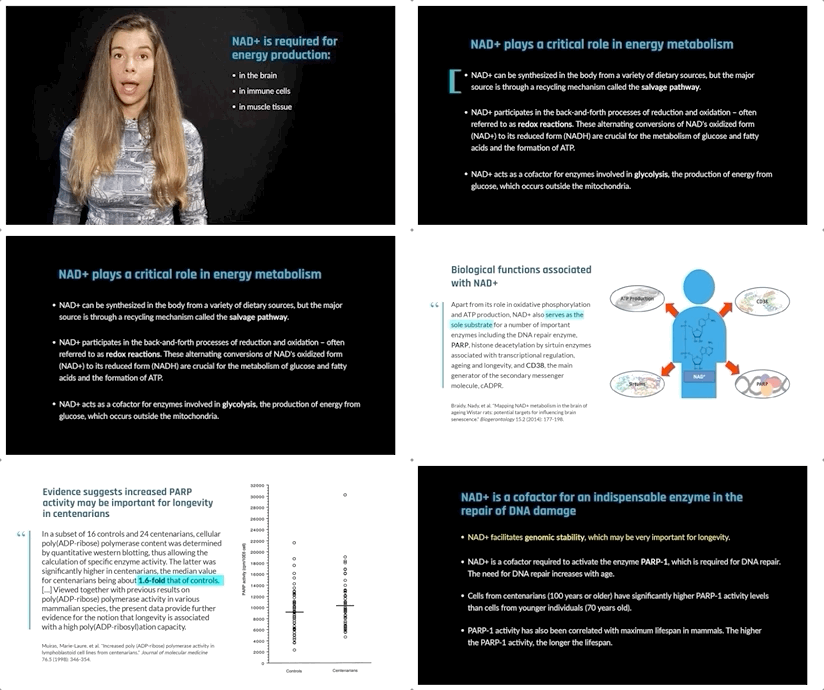
Learn more about the advantages of a premium membership by clicking below.
Hear new content from Rhonda on The Aliquot, our member's only podcast
Listen in on our regularly curated interview segments called "Aliquots" released every week on our premium podcast The Aliquot. Aliquots come in two flavors: features and mashups.
- Hours of deep dive on topics like fasting, sauna, child development surfaced from our enormous collection of members-only Q&A episodes.
- Important conversational highlights from our interviews with extra commentary and value. Short but salient.