Why VO2 Max Is a Powerful Marker of Longevity
Get the full length version of this episode as a podcast.
This episode will make a great companion for a long drive.
The BDNF Protocol Guide
An essential checklist for cognitive longevity — filled with specific exercise, heat stress, and omega-3 protocols for boosting BDNF. Enter your email, and we'll deliver it straight to your inbox.
You'll also receive updates from Rhonda & FoundMyFitness
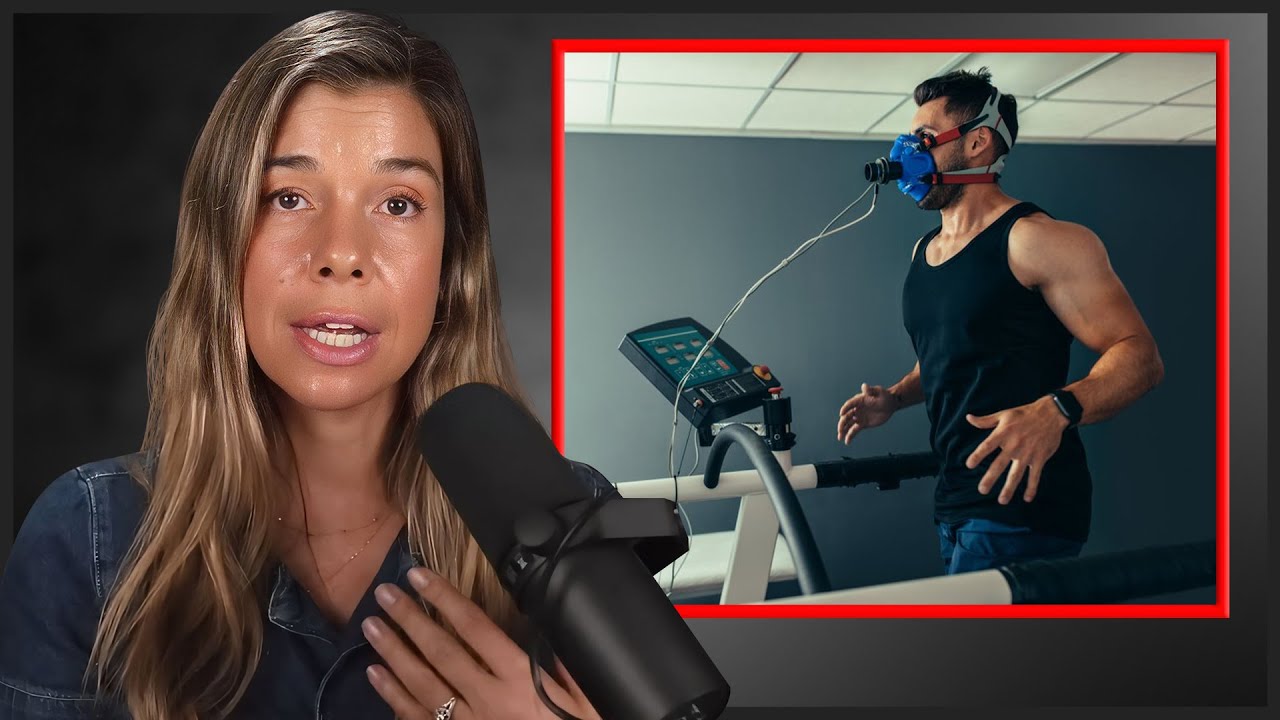
In this excerpt from Dr. Rhonda Patrick’s 2024 CrossFit Health Summit presentation, she describes VO2 max as a marker of cardiorespiratory fitness and a strong predictor of longevity. Moving from below-normal fitness into higher categories was associated with longer life expectancy, and the cohort she discusses showed no observed upper limit to the association. These estimates are observational; they do not prove that a specific VO2 max increase adds a fixed number of years.
A study of 122,007 clinically referred adults found progressively lower adjusted all-cause mortality at higher fitness levels, including the elite category. Low fitness carried risk comparable in magnitude to major clinical risk factors, but residual confounding and referral selection limit causal interpretation. [1]
Dr. Patrick recommends vigorous intervals when moderate training does not improve an individual’s VO2 max and presents repeated one-minute efforts and the Norwegian 4-by-4 as practical options. For tracking without laboratory testing, she describes a paced 12-minute run or walk on a flat course as a field estimate.
This clip is excerpted, with permission, from Dr. Rhonda Patrick's presentation at the 2024 CrossFit for Health Summit. Thank you to CrossFit for allowing us to share it.
- ^ Mandsager, Kyle; Harb, Serge; Cremer, Paul; Phelan, Dermot; Nissen, Steven E.; Jaber, Wael (2018). Association Of Cardiorespiratory Fitness With Long-term Mortality Among Adults Undergoing Exercise Treadmill Testing JAMA Network Open 1, 6.
So let's start with the vigorous exercise. So cardiorespiratory fitness is probably one of the most important biomarkers that we can measure via VO2 max, so maximal oxygen uptake during maximal exercise, that really indicates our fitness levels, right? But it also is probably one of the most important indicators of longevity. And there's been studies that have shown, probably the most important, I would say, The maximal benefits you get from improving your cardiorespiratory fitness go from if you're below normal and you go anywhere above that. So if you're below normal VO2 max and you go just to normal, you're getting about a 2.1 increase in life expectancy.
If you go below normal to high normal, which is about where half the population lies, then you're getting an almost 3-year increase in life expectancy. And then if you go to like more of an elite level, so you're getting into like above the upper limit, that's a 5-year increase in life expectancy compared to where you were when you were below normal. And about each unit increase in your VO2 max is associated with a 45-day increase in life expectancy. And there was a really important study published in JAMA journal. This was like in 2018, and there's now been a couple of papers since then. But I really liked this study because it really sort of showed that there wasn't an upper limit on the longevity benefit of improving your VO2 max.
And so people that were in the elite group of VO2 max, so this is, we're talking like the top 2.1%, those people had an 80% lower all-cause mortality compared to people that were in the lower 20% or so VO2 max, if you were not the elite, but like just you still were really fit, you had a high VO2 max, you had great cardiorespiratory fitness, you still had a 20% increase in all-cause mortality compared to the elite athletes, like the people that had the really good VO2 max. So there seemed to really be a benefit at every level. But what was so interesting about this study was that People in that low fitness group, they had a low VO2 max. Their risk of death and all-cause mortality was similar to having diseases like type 2 diabetes, cardiovascular disease. It was similar to smoking.
I mean, these things that everyone focuses on, these disease states that everyone focuses on, and we know they're bad. We know they decrease life quality. They decrease lifespan. But what people don't focus on is how Not having— not being physically fit, not having a good cardiorespiratory fitness is almost like having one of those diseases. And I really think that puts it into perspective how important VO2 max is for longevity. So how do you improve your VO2 max? How do you improve your cardiorespiratory fitness? Well, aerobic exercise is definitely one of the best ways to do that. What type of aerobic exercise? I think it's pretty clear that high-intensity Interval training is one of the best ways to improve your VO2 max, and particularly when you do longer intervals.
Yes, you can improve your your cardiorespiratory fitness with any type of aerobic exercise, particularly if you're starting from being sedentary and then going up. Right? But there was a really important study that was published—a large, large population of people—that showed people that are doing moderate intensity sort of zone two like training. You know, this is the kind of exercise that. is more enjoyable. You can go for a run, and you can still have somewhat of a conversation, you're breathy. Those people are doing 2.5 hours per week. They're meeting the guidelines, and yet, they couldn't improve their VO2 max, about 40% of those people. So, you're talking like half the population here, until they added in some high-intensity interval training.
And, once they added in some high-intensity interval training, they were able to improve their VO2 max. And so I really think that, again, this highlights the importance of really trying to get your heart rate up to at least 80% max heart rate or more. The question is, well, what kind of protocols are best for improving VO2 max? I mentioned longer intervals. I think probably, so Dr. Martin Gibala does a lot of this research at McMaster University in Ontario, Canada. And he has talked about 1 minute being sort of like probably the minimal effective dose for improving VO2 max, like at least getting in one, doing some 1-minute intervals and repeating that 4 or 5 times.
But I think one of the most evidence-based protocols, if you look in the literature out there for improving cardiorespiratory fitness, is the Norwegian 4x4 protocol. And this is where you do 4 minutes of the most— you maintain the intensity that you can for that entire 4 minutes. So you don't want to go out all out in the first minute. So you want to be able to, like, pace yourself. It's 4 minutes of, you know, high-intensity exercise followed by 3 minutes of recovery, and you do that 4 times. So it's a pretty brutal workout, but it's the Norwegian 4x4, and it's one of the best ways to improve cardiorespiratory fitness as measured by VO2 max. If you are interested in measuring your VO2 max, the best way to do it obviously would be directly to measure it, go to a lab that measures VO2 max.
If you don't have access to one of those, you don't wanna pay or whatever, there's a good evidence-based way of estimating VO2 max. And that's really the 12-minute run test or walk test depending on your fitness level. And essentially all you need is a wearable device that tracks your distance and you run, you need a flat surface because anything hilly will, obviously you won't run as far 'cause it's more challenging. So you need a flat surface, like a track field, and you run for 12 minutes, and you pace yourself. You want to go hard, but you want to be able to do it the entire time. And then, there's an equation you can look up, 12-minute run test equation, VO2 max, and it's the distance, and this whole equation will give you a really good estimate of your VO2 max, for anyone that's interested in sort of seeing how their training affects their VO2 max.
Attend Monthly Q&As with Rhonda
Support our work

The FoundMyFitness Q&A happens monthly for premium members. Attend live or listen in our exclusive member-only podcast The Aliquot.
Aerobic News
- Cardiorespiratory fitness may be a far greater predictor of gut microbiota diversity than either body fat percentage or general physical activity
- A combined aerobic-resistance training regimen proves equally effective for cardiovascular health as aerobic alone.
- 30 minutes of moderate-intensity aerobic exercise (64.9% of VO2 max) three times a week stabilized choline concentrations in the brain.