How Caffeinated and Decaf Coffee Differ for Brain Health
The BDNF Protocol Guide
An essential checklist for cognitive longevity — filled with specific exercise, heat stress, and omega-3 protocols for boosting BDNF. Enter your email, and we'll deliver it straight to your inbox.
You'll also receive updates from Rhonda & FoundMyFitness
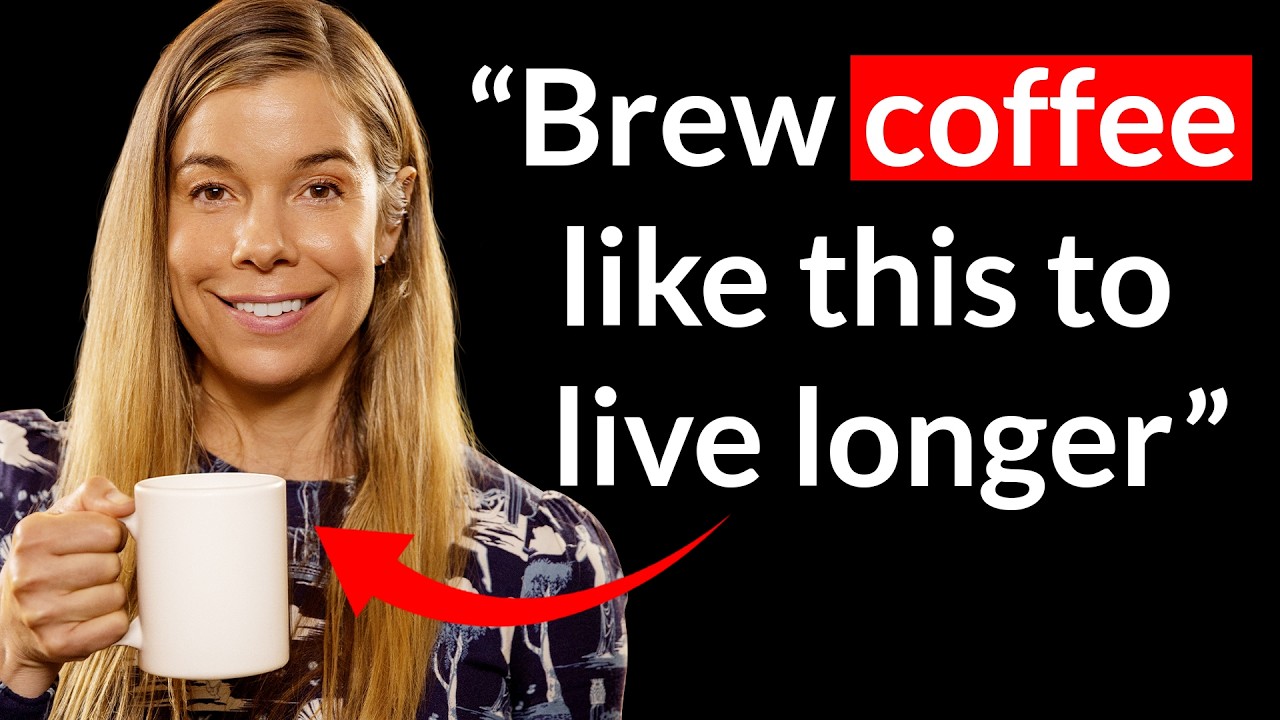
Caffeinated and decaffeinated coffee share many polyphenols, but caffeine adds alertness and blocks adenosine receptors involved in sleep pressure and dopamine signaling. In this clip, Dr. Rhonda Patrick and Derek from More Plates More Dates discuss why that difference may matter for brain health. A meta-analysis of 26 observational studies associated caffeine exposure with a lower incidence of Parkinson's disease, with a pooled relative risk near 0.75. This makes caffeine the clearest distinction when considering coffee's proposed adenosine-mediated Parkinson's pathway. [1]
Coffee's metabolic associations extend beyond caffeine. A dose-response meta-analysis of 30 prospective studies, including more than 1.18 million participants, associated each additional daily cup with about a 6 percent lower incidence of type 2 diabetes, with similar patterns for caffeinated and decaf coffee. A separate analysis of more than 10 million participants found favorable mortality associations for both forms, suggesting that coffee's polyphenols and other compounds may contribute alongside caffeine. [2] [3]
Randomized trials also provide a closer look at short-term biological effects. In 100 healthy adults, 500 milliliters of dark-roast coffee per day for four weeks reduced a blood-cell DNA strand-break marker by 23 percent from baseline compared with water. For regular use, paper filtering can reduce the cholesterol-raising diterpenes retained by unfiltered coffee, while caffeine dose and timing can be adjusted to protect sleep. [4] [5] [6]
This clip is excerpted, with permission, from a conversation between Dr. Rhonda Patrick and Derek from More Plates More Dates. Thank you to More Plates More Dates for allowing us to share it.
- ^ Costa J; Lunet N; Santos C; Santos J; Vaz-Carneiro A (2010). Caffeine exposure and the risk of Parkinson's disease: a systematic review and meta-analysis of observational studies. J Alzheimers Dis 20 Suppl 1, .
- ^ Carlström M; Larsson SC (2018). Coffee consumption and reduced risk of developing type 2 diabetes: a systematic review with meta-analysis. Nutr Rev 76, 6.
- ^ Li Q; Liu Y; Sun X; Yin Z; Li H; Cheng C, et al. (2019). Caffeinated and decaffeinated coffee consumption and risk of all-cause mortality: a dose-response meta-analysis of cohort studies. J Hum Nutr Diet 32, 3.
- ^ Schipp D; Tulinska J; Sustrova M; Liskova A; Spustova V; Lehotska Mikusova M, et al. (2019). Consumption of a dark roast coffee blend reduces DNA damage in humans: results from a 4-week randomised controlled study. Eur J Nutr 58, 8.
- ^ Cai L; Ma D; Zhang Y; Liu Z; Wang P (2012). The effect of coffee consumption on serum lipids: a meta-analysis of randomized controlled trials. Eur J Clin Nutr 66, 8.
- ^ Gardiner C; Weakley J; Burke LM; Roach GD; Sargent C; Maniar N, et al. (2023). The effect of caffeine on subsequent sleep: A systematic review and meta-analysis. Sleep Med Rev 69, .
Dr. Rhonda Patrick: I would say that the biggest difference between caffeinated and decaffeinated coffee involves the brain. People who drink caffeinated coffee can reduce their risk of Parkinson’s disease by up to 60 percent. I think it is clear, night and day. If you want neuroprotective effects, cognitive enhancement, or improved performance, caffeinated coffee is the way to go.
Coffee also shifts aging clocks by a few weeks. It is not much, but it is something. Is it the caffeine or the polyphenols? It is probably both. Multiple studies indicate that this occurs.
There is also a randomized controlled trial in which people were given caffeinated robusta coffee. Researchers measured DNA damage in blood cells, specifically double-strand breaks. This type of damage can lead to oncogenic mutations that cause cancer. It is among the most harmful forms of DNA damage. Double-strand breaks can also accelerate aging and play a role in epigenetic aging, which relates to the biological clocks I was just discussing.
People who drank robusta coffee lowered their double-strand breaks by 23 percent compared with people who drank water, which is a robust effect. Again, it was caffeinated coffee, not decaf. Could decaf have done the same thing? We do not know because that experiment was not done.
Type 2 diabetes is another important area in which coffee is known to be beneficial. You might say, “Wait a minute. I have read studies showing that coffee can acutely raise blood glucose.” I have measured that in myself while wearing a continuous glucose monitor. Yes, coffee can produce an acute rise in blood glucose because of sympathetic activation.
Over the long term, however, coffee appears to be beneficial. Both caffeine and the polyphenols in coffee, including chlorogenic acids, activate AMP-activated protein kinase. This master metabolic sensor activates energy pathways and shifts the body toward using fatty acids rather than glucose for energy. Glucose may be directed into useful tissues such as muscle instead of being stored as triglycerides. Long-term studies show that coffee is beneficial for metabolic health.
The real surprise for me was that the relationship with neurodegenerative-disease risk also depended on caffeine. I thought the polyphenols would be responsible, but caffeine seems to be the major driver.
Derek: Yeah.
Dr. Rhonda Patrick: There are different neurodegenerative diseases. With Parkinson’s disease, people lose dopamine-producing neurons in a part of the brain called the substantia nigra. This affects motor control, motivation, and mood. Dopamine plays a role in the willingness to act on something.
Adenosine receptors appear to play a key role in the Parkinson’s story. People who drink caffeinated coffee can reduce their risk of Parkinson’s disease by up to 60 percent. That is important to me because Parkinson’s disease runs in my family. My father has Parkinson’s, so I am very concerned about preventing it.
Caffeinated coffee appears to be the way to go rather than decaf. I think that comes down to blocking adenosine receptors. Persistent activation of adenosine receptors produces inhibitory signaling that seems to play a role in Parkinson’s disease in a specific part of the brain. My father never drank coffee. I know that is only an n-of-one observation, but caffeine seems important for Parkinson’s prevention and for Alzheimer’s disease as well.
You will find some studies in which decaf coffee appears beneficial, but the relationship is much stronger when caffeine is included. If you want neuroprotective effects, cognitive enhancement, performance, or longevity benefits, caffeinated coffee is the way to go. Caffeinated coffee is not bad for you.
For a long time, there was an idea that coffee might cause cancer because roasting coffee beans produces acrylamide, which is a carcinogen. Do you remember that?
Derek: It does not surprise me that somebody would have said that.
Dr. Rhonda Patrick: It was classified as a probable carcinogen. It turns out that coffee is not a probable carcinogen; it is associated with a lower risk of several common cancers, such as liver cancer. As more data emerge, we realize that the amounts of acrylamide in coffee are so small that they do not appear to matter.
Derek: What do you think is the mechanism? I do not necessarily mean stimulants broadly, because there is a point at which too much dopamine neurotransmission can cause neuronal death. Is some stimulatory effect in the brain offsetting neurodegeneration?
Dr. Rhonda Patrick: It is not really known. I am very curious and have looked into it, but why caffeine appears protective against neurodegenerative disease is not understood. Nicotine does something similar, particularly with Parkinson’s disease. There is some overlap between nicotine and caffeine stimulation. That intrigues me because there is part of this story that has not been figured out.
Derek: Yeah.
Dr. Rhonda Patrick: We see it in large data sets, we see it replicated, and we see it with other stimulants. I am not promoting nicotine. There are obvious tradeoffs with smoking and perhaps even with nicotine itself. We do not really know. There is a mechanism that needs to be uncovered to understand why this stimulation appears beneficial for protection against neurodegenerative disease. The association is particularly strong for Parkinson’s disease with both caffeine and nicotine.
Derek: I wonder if that is because Parkinson’s is more dopamine-related and the neurotransmission component is an important part of the mechanism.
Dr. Rhonda Patrick: I think it is. Studies show that inhibiting adenosine A2A receptors increases dopamine-receptor activity. There is a feedback mechanism.
Derek: Yeah.
Dr. Rhonda Patrick: I do not know exactly why. Perhaps a neuroscientist could explain it better. The phenomenon is observable, but the question is why. Adenosine signaling appears to involve inhibitory signaling as well.
Hear new content from Rhonda on The Aliquot, our member's only podcast

Listen in on our regularly curated interview segments called "Aliquots" released every week on our premium podcast The Aliquot. Aliquots come in two flavors: features and mashups.
- Hours of deep dive on topics like fasting, sauna, child development surfaced from our enormous collection of members-only Q&A episodes.
- Important conversational highlights from our interviews with extra commentary and value. Short but salient.
Coffee News
- Daily consumption of dark roast coffee reduces DNA damage in healthy adults.
- Drinking black coffee may reduce the likelihood of early death by up to 17%.
- Coffee consumption is associated with a reduced risk of irregular heartbeats.
- wo coffee compounds (cafestol & caffeic acid) increased glucose uptake into muscle similar to an antidiabetic drug.