How Coffee Supports Healthy Aging
The Omega-3 Supplementation Guide
A blueprint for choosing the right fish oil supplement — filled with specific recommendations, guidelines for interpreting testing data, and dosage protocols.
You'll also receive updates from Rhonda & FoundMyFitness
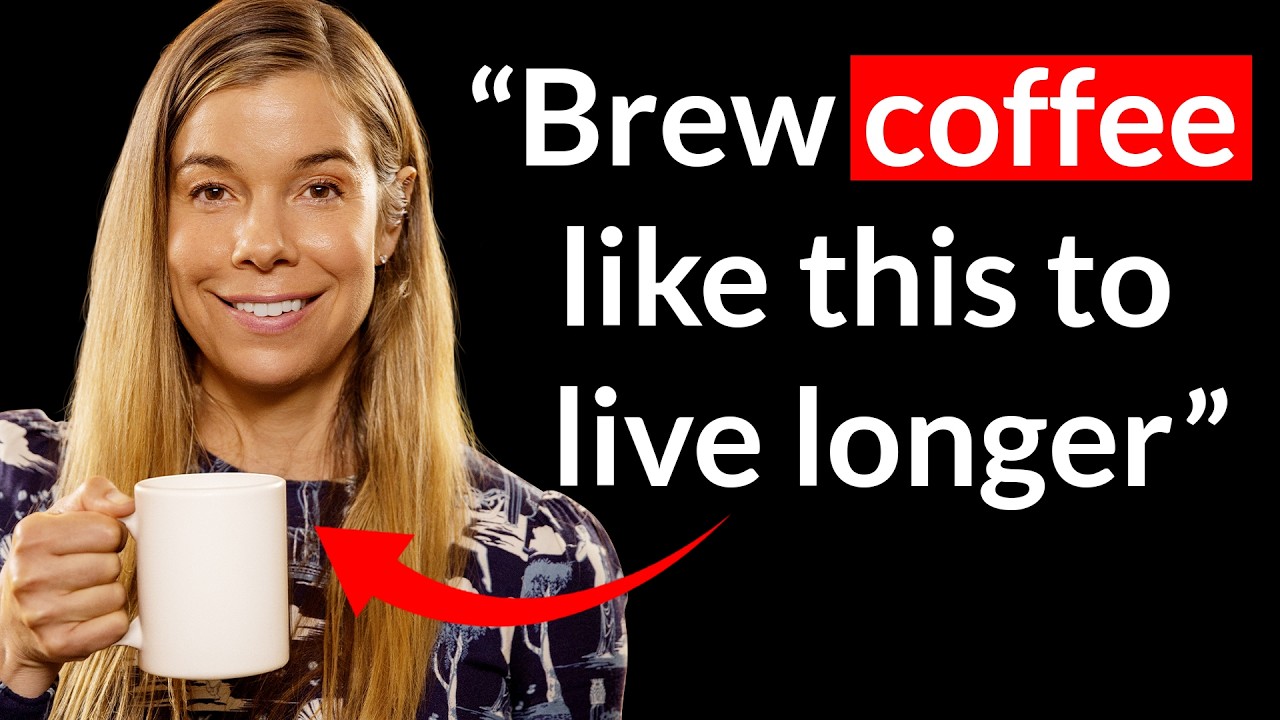
Coffee contains caffeine and polyphenols such as chlorogenic acids. In this clip from Dr. Rhonda Patrick's appearance on Mayim Bialik's Breakdown, she discusses how coffee preparation, dose, and caffeine content can shape its effects. In the 521,330-person EPIC cohort, participants in the highest country-specific quartile of coffee intake had lower all-cause mortality over an average 16.4 years than nonconsumers. The association was observational, with hazard ratios of 0.88 in men and 0.93 in women. [1]
Caffeinated and decaffeinated coffee may share part of that association. Across three large US cohorts totaling 208,501 adults, one to five cups per day of either caffeinated or decaffeinated coffee was associated with lower mortality. Because these were prospective cohorts rather than randomized trials, the findings support an association while allowing for differences in smoking, diet, sleep, and other behaviors. [2]
Brewing method changes the compounds that reach the cup. In a six-month randomized trial of 46 healthy adults, five to six strong cups of cafetière coffee per day raised LDL cholesterol and alanine aminotransferase relative to paper-filtered coffee. This supports Dr. Patrick's practical distinction between unfiltered coffee, which retains more cafestol and kahweol, and paper-filtered coffee, which removes much of these diterpenes. [3]
This clip is excerpted, with permission, from Dr. Rhonda Patrick's appearance on Mayim Bialik's Breakdown. Thank you to Mayim Bialik's Breakdown for allowing us to share it.
- ^ Gunter MJ; Murphy N; Cross AJ; Dossus L; Dartois L; Fagherazzi G, et al. (2017). Coffee Drinking and Mortality in 10 European Countries: A Multinational Cohort Study. Ann Intern Med 167, 4.
- ^ Ding M; Satija A; Bhupathiraju SN; Hu Y; Sun Q; Han J, et al. (2015). Association of Coffee Consumption With Total and Cause-Specific Mortality in 3 Large Prospective Cohorts. Circulation 132, 24.
- ^ Urgert, R.; Meyboom, S.; Kuilman, M.; Rexwinkel, H.; Vissers, M. N; Klerk, M., et al. (1996). Comparison Of Effect Of Cafetiere And Filtered Coffee On Serum Concentrations Of Liver Aminotransferases And Lipids: Six Month Randomised Controlled Trial Bmj 313, 7069.
Mayim Bialik: Talk to us about coffee.
Dr. Rhonda Patrick: Coffee? I know. Should you drink it? Should you not drink it? Everyone drinks it, right? Who doesn't drink coffee?
Mayim Bialik: I don't drink coffee.
Jonathan Cohen: Well, you drink a little tea through your boba, but probably not enough caffeine.
Mayim Bialik: Oh my gosh. Do you know how much microplastic is in boba? I know. He always tells me there was a girl on Instagram and her stomach was full of boba. It was like one big plastic mess.
Jonathan Cohen: Those things are plastic. Honey, it's the only fun thing left. You're just putting in Lego pieces.
Dr. Rhonda Patrick: Eat it with fiber. Fiber helps stop the absorption of microplastics.
Mayim Bialik: Put chia seeds in my boba.
Dr. Rhonda Patrick: Yes, that's right. Chia seeds in the boba.
Jonathan Cohen: I want to reconcile the benefits of coffee. I drink a good amount of coffee.
Mayim Bialik: He gets weird if he drinks too much, and he gets weird if he drinks too little.
Jonathan Cohen: That is correct.
Dr. Rhonda Patrick: Add some L-theanine.
Jonathan Cohen: I've tried that, but Dr. Amen is like, "No, caffeine is not good for your brain. It restricts blood flow." He's totally against caffeine. Help me reconcile the difference.
Dr. Rhonda Patrick: Oh my gosh, really? That's so interesting. We'll get to the brain in a minute, but I did a deep dive on coffee, and it has so many health benefits that are undeniable. The polyphenol content in coffee is extremely high. We're talking about coffee itself, not coffee with a ton of sugar and milk.
Jonathan Cohen: I drink my coffee black.
Dr. Rhonda Patrick: The additives can negate the benefits.
Mayim Bialik: A lot of people are like, "I go to Starbucks. It's great." Sorry.
Dr. Rhonda Patrick: No, it's the coffee itself. Polyphenols such as chlorogenic acids are powerful. They have anti-inflammatory and antioxidant activity. Studies have shown that people who drink one to three cups of coffee a day have lower all-cause mortality, around 30 percent lower than people who do not drink coffee.
There have also been studies looking at biological aging through epigenetic signatures, the methylation groups that change with age. You can estimate someone's age from those patterns. Coffee consumption was associated with delaying biological aging by about one year. It has also been associated with lower cardiovascular disease risk and type 2 diabetes risk.
When it comes to dementia and Alzheimer's disease, I should note that decaffeinated coffee is also beneficial because of the polyphenols. It is not the caffeine unless we're talking about the brain. The associations with dementia and Alzheimer's disease seem to depend on caffeine. Decaf did not have that effect. The amount of vasoconstriction from caffeine is not that high, and the polyphenols may counter it, but you might expect decaf to have the same effect. It does not. Caffeine seems to be required.
That is interesting because nicotine, which is all the rage and which I would stay away from, has some similarities.
Mayim Bialik: I'm sorry, nicotine is all the rage?
Jonathan Cohen: People are using it. She doesn't go on the internet, so she doesn't know. Also, the Dr. Amen study involved people who drank six or more cups a day. It was a high volume of coffee.
Dr. Rhonda Patrick: Let me explain. People who drink around eight cups or more a day have an increased risk, but it was only at eight cups or more. At one, two, three, or four cups, they had a 50 percent lower risk.
Jonathan Cohen: There is something about excessive intake. I don't know who is drinking eight cups, but that is a lot.
Dr. Rhonda Patrick: It will disrupt sleep, which is itself a dementia risk. The way you brew coffee also matters. Filtering removes diterpenes, which can increase LDL cholesterol. That is important because coffee can increase LDL cholesterol, especially if you're adding cream.
Jonathan Cohen: Wait, you were going to talk about nicotine. Nicotine is all the rage.
Dr. Rhonda Patrick: Nicotine is used as a nootropic. People use little mints, Zyn pouches, or Nicorette gum for a nootropic effect. It can improve focus and productivity. I'm terrified that I will love it, so I'm definitely not trying it.
Jonathan Cohen: It's delightful. It's a great drug. Some people claim it has an anti-Alzheimer's effect.
Dr. Rhonda Patrick: That's what I was getting at. A few studies have looked at nicotine. Nicotine also causes vasoconstriction. There is a little similarity between nicotine and caffeine.
Mayim Bialik: They're both diuretics, right? Is nicotine a diuretic too? They used to recommend it for digestion.
Dr. Rhonda Patrick: I didn't know that. I think there is some overlap. Coffee required caffeine to be associated with protection against Parkinson's disease. They may be doing something similar where there is a protective association with neurodegenerative disease, although there is a lot of speculation.
Mayim Bialik: Just don't smoke it. Put it in your gum.
Dr. Rhonda Patrick: No, I don't think that's good. Nicotine can contribute to cardiovascular disease and hypertension. It constricts blood vessels.
Jonathan Cohen: Got it. So that is not only a mechanism of smoke. That is nicotine.
Dr. Rhonda Patrick: Yes. That is not a mechanism of caffeine. People are using nicotine because they want to be productive and smarter.
Mayim Bialik: Can't they just microdose like all the guys in Silicon Valley?
Dr. Rhonda Patrick: If you're going to do it, definitely use a small dose. But people are not. I've had people come up to me after talks and say they go through six of these a day. I'm like, "Six of these?"
Jonathan Cohen: Closing the loop on coffee, I've heard that decaf is washed with chemicals, so you should avoid it because of the chemical process.
Dr. Rhonda Patrick: It depends on the decaf coffee you're buying. A paint-thinner-like method can be used to decaffeinate coffee. However, by the time it ends up in your cup, the amount is so insignificant. Studies showing benefits of decaf include people drinking ordinary decaf coffee. Other methods include the Swiss Water process and the carbon dioxide process.
Mayim Bialik: Don't tell him. He'll start doing it.
Dr. Rhonda Patrick: I understand the concern because you can obsess over little things, but you have to choose your battles. I don't think that is a battle to choose. Studies show that people drinking decaf coffee have many benefits, and most of them are drinking ordinary decaf.
Jonathan Cohen: Tell me your coffee protocol. What filter system are you using?
Dr. Rhonda Patrick: I like pour-over coffee and the Chemex filter. I use the unbleached brown paper filter.
Mayim Bialik: Are there coatings of microplastic in those? That's what I use, and I'm wondering.
Dr. Rhonda Patrick: There are not supposed to be, but I'm sure a study will come out in a month or two saying yes, because that seems to be where we're going.
Jonathan Cohen: The ceramic filter clogs, and then you spend 25 minutes making your coffee.
Mayim Bialik: Do you want to die or don't you?
Dr. Rhonda Patrick: That's the best way. I also drink instant coffee, which has benefits as well.
Jonathan Cohen: Interesting. I didn't picture you as a Folgers girl.
Dr. Rhonda Patrick: Not Folgers, but sometimes I don't have time, or I'm traveling, so I'll drink instant coffee.
Mayim Bialik: I've had one can for 20 years in the freezer because I use it when I make my honey cake.
Dr. Rhonda Patrick: There is a brand called Mount Hagen instant coffee that is pretty good.
Jonathan Cohen: What's the difference between the benefits of instant coffee and pour-over coffee?
Dr. Rhonda Patrick: With instant coffee, you're getting many of the same polyphenols. With pour-over coffee, you're filtering out the diterpenes that can raise LDL cholesterol. The amount in instant coffee is so small that it is not a major factor.
Supporting our work
If you enjoy the fruits of
 , you can participate in helping us to keep improving it. Creating a premium subscription does just that! Plus, we throw in occasional member perks and, more importantly, churn out the best possible content without concerning ourselves with the wishes of any dark overlords.
Coffee News
- Daily consumption of dark roast coffee reduces DNA damage in healthy adults.
- Drinking black coffee may reduce the likelihood of early death by up to 17%.
- Coffee consumption is associated with a reduced risk of irregular heartbeats.
- wo coffee compounds (cafestol & caffeic acid) increased glucose uptake into muscle similar to an antidiabetic drug.