How Fasting Changes Fat Burning and Brain Fuel
The Omega-3 Supplementation Guide
A blueprint for choosing the right fish oil supplement — filled with specific recommendations, guidelines for interpreting testing data, and dosage protocols.
You'll also receive updates from Rhonda & FoundMyFitness
Intermittent fasting is often presented as a direct fat-burning switch. In this clip from Dr. Rhonda Patrick's appearance on The Diary of a CEO, she explains that a shorter eating window can make calorie reduction easier, while a longer overnight fast shifts fuel use toward fatty acids and ketones. Human trials show that time-restricted eating can support modest weight loss, but it has not consistently outperformed conventional calorie restriction or produced additional visceral-fat loss when compared with structured dietary counseling. [1] [2] [3]
Dr. Patrick also describes her preference for fasting in the morning, the cognitive focus she associates with ketosis, and her use of short aerobic workouts before eating. Fasted aerobic exercise increases fat oxidation during the workout, but evidence does not show reliably greater long-term body-fat loss, and evidence for superior training adaptations remains incomplete. [4] [5]
The practical boundary is exercise duration and overall energy availability. Pre-exercise feeding can improve prolonged aerobic performance, while persistent under-fueling can disrupt reproductive function in active women. Ketones can serve as an alternative brain fuel, but current evidence does not establish that ordinary intermittent fasting clears brain fog in healthy adults. Human studies also cannot define a universal hour when autophagy switches on. [6] [7] [8]
This clip is excerpted, with permission, from Rhonda Patrick's appearance on The Diary of a CEO. Thank you to The Diary of a CEO for allowing us to share it.
- ^ Liu D; Huang Y; Huang C; Yang S; Wei X; Zhang P, et al. (2022). Calorie Restriction with or without Time-Restricted Eating in Weight Loss. N Engl J Med 386, 16.
- ^ Alexandria, Shaina; Chakos, Kaitie; Cienfuegos, Sofia; Ezpeleta, Mark; Gabel, Kelsey; Lin, Shuhao, et al. (2023). Time-Restricted Eating Without Calorie Counting For Weight Loss In A Racially Diverse Population Annals Of Internal Medicine 176, 7.
- ^ Dote-Montero M; Clavero-Jimeno A; Merchán-Ramírez E; Oses M; Echarte J; Camacho-Cardenosa A, et al. (2025). Effects of early, late and self-selected time-restricted eating on visceral adipose tissue and cardiometabolic health in participants with overweight or obesity: a randomized controlled trial. Nat Med 31, 2.
- ^ Vieira AF; Costa RR; Macedo RC; Coconcelli L; Kruel LF (2016). Effects of aerobic exercise performed in fasted v. fed state on fat and carbohydrate metabolism in adults: a systematic review and meta-analysis. Br J Nutr 116, 7.
- ^ Aird TP; Davies RW; Carson BP (2018). Effects of fasted vs fed-state exercise on performance and post-exercise metabolism: A systematic review and meta-analysis. Scand J Med Sci Sports 28, 5.
- ^ De Souza, Mary Jane; Mallinson, Rebecca J; Strock, Nicole Ca; Koltun, Kristen J; Olmsted, Marion P; Ricker, Emily A, et al. (2021). Randomised Controlled Trial Of The Effects Of Increased Energy Intake On Menstrual Recovery In Exercising Women With Menstrual Disturbances: The ‘REFUEL’ Study Human Reproduction 36, 8.
- ^ Fortier, Mélanie; Castellano, Christian-Alexandre; St-Pierre, Valérie; Myette-Côté, Étienne; Langlois, Francis; Roy, Maggie, et al. (2020). A Ketogenic Drink Improves Cognition In Mild Cognitive Impairment: Results Of A 6‐Month RCT Alzheimer's &Amp; Dementia 17, 3.
- ^ Dethlefsen MM; Bertholdt L; Gudiksen A; Stankiewicz T; Bangsbo J; van Hall G, et al. (2018). Training state and skeletal muscle autophagy in response to 36 h of fasting. J Appl Physiol (1985) 125, 5.
Steven Bartlett: So, on this point of fasting, are you a fan of fasting to combat visceral fat? Could you also give me your thoughts on being in a ketogenic state as it relates to visceral fat?
Dr. Rhonda Patrick: People often think about intermittent fasting as one thing: weight loss. But there is a lot going on here, and I like that you mentioned being in a ketogenic state because there is also a metabolic switch. This is the switch from burning carbohydrates and glucose to burning fatty acids and entering ketosis. Those are two different things.
Intermittent fasting is essentially a tool that people can use to reduce their calorie intake without having to count calories. That is why I like it. You can lose weight by counting calories and reducing your calorie intake, but I personally think that is a lot of work. Some people love doing it, and that is great. Whatever works for a person.
The way intermittent fasting helps people lose visceral fat is by reducing calorie intake. It is a tool I like because I can skip one meal—while making sure I get enough nutrients and protein in the meals I do eat—and create a caloric deficit without having to count everything. It is easier for me.
Steven Bartlett: How do you do that? What is your method?
Dr. Rhonda Patrick: I like to fast in the morning because of ketosis, which I call the metabolic switch. You are not eating while you sleep. If you are in bed for nine or ten hours, you are not eating during that time. It takes about 10 to 12 hours for your liver to deplete glycogen. Glucose taken up by the liver is stored as glycogen so that you can use it for energy later when you do not have energy coming in.
Steven Bartlett: So glycogen is like the petrol station. It runs out of petrol and switches to diesel.
Dr. Rhonda Patrick: That is right. After that metabolic switch, when you deplete glycogen while sleeping or not eating for about 12 hours, your body changes fuels. This timing is relative because it depends on the foods you eat and how physically active you are. If you eat a lot of high-carbohydrate, refined-sugar foods, it might take longer to deplete glycogen because you keep filling the fuel tank. If you eat foods that are lower in carbohydrates, you might deplete glycogen sooner.
When you deplete glycogen, your body still needs energy, but glucose is not available. Fatty acids are mobilized from adipose tissue, including visceral fat. You start using those fatty acids for energy, and ketones are produced in the process.
I typically fast for about 16 hours a day and eat my meals within an eight-hour window. I like being in that metabolic-switch state for several reasons. Ketones provide the brain with readily usable energy, but they also act as signaling molecules. It is as though they are telling the brain, “This is a stressful time. There is no food. You need to be cognitively sharp and find food.”
That is an evolutionary adaptation. For thousands of years, humans went through this metabolic switch because food was not always available. When I enter that state, I feel more cognitively sharp and less anxious. Ketones also help increase GABA, an inhibitory neurotransmitter that can help you feel calmer. When I feel calmer, I am more cognitively focused because the background anxiety is lower. I like being in that state in the morning because that is when I get my work done.
I also like fasting because it gives the body more time in a repair state. A fed state is important for anabolic growth, but repair is also important because growth comes with damage. You want to repair that damage because damage can accelerate aging. I do not want to wake up and eat as soon as I have barely depleted liver glycogen. I want to extend the fasted state a little longer. Repair is still active during a fed state, but it is heightened when you are fasted.
Those are the reasons I like intermittent fasting. I feel good when I do it. I also do a lot of cardiovascular and aerobic-endurance training while fasted, including running and biking. I am not going for a 10-mile run; I am going for a three-mile run. If I were going for a 10-mile run, I would not be fasted because I would need fuel.
Studies have compared aerobic-endurance training—such as running, cycling, and swimming—in fasted and fed states. Much of the benefit from aerobic exercise comes from how the body responds to the work. The work causes inflammation and oxidative damage, and the body responds by activating anti-inflammatory and antioxidant pathways.
Your body also needs fuel. If you are fasted, you become better at burning and oxidizing fat, and you can continue to do that better throughout the day. You also develop mitochondrial adaptations and make more mitochondria. Mitochondria are tiny organelles inside most of our cells that make energy. They are important for the brain, heart, lungs, and everything else. Exercise increases the number of new, healthy mitochondria you make whether you are fed or fasted, but the adaptation can be greater when you are fasted.
There has been a big debate about whether this applies to both men and women. My reading of the literature, along with what I have learned from experts who study male and female responses to exercise, starts with this question: How do you feel when you exercise fasted? If you feel terrible, that is a sign. Listening to your body is important. There are times when I need to eat before I exercise, and I listen to my body and eat.
It also depends on what you are doing. Are you doing a 30-minute run or a two-hour run? If you are doing a two-hour run, you need to fuel. That is a large stress. For a 30-minute run, you do not necessarily need to fuel first.
The problem for women can arise when they are in too much of a caloric deficit, do not refuel enough afterward, and perform very long, high-volume exercise. That can disrupt hormones such as follicle-stimulating hormone and luteinizing hormone. Women can become amenorrheic, stop ovulating, and stop having menstrual periods.
Steven Bartlett: What is the evolutionary reason for that?
Dr. Rhonda Patrick: The body senses that there is not enough food and energy available to sustain a growing fetus. It essentially decides not to allow a pregnancy, so ovulation stops.
This is not common. It occurs in situations such as elite female athletes who are not eating enough food. I did this to myself in my early twenties when I was racing marathons. I ran eight to ten miles a day, five days a week, and I was eating carrots and hummus. I was not fueling myself adequately.
If you feel terrible when you train fasted, do not do it. If you want to train somewhat fasted, you could have a protein shake with a little almond milk so that you are getting something without eating a full meal.
I do a lot of my training fasted. I am 47 years old and in perimenopause.
Steven Bartlett: You are in phenomenal shape.
Dr. Rhonda Patrick: Thank you. As I started to reach perimenopause, I noticed that I had to be more aggressive and put in more effort to prevent fat from accumulating around my belly. It started appearing, and I did not want it. It was not an option for me.
Get email updates with the latest curated healthspan research
Support our work
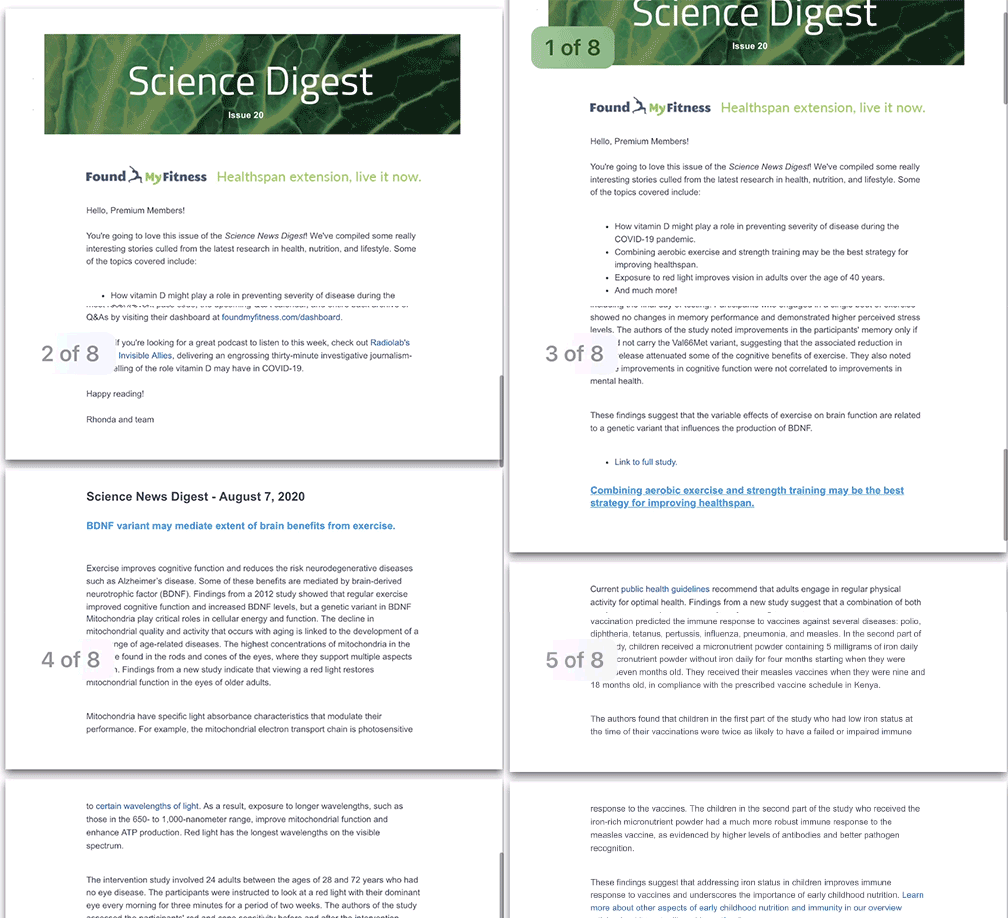
Every other week premium members receive a special edition newsletter that summarizes all of the latest healthspan research.
Fasting News
- Alternate-day fasting outperforms other intermittent fasting methods in weight loss and cholesterol reduction, according to a systematic review and meta‐analysis.
- Intermittent fasting three nonconsecutive days per week coupled with regular exercise promotes more weight loss than daily calorie restriction.
- Fasting-based dietary strategies, including intermittent fasting and time-restricted eating, show slight superiority over calorie restriction for promoting weight loss and improving insulin sensitivity.
- Cyclic fasting-mimicking diet in cancer treatment: Preclinical and clinical evidence
- Mild intermittent fasting can have a surprisingly negative effect on immunity: skipping breakfast led to a 90% drop in white blood cell count.