How Insulin Resistance Can Appear Before High Glucose
Get the full length version of this episode as a podcast.
This episode will make a great companion for a long drive.

The Omega-3 Supplementation Guide
A blueprint for choosing the right fish oil supplement — filled with specific recommendations, guidelines for interpreting testing data, and dosage protocols.
You'll also receive updates from Rhonda & FoundMyFitness
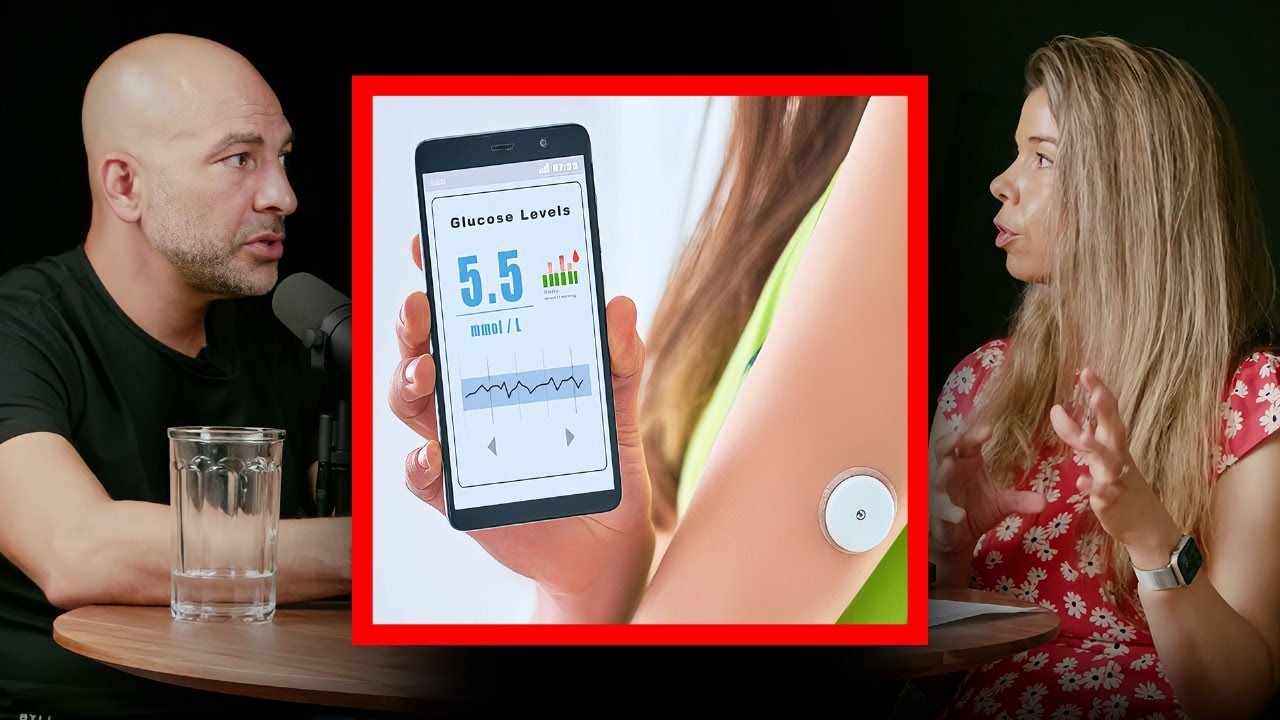
In this clip from Dr. Rhonda Patrick's interview with Dr. Ben Bikman, he describes how insulin resistance can be present while fasting glucose still appears normal. He focuses on changes after eating and on two visible findings, acanthosis nigricans and multiple skin tags, as possible reasons to look more closely at metabolic health.
Clinical studies support these skin findings as associations rather than stand-alone diagnoses. In one hospital study, insulin resistance was more common in people with acanthosis nigricans or skin tags than in controls. Separate studies also found higher insulin measures among people with biopsy-confirmed acanthosis nigricans and among patients with multiple skin tags. [1] [2] [3]
Post-meal glucose can add useful context, and a CGM can help a person see how glucose changes with meals and activity. Standard metabolic screening still relies on validated laboratory measures such as A1c, fasting plasma glucose, or a two-hour glucose value after a standardized oral glucose tolerance test. Skin changes or unexpected glucose patterns can therefore be useful prompts for a clinical evaluation. [4] [5]
- ^ Singh SK; Agrawal NK; Vishwakarma AK (2020). Association of Acanthosis Nigricans and Acrochordon with Insulin Resistance: A Cross-Sectional Hospital-Based Study from North India. Indian J Dermatol 65, 2.
- ^ Varthakavi PK; Waingankar A; Patel KL; Wadhwa SL; Khopkar U; Sengupta RA, et al. (2002). Acanthosis nigricans: a dermatologic marker of metabolic disease. Indian J Dermatol Venereol Leprol 68, 2.
- ^ Sari R; Akman A; Alpsoy E; Balci MK (2010). The metabolic profile in patients with skin tags. Clin Exp Med 10, 3.
- ^ American Diabetes Association Professional Practice Committee for Diabetes* (2026). 2. Diagnosis and Classification of Diabetes: Standards of Care in Diabetes-2026. Diabetes Care 49, Supplement_1.
- ^ Klonoff, David C.; Nguyen, Kevin T.; Xu, Nicole Y.; Gutierrez, Alberto; Espinoza, Juan; Vidmar, Alaina (2022). Use Of Continuous Glucose Monitors By People Without Diabetes: An Idea Whose Time Has Come? Journal Of Diabetes Science And Technology 17, 6.
Dr. Rhonda Patrick: Just as a follow-up question, continuous glucose monitors are becoming very popular. Many people have them without a prescription. You can get them. Are there any signs or tests people can use to look for this potential problem of having high insulin? In fact, they're not measuring insulin, but glucose.
Dr. Ben Bikman: To answer the question directly, I'm an enormous advocate of CGM use. The more we democratize access to CGMs, I think the better we put individuals in a position to be their own coach. They don.t need to have someone like me or you berating them and telling them to change their habits and eat a little better. When you see how your body's responding to what you're eating and the CGM enables that, you end up making your own lifestyle changes. So, with the use of the CGM, fasting glucose isn't going to be the best indicator. It's going to be the dynamic glucose. So, if you've eaten a carbohydrate-heavy meal or a simple carbohydrate, I shouldn't call it a big meal, but a simple carbohydrate like two pieces of bread, if your glucose levels aren't back down to normal by about two hours, that suggests a problem. So in my mind, the greatest utility of the CGM is to monitor the dynamic changes rather than the static question, "Where am I every morning?". That has less value. The dynamic changes are what has value. But beyond the use of the CGM, if a person's curious about their insulin resistance, in many instances, you don't even need to get a blood test. The skin is a window to the metabolic soul. There are two things you can observe on your skin, and both are generally around the neck. One of them is a condition called acanthosis nigricans. Around the small skinfold most people have on their neck, the skin becomes darker which can be harder to tell depending on the pigment of the person's skin. But what is obvious regardless of pigment is the kind of crinkled tissue paper texture of the skin. The skin will be rough, like crinkled tissue paper. So that's acanthosis nigricans around the neck. And then the other one people know is called skin tags. It is not a rounded mole, but rather a distinct, small, mushroom-stalk-like column of skin. People probably know what I'm talking about. You can see them around the neck. Sometimes you can see them around the armpits. But again, it's just a teeny little like a little mushroom stock almost of skin. Skin tags. Both of those are very strong evidence of insulin resistance. The nice thing is that as insulin sensitivity improves, those problems go away, just like everything else will.
Dr. Rhonda Patrick: So many researchers, including you, view insulin resistance as a root cause of many chronic and age-related diseases. Obviously, type 2 diabetes, obesity, and cardiovascular disease are in there.
Dr. Ben Bikman: Alzheimer's, fatty liver disease, infertility.
Dr. Rhonda Patrick: So why do people think of that as the root cause of so many chronic diseases? You're talking about insulin resistance being common and the prediabetic state being pretty common. What do you think the reason is?
Dr. Ben Bikman: For the first part of the question, I unapologetically embrace the view that to some degree, that's italicized wording there, to some degree, insulin resistance is a common root cause for most chronic diseases. So I'm not claiming that it's the singular cause. For example, the connection between insulin resistance and breast and prostate cancers, the two most common cancers in men, in women and men respectively. I'm not saying insulin resistance is the singular contributor, not at all. But it is absolutely a contributor with regards to Alzheimer's disease. Insulin is not probably the singular contributor but it is one undeniably and the same goes for polycystic ovary syndrome the most common infertility in women or erectile dysfunction in men and fatty liver disease and hypertension. In fact, this is the question I asked myself as an academic at my university when I got tenure. I looked at the rest of my future career and thought, "Do I want my career to be defined by the number of peer-reviewed papers I publish in science journals?" I thought, "No, that.s not enough," because most people will never read those articles. No one will ever get a direct benefit from them. I thought about the one message I would want to convey to people as a biomedical metabolic scientist, and it was this one. It was that to some degree most of chronic disease can be attributed to one common origin. And so rather than trimming at the branches of this sick tree where we are giving the patient a drug for their Alzheimer's disease, we.re giving the patient a drug for hypertension, we're giving them a drug for their infertility. What if all of those were actually just branches coming off of one tree? Let's just cut down the tree. So when we can acknowledge a sort of common soil hypothesis, it starts to simplify the clinical approach. So all of this in my mind is a reflection of just how powerful the hormone insulin is. Most individuals only think about insulin as being a hormone that controls blood sugar, which is fantastically unfair. Insulin is one of the few peptide hormones that will literally affect every single cell of the body from brain cells to bone cells, lung cells to liver cells, and every cell in between. There's no exception. Insulin will have an effect at every cell of the body. And the particular pathology with insulin resistance is unique because you have some cells that aren't responding very well to insulin. Like in the case of erectile dysfunction, insulin is less capable at producing nitric oxide in the endothelium of the blood vessels. So there's less vasodilation. Less vasodilation means compromised erectile function. So on one hand, you have some cells that suffer because they're not responding. But on the other hand, you have some cells that are overstimulated because insulin resistance is insulin not working the same at all cells of the body and blood insulin levels are higher. So there's too much insulin. Some cells are responding too much to that insulin. So with polycystic ovary syndrome, for example, that's not a problem of the insulin signal not working well. That's a problem of there being too much insulin stimulating the ovary to inhibit the conversion of testosterone into estrogens and thus she manifests with polycystic ovaries. So, to some degree, most chronic diseases can be connected back to insulin resistance and to me that has a tremendous power. That's a reason to focus on that disorder.
Get email updates with the latest curated healthspan research
Support our work

Every other week premium members receive a special edition newsletter that summarizes all of the latest healthspan research.