How Vitamin D Status Connects to Gene, Brain, and Immune Function
The Omega-3 Supplementation Guide
A blueprint for choosing the right fish oil supplement — filled with specific recommendations, guidelines for interpreting testing data, and dosage protocols.
You'll also receive updates from Rhonda & FoundMyFitness
In this Institute for Functional Medicine excerpt, Dr. Rhonda Patrick answers a longevity question with a food-first premise: identify essential micronutrients and choose foods that supply them before focusing only on what to avoid. She uses vitamin D as an exception often obtained through sun exposure or supplements and states that about 70% of the U.S. population is below 30 ng/mL. An older national survey found about 23% at or above that threshold, but prevalence changes with the cutoff, population, season, and assay. [1]
Dr. Patrick explains the conversion pathway: vitamin D3 becomes 25-hydroxyvitamin D in the liver, the main circulating blood measure, and then 1,25-dihydroxyvitamin D in the kidney. The active steroid hormone binds the vitamin D receptor and regulates gene transcription. She links this biology with serotonin synthesis, brain function, and immune function.
For people who begin deficient, Dr. Patrick discusses about 4,000 IU per day raising blood levels toward sufficiency. A small randomized study supports an increase in 25-hydroxyvitamin D under tested conditions. [2] Four thousand IU is the adult tolerable upper intake level, not a target for everyone. Dose and retesting must account for baseline status and clinical context.
A large randomized trial found that daily vitamin D supplementation did not reduce invasive cancer, major cardiovascular events, or all-cause mortality in generally healthy older adults. [3]
This clip is excerpted, with permission, from Increasing Healthspan: From Micronutrients to Hormetic Stressors. Thank you to the Institute for Functional Medicine for allowing us to share it.
- ^ Ginde AA; Liu MC; Camargo CA Jr (2009). Demographic differences and trends of vitamin D insufficiency in the US population, 1988-2004. Arch Intern Med 169, 6.
- ^ Vieth R; Chan PC; MacFarlane GD (2001). Efficacy and safety of vitamin D3 intake exceeding the lowest observed adverse effect level. Am J Clin Nutr 73, 2.
- ^ Manson JE; Cook NR; Lee IM; Christen W; Bassuk SS; Mora S, et al. (2019). Vitamin D Supplements and Prevention of Cancer and Cardiovascular Disease. N Engl J Med 380, 1.
Dr. Kalea Wattles: Let’s dive right in. In general, will you tell us some of your favorite go-to, lifestyle-based longevity tips?
Dr. Rhonda Patrick: I think it’s important to consider low-hanging fruit: things that don’t have a lot of resistance or barriers for people to start applying in their daily lives. Some of the easiest things people can do unfortunately usually come down to taking a pill. You might be wondering what I’m talking about.
Micronutrient inadequacy is a widespread problem in the United States and other developed countries. There are about 30 to 40 essential vitamins, minerals, fatty acids, and amino acids that we have to get from our diet. If we don’t get them from our diet, we’re going to be inadequate in them.
These essential micronutrients do very important things in our body, from running our metabolism to ensuring that our enzymes work. Enzymes are proteins inside our cells that do the work responsible for everything from pumping our blood to immune function and neurotransmitter function. They require micronutrients as cofactors.
I think it is safe to say that a food-first approach—getting all your micronutrients from whole foods and eating diverse foods—is paramount. However, for whatever reason, many people will not do that. They’re busy, they have a habit, or perhaps there are other sorts of dysregulation in satiety mechanisms. Getting some important micronutrients from a supplement can therefore be easy.
Vitamin D is an easy one. We usually make it in our skin from the sun. About 70% of the U.S. population has inadequate vitamin D, defined as less than 30 nanograms per milliliter. If you’re in Europe, you would multiply that by 2.5. Seventy percent of the U.S. population has levels below that.
Many meta-analyses over the decades, dating back to the 1960s, have examined vitamin D levels and all-cause mortality. It is fairly clear that having levels above 30 is associated with lower all-cause mortality. In other words, people are less likely to die from nonaccidental causes. Cardiovascular disease is probably the weakest association with respect to vitamin D. Cancer mortality and respiratory-disease mortality are lower. Those are two of the large drivers of the lower all-cause mortality.
Taking a vitamin D supplement is one of the easiest things to do. Why is widespread deficiency so common? We’re inside our cubicles and offices. With computers and other technological advances, we don’t spend as much time outside doing agriculture or the kinds of outdoor jobs that were common 100 years ago. People therefore aren’t making vitamin D in their skin.
In addition, a variety of factors regulate whether we can make enough vitamin D in our skin. One is age. A 70-year-old person makes only about 25% of what they made as their 20-year-old self. It becomes very inefficient as you get older. Another factor is skin color. Melanin is a pigment that acts as a natural sunscreen. It also filters UVB radiation, which needs to penetrate the skin to initiate vitamin D3 synthesis. Sunscreen also does that. There are many reasons people don’t get as much vitamin D in the modern world.
Vitamin D is one of the cheapest and easiest supplements to take. Studies have tried to determine how to take a person who is deficient—20 nanograms per milliliter or less—and bring that person to sufficiency. Below 20 nanograms per milliliter, you begin to run the risk of bone problems and other severe problems, such as immune dysfunction.
People who are deficient and supplement with about 4,000 IUs per day can bring themselves to a sufficient level above 30 nanograms per milliliter and perhaps closer to 40. Four thousand IUs per day is the tolerable upper intake set by the Institute of Medicine for vitamin D3.
Vitamin D is unique among vitamins because it is converted into a steroid hormone. Vitamin D3 goes to the liver, where it is converted to another metabolite called 25-hydroxyvitamin D. That is the major circulating vitamin D metabolite and the form usually measured in a blood test. It then goes to the kidneys, where it is converted into the steroid hormone 1,25-dihydroxyvitamin D.
Most people think of estrogen and testosterone when they hear “steroid hormones.” Imagine if 70% of men in the United States were deficient in testosterone. It would be terrible. Vitamin D is different because it can enter the nucleus of a cell, where all your DNA is. It binds to its receptor and to DNA, turning some genes on and activating them while turning other genes off and deactivating them in a coordinated fashion.
These genes are important for everything from brain function—vitamin D is important for serotonin synthesis in the brain—to immune function. That is why vitamin D plays such a critical role in helping prevent respiratory diseases. So, as low-hanging fruit, vitamin D is an easy one.
Get email updates with the latest curated healthspan research
Support our work
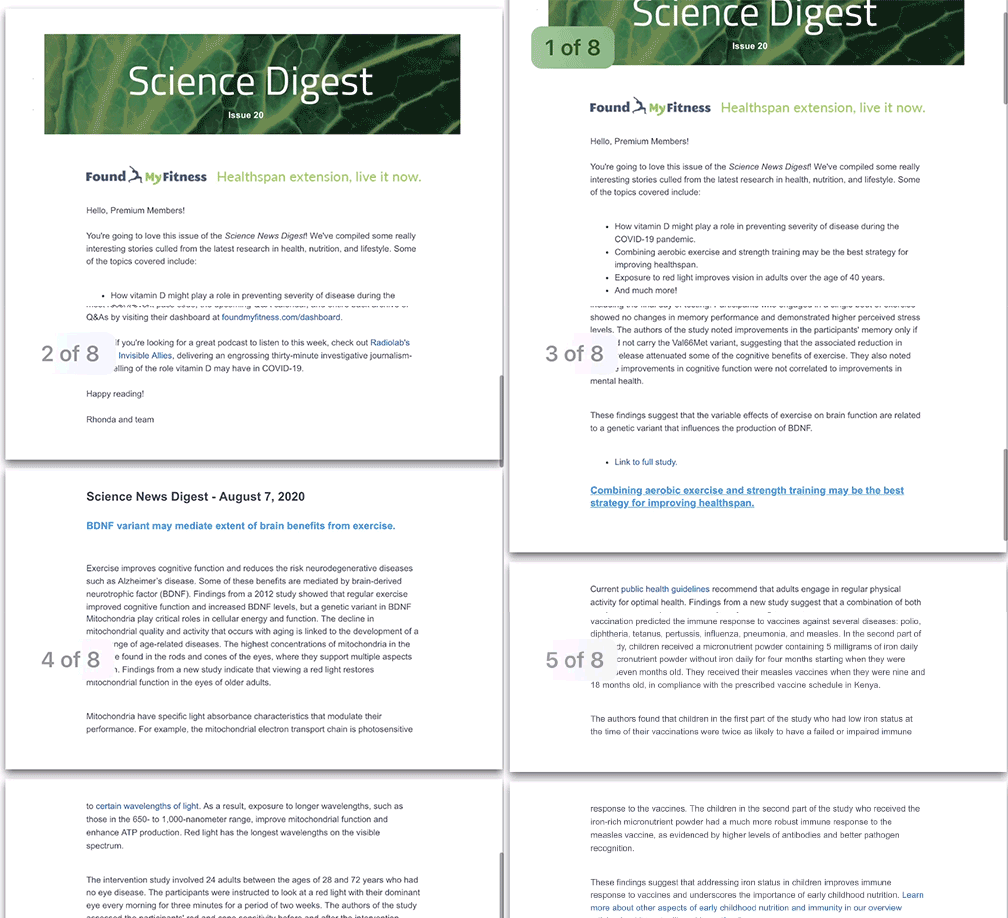
Every other week premium members receive a special edition newsletter that summarizes all of the latest healthspan research.
Vitamin d News
- Check out the Vitamin D Infographic I was privileged to be able to do in collaboration with FMF!
- Low magnesium levels impair vitamin D metabolism.
- Supplementing with 4,000 IU of vitamin D per day for 16 weeks reversed epigenetic aging by 1.85 years in overweight and obese African Americans
- Berries have a compound called pterostilbene that works with vitamin D to improve immune function against infection