#106 How To Increase Your Testosterone Levels Naturally | Derek from MPMD
This episode is available in a convenient podcast format.
These episodes make great companion listening for a long drive.
The BDNF Protocol Guide
An essential checklist for cognitive longevity — filled with specific exercise, heat stress, and omega-3 protocols for boosting BDNF. Enter your email, and we'll deliver it straight to your inbox.
You'll also receive updates from Rhonda & FoundMyFitness
Testosterone is far more than just a muscle-building hormone. It's a cornerstone of health influencing mood, cognition, bone density, libido, and even longevity.
In this episode, Derek, host of the popular YouTube channel 'More Plates More Dates' and co-founder of Marek Health, joins me to unpack testosterone's true role in health, from bone density and insulin sensitivity to brain function and longevity.
Derek and Rhonda also discuss:
-
Best practices for measuring and interpreting testosterone levels
-
Key symptoms of low testosterone in men
-
Is alcohol sabotaging your testosterone levels?
-
Common micronutrient mistakes hurting hormone levels
-
Which type of exercise boosts testosterone most?
-
Do vitamin D, zinc, and magnesium actually help?
-
Does boron significantly raise free testosterone?
-
Ashwagandha's true potential for testosterone enhancement
-
Is Tongkat Ali the best herbal testosterone booster?
-
Tongkat Ali or boron—which is superior?
-
Shilajit, Tribulus, Fenugreek—do they actually work?
-
The four best supplements to raise testosterone levels
-
When should you consider testosterone replacement therapy (TRT)?
-
Key biomarkers you must track on TRT
The Role of Testosterone
"Testosterone is not just about sex drive or muscle size; it is a hormone that touches almost every aspect of our health." Click To Tweet
General Effects in Men and Women
Testosterone is the body's primary anabolic hormone, sustaining muscle tissue, bone integrity, insulin sensitivity, and neurological health, both directly and indirectly via its aromatization to estrogen. Reduction to DHT is necessary for full maturation/sexual differentiation to reach adult male maturity.
Men typically have ten times higher testosterone levels than women, but in women, it still plays a critical role in supporting cognitive function, cardiovascular health, bone density, and anabolic activity in muscle tissue—many of the same physiological effects in men, just at a lower concentration. Testosterone is also aromatized into estradiol and estrone, which are vital for fertility-related processes in women. Even at lower levels, women rely on testosterone for things like bone integrity and brain health.
Tradeoffs and Longevity
In many species—including humans—females tend to outlive males. Could this be related to males' higher testosterone levels negatively impacting longevity?
The scientific literature is not conclusive on testosterone's role in longevity. Risks appear mainly at supraphysiological levels, including cardiac remodeling and dyslipidemia. Derek believes there may be some role of metabolic resource demand that's higher in males than females due to testosterone's effect on muscle mass—larger humans tend to have lower life expectancies than smaller ones.[1] A bigger body size and more muscle mass is more resource-intensive, requiring a higher metabolic rate to sustain and lowering lifespan in the process.
Historical examples, such as the male castrati, illustrate how lack of testosterone exposure during puberty influences health. Castrati were young boys castrated before puberty to preserve their high-pitched singing voices, particularly in European opera from the 16th to 18th centuries. Because they never underwent the normal surge in testosterone, they did not develop many male secondary sex characteristics, had distinctive body proportions and bone structures, and sometimes experienced compromised bone integrity and osteoporosis due to low estradiol levels.[2] Reports suggest they may have lived longer on average than intact men. One study of Korean Eunuchs (castrated males) found they lived 14–19 years longer on average than non-castrated males of a similar socioeconomic status.
But castration comes with major quality-of-life tradeoffs, including infertility and reduced musculoskeletal health. It's not as simple as "less testosterone equals a longer life."
Are Testosterone Levels Really Declining?
"It is not that men today are fundamentally different from those sixty years ago—it is that our lifestyles are." Click To Tweet
Some of the perceived decline in testosterone over time may be due to changes in measurement methods. However, evidence does suggest a downward trend, largely driven by obesity, sedentary lifestyles, and environmental influences. Some studies suggest that testosterone levels have dropped by as much as 10–20% over the last two decades (at least among younger men in the United States).[3]


Used under the Creative Commons Attribution 4.0 International License (http://creativecommons.org/licenses/by/4.0/). From Chodick, G., Epstein, S. & Shalev, V. Secular trends in testosterone- findings from a large state-mandate care provider. Reprod Biol Endocrinol 18, 19 (2020).
- ^ Samaras, Thomas T (2012). How Height Is Related To Our Health And Longevity Nutrition And Health 21, 4.
- ^ Zanatta, Alberto; Zampieri, Fabio; Scattolin, Giuliano; Rippa Bonati, Maurizio (2016). Occupational Markers And Pathology Of The Castrato Singer Gaspare Pacchierotti (1740–1821) Scientific Reports 6, 1.
- ^ Lokeshwar, Soum D.; Patel, Premal; Fantus, Jake; Halpern, Joshua; Chang, Cecilia; Kargi, Atil Y., et al. (2021). Decline In Serum Testosterone Levels Among Adolescent And Young Adult Men In The USA European Urology Focus 7, 4.
-
Why Testosterone Is Vital
-
Why is testosterone essential for men?
-
The role of testosterone in women's health
-
Does higher testosterone shorten lifespan?
-
What the castrati reveal about testosterone and longevity
-
Measuring Testosterone
-
Free vs. total testosterone—what's the difference?
-
When is the best time of day to measure testosterone?
-
Factors that confound testosterone measurement
-
Reference ranges or symptoms—which matters more?
-
When is high testosterone a red flag?
-
What LH and FSH reveal about testosterone production
-
Structural defects that could contribute to low testosterone
-
Sex Hormone-Binding Globulin (SHBG)
-
Could high SHBG levels be limiting your testosterone?
-
How oral contraceptives impact SHBG levels
-
Why SHBG increases with age—and how diet and lifestyle accelerate it
-
How diets like keto affect SHBG and testosterone levels
-
Why the carnivore diet often results in low testosterone
-
The connection between libido, fat loss, and hormone-binding proteins, especially in women
-
Primary Drivers of Low Testosterone
-
Key symptoms of low testosterone in men
-
Is alcohol sabotaging your testosterone levels?
-
Why low-fat and low-carb diets might lower testosterone
-
Common micronutrient mistakes hurting hormone levels (zinc, magnesium, and vitamin D)
-
How excess body fat impacts testosterone
-
When endurance training goes too far
-
Are endocrine disruptors truly harming male hormones?
-
Air quality
-
Are testosterone levels actually declining?
-
Why dietary fat is essential for hormone health
-
Is a ketogenic diet bad for testosterone?
-
Which type of exercise boosts testosterone most?
-
Testosterone-Boosting Supplements
-
Do vitamin D, zinc, and magnesium actually help?
-
Does boron significantly raise free testosterone?
-
Ashwagandha's true potential for testosterone enhancement
-
When supplements backfire: anhedonia and overuse
-
Is Tongkat Ali the best herbal testosterone booster?
-
Tongkat Ali or boron—which is superior?
-
Shilajit, Tribulus, Fenugreek—do they actually work?
-
The four best supplements to raise testosterone levels
-
Measuring Cortisol Levels
-
Why salivary cortisol levels are much more indicative than blood levels
-
Testosterone Replacement Therapy (TRT)
-
When should you consider TRT?
-
What realistic benefits can TRT provide?
-
Does TRT raise heart disease and erythrocytosis risk?
-
Risks of having thicker blood when on TRT
-
Creams vs. injections
-
Does TRT increase prostate cancer risk?
-
Hair loss, acne, sleep apnea—what are TRT's real side effects?
-
The rollercoaster effect of testosterone injections
-
Could low testosterone be riskier than TRT?
-
Choosing the right TRT delivery method
-
Oral testosterone delivery methods
-
Intranasal delivery methods
-
Cautions with testosterone cream
-
Do smaller, more frequent injections reduce risks?
-
Can you maintain fertility while on TRT?
-
Why TRT quickly shrinks testicles
-
Key biomarkers you must track on TRT
-
Testosterone Therapy for Women
-
Symptoms, ranges, and risks
-
Why women's hormone therapy requires tighter monitoring
-
Can DHEA supplements safely raise testosterone in women?
-
Hair Loss Remedies
-
What actually causes hair loss?
-
Does your maternal grandfather determine your hairline?
-
Why stopping hair loss means accepting risks
-
How effective are ketoconazole, minoxidil, and microneedling?
-
Minoxidil side effects
-
Topical vs. oral minoxidil—how do side effects compare?
-
Is microneedling effective without minoxidil?
-
Do finasteride and dutasteride alter brain chemistry?
-
Finasteride and the nocebo effect—are side effects imagined?
-
Does minoxidil delay baldness or just mask it?
-
Can dutasteride extend your lifespan?

Rhonda: I'm sitting here with Derek from More Plates More Dates. You may know him from his very large YouTube channel where he talks about all sorts of things. Hormones, exercise, training. I became sort of aware of your work because you were on our Mutual Friends podcast, Peter Attia a couple of times. Super interested in, you know, your own personal experience, but you also run a company that's a preventative health company that helps people optimize their hormones, among other things. And so, I mean, I'm excited to have a conversation with you. You've got a lot of this experience, you know, personal experience, but also experience just running this company where people are coming to your company to help optimize their hormones. And so it's a. A little bit of a different episode here. As you guys know, I cite everything on the podcast, and so I'm excited to kind of dive in and talk about all things hormones with you, Derek. So thanks for coming on the show.
Derek: Thanks for having me. I really appreciate the invite.
Rhonda: I'd love to kind of start. I want to talk about testosterone. As you know, you know, kind of discussed this earlier. You're very knowledgeable in this area. In fact, we had a conversation and I was asking you some questions, and your knowledge was very impressive in terms of the scope and depth.
Derek: No, thank you.
Rhonda: So all things testosterone. Kind of just wanted to start with the role of testosterone in men. I mean, it's obviously fundamental for male health, but I'd love if you could kind of just outline some of the primary functions of testosterone in men.
Derek: Yeah, I think at a basic level, it is the primary anabolic hormone men rely on for the sustainment or growth of muscle tissue, bone health, bone integrity, inhibiting degradation indirectly through some of those pathways as well, like insulin sensitivity. If you have worsened body composition, it becomes more difficult to handle glucose adequately. Neurological health, or the aromatization, the actual tissues themselves. There's an array of things that are supported critically by testosterone and its indirect metabolite activity as well, through its aromatization to estrogen and I guess notably, but often overlooked, it's easy to forget, but in adolescence, the 5 alpha reduction to DHT.
So the conversion of testosterone to DHT is necessary for full maturation, sexual differentiation to basically reach full adult male maturity. And there's a myriad of examples where FDHT is either too low via genetic predispositions or through different means. Then there is inhibited maturation. And that's where you get into some of these more unique intersex cases. But essentially, at a base level, this Is the primary male all but significantly impactful in females as well. Hormone that is present at about 10x the concentrations in males and kind of differentiates them in terms of sexual identity and male characteristics.
Rhonda: I do, we are going to focus a lot on the role of testosterone in males and men, but I do kind of just briefly before we will eventually talk about females and women, but women, what, what is the major role of testosterone in women? I mean women obviously don't make as much as men, but they do make testosterone and it does play a functional role.
Derek: Yeah, yeah. And like again, it's a non exhaustive list that I just presented. Like the list extends beyond into erythropoiesis, the production of red blood cells, intra testicular testosterone production, absolutely critical for fertility as well. And in women, all but not directly analogous intraganately. But elsewhere in the body the activity of testosterone is still necessary for a lot of the same things. Cognitive health, some level of cardiovascular support, bone integrity as anabolic activity and muscle tissue, all the same stuff is still the case in women, just to a much lower magnitude. So, but similar, as you would expect, there's less of a concentration required to sustain a female musculature than a male. So the concentration differential is about 10x.
But in women the main function of testosterone still overlaps with males, but intraganately it is more to facilitate as a substrate of estrogen production. So getting that sufficient amount of aromatization into estradiol, but also the conversion into estrone which then turns into estradiol, as well as to facilitate all of the female fertility facilitated processes.
Rhonda: So given the role of testosterone and all these important physiological processes that you just described, everything from muscle health, bone health, neurological health, red cell production, et cetera, what about trade offs of testosterone? And I mention this because of my interest in longevity, my long interest in, you know, life expectancy and looking at, you know, life expectancy between men and women and you really see amongst like pretty much all mammal species that the females outlive the males. Obviously there's a lot of differences going on there, but testosterone is als something that does, you know, differentiate. There's a big difference between the levels of testosterone between males and females. So I'm kind of curious. I know you, you think about a lot of these things and so I'm curious what your thoughts are with respect to the trade offs of testosterone with respect to longevity.
Derek: I think it would be highly speculative because obviously I would love to just point to some clear cut literature that says based on these studies on, you know, inhibiting IGF1 or having really low androgen levels equals lower body weights, equals longer lifespan or something to that effect, that could be a common kind of denominator, but it's not as cut and dry. I do think there is some level of metabolic resource demand that is needed to actually support the infrastructure of a male that is more intensive than a female. So I would in general, like larger humans are going to die quicker than smaller ones, at least from what I've seen trend wise.
Rhonda: And.
Derek: In supporting that, it is something that requires more hormone production in general, which is also more intensive on all organ systems. Accordingly, to actually facilitate and get that hormone production to the level it needs to sustain that larger human. So that's a highly speculative take on it, but that would be part of the reason. But at a high level, if you want to extrapolate to, you know, at higher levels, androgens will be neurotoxic in a dose dependent manner. Past supra levels, it will cause cardiac remodeling in a negative manner. Like all of the dyslipidemia.
All of the negatives that you would hear about when it comes to anabolic steroid use to some extent at supra levels are going to be present from testosterone, all but to a more muted extent because it's not a synthetic drug that is manipulated in a lab to create, you know, something that is not a substrate for aromatization and some of the other stuff that is protective. But that's a high level speculative take.
Rhonda: Yeah, I mean it's kind of a loaded question because there's probably a lot of factors at play here in terms of like the differences in life expectancy between males and females. And you're pointing out the size difference is one, one, you know, maybe it's the lack of estrogen, right. Not the presence of testosterone, but not lack of estrogen. Obviously men make estrogen, but not to the same degree as women, premenopausal women. But have you, have you looked at any of that literature? Are you aware of it? The, like the male castrati, like, so the, the men that are like, yeah.
Derek: They castrate like they are osteoporotic as a consequence of a lack of sufficient aromatization into estrogen. And their growth plates, the epiphyseal growth plates don't close fully because of that lack of aromatization in adolescence, which is facilitated essentially entirely by testosterone as the substrate, similar to what it is in women. But if you castrate a male and adolescence and he no longer has intra testicular testosterone production, he is now functioning off of solely adrenal production, which is like a drop in the bucket to what you actually need to function at a high level. Like you're not going to have sufficient bone development and you are going to suffer from osteoporosis inevitably. And if those, those who don't know what the castrati are.
It's really interesting. So it's individuals who were had angelic singing voices and I'm not sure where the last, who the last documented one was, but it was actually more recent than many would probably think. It's like within the last 100 to 200 years. But anyways, you can listen to them on YouTube singing and some of these old audios that were recorded and it's, you know, a youthful angelic singing voice that comes across as somewhat and like androgynous to some extent. And obviously going through male puberty and being subjected to male amounts of testosterone and DHT would, you know, like quote unquote wreck that voice because it's going to be masculinized and get like fully, you know, the deepening that would happen, that's irreversible.
So the castrati were individuals that were castrated in order to prevent them literally from going through puberty adequately. So they would actually grow into men without the full maturation that would come from androgen exposure and adolescence. And as a result, you know, they would have a lack of adequate sexual differentiation maturation and their bones would reflect that as well via the osteoporotic outcomes they underwent.
Rhonda: Did you happen to see that their life expectancy was increased though, compared to, I mean, so, I mean it's like you're, you're living longer, but not necessarily the quality of life is notably, though.
Derek: Their estrogen levels are in the ground. So you saying a second ago about the estrogen.
Rhonda: Right. So maybe, I don't know, it's. It's interesting. Like what is it, you know.
Derek: Well, it's definitely a lower capacity to build muscle and bone, which is less resource intensive and you're a smaller human. So maybe as a result you are literally a walking, I don't know, like shell of a man, essentially. So you don't require as much to sustain, but your quality of life is dramatically hindered.
Rhonda: Right? Yeah. So you live longer, but you don't necessarily want to, Right? Yeah. So that's kind of interesting. I just kind of wanted to get your perspective on that. So I'd love to kind of dive into an area that I know you have a lot of knowledge, you know, just based off of your. Your company, Marek Health, where you guys are really helping people optimize their hormone levels. And so I kind of want to talk a little bit about some of the best practices for measuring testosterone, interpreting the results. Could you kind of outline some of the optimal best practices for actually measuring testosterone level? So, you know, optimal timing, repeated measures like free testosterone versus bound testosterone or total testosterone. Right. Like, what's the difference here? What, what do people. What should they, like, consider?
Derek: Mm. So total testosterone is the number that most people are familiar with, which reflects the total production that can be detected in your sample of blood that was taken. So floating around, how much testosterone is there, inclusive of the testosterone bound to binding proteins. So just because it's in your blood, though, it doesn't mean it's biologically active. If it's bound to these binding proteins produced by the liver, it could be either entirely inactive or like, readily available to be dissociated, but not yet fully active as well. So you have, you know, SHBG is the primary one sex hormone binding globulin produced by the liver. This acts as a regulator of androgenicity in the body, which is like, how much androgen exposure systemically you would be exposed to.
And the body has this kind of regulating mechanism to partly to make sure that, you know, females stay feminine, males stay male, and regulate which tissues get which hormones when and transported around the body. Because these are hydrophobic, like, they're fat soluble and would not go through the blood to where you want them without some sort of carrier. So they have a hydrophilic vehicle similar to, like, how cholesterol would get moved around through its, you know, apob particles and whatnot. And these binding proteins, SHBG and albumin, comprise the vast majority of testosterone. I think SHBG is about 60% of your total T will be bound by SHBG. And then like 38% is albumin, and then 2% to 3%, roughly, depending on how much SHBG produce.
And some other factors is actually free testosterone. So the free testosterone number is just like freely circulating, not bound to binding proteins, and it's like, ready and readily available to be used by target tissues should it bind to the androgen receptor and cause the transcriptional activity. But in general, the two numbers you care about the most are going to be the total testosterone, which is like total production reflection. So, like, how much are you actually capable of making, which is important. A lot of people will just say, just look at Your free because that's like the number that matters because that's what's actually available to use.
And that's true, but it still doesn't reflect total production capacity, which is important to assess the viability of the organ response to the pituitary output. A myriad of things. So total testosterone, total production, including that bound to binding proteins, influenced by liver, health, diet, bunch of different factors. Free testosterone, about 2 to 3% in an optimally healthy male. Typically that is just freely available to be used. And then as far as measurement, kind of like best practices, typically in the morning is the best. Testosterone is kind of, it's like a pulsatile secretion fashion. So you would see in a diurnal rhythm chart showing the secretions of testosterone throughout the day. It kind of pulses out in waves.
So you would have like the biggest pulse early in the morning and then it kind of like goes across, ebbs and flows throughout the day until it reaches its low point later at night. And then as you sleep it starts to ramp back up again. So typically the best way to assess peak levels would be early in the morning. And ideally you would have not taken certain confounding variable supplements like biotin that can cross detect is, you know, estrogens and whatnot. And typically labs will provide kind of like a guideline of what not to do. But in general the rule of thumb is, you know, go in fasted early in the morning, avoid your multivitamin probably if it has biotin in our biotin containing supplements, and be hydrated to reflect your actual hematology profile correctly.
Cause some people incorrectly think they have a elevated, you know, hematocrit level when in reality they're just super dehydrated when they go in. Cause they just got up, rolled out of bed and are, you know, dehydrated from hours of sleeping and you know, not hydrating properly when they wake up and they just roll in and think that oh, I'm gonna have a heart attack and then I gotta donate blood now. Which might not be the case. So I know that's a mouthful. But early in the morning and ideally you would get a repeat measurement before you make any sort of, especially before you make any sort of choices on path forward. Because you definitely want to get confirmation if you have a low reading or even one that's like mildly concerning.
Because again these things can be so variable depending on so many factors that you might have a blip where it's a snapshot in time of your blood. You see, you know, a 495 total T. And you think, well, that's not great. It should be closer to a thousand. That's what I hear is good. And you know, all these podcasts and whatnot, that's what my friends are at. They're at 900. Like, I only have 495. I should have way more than that. And some people haphazardly get on testosterone shockingly. But it happens. And there are a lot of clinics that will tell you, like, oh, yeah, you can get that up. Let's get this up to, you know, 900. And that's all they need to give, you know, to justify it to themselves. So, yeah, you definitely don't want to go off of one reading.
You want to go off of symptoms and repeat measurement to confirm your findings before you even decide what the path forward is for natural interventions and assessment of what is happening at the organ level and at the hypothalamic pituitary level.
Rhonda: So you sort of alluded to this, but, like talking about reference ranges, and I kind of want to get into that because, like, you know, there are these like reference ranges that you see, and I'm just kind of like curious, like, how does a man navigate where their testosterone should be, what the reference ranges mean? How do you look at this? You. How does, like, you know, how. How does your company look at this in respect to, with respect to age, with respect to like, symptoms? Let's say someone's on the lower end of the reference range but they have no symptoms. Or someone, someone's at the higher end of the range but they have symptoms. Like, how does one sort of interpret what their testosterone data shows? And how does the potential for someone who's actually hypogonadal? So people that are actually not making testosterone. Right. How does that sort of complicate it in general?
Derek: I think it does get convoluted because people will see a reference range and assume and understandably. So, like, there's a lot of things that people will just say, oh, target the top of the reference range. This is where you should be. And in general, it's not a bad recommendation. Often for things that modulate quality of life related outcomes. You know, like even when we talk about vitamin D, it's like, you know, you should probably be at like 60, even though the low end is like 30. Typically if you were at 40, people would be like, you know, try and bump that up to 50 or 60 with testosterone. People think similarly, and justifiably so sometimes.
But often what is overlooked is the Fact that the actual androgen receptor content, which is like, how many androgen receptors you have in like a concentrated area, or also the sensitivity of it, like, what kind of transcriptional activity do you get subsequent to binding? Those things all factor into, like, how much of an impact the androgen has on after binding to the receptor. So just because you have less testosterone than the next guy, it doesn't necessarily even mean that you have less muscle growth potential or less, you know, you know, bone support capacity or less neurological support. Like, it's not guaranteed any of these things based on absolute values. It should be a combination of symptoms as well as blood values.
But oftentimes too, the blood values should be superseded by symptoms in some cases too, because you'll have some individuals who have insensitivity at the ar. So it's not just about how sensitive are you and can you get away with lower testosterone. Some guys need higher testosterone to be able to actually function well. And they might otherwise be told, oh, you know, you don't need testosterone, your total testosterone is 900. But they might have a, you know, super high sex hormone binding globulin that's gobbing it all up and they have a low free testosterone or their actual receptor activity after binding is like subpar, or they have a, you know, gene mutation that inhibits the actual activity of it.
And that's where you get into some of these convoluted cases with like, you know, the Olympic boxer and like, we're not going to go down that road. But some of these individuals who, like, you know, there's a spectrum of androgenic activity that is influenced not just by the total levels on paper, but it is very much dictated by your actual response to the hormone too.
Rhonda: Is that something that's measured readily? Like, can you measure your response to, you know, androgen receptor activity? Is that, or is that something that's not really known? And you kind of have to do some.
Derek: There are like, proxies for it. In general, it's very crude the way they assess if you are one of the individuals on this, like, spectrum of androgen insensitivity. It's literally like manual assessments essentially of like, your gonadal development, which is like, kind of, you know, demeaning potentially. If you're somebody who is like, already obviously insecure about what's happening, and then you're just subjected to some sort of like, subjective analysis of like, an expert who determines if you've had sufficient enough, like male sexual secondary characteristic development. But in general, there are proxies for activity.
And you know, if you're somebody who has like, if you, if you looked at blood work for example, some individuals think oh the guy with a natural like 1300 total TE, that's probably great. That guy is like a, an outlier genetic phenom. Oftentimes it's a reflection of some sort of problem. Like they need to produce more to reach adequate activity. So like sometimes the body is screaming at the testes because it's not getting adequate production to do what it needs to do and it's resulting in you shooting out more gonadotropins to make more testosterone. So typically you will see this reflected in some sort of symptom either through actual development in adolescence being not adequate or through biomarkers. It becomes pretty clear because you'll, there will be other factors that are clearly outlier oddities in blood work. When you see somebody who is not.
Rhonda: Responding adequately, what will you mentioned the ganot tropins. Like what would like the lute Luten luteinizing hormone or follicle stimulating hormone. F. Fsh. What would those kind of look like in the cases where it's kind of like a red flag? I mean is like these are very.
Derek: Outlier scenarios that I'd be deviating into where people are like, you know, overshooting to try and meet some sort of physiologic activity. Like most guys are going to be falling into the bucket of they have Logan at tropins or low response to it from age related decline. That's more of like, you know, what most people will find relevant. So I'll start there. In general, the thing you would be looking to first is okay, like what are your levels, your total, your free levels? Are they, do they look good? Do you have any symptoms? And let's just say you do have symptoms and you're looking at these numbers and they look, you know, okay.
At that point you would be looking the actual output from the pituitary is going to be dictating what the signal to your testes is to actually produce testosterone. So the LH from the pituitary signals to the LY cells to make the intra testicular testosterone. So is that signal adequate? Is one thing to assess and that has a clinical reference range. But also individuals who are primary hypogonadal similar to what we talked about when it comes to assessing, you know, when women are hitting menopause, like what kind of would you look to in men if you are not responding and producing adequate testosterone at in the testes? Like you will be trying to make more luteinizing hormone typically to try and push that signal.
So it's, your body's going to recognize I'm not getting enough testosterone out of this LH that I'm making. So the signal isn't sufficient. I'm not getting enough testosterone and or enough estrogen from that to provide the negative feedback that tells me to stop making GNRH and other the pituitary hormones. So I would just, it would just keep shooting and trying to like probably overshoot you into adequate territory. So you would, if you were primary hypogonadal, you would see the reflection typically of high Gadot tropins or you would also see some sort of like structural defects. And that's where you would get into like, you know, ultrasounding for. I think the prevalence in males is like 15 of males have a varicoseal.
I don't know if you know what that is, but it's like varicose veins in your testes essentially. And it looks like like twisted, kind of like the same thing you would see in varicose veins in your legs. It's like in the side of like the testes. And it inhibits thermoregulation and significantly impedes testosterone production locally and fertility. So that oftentimes. Well, 15 of men, from what I recall is the number for prevalence pretty significant though for something a lot of people don't know exists. And if you are, you know, doing all the lifestyle stuff and it's not working and you think you're doing everything correctly and you must need testosterone. Sometimes it can be overlooked that there are structural defects.
So like typically the first thing you would look to is like, am I capable at the organ of responding to the signal? And like, is the signal adequate to begin with? Because if there's like a primary hypogonadal outcome, it would be some sort of like structural response problem in the testes themselves. If that's not an issue and you've ruled out all structural problems, you know, age related decline and is not a factor and you're, you know, otherwise, you know, everything's all accounted for from that angle. You would look upstream to the pituitary and say, okay, well at that point am I producing enough LH and fsh? And this is typically the outcome you would see in men.
Not always, but like a lot of men who are kind of like not sure if they need testosterone, they'll have like a relative proportional inadequate signaling driven through a myriad of factors including but not limited to lifestyle, some age Related decline, toxins, exposures, a myriad of things. And that's kind of like where people have this opportunity to try and incrementally maximize all the areas in their life to try and improve the output. Because if you have sufficient functioning organs and your output is just insufficient, you might be able to get that up to snuff, to where you need it, just by getting leaner, losing body fat, fixing your diet, addressing micronutrient deficiencies, quitting smoking, not drinking anymore, fixing your sleep, you know, all the smorgasbord of things.
Rhonda: Yeah, we're gonna, that, we're gonna get into a little bit, but. Okay, what about the sex binding globulin hormone?
Derek: Sbgh, shbg? Sorry, Sex hormone binding globulin.
Rhonda: Sex hormone binding globulin. What about the sex hormone binding globulin? Like, you're talking about, like, if, if you have a lot, if you have a high level of that and it's bound up to your testosterone. So a couple of questions here. What regulates those levels and what regulates, like, how much of that testosterone can then get away from that, you know, binding protein and then be used to, you know, obviously exert hormonal activity. So, you know, can you, can you like, dial in looking at just that binding protein itself to help kind of solve some issues?
Derek: Yeah, and it gets really complicated in this regard because what a lot of people don't address is so dht, dihydrotestosterone, mentioned earlier, how it's like the primary hormone that will determine if you reach full maturity in adolescence. Like, you will still be markedly male, probably if you have adequate testosterone production, but you won't get full maturation if you have, you know, 0dht from a defect in the enzyme that encodes for 5 alpha reductase or something. But that hormone, the most androgenic hormone in the body, that essentially determines if you fully masculinize or not, or you end up, you know, with a micro penis that has a much higher binding affinity for SHBG than testosterone does.
And then testosterone has a much higher binding affinity for S, H, P, G than estrogen does. So even though on paper we're talking about the importance of free test versus total test, which is very important. Also very important, which most people aren't going to test in their blood, is the DHT level that males will rely on through adolescence and to some extent in adulthood, potentially depending on their test levels, that is going to get gobbed up even more proportionally by shbg. So if you have high shbg. Not only is your free test potentially inadequate, despite adequate testosterone production, proportionally your free dht, which is like the main androgenic hormone, is like way more gobbed up.
And this gets really rough in females because they, a lot of them are using things like combined oral contraceptives, which crank SHBG through the roof through the liver interaction with the oral. Combined oral contraceptive pills, depending on which drug they're using in general, ethanol, estradiol, plus some progestin, depending on how androgenic the progestin is, it'll depend on how much the SHBG goes up. But you'll see in adolescent women or women who are, you know, in full adulthood that are taking combined oral contraceptives, their total testosterone will suppress upwards of 50 to 60% and free testosterone upwards of like 70 to 80%. So they're walking around like borderline asexual, castrated by a pill, essentially.
Rhonda: And that's only with oral.
Derek: That's with oral. But like any sort of progestin that is synthetic will have negative feedback to some degree, all but much lesser. So via a localized iud, releasing a level noted estral or something, and you're not having to take that supporting estrogen, estradiol, that comes compounded into it. So it depends on the format. But a lot of girls are still using the combined pill. So it's just worth noting nonetheless that when these SHBG levels are skyrocketed or even like high on, you know, a clinical reference range, if you are somebody who is like moderate, you know, T production or low normal or whatever, like the proportional hit to your DHT getting gobbed up could be like the differential between you being symptomatic versus not as well as your free T, even though it's proportionally less gobbed up, the DHT could be like nuked entirely, essentially via the SHBG levels being high.
Rhonda: Since we're talking about the SP SBGH levels, I kind of want to like, what is their lifestyle? So does age regulate that and, and also like lifestyle factors?
Derek: Yeah. So like a common thing that people hear is when you hit 30 years old, your total testosterone will decline by 1% per year. But the reality of what makes this even worse is your SHBG levels will increase year over year, proportionally faster, thus making the velocity of free testosterone decreases dramatically more so proportionally. So even though total test decreases by 1% a year, your free test will decrease by up to 2% per year. And that's the one that you need to like, do stuff in the body through like freely circulating activity. So it's very important and very relevant for dictating what activity you have in different tissues in the body because it's ultimately the only one that can actually bind to the receptor and do what it's supposed to do.
So the SHBG levels will be dictated by age, will be dictated by liver health, to some extent, will be dictated by other medications, especially oral formulations. Insulinic signaling as well, hugely implicated if you're on a ketogenic diet, you can absolutely expect your SHBG levels to be through the roof and your free test to be much lower. So carnivore diet, guys, there's a reason they eat fruit now. It's because their free test levels were all, and their total test levels were high and they thought it was fine. But in reality they had like borderline hypogonadal free test levels often because they were overlooking the fact that insulinic signaling is needed to actually get SHBG to a meaningfully reasonable level for a male. So.
Rhonda: And this is also something that would be relevant for females too, right?
Derek: Yeah. And these binding proteins also exist for other hormones in the body because they all function in similar ways through cargo systems and transport mechanisms in the body. Like you will have binding proteins for IGF1, you'll have binding proteins for thyroid hormones. Like it's not uncommon to see people with like normal on paper levels for certain hormones. But then when you dig deeper, all the free hormones are like proportionally horrible because they're all bad. Like the, the total production looks okay, but it's because it's factoring in all these like bound up hormones that are in use, like unusable essentially.
Rhonda: Is that something that's common? Like, I mean, would you say that's.
Derek: It depends on the person and lifestyle. So. But yeah, probably, especially among women because I, you know, a lot of them are you, you only have so much androgens to work with to begin with. Like your production is you know, a tenth of males typically. And then if you are occupying all of your androgens because you know, essentially the SHBG is going to, with a much higher binding affinity, mop up all your DHT and testosterone, not all of it, but like a significant amount of it. If it's high in any like higher than it should be, like it will impact your like free androgenic signaling so significantly that might put you into like the, you know, female hypogonadal equivalent territory essentially. So you could be like it's not uncommon for girls to walk around borderline asexual or like literally no drive throughout their entire adolescence, 20s, 30s, and think it's normal and it's just not what they're supposed to be walking around.
Rhonda: Like so in other words, like if they have, if their libido is like totally down, perhaps like they're having a harder time losing fat. Gaining, also losing fat. It might, it could come down to this, right?
Derek: Bone integrity.
Rhonda: Bone integrity, right. Yeah.
Derek: So that sounds like a bit lesser. So depending on if they're on like obviously you know, if you're on a combined role contraceptive pill, it has estrogen in it, you know, however much it does that to what dose, you know, you get into the nuance. But ultimately like you're inhibiting natural hormone production quite dramatically through a myriad of means. Like think about guys who are just like natural having to deal with what they deal with as is, you know, the sleep impact, the cortisol impacts, the fat impact of being, you know, obese. And then if you have women who deal with all those same problems, you're going to have all the, the suppressive results of all of those lifestyle things, the diet, the nutrition, the whatever.
And then you also factor in medications on top of that too that maybe men don't typically have to take to, you know, achieve contraception. Like you know, that's typically often I think the final blow that will like push women into like, you know, closer to low drive territory often and almost certainly lower quality of life for a lot of them. Now that's not to say because I think this gets misconstrued often is that's not to say don't use contraceptives at all. Like there are absolutely better ways to go about it. I'm just giving examples that I see as commonplace.
Rhonda: No, no, it's, this is great, this is great information. You know, since we're kind of talking a little bit about symptoms, let's kind of circle back to talking about like what are the symptoms of low testosterone. You know, we're talking about men here, but like we talked about libido, muscle mass. Like what are, what are like the classic symptoms that men should be looking out for? Is it something that's hard to differentiate between, okay, this is testosterone or other things?
Derek: It does get tough because as you would imagine, a lot of the lifestyle related things that lead to low testosterone will come with the decrement to quality of life just via, you know, if you have poor sleep, like you're not going to feel great because you didn't Rest enough and then you add that on top of the inhibition of, you know, your output of Gadot tropin, pituitary hormones and response to them as well. Like, it's like a one, two punch often a lot of this stuff. So in general, I would look to things like libido, erection quality. Obviously that's more, you know, circulatory often, but still notable nonetheless. If you suddenly, you know, if you don't have morning wood anymore, like, you got to look into it regardless if it's circulatory or hormone mediated.
Might be a combination of both. You no longer are able to hold muscle as easily or build muscle as easily. You're, you know, losing strength in the gym. Your recovery capacity is inhibited relative to what it was when you were younger. Mood dysregulation, irritability. And these are all like really general, vague symptoms. And I would love to just say, oh, look at, you know, the. This exact thing will happen. But in reality, it's often a constellation of things that comes as a vicious circle effect of the, you know, factors that led to that deterioration of testosterone to begin with. Or if you were just, you know, never had reasonable testosterone to begin with, you would have probably not gone through puberty adequately to begin with.
So like, the genetic factors, like some of these, like more outlier cases become a bit more obvious because it's like you just never really like fully masculinize in adolescence. You might have a higher voice, you know, you a lot of those things, but are less relevant for the average person. For the average person, it's going to be more of these general symptoms and it's warranted to get a test at that point and just see what's up.
Rhonda: Right? Yeah. So then that in combination with the test and the things that we just talked about is kind of like where.
Derek: You know, like pre diabetic, you know, progressing towards, you know, pre diabetes, insulin resistance. A lot of this stuff is going to be ultimately determined by blood work though, because a lot of people aren't gonna be able to identify this autonomously, reliably. So that's kind of where I'd point to the more vague stuff like the quality of life. Like, do you notice a blatant deterioration with no other factors changed? Erection quality, you know, libido, vigor, muscle mass, strength, fat, body composition, stuff like that.
Rhonda: So you mentioned the. The by age 30, total testosterone decreases by about 1% per year. And then you mentioned even in general. In general. Right, right. On average, like. Yeah, exactly. There's.
Derek: And that's where I'm Gonna absolutely seen seven year olds with, you know, 900 total teas.
Rhonda: So, so the, the question is then like there, there are lifestyle factors that really can sort of modulate that, you know, general decrease or not. So maybe you can accelerate it or maybe can slow it. Right. And I kind of want to dive into some of that, those, those lifestyle factors like what should men avoid or try to minimize in terms of their environmental exposure? Or lifestyle factors that are known to accelerate the decline in testosterone and or increase the binding proteins so there's less free testosterone. Right. Anything that's going to necessarily regulate the ability of testosterone to exert its, you know, its function essentially.
Derek: I would love to bang out an exhaustive list, but forgive me, I guarantee we'll miss something. But like alcohol, you know, the direct toxicity effects of that does inhibit actual steroidogenesis in the testicles themselves. It will also impact sleep dramatically, which has the vicious backhand effect of in know, inhibited output of signaling hormones which indirectly will also impact body composition which, you know, the whole downstream cascade of that. Smoking obviously not helpful.
Rhonda: How much alcohol is it? Is it like any amount or like light drinking, moderate drinking?
Derek: I think like obviously the safe answer for me is to say no drinking. I think it would be more like a dose dependent toxicity effect. And what is your capacity to handle it? Because ultimately the testes are very affected by oxidative stress and if you're not capable of handling that adequately, like it will reflect in your inadequate output of hormones locally. So I would love to give like hard and fast numbers, but there are a lot of people who will be able to get away with like murder and probably be okay. There are some guys who like you might be low normal function to begin with and like that, you know, couple drinks a week like you know, throws off your sleep a bit and kind of pushes you over the edge. Like it all depends. It is very much a spectrum.
So like going from like optimal to like blatantly hypogonadal from a symptom perspective. It's not like it's just on verse off like your way. There is a, you know, it's, it's transition of you know, shittiness as you arrive to that like worst case scenario. So other things I could point to, if you have a totally fat deficient diet, I think that's you know, of a macro distribution that would be reflective of something that's almost certainly going to hinder your capacity to produce hormones. Also if you have a void of carbohydrate intake, diet. It would also be something that would inhibit freely circulating hormones from liberating themselves and lack of protein.
Like you would not be able to produce, you know, get as robust of a response recovering from workouts and be able to build muscle which indirectly is going to improve body composition and improve your hormones as well. So it's all kind of like balanced diet, don't eat bad micronutrient intake. I could definitely point to if you're deficient and not every mineral or vitamin is going to be, you know, game changing, dramatic impact on your test levels. But things like zinc, magnesium, vitamin D, like these all have a marked impact on your testosterone, either response to it or capacity to produce it.
Or even like, like you mentioned our podcast, a conversion of vitamin D into activ vitamin D. Like you might think you have adequate vitamin D status via your dose you're taking that's super high but you're not actually utilizing it, but you think you are and that's, that's impacting your testosterone production and your response to it at the androgen receptor itself as well. So I think from a minerals and vitamin standpoint the low hanging fruits are typically going to be like B vitamins but in particular like from a mineral side, you know, you have, you know, magnesium, zinc and the vitamin D3 are going to be three things that specifically on top of the minerals and vitamins that everyone's familiar with from multivitamins and whatnot are more difficult to get in adequate doses.
All but zinc is typically adequately in many multivitamins, but the magnesium in particular almost never is because of the weight of it. You would be having to take a multivitamin that's like 8 to 10 capsules otherwise which just nobody does. And then the vitamin D, it's fat soluble, typically you're going to have it in like a soft gel or something and it's not always going to be at the dose you need in the multivitamin. So just worth noting. So those are just some low hanging fruits that are if you don't look to those as part of your micronutrient optimization strategy, like you could be overlooking low hanging fruit that debt like is a deterioration of you know, 100 plus nanograms per deciliter per deficient micro potentially depending on how severe the deficiency.
Other things I could point to being obese like the worst one probably that I probably should have mentioned first but is like so dramatically impactful on your negative feedback to the hypothalamic pituitary axis. So by that I Mean, men who are obese and women, if you have a significant amount of fat, it is going to elevate your aromatization, which is, you know, your conversion of testosterone to estrogen. And this is more impactful in males because of how the brain gets signaled from estrogen, not testosterone directly as significantly. There's a bit of a nuance there. But in general, like, you need adequate estrogen to tell your brain, okay, we're good. You don't need to make enough testosterone, more testosterone, because I have enough estrogen.
Like, that's kind of like the downstream cascade of these metabolite conversions is you produce testosterone in order to produce other things too. And the estrogen is a very potent mediator of telling your brain, we're good. And if you have a significantly elevated amount of estrogen being converted from your testosterone that you make because of how much fat you have, you are basically achieving the proportional increase in estrogen that is much higher than the amount of testosterone substrate that led to that conversion. So you have that signal telling your brain, okay, we're good, but the amount of testosterone you actually had to begin with was not good. So that's problematic. People who are obese have, you know, upwards of.
I would love to give hard and fast numbers, but it could be like, significant, like half of a reference range maybe, you know, the. It could be the differential between you being, you know, the quality of life of you're fine versus you're blatantly in, you know, severe deficiency. And what else could I point to?
Rhonda: What does weight loss do to. To the. To those levels? Like, if you are someone that's obese and then you lose weight, does that bring you back?
Derek: Yeah, as long as you are losing, ideally, like, visceral fat and like, overall fat loss is going to be very supporting of getting that ratio back into balance of your estrogen and the amount that's converted to estrogen, estradiol in particular. And once that balance is favorable because you are leaner, you will have a balanced amount of feedback to the brain that then regulates, like, the perfect homeostasis between, okay, now we have adequate testosterone and estrogen. So you will actually notice more testosterone being produced because it realizes to get this signal that we deem adequate, we had to produce more testosterone to get that amount of estrogen. So there's this goldilocks zone.
Of course, you can't just, you know, become, you know, a malnourished, you know, low, like, bodybuilder shredded person and just continue to get this elevation in proportion. It's at some point you will end up essentially starving your body of the nutrients needed to actually support hormone production. But in general, you know, guys who are, you know like 12, like 12 to 15% body fat ish will find that they have a increase in testosterone dramatically relative to when they were obese and it's like super significant and how much it will improve hormone status. So. And then the sleep. I think I might have already mentioned that.
Rhonda: Yeah. What I definitely want to dive into some of the diet things in a minute but I wanted to ask you about a couple of things for, with respect to maybe factors to avoid what effect is like excessive endurance training have on testosterone. Because I thought I came across some literature where it was a negative effect and I wasn't sure like how robust.
Derek: I think it is pretty dramatic pending it exceeds your capacity to recover. So that sounds like a weird way to answer the question. But like some people have a higher tolerance for stress and that's you know, reliance on a bunch of different factors. But if you are somebody who is not fueling yourself correctly to handle that amount of endurance training like you were just say you're in a calorie deficit and you're trying to be like, I don't know, six pack shredded for the summer and like look as good as possible, but also fuel your like endurance event efforts. Like you're probably like not doing too, you're not doing two birds one stone.
Like you're doing two things like inadequately almost certainly and malnourishing yourself and ending up in a state of hormone deficiency as a result. Probably like you see in studies all there are cases that you can point to of what happened to natural bodybuilders as they diet for a show. And you can see in like as they start to get closer to stage ready, which is like the most shredded basically any documented human gets. Essentially the requirement to get there is a state of malnourishment essentially. And at some point typically once you start to cross into that like you know, single digit body fat threshold, you start to become so malnourished that you are inhibiting your actual capacity to produce hormones adequately.
You almost enter into like, you know, preservation mode slash like hibernation or something and it's kind of just like save yourself, we're starving to death. Like how do I stop everything metabolically taxing from happening? Let's shut down all systems. Nor do we have the substrate to actually produce these hormones to begin with. That's kind of what happens when you get like really, really malnourished and with endurance running, like I've seen guys out eat, you know, 5,000 plus calorie per day diets when they're doing like really intensive endurance activity. So if you are not fueling adequately and with the right fuel, micronutrient density, macro allotment, the how much of it is like carbs versus fat versus protein.
Rhonda: Yeah.
Derek: You could absolutely exercise yourself into a state of hypogonadism easily.
Rhonda: I kind of like I would, I would caveat.
Derek: Not easily. It's hard to train that hard, right?
Rhonda: Yeah, no, it's definitely not easily. Like there's not a lot of people.
Derek: That are kudos to the people mentally strong enough to do that, I guess.
Rhonda: Well, I, I kind of think of the analogy here. For women. It would be like when women are excessively endurance training and in a severe caloric deficit and they become amenetic. Right. So they're essentially not ovulating anymore. And in fact you mentioned like wanting to get shredded for the summer. Well, I actually in my 20s was, was doing this very thing where I mean I was running like 10 miles a day and I was eating like carrots and hummus and that's it. You know, it was like not fueling myself. No. Like hardly any fat. You know, it was very like very sort of like low protein, you know, low fat diet.
Derek: Yeah.
Rhonda: And I definitely got shredded is. But like I became a for several months, you know, where I just didn't get my period and I wasn't ovulating and so I had to add back the calories in the food. It was like. And it took a while.
Derek: Yeah.
Rhonda: For my body kind of like recalibrated.
Derek: Yeah.
Rhonda: But I feel like that's kind of like the analogy that like it is, it's like you, your body shuts down. It's like, okay, I'm not getting enough calories. Reproduction is not essential right now. Survival mode. Right. Not reproductive. Not reproductive. Like happy growth mode. It's like survival mode.
Derek: And like some people might not even realize how significant of a deterioration in hormone production. I'm talking about like to give context, men who are dieting for bodybuilding shows naturally it is not uncommon to see the end result of a hormone profile on like the last week them to look more female on paper than like their girlfriend. Like that's how low their testosterone levels are.
Rhonda: That's wild. Yeah, that's wild. Just to kind of sum up the like factors to avoid.
Derek: Not always, but sometimes.
Rhonda: I wanted to get your opinion on endocrine disrupting chemicals like how, how have you or has your, you know, your company looked or seen anything or do you have any speculation into like what the scientific literature has shown in terms of them affecting hormone levels?
Derek: Yeah, I think we're pretty convinced that there is an effect. It's just the magnitude at which you often see hyped up. I think maybe over exaggerated. There are low hanging fruit things to absolutely avoid. Like don't use you know, plastic Tupperware and like heat it up and stuff like that. Try and use glass when you can. Try and ensure you have like high quality air if possible. Like pollution I think is a big factor for like your body's capacity to deal with stress and like the allocation of resources to be chronically dealing with a toxic environment will inhibit systemic like broad systems water quality. Like if you can make sure you have like decent water I think that'd be solid.
But as far as like the actual magnitude of impact of those things for most people I think is going to be relatively negligible. In contrast to like the obesity, the diet, the exercise, the sleep quality, the potential carcinogens they might be exposing themselves to, you know, some of the lifestyle stuff is like way more important to be addressing as like the base infrastructure before you start thinking about like oh it must be my like shower that is like shooting chlorine at me. Like it must be that or sure get a shower filter but like it's not going to be the game changer. I do think avoiding like the basics though like you know, switch the glass where you can, don't use plastic water bottles, stuff like that.
And there is blatant evidence showing interactions with estrogen receptors with some of these compounds as well as androgen receptors, which in turn will impede the ability of the actual hormones you produce to bind to those receptors and do what it needs to do. So you're like essentially competing with yourself for activity in the body. Like you're you know, competing with these like even if they're like moot activity compounds they still act as like ant anti androgens or anti estrogens via the occupying of receptors. So to whatever degree they are doing it at all is not ideal because it's inhibiting like space that could be occupied by actual endogenous hormones that you need to produce and need to work properly. And you don't want to be competing with like environmental toxins to like do things in the body.
Rhonda: What do you you hear? You like I often hear from many people, popular, you know, media as well as just people I speak to or comments that I read about testosterone levels being lower now in men than they have ever been. For one, like, is that true? Do you think that's true? And two, like, what are some of the major contributors? Is it obesity, since obesity is rampant, I mean, or is it just like everything that you mentioned, all sort of like compounding together, not necessarily just the increase in, you know, BPA and plastic, you know, endocrine disrupting chemicals that are now a lot more prevalent than they were, you know, 70, 60 or 70 years ago.
Derek: I did a video a while ago on like the earliest finding I could find of recorded testosterone levels in, I think it was like military soldiers or something. One thing that I think is notable is the actual detection sensitivity of testing is absolutely much different now than it was, you know, 60 years ago. So to contrast, like, oh, the total test of some guy 60 years ago versus now is equivalent even on like a testing methodology basis is like flawed to begin with because it's probably not an accurate comparison. But is there a trend downwards? I would say yes. And I think it is mostly dictated by the obesity, the diet, the lifestyle stuff.
So, you know, like you, there's obviously things to deal with in the environment that are less favorable and are not supportive and probably not benign. But like, in general, I think most people that worry about this stuff, they would be put their mind at ease by dialing in everything else, which is not that hard to do. It's often free or know, cost less money, you're eating less food, you know, go to the gym, etc. I'm not saying that's easy to do, but like, dial in your basics. Once you do that, you have like an inc. You have your baseline. Let's just say you get a blood test and you see where you're at. From there you can start doing some of the minute changes like putting, you know, a chlorine filter on your shower head, do this, change your water source, whatever.
Do you notice an incremental uptick in your Gadot tropin output or your response to it at that point? If yes, like, okay, maybe it was a meaningful change. But like, until you do that, like you're kind of just taking shots in the dark. Assuming all of these things are, you know, occupying your mental bandwidth and concerning you, that may not be worth your concern to that degree.
Rhonda: Does chlorine have an effect on testosterone? I don't, I don't. Like, maybe. Okay, yeah, I think, I think more of like bpa, but and consuming it like orally. Like you said, hot, like heating up the plastic or like yeah, voice hot beverages, like going into like something plastic. But yeah, I, I agree. I think that these lifestyle factors are, are paramount and I'd love to kind of get a little bit more into some of those. Particularly like so you've already mentioned the diet and I'm kind of, you mentioned protein, fat, carbohydrate, you know, like so what, what, what? Why are some of these important? So fats are important to make, you know, the backbones of, of hormones. Maybe we can talk just a little bit about like why low fat diets and why people should be incorporating fat into their diet to make sure that they're.
Derek: Yeah, like in general it's not like if you have, for example, if you ingest cholesterol, it doesn't necessarily mean you're going to have like a dose dependent elevation in your like serum cholesterol, as I'm sure everyone knows here. But there are like certain baseline requirements to serve as the substrate for producing cholesterol derived steroids in the body. And these are all ultimately derived from cholesterol and then get cleaved and manipulated through enzymatic processes to make all the hormones in your body, including but not limited to testosterone, estradiol, et cetera. So in general it does seem like having a sufficient amount of fat is worthwhile and does seem to impact how much hormones you can actually produce and the carbs for actually mediating.
And this is going to depend on, you know, activity levels, how demanding of exercise you do if you burn through them versus not, if you're sedentary versus not, but in general is going to be. The insulinic signaling is somewhat necessary to facilitate a balance of free androgens, including free other hormones in the body that often go overlooked to actually do what they're supposed to do. Because a lot of people won't even measure the free levels of, you know, like the IGF one, the, you know, the T3, like you'll, you know, some of this stuff gets like hyper nuanced when you get into what hormones are actually bound up that you don't realize estrogens, dht, etc, so having a balanced diet and then the protein like you mentioned, from like a mechanistic perspective, like I think in general these things all serve as building blocks is the simplest way I can put it.
And having a deficiency entirely of one or the other, it's just like it's kind of the expected outcome. Like it's often not going to be ideal to be missing something entirely that your body utilizes for Critical, you know, structural things.
Rhonda: Well, it's interesting I learned something from you because I, you know, I was aware of the importance for, you know, of, of fat particularly likes, you know, a certain amount of saturated fat which is known to increase endogenous cholesterol production, but the carbohydrates and the insulin response and like having that insulin action or response, like, and I didn't realize that was also important and you know, especially for the free, you know, hormones, like the act or the amount of free hormones. So it's, it's, it's interesting to think about like a ketogenic diet. You know, as you mentioned, like some people can really be in a problematic state if they're on a ketogenic diet and their free testosterone just kind of tanks.
Derek: And it's not to say that it will absolutely happen. Like, I'm sure there are a lot of people that thrive on long term ketogenic diets or may even clinically require them. So like, I certainly don't want to come out here and suggest if you're on a ketogenic diet, stop doing it. Like talk to your doctor first. Obviously it's just like mechanistically this is what happens if you have a lack of insulin signaling, you will have less capacity to suppress the binding proteins.
Rhonda: Well, what you're saying is like get your hormones measured, measure them. Right. And make sure that you're monitoring.
Derek: Yeah. Be informed before you like freak out about anything.
Rhonda: Right, yeah. With respect to other sort of like lifestyle factors that can maybe boost testosterone. So we're talking about dietary factors here. What about exercise? I, you know, resistance training is one that comes to my mind when I think about trying to boost testosterone. I mean, is there merit to that? Is that something that moves the needle?
Derek: Yeah, I think it's kind of like in simplest way I could put it, is like descending order of intensity essentially. So like you know, weightlifting at the top and then you have like, um, some of your, more like hit style workouts underneath that. And then at the bottom of it would be like the most basic of, I don't know, barely exerting yourself, but like getting out there and moving that is going to have the least impact in general. And at the top it's going to be, you know, the muscle building, facilitating processes, the things that build bone, et cetera, Resistance training, that's going to be the most directly impactful. But ultimately it's also going to be what is the overall exercise regimen that you adhere to.
Because a lot of people, the problem is not even necessarily like, oh, what's the perfect thing? Like, it has to be something you enjoy enough that you'll adhere to it. So it's like adherence almost trumps optim optimal in some capacity. So like get the thing you can adhere to, the diet model that you can adhere to. Like a lot of people, the, the diet that on paper is the best, it won't be the one that you stick to for more than like six weeks. So like don't do that one if that's the case because you're not going to stick to it and then you're just going to end up where you were before. So calories trump everything, unfortunately, you know, or fortunately because it gives you a lot more versatility with like your choices. I think.
It's not like you're stuck in a myopic kind of, you know, box of I have to be on like the Mediterranean diet or I have to be on the carnivore diet or I have to be on the vegan, you know, the, whatever. There are a lot of ways to skin a cat and ultimately it's going to come in mainly from energy balance and then also from there optimizing for, you know, having adequate protein, fat presence, carbohydrate balance to support your, you know, whatever exercise you're doing and the intensity of it and all the things underlying that.
Rhonda: Yeah, with respect to some of the micronutrients, it kind of, this kind of gets into the, the supplement area as well. But you mentioned some important ones that I've also kind of like come across in the literature and that being vitamin D, zinc, magnesium. Can we, can we kind of just dive a little bit into their effectiveness? Like there's like, is there human data on it? Like, do you know anything about how they're working? I mean, I've seen, I've read some of the, the human studies particularly on the vitamin D and like getting like higher dose vitamin D supplementation, improving testosterone. But I mean, I'd love to kind of just take a moment to kind of talk a little bit more about that if, if you want.
Derek: Yeah, like in general, I think the most reliable things that move the needle, if you were deficient, what is, I don't know if people are familiar with the zma. It was like a, the first like combo supplement that was sort of seen as like a testosterone booster that was available on the market and it's you know, like zinc, magnesium and I don't remember if the, the A was something else. But vitamin D is the third thing I don't remember what the A stand is for, but those are the three things that move the needle most reliably that are natural you, you know, otherwise would get through your diet. But likely non sufficiently. Maybe zinc you might but like magnesium pretty difficult I would say for a lot of people.
They don't realize how deficient they are and then even like supplementing accordingly. It's like you know, getting one that you respond that you tolerate well with your digestive system has the yield that actually produces enough magnesium from like the elemental weight of the supplement, which is not that complicated. I don't want to make it sound super complicated, like a lot of them are fine. Rhonda has great articles on magnesium formats that are bioavailable and yield more than enough magnesium. Yeah, the vitamin D having an adequate amount and making sure you're converting it and actually getting the activity from it.
Mechanistically there is some level of like gene transcription capacity facilitated through these like, like vitamin D is a hormone for example, and it does also affect androgen receptor activity and some like the capacity for androgens to do what they do, not just like the production of the amount of them. So similar to what I talked about earlier where you have this kind of like receptor interaction, how well can you actually utilize these hormones to do the things it needs to do in the body? Some of this is going to be facilitated by the adequate minerals and hormones through vitamin D supporting it. And it's not necessarily measurable as much like directly, but all you can really do is like backfill accordingly to hit your needs and then assess your kind of like proxies and your blood work and your symptoms and kind of go from there.
Rhonda: In your opinion, like let's say someone is on the deficient range of vitamin D, their inadequate magnesium, perhaps their zinc is you know, maybe okay or in the, in the inadequate range. Would getting to that sufficient status really move the needle with respect to like testosterone?
Derek: I think if you were on the low end of the reference range or literally hypogonadal and you were clinically low or deficient for those, depending if it's all three or not because obviously there'd be an additive effect.
Rhonda: Most of them are, I mean at least vitamin, vitamin D, magnesium, pretty common.
Derek: Yeah, I would say like you're looking at probably a potential incremental difference of 100 to 150 total t. Maybe it kind of depends on the person. Of course, like I've seen more robust response in some studies, but I also don't want to like over exaggerate the expectations. But it is meaningful. Like it's something that apps and some of it can't be directly measured either. Like we're talking about the total T number. But it's like how do you know how much your deficient vitamin D is impacting your ability to like use it correctly? And then even if you had the sufficient vitamin D, the magnesium impact on all that and the DNA interactions and whatnot, it's like you know, you would have, you'd be speculating at best.
So and then there are some other more like tangential supplements that are not as like obvious no brainers that are helpful. They're just facilitating mechanisms that are not like this is a vitamin you need almost regardless of what your test levels were kind of thing.
Rhonda: Yeah, I'd love to talk about those. I mean you hear some of these herbal supplements and like some of the ashwagandha fenugreek with Tongkat Ali. I mean, yeah, let's dive into that. Like are they effective? Which ones are effective? Which ones are hype?
Derek: Yeah, I think one that I would would be worth mentioning all but the literature isn't super robust. It is boron. So that potentially has a suppressive effect on SHBG levels. There's some literature that looks promising all but I wouldn't hang my hat on and say it's a guarantee it's going to suppress your SHBG from like the high end of the reference range to something that's like much more, you know, much better. But like it may, it does seem to work for some people. And in general it can be a supporting adjunct that some people are. It's not something you typically get through your diet in like significant quantities anyways. Like often people will. It'll come into multivitamin typically.
But the quantity that moves the needle for SHBG I believe was like 6-12mg and can be meaningful for actually liberating free testosterone, not for actually producing more total tea. The other one that's probably worth mentioning, ashwagandha, specifically extract that is standardized to a sufficient quantity of withanolides and not just your standard run of the mill generic ashwagandha. You want to look for ideally a patented, you know, sensoril or a KSM 66. These are patented formats of ashwagandha that are standardized to a target yield. So you know that what you're getting is what you're supposed to be getting rather than relying on, you know, certificates of analysis from China of a generic extract So I would.
Rhonda: What was that compound? They're standardized to again with analyzed. Okay.
Derek: It's like the. It'll show right on the label. It'll be like Ashwagandha bracket standardized to X percentage with with analyze and depending on if you have KSM 66 that's 5% sensory is 10. The difference between why you would pick one or the other is the actual total dose. You could get away with using less milligrams of the case of the Sensoril because it has more with analyz per milligram inclusion in your product. But they're both like impactful.
Rhonda: Is that the active compound that affects testosterone or.
Derek: It seems to be. And when I say testosterone.
Rhonda: Yeah, clarify.
Derek: It's like the indirect effect via suppressing cortisol seemingly and kind of like the stress response manipulations that it can induce which are favorable for people who are anxious, who have very stressful lifestyles who could benefit from it. But it is not a catch all supplement that will benefit everyone. And some people, it will push them into anhedonia territory which is like a numbing of emotion. So you don't want to really? Yeah. If you overdo it, it will like literally suppress your stress response so significantly that everything's just like black and white.
Rhonda: What's, what's. So what, what, what's a dose that would be considered overdoing it? And what's a dose that would maybe be effective for. For suppressing the cortisol response and indirectly affecting testosterone by not having the cortisol decreasing the testosterone?
Derek: Like I would go with the clinically like supported dose for something that's efficacious. I wouldn't necessarily suggest somebody, you know, take something that's lower than what I've seen to actually work. But in general it seems to be a cumulative effect over time. Maybe there are some people who might push you over the edge sooner and like certainly it's something to be cautious of and be aware of. As a disclaimer, before you jump on any testosterone augmenting supplements, just be aware of the mechanism of how it works based on your own individual biochemistry. Because this is not something like a vitamin D that you can just sequester into sub Q fat and just like get rid of at some point.
It's like it could impact your mood regulation quite significantly for a bit depending on like what your neurotransmitter balance is at baseline. Like if you are already borderline like emotionally numb as a person and you take Regan like you might literally like cease to care about Anything.
Rhonda: For all I know that sounds awful.
Derek: Yeah.
Rhonda: But I mean for someone who is more of an anxious phenotype, like 600.
Derek: Milligrams, 600 milligrams I think is the dose but double check on that. Cuz I might be misremembering but I'm pretty sure and that is impactful to the tune of upwards of another 100 points seemingly I could be misremembering. Exactly. But it's like I think it's triple digits pretty reliably for those who can benefit from it. And for some people it's like a game changer supplement that really improves your quality of life outside of just the testosterone enhancing capacity of it. Because some people deal with a lot of stress in their life and need that extra resilience or suppression of how much it's affecting their mental state.
Like some people, they can't even get to sleep because they're ruminating and they're constantly anxious and having that kind of suppressed stress response can be very, very net beneficial. And then on top of that improves their sleep and also improves their testosterone through the reduction of the kind of like glucocorticoid responses. And yeah, so it's. It works for sure. The literature seems sound on it. Some of it is funded by some of these companies that do have the patented extract. So just be aware of that. But at least from what I've seen in blood work, anecdotally too it seems to work. Tongkat Ali, another very notable one. This is one that works through a different mechanism.
It seems to be a bit more speculative how it works, but it seems to do a few things, potentially one being minor SERM activity. Potentially, and this is more speculative, SERM is like a selective estrogen receptor modulator. So something that binds to estrogen receptors and either like positively or negatively modulates them in selective tissues. So there are certain tissues where it would be more favorable to have a selective inhibition of certain hormones versus others would be detrimental. Like you wouldn't want to inhibit estrogen's activity in bone for example, because that would cause bone degradation. Having an inhibition at the hypothalamus level level may, depending on the person, help increase testosterone via the inhibition of that feedback loop.
Now I don't necessarily think it is a SERM that's just like the tertiary potential mechanism and it is speculative. The main mechanism that people seem to agree on that it does do suppression of SHBG to some extent as well as the upregulation of steroidogenesis intratesticularly so like locally upregulating, I believe it's steroidogenic acute regulatory protein that basically incorporates cholesterol into the mitochondria to actually undergo these enzymatic cleaving sequences that result in the production of testosterone locally. So it seems to like help upregulate the process that actually enzymatically spits out testosterone essentially locally.
So that one seems to work well for individuals who have high SHBG levels or potentially higher estrogen levels than they you know is otherwise fixable via basic lifestyle changes and whatnot. Because everyone has their own proportion of metabolism. At the end of the day it's not always going to be optimal even if you have what is otherwise like a great diet and lifestyle. Um, but also it's just like I think it's for people who have adequate everything looks on paper to be sufficient, but their SHBG might be a bit high or they could use a little bit of a boost. And it seems to work to the tune of a hundred to 200 nanograms per deciliter for some people and depends on how potent of a standardized extract you get. You want to look for one that is HPLC tested for uricomanone.
That's the active ingredient in Tongkat Ali that actually has the bioactive effect that you're looking for. There are a lot of Tongkat Ali supplements that just say Tongkat Ali or I'll say Tongkat Ali like 100 to 1 or like 10 to 1 or whatever. Like these are kind of meaningless numbers from what I understand. Like you're not going to get a 200 to 1 version of a tongkat and even if you did, there's no indication there's any uricomanone in it. So similar to the ashwagandha, you want something that actually says this is how much of the literal ingredient that does what you're looking to get out of it in it. And here's a third party test to verify it. So.
Rhonda: And what was that ingredient called again, Yuri?
Derek: Cominone.
Rhonda: Got it.
Derek: And E U R Y A C O M A N O N E I think.
Rhonda: Now how does Tongkat Ali compare to like boron? Is it? I mean it sounds like for men it might be like you're getting a bigger bang because it's doing. It's working in two different ways.
Derek: Yeah, it's a good question. Boron is a mineral that is. Seems to be something that is mechanistically, I wouldn't be able to say of for certain what the differential is how they affect the SHBG binding complex. Like I would be trying to, I might misremember. I don't want to miss a peak. So.
Rhonda: Okay. Well, yeah, it's just kind of interesting. But would, would the Tongkat Ali work in women as well? Just through the SHBG or maybe the like, I don't know which. Just for off, like off the, you know, topic here. Boron has also kind of been thought to potentially be a longevity molecule as well. There's some evidence that boron may be involved in like improving aging. So yeah, when you said boron I was like, oh really? That sounds interesting.
Derek: Yeah, I feel like that's almost like a lower hanging fruit thing because it's just typically part of a multivitamin that may just not be dosed high enough. And you can just like stack on top and see if it has an incremental decrease to shbg. And then the ton is like more of a speculative one that you don't want to just like take until you've exhausted some of the other options. But it's like the more exotic kind of like hammer that you might want to take to the situation if it's like your last resort before, you know, I've tried everything. My lifestyle's perfect. Perfect. My diet's dialed, my micronutrients are accounted for, my sleep is good, I don't drink, I don't smoke and my total tea is still inadequate and I don't feel that great.
Should I try something that's like one of these exotic things that seems to have a reasonable safety profile and like an efficacious, you know, you know, impact in men and young healthy men at that. Like there are literature showing the effects in young healthy men, not just like age related, like declined men. So notable. Now as far as its impact on women, I would think mechanistically it would do a similar thing. But like I don't have a study I could point to that says it's the same. So I would think, but I don't know.
Rhonda: Are there, are there any others? You know, I hear about, you know, the, the fenugreek and then the. Some of these like D aspart aspartic acid or are there any others that are notable or would you say more hype?
Derek: I think a lot of those have been disproven, like tribulus, D aspartic acid, fenugreek. One that is notable that might do something is shilajit. If you get a high quality shilajit, it may provide enough like the actual capacity of your organ to respond to hormones is partly conditional on its ability to tolerate stress and reactive oxygen species locally too. So if you have more than you can deal with and you introduce a potent antioxidant to the equation, you may be able to like attenuate and neutralize the kind of like decrement to performance and kind of like net out more local hormone yield. So Shilajit seems to be impactful on intra testicular antioxidant activity, but I wouldn't, it's another one that requires like careful sourcing and it's also one that's like more speculative and indirect because like there are probably better ways to manage your oxidant, like your antioxidant profile. I would think so.
Rhonda: So your top four supplements for testosterone.
Derek: Would be zinc, magnesium, vitamin D not in order, just the top three, I would say. And then I guess for impact I would probably say like Tongkat Ali, but probably boron would be my safer next choice just for like safety profile.
Rhonda: Okay, great. Unless, and, and then if you're like the anxious person adding, yeah, ashwagandha and.
Derek: Just be like cognizant of what it's, how it works because you, you may be able to get the benefit at a lower dose. You may be able to cycle it depending on how you respond to it. Like similar to you with caffeine. Like, there's no hard and fast rules on all this stuff. Like there are studies you could adhere to, like the protocols designed, but they're ultimately just designed by, you know, scientists who thought this was the way to do it. And like for you and your individual biochemistry, it may not be the ideal way.
Rhonda: Right. I mean, I've been interested in Ashwagandha. I kind of experimented with it like half heartedly like years ago. And I think I'm gonna now bring it back into circulation because I do, I am interested in, in the stress management part of it, like lowering some of the cortisol and stress, although I do that with exercise. But if there's like a side effect of like, you know, just a little bit of testosterone boost, like that would be great, you know, for me. So I think that's going to be another experiment of mine that I, I try out.
Derek: Check your blood first though.
Rhonda: Yeah, no, I'm, that's already told you. I want to get my, my hormones. It's, I've had them measured but like I don't feel confident. I haven't had repeated measurements because once.
Derek: You get that blood test, you're gonna be Like, I shouldn't have taken Ashwagandha because now I have no idea what this means, what the.
Rhonda: What the baseline was. Yeah, no, definitely. For sure. But let's talk about, like, let's say people are. You know, try.
Derek: If you do assess your cortisol stress response, I would highly recommend a Dutch test over a blood test.
Rhonda: Why is that?
Derek: Salivary cortisol levels are far more indicative of what's happening from a stress response standpoint than your, like, transient serum cortisol levels will be.
Rhonda: Oh, really?
Derek: Yeah. And because this is, like, the snapshot in time, and it in the serum is just, like, not an accurate reflection measure, the salivary levels will fluctuate, and they get, like, multiple readings, and they create, like, an average curve for you, and they actually map out your day as opposed to with blood. You get, like, one big draw. The cortisol is measured one time, and it's like, okay, you're like, high end of normal. Like, what do we do with that information? The salivary one's a little bit more indicative of, like, here are multiple time points of the day, and, like, here's where we'd expect you to be at these points. And, like, this is how you're responding to your day stressors kind of thing.
Rhonda: Cool. All right.
Derek: And it's, like, less intrusive to, like, spit in a tube, you know, or whatever.
Rhonda: Right. And do they. And do you usually you spit in multiple times a day to kind of get.
Derek: Yeah. I've actually not done a Dutch test personally, but I'm pretty sure it's just. You spit in a tube. Yeah.
Rhonda: Yeah. Okay, good information. Let's kind of transition to, like, people that have. Let's say, like, we're. Let's get back into the men category here that have, like, exhausted these natural ways. They've, like, you know, perhaps lost weight or done all the lifestyle factors that we've talked about to improve their testosterone. They're both total and free. All that above. Who should consider hormone replacement therapy? Like, how does a man identify whether or not they're a good candidate? I mean, is it really just recommended for men with clinically low testosterone and symptoms or, like, what? We kind of touched on this a little bit earlier, but I kind of want to just go into this area now of actual testosterone replacement therapy.
Derek: So, like, there are definitely scenarios in which it's more obvious because there is a structural issue that cannot be rectified via any sort of lifestyle change or, like, sleep hygiene, manipulation or whatever. Like, if you have primary hypogonadism and you've ruled out the ultrasound, like, varicose, there's no issues. You're not, like, cooking your testes in, like, a hot tub every night. You're not, I don't know, like, your sleep is dialed. Your micronutrient intake is on point. Also satisfactory amounts of calories. Like, I think I might have probably indirectly touched on this. But, like, via the getting to a good body fat, like, you still need to have an adequate amount of energy to actually meet the needs to produce hormones, too.
So, like, adequate amount of calories, not overdoing it, underdoing it. If you've done all of the stuff that we kind of, like, talked about and you've ruled out pituitary adenoma, you've ruled out any sort of, like, I don't know, like, structural defects and signaling is adequate or even supra physiologic, and you're just not responding. Like, at that point, it's kind of like, okay, you're. We could try hammering you with some HCG and see if we can stimulate a satisfactory response with like, a manual, like, extra push at the lighting cell or use some, you know, some of these other, like, augmenting, you know, steroidogenic supporting things like Tomcat or whatever. But if that's not working either, like, your.
Your testes are cooked and you got to be on test at that point because you're just not responding to any natural stimulation whatsoever. That is not typically the I. The outcome of a lot of guys who end up on testosterone. A lot of guys end up on it through like, like secondary diet, like, hypogonadal symptoms through, like, the pituitary, either inadequate output or insufficient response to that output, plus an insufficient amount coupled with it coming out of the pituitary. There's not a lot of people that are literally showing up with, like, your testes don't respond whatsoever in those individuals. Like, it's app. It's kind of like if you've exhausted all resources, you've tried the whole manual stimulation directly, because HCG is.
The way you would actually test that out is you would actually look at, okay, if we actually hit your lighting cells directly with a signal and we escalate that to, like, the maximum degree and we use fsh, too exogenous. It's like, if you're still not responding to that, there's no saving it at that point unless you have, like, such a significant amount of oxidative stress that you're just, like, not dealing with. But that would have been Taken care of with the lifestyle stuff we mentioned. So primary hypogonadal, like you're gonna probably be on exogenous testosterone. And it's literally like testosterone. You can't fix it with N Clomiphene, you can't fix it with hcg, you can't fix it with hmg. There's no other way around it.
Like you're taking the literal hormone because it's the only thing that will get you testosterone. Like, you can't produce it. So there's that and there's different ways you can take it, of course, which we could, you know, get into later. But the next situation that's a bit more relevant is like the secondary hypogonadism situation where somebody has pro, like testes that function just potentially to like a suboptimal capacity. And there might be some level of like low gadot tropin output facilitate facilitated through some level of like lifestyle or diet or whatever. Like Peter, for example, like, he's pretty dialed and like he did a lot of stuff to try and like fix it before he went to any sort of replacement. Sleep hygiene is on point.
Like the guy, like, what else could you do when you're him, right? He's I think 50 years old. So what he did was he used HCG, which was assessing. Okay. Like, are the testes responding to like a manual signal? And they were. And he's like replaced his hormones entirely by using a manual LH mimic. Essentially why his pituitary wasn't shooting out enough LH to hit the amount like the enough stimulation he would need to produce the same amount of test that would hit his like, optimal variety of factors, age related decline, who knows. But probably a combination of multiple things.
And at that point it's kind of like, do you want to manually backfill with signal or do you want to take hormones pending you've done all the exhaustive, you know, things to try and like check the boxes because, you know, some people don't care as much and don't want to check the boxes. But like, in general, I would say it would be worthwhile to learn why you have the problem, even if your intention is to just end up on testosterone anyway. Like, I wouldn't, I wouldn't delay treatment if you're symptomatic and it's like hurting your quality of life. But I also would like do some due diligence to just like assess like what's happening.
And I think HCG for people who are like secondary hypogonadal Is sometimes a good middle ground of assessing, like, is this a testicle functionality problem or is it like my pituitary output is not sufficient? Because at that point you can kind of tell like which organ is it that's failing me here. So there's that and then like upstream to that there's the actual hypothalamus and the GNRH output, which is the thing that stimulates the pituitary to make the LH and the fsh. And throughout that whole cascade, you could have insufficient signal from that, insufficient response to that signal, and then insufficient pituitary output from that weakened signal and the response to it.
Like it's a deteriorating thing that by the end of it, when it actually hits your testes may just be like suboptimal for your response to be adequate through often age related decline. But it's a culmination of things. So circling back to the original question, like, how do you make sense of all this and decide when is the appropriate time to be on hormones versus not? That's where you have to work with like a really highly educated medical professional in general. Like, I would not try and cowboy this yourself. Even trying to like learn it from, you know, online content, whatever.
Like, I think it's, I think it's good to learn how this stuff works mechanistically so you go in informed and don't end up putting on a haphazard regimen by a doctor who actually just wants wanted you on medications. Because if you know this stuff, it's pretty easy to identify who's like a shitty clinic who just wants to like get you committed and stuck on lifelong hormone support and you can like weed it out really quick. Even if the doctor seems well intentioned, he wants to help you. He wants to, you know, support your quality of life. Says all the right things, seems professional, seems knowledgeable. If you don't know this stuff, it's kind of like you would be going in blind and assuming that's what you need to do. And a lot of people just end up on hormones and that's it.
And sometimes there's nothing wrong with that. Sometimes that might be what you need. But sometimes people want to know what were the natural avenues I could have taken. Could I have, you know, done something else? Could I have maintained the signal from my brain to my testes this whole time? I'm just missing something.
Rhonda: No, it's a really good point. You know, and also like talking about what any, you know, key risks and side effects are as well. So I mean, that's that's kind of important. But like, before we get to the risks, like, what kind of benefits for can someone who is, you know, clearly like experiencing these symptoms of low testosterone expect from, you know, perhaps doing testosterone replacement therapy? I mean, you mentioned hcz, hcg, but I'm kind of here directing it more towards like actual testosterone replacement therapy.
Derek: Yeah, it would be in general, if you are satisfactory in your replacement of these hormones to a physiologic replacement level, like, you should notice a amelioration of all symptoms. The best way I could put it. Now, again, it's obviously you should not expect that you're gonna feel exactly the same as you did when you're like 20 years old. Like, I think some people think when they're 50, oh, I'm gonna get on TRT and it's going to be, you know, like, being 20 again. And like, to some extent it could be because, like, on paper, like, your test levels might be the equivalent, but it doesn't mean the way you metabolize the hormones into estrogen is going to be the same. It doesn't mean that the way you respond is going to be exactly the same.
In general though, the target is to ameliorate the symptoms and then like dial in from there kind of thing. So, like, I think what people should expect is like, the intention of it is get rid of your symptoms. Similar to like menopausal therapy. Like, you want to get rid of your hot flashes. You want to ensure that you are not. Like, your bone integrity is like actually supported. Like, all these things are like your baseline requirements of why you're doing it is just to like, get rid of the negative and get to a baseline indirectly, you will feel much better. So it's like you will feel better from the result of it. But like, don't expect to be Superman unless you're. You might feel like Superman relative to your state. Just depends how deficient you were to begin with. And it's all contingent on multiple things. So it's hard to put hard and fast generalities on this stuff. But like, your target should ideally be symptom relief.
Rhonda: Right. So you're not like necessarily going to be shredded in a. Yeah. In a couple of weeks. And yeah, I mean, I think, you know, it's. It's important to point out, like, some guys might see that their testosterone is like, on the lower end of the normal reference range and like, want to do something about it. Like, with respect to like, not skipping over the lifestyle factors and just like, I'm gonna go straight into like, I'm just gonna take some testosterone. Right. And I think that would be the case to avoid. Right. If you're not. Especially if you're not really having symptoms, but you're just kind of like, freaked out by the numbers, right?
Derek: Yeah, I definitely wouldn't make any rash decisions based on numbers on a piece of paper because I, I know a lot of guys who, like, the best physiques in natural bodybuilding are like, guys with 500 total testosterone. Like, I know guys with three times the amount of testosterone production, much worse physiques. Like, it's not always the number on a piece of paper. It's your genetics, your response to it, literally how many muscle fibers you have at birth. Like, there are a lot of factors that determine what you're going to look like, how you're going to respond, the shape of your muscle bellies and how they appear to people. Your body fat level, especially, like, if you are leaner, you will just appear more muscular. You know, stuff like that.
Rhonda: Right?
Derek: Yeah.
Rhonda: Okay, so let's talk about some of the important risks that, you know, people should keep in mind when they're going to start testosterone replacement therapy. I know you've, like, talked about this, heard about it, like, the cardiovascular disease risk. I mean, for a while it was a controversy, right? Like doing testosterone replacement therapy is going to increase your cardiovascular disease risk. There's the, the Traverse trial that came. That's kind of. We got some pre, Pre. Public, like pre. Pre data here where it seems as though this is a very large trial, placebo controlled, where it seems as though men, these are older men that were at least, it seems to be hypogonadal, like they were low testosterone. And if they were given testosterone replacement therapy to a normal, like, physiological restoration range, there's no really adverse effects on cardiovascular outcomes. What are, what's, what's the thought here with respect to cardiovascular disease risk?
Derek: I think the only issue is, like, defining what restoration of physiological testosterone production equates to is. Like when we were talking about, like, coffee and like, how much caffeine is in a cup of coffee. Like, it could vary so much. Like some guy's replacement, adequate physiologic replacement, what he was when he was younger, highly variable. And in that Traverse trial, using Androgel to bump your total T from like, Hypogonadol to like 400 is not necessarily indicative of what I would say a lot of people are looking to the data to see what the results were of testosterone therapy because a lot of guys are on injectable test boosting to 1000 total T with a disproportionately high free testosterone.
Because when you inject infrequently too, you drive your SHBG down proportionally. That is not the same as a guy who's using an androgel to get to like 430 total tea. So taking that outcome and running with it as like no cardiovascular risk, I think that's a bit haphazard, personally. Now it's obviously promising data and like, it's great that it came out. Like, it's very, very promising. The only problem is, like, how many guys are actually using that medium of therapy? Like, I don't know, none. Like, I don't know a single guy using Androgel. And that's fine. Like, it's still data and it's still worthwhile and it's still good.
It's just like, not, don't take that as like the, the sign off that like you're, you know, 200 milligrams of testosterone and anthate per week that you're like, you know, more aggressive. Protocol has been designed to do is like going to be the same outcome. Like, it's not. You're going to have the erythropoiesis increase that might not be reflected in the traverse trial. You're going to have the disproportionately high energetic signaling. Like, you're going to have a lot of things that you would or you were looking to get the reassurance that won't happen, but you have absolutely need to be cognizant of because will probably happen still.
Rhonda: No, this is, this is so important. And that's kind of why I was like, these are hypogonadal and, you know, it's like, I guess their normal physiological range. That's not really accurate if it's only going to like 400. So basically you're just making them none hypogonadal. But it is important because you mentioned erythroparesis. And so this is, this is another kind of concern, you know, with testosterone, which does regulate red blood cell production, it does increase, you know, the thickness of blood and polycythemia is a, is a, is, I would say, a risk factor. Right. So, you know, how, how substantial is this? I mean, I think I've read studies where it's like almost 25% of men have thicker blood that are on testosterone replacement therapy now.
It doesn't necessarily mean it's like to the point where it has to be treated. But it is thicker, right? It is like the hermatica is, is, is thicker. So you know, how, how should men weigh these risks for the cardiovascular disease risk, the poly, polycythemia. So for people like listening or watching, that isn't a concern because it increases, you know, stroke risk, it increases the, the potential for, you know, cardiovascular events as well. So like, what are your thoughts on sort of weighing those risks.
Derek: To the opposite side of the coin on that Androgel, you know, like, it's not necessarily physiologic replacement. The thing to note is it should be expected that if you use more testosterone, you're going to have more erythropoiesis. Like that's literally what it does. So to think that it would be a net negative because you have a 25% increase in that via your testosterone administration if you were hypogonadal to begin with, which presumably is the reason you're getting on trt, you know, depends on the person. But like going from hypogonadal where you might be like borderline, like anemic for all we know, and then having the 25 bump, like, maybe you need that to actually like have adequate oxygen carrying capacity and like actually sufficiently fuel your body.
So it's not to say it's like net bad, net good. It's all about where do you achieve. Like the problem is, is like the definition of symptom relief too is so vague because you could achieve some symptom relief at, you know, 450 total t maybe depending on the person. Or it might be at like 800 or it might have been like, even if it was 450, like if you got up to 800, you're still in normal on paper. So like, is that bad? You know, who's to say? Yeah, I think most people would say it's the high of normal because that's literally what it is on a reference range. So it all is going to be just being cognizant of the fact that androgens will do what androgens do, which is they will, in a dose dependent manner, drive rethropoiesis. They will induce cardiac remodeling if you push it too hard.
Not necessarily within physiologic limits. But like, these are things to be aware of. Dyslipidemia will become more of a concern at a higher level, especially depending on the medium of administration. If you're dosing infrequently, like once a week with a shot, it's going to be a Different outcome than if you're doing like daily, you know, little pulsatile cream administrations or like micro injections, like subcutaneously where you're bleeding out the effect more. It will all be impactful. So I think it's more about there is a risk all, but there's not going to be data that says directly if you replace the 800 total T, it's going to be dangerous. Nor is there data that says it's safe either.
Like, you can kind of take from the Traverse trial what they found and extrapolate out like what you know from graded dose response studies which do exist and like realize, okay, like somewhere in the middle here, if you're one of those guys who like, wants to hit that, you know, high normal. Because I don't know, like, who's to say you're in the wrong for wanting to be like optimally vital too? It all kind of depends on the person. You have to weigh the risk accordingly because it's not risk free. You're still going to have to keep an eye on your hematology panel. Is it getting out of whack to a degree that is like unsustainable. You're like looking at phlebotomy. It's just to maintain something that looks normal. Or is it like adequate slash, like optimal for you now to feel like you have enough energy to not like faint when you get up?
Rhonda: I don't know.
Derek: It depends on the person. Yeah, it's just like an understanding of all of the interplay of things and not taking the sign off. You know the one the Traverse trial is like, you know, you're get a jail free card. Like, it's just you're still gonna have to keep an eye on your blood work. You're still gonna have to have like a doctor who knows what they're talking about and is like very rigorous about this stuff. You have to know how the different administration methods and frequency will impact things. Because, like, you're probably not going to be on Androgel using a little dose that gets you to 420 nanograms per deciliter. You're probably not on that protocol.
And if you are like, yeah, okay, look at the Traverse trial, like, maybe you can get like a bit more reassurance, but like, you're probably not that guy. And that's fine. If you're not, it's just like being very realistic about what to expect. And you know, there is dyslipidemia. There is an increase in blood viscosity to some Extent, there will be a suppression of SHBG if you're doing injections infrequently, which will elevate your androgenic signaling beyond what is physiologic. Like most people are supra, at least transiently, without knowing it.
And by that I mean, by supra I mean like more than you would have produced physiologically because it's not physiologic to have your hormones transiently shoot to like, I don't know, 1200 or 1500 total T with a disproportionately high free testosterone from administering once or twice a week. Twice a week's a bit, quite a bit better, but once a week, for example, and then it crashing back down before you shoot again. Like that's not physiologic really at all. So you need to be aware that's going to cause more elevations in these like problematic biomarkers than would be if you tried to maintain what is reflective of like daily normal production.
So like the ideal protocol would be literally replacing your daily testicular output, which is adherence problematic for a lot of people because not everyone wants to be using like a scrotal application of cream twice a day. A lot of people don't want to be injecting daily subcutaneously with like a micro amount of testosterone. They just want to be one and done one shot a week even. Some of the, the problem too is like the pharma, Pharma has set it up so you might be forced to, to take it infrequently and at a high dose because they have these auto injector pens that are preloaded. So you like have to shoot it in one shot or you don't take it. Yeah, so like Zed is like the preloaded testosterone and antate farmer grade that is often prescribed. And it's like, well, you gotta, you, you either do the one shot, one kill and take the whole dose or you like don't take it.
Rhonda: So, so with the, you're, you're touching on an important point here that, that supra physiologic level, like the amount that you wouldn't necessarily have in like a normal physiologically. I mean, I read a study where it was like 25% of men have this and it seems like it might be due to this like dosing this injection, you know, protocol. What, what's, what's wrong with the cream? Like is, is that something that doesn't get your levels high enough or is it just like annoying to have to do Every day it kind of.
Derek: What's the, I mean it depends on the person because it would be personal, subjective opinion for me to say like why I wouldn't do it. In general, the reason most people don't want to do it is adherence. Lifelong. Like this is something you're going to do forever. Typically somebody going to apply a cream to their scrotum twice a day. It's not that fun. Like it's like something that you have to go out of your way to do. Wherever you are, you're traveling, whatever. Like you will go hypogonadal with pretty quick if you don't get in the bathroom and wipe some cream on your balls.
Rhonda: Yeah, I mean I, I get that. But like you know, like stroke risk, cardiovascular disease.
Derek: Oh yeah. If you want to be optimal. The problem is a lot of people will favor adherence and sustainability similar to diet over optimal. And that's fine. Just you have to be accepting of the risk profile that comes along with it.
Rhonda: Okay, what about other like parts of the risk profile? So like how does it affect the prostate? I read about fertility, I mean being a big one too. It's, it's suppressing fertility.
Derek: Yeah.
Rhonda: Sleep apnea can be exacerbated as well. I mean these are all like part of the risk profile things to consider.
Derek: Yeah. When it comes to prostate, that is something that, at least based on the most recent literature that I'm aware of is. Are you familiar with the androgen saturation model? Basically if you go from hypo.
Rhonda: Oh yes, yes.
Derek: Okay.
Rhonda: But go ahead, please, please explain it. Yeah.
Derek: So essentially from what I understand based on most recent literature, it shows that if you go from hypogonadal to eugenadal or like the threshold of it, which is like, you know, on a reference range, roughly like 300 plus nanograms per deciliter, going from hypo to that, that differential will be positively stimulating of like prostate growth. You know, PSA levels will go up, et cetera. But beyond that, you are not necessarily in a dose dependent manner, like a muscle or something going to be inducing size increases. Like if you took, even if that were the case, you'd have bodybuilders who take, you know, thousands of milligrams of steroids per week. They would have prostates like busting outta their bodies at that point.
So it's not necessarily the case, but it's not like it's, it's still worth monitoring your PSA for trends and longitudinal patterns as you get older. Cuz like it will still have the same, you know, susceptibility to things that happen as you age, but the actual impact on prostate related issues and like growing cancer from scratch. If you don't have pre existing cancer cells like you're not going to just like spawn cancer from taking testosterone. So I think that risk is a little bit overblown. Fortunately we have data that seems to be pretty strongly indicating that you're not going to have to worry about that.
If you are somebody who is otherwise healthy cancer free and you're just going from like, you know, like you would probably have a small prostate to begin with if you were hypogonadal anyways you're probably just going to where you would be if you had normal levels. So it's not like that growth is even bad either getting to the Ugandal state. So just keep an eye on the PSA and be aware of it. But it's not something that seems to just like dose dependently escalate. The other stuff is worth mentioning you in general like when I said testosterone does testosterone things in a dose dependent manner.
Even if your protocol is dialed in, if you're producing more than you would physiologically that your body can tolerate as well, like you will have the whatever backhand consequence of managing the extra estrogen, the extra dht, you know, that could lead to extra acne, hair loss, gynecomastia if you have excessive aromatization locally in the tissue that is not antagonized sufficiently by the DHT and testosterone signaling, hair loss in the scalp, annoying body hair that sucks to get rid of. If you care about that sort of thing more facial hair growth, deepening of the voice more than you already have as a male.
Surprisingly there's like often like if you're, if you were low T to begin with like typically guys who get on and then like push their test levels up to high normal especially will notice like a little bit of a deepening. Like these are all kind of like the kind of like the maximization of the male secondary sexual characteristics being like pushed to the nth degree within physiologic parameters. Sleep apnea will get exacerbated pending your neck size increases, muscle increases in size, things that are contributing to the obstructive nature of your soft tissue falling into your airway will get worse pending you are dosing in a manner that pushes you there. So if you're physiologically replacing like a lot of this stuff is probably a moot point but a lot of people won't be.
They'll be pushing to optimal, optimal quote unquote, which is fine. Just be aware that you will potentially increase your risk of sleep apnea and keep an eye on it. I would absolutely recommend anybody, even before they get on trt, get their like a basic sleep study done. It's a lot less intensive than you might think. And there are actually like pretty reasonable at home devices that measure like apnea episodes per hour that will like essentially put you on a chart of how many episodes of like ceasing breathing are you having per hour. And you could have a baseline there and see if that goes up when you get on trt. So it's not like this is a questionable like what's going to happen in your sleep apnea susceptibility.
Like literally measure it like you have your baseline when you're not on it, now you're on it, what's the difference? And like you would see in real time the literal diagnostic metric either going up or go not changing at all. And then you would have your answer kind of thing. But it is a possibility for sure, just like any of this stuff is. But if you're physiologically replacing like the risk is relatively low.
Rhonda: Unless we're talking about that supra physiological level where it seems as though like one in four men don't even know they're in that level.
Derek: They are even transiently transient in blood work. If you for example, if I'm on Zyostat and I'm shooting once a week an auto injector pen and I'm checking on trough day, which means like typically you're a lot of physicians will say check your test levels on like the day where your test levels are lowest based on the pharmacokinetic profile of whatever the format of testosterone you're using. So if you're on a long estro testosterone formulation like a testosterone cipionate or an enantate, these are the typical prescriptions to make allow you to get away with dosing only like once or twice a week for adherence.
But the reflection of that in blood work is you would typically see because you're bolus dosing it at once, your blood work would shoot into supra range depending on the total dose of course. But like a lot of people, this is what happens. They shoot until like I don't know, 1300, 1400, 1500 total t with the proportional 5 alpha reduction to DHT suppression of SHBG disproportionate freeing of free androgenic signaling via more DHT being free than would otherwise be. Normal. More free T than is proportionally normal. More aromatization than would be possible if that dose was like even. Spread out on an even curve throughout the week on micro injections.
Increase in erythropoiesis acutely beyond physiologic, you know, capacity to, you know, an unhealthy acute level at least for a periodic period of time. And then you're in like a slow or steep depending on like the ester crash essentially into like sort of normal looking territory until your next shot. That's the reality for a lot of guys again in Europe they do testosterone undecannoate maybe, or it's either a sustenance formulation, maybe it's undecannal. And they'll do like one shot every like few weeks. It's crazy. So they'll like shoot their tests into the stratosphere and then it'll like crash into hypogonadal territory and then they pin again or shoot, inject. That's what I mean by pin.
Rhonda: Yeah, my. I mean you.
Derek: So it's like a roller coaster of like I can imagine. It's like the equivalent of what females deal with times like some magnitude.
Rhonda: I mean it sounds. They must be like also just like they get aggressive and stuff and like.
Derek: Irritable regulation would be like, right. Impossible to expect, you know, like, I don't know, like I wouldn't want to wish that on anyone. Like that would suck.
Rhonda: I mean to me. So like let's say adherence, like compliance, that's a whole issue. Right? Obviously. But let's just like if we're just talking about risk profile. Right. Like you're not wanting to really get into that supra physiological level. You're not like, you know, you're not like the bodybuilder. You're not like, you know, you're the person that just really wants to keep that risk low, but you want to get the benefits. Okay. Like that's, that's what you want. You really don't want the risk like just not, not on the, not on the table for you. What would be the best? There's the different methods. You kind of mentioned a few. Maybe you could kind of just go through them again briefly. But like what would be the best method to get you to a more normal range?
Maybe you're not someone that's totally hypogonadal, but like, you know, like low T symptoms. Right? Lower T and symptoms. What, what, what? You're aging. You're an aged, you know, like 50 year old man or something. What would be the ideal delivery method that would really get you those benefits but lower that risk profile?
Derek: Yeah. And one thing just to add before we enter that subtopic, I do want to clarify if somebody was to take an amount of testosterone, even if it put them to like high normal of the reference range, but it was something you tolerated in youth and like your body was capable of handling, which a lot of people are. If you do it responsibly, understand what you're taking, know how to monitor your biomarkers, are lean, healthy, have a good diet, lifestyle's dialed in, you're aware of the risks. All that stuff is like overseen with a level of education, some level of rigor, and like obviously decreasing need over time. As you start to dial it in, you'll.
It's not, it's like rigorous of an oversight process because after you're in your dialed protocol, it's just kind of like living your life and you know what to expect from your blood work at that point and how it affects everything. You'll probably be fine. Probably. It's just being aware it's not zero risk. Like, it's just like, that's the thing people need to accept if they want to be pushing, you know, to some level that is like just in general, like it's never going to be risk free. But I could still also say with certainty that if you're hypogonadal, you're going to be healthier replacing to physiologic than you would staying hypogonadal for sure. Like you are a thousand percent in cardiotoxic, neurotoxic quality of life down the, you know, the toilet territory.
If you're like in hypogonadal levels, almost certainly. So hopefully that's like somewhat of a consolidated raft because I don't want to like sound too like it's worth being cautious and aware of all this stuff, but like it's certainly not to. Don't dissuade yourself out of like fixing your levels too. Like, it's critical that you have adequate hormone production, similar to women in menopause. Like, the, the benefit outweighs the risk like essentially every single time, essentially. And you just have to be responsible about your approach to what that is. Ascend.
Rhonda: Well, especially if you're, you're monitoring biomarkers and we'd. I'd love to like talk about some of those in a minute, but I think that's, that's the key too. Right? Like monitoring. Right.
Derek: Yeah. Okay. So then circling back to administration. Like the ideal way to go about it. I can say off the rip, I would not do pellets, I would probably not do Android gel if you're a male. If you're a female, it's a bit different which we can get into the creams through compounding pharmacies. That's probably the only like tolerable way you're going to have something that you can apply scrotally to get the ideal absorption pharmacokinetic profile that would be reflective of something that's like more natural. So like that is probably on paper arguably the best way to go about it. It's just not necessarily something everyone wants to do.
But it, it works well and it will get you to the levels that are great and look pretty physiologic and like kind of reflect the pulsatile diurnal nature of normal testosterone secretion. And it's also converting like locally like in the area you would actually be producing it too like there is a local effect too through, through like 5 alpha reduction in the skin and stuff like that, which can result in. That's why monitoring like DHT and some of this other stuff can be important. But that's like a whole more nuanced discussion. But in general the cream scrotally is reliable, good, produces a very favorable outcome and a lot of guys will be quite happy with that method.
The other method that I would say is worth considering and like the typical one that most guys do is injection, which it's a bit more predictable typically in terms of like what you're going to get out of it. In terms of adherence, it's a lot easier because you don't have to shoot it daily. You can also modulate the release pattern of it through either the ester. So like you'll typically get prescribed like the longest bleed ester. So cipionate has a half life of like, I think it's like 10 days or something. Eight to 10 days depending on how, depending on individual biochemistry and how you kind of like cleave the ester.
But you can also change the way it absorbs via injecting subcutaneously into stomach fat or into any subq fat versus intramuscularly where it's more quickly going to get absorbed and assimilated. So you can also bleed out the effect even more and make it even more stable in your blood levels. And it's pretty easy to adhere to a TRT protocol of like micro injections even on like a relative frequent basis like every other day. Is pretty damn stable subcutaneously is what a lot of guys do. And it works really, really well. And you know, it keeps a very stable hormone concentration curve. It's pretty predictable. And what's going to happen, you just kind of like gotta be aware of the, you know, how hard you're pushing it and what that will do to your risk profile accordingly.
The other way that's promising that I would say is oral testosterone undecannoate lymphatic absorption patented format. So there is three I believe, Tando, Jatenzo and Kaisertrex. And they've basically managed to make a lymphatically absorbed testosterone undecannoate you can actually swallow orally. Whereas back in the day they would have had to make it hepatotoxic to actually make it through the liver through first pass metabolism and actually like make it into circulation to any meaningful level. They'd have to like add like a 17 alpha alkylated group to it and make it like a terrible for you oral steroid essentially. This does not have the same level of stress.
It's not stress free as far as I know, but it's will get you the me a meaningfully significant like get you replacement of total T levels to like mid to high range depending on the person likely achieve symptom relief for guys who are hypogonadal and is pretty sustainable because you're just popping something. So some people prefer that. Pretty expensive though and kind of like a newer medium of administration but promising nonetheless. Typically what guys are doing though still is the injections and the, or the cream and the other method is intranasal which I'm sure you've probably heard of for like, you know, hypoactive sexual disorder for women has a potential for that as well as for men as like a different medium of getting like an erythro policis stimulating free version of test.
Because it's so acute it's just like an unsustainable daily treatment unfortunately like it's okay if you're trying to have like an on demand libido boost as a female or something, but for a guy using it like multiple times a day in snorting something, it's like not something any guy I think would want to do for. And even if they think it's cool to begin with, I think for once you get to like the month or couple month mark you the novelty would probably fade. Like a lot of guys are you know, super excited when they start testosterone injections. Like it's like this rush you're using like this hormone and it's you know I'm replacing and it's you know it feels like this big significant thing and then, then you know, year end it's just like oh I gotta do my injection.
So it's like whatever you can most sustainably adhere to that is like the safest will achieve the outcome you desire. The symptom, relief is the one you should stick to. And the cream, I guess I didn't mention the obvious but like transference if you have children, you have pets, like there are concerns with you know like what you are going to rub it off on and like how like your hygiene with it. So that's worth mentioning cuz like there are cases of transference issues that have been noted in media. You know I think I did a video a while ago where some dad accidentally was like wiping residue on his kid without even realizing it even after he like thought he cleaned it and his kid was like starting to get masculinized from the, from the testosterone residue or something.
Rhonda: Wow.
Derek: Yeah. Crazy. Cuz it's like the levels are so low like any like significant amount will like push things in like a significant incremental direction that is like gonna cause problems. So that's a thing. Whereas injection, it's like you're in the bathroom, you do it and it's clean and done totally sterile. You don't have to worry about like are my hands fully clean? You know, is somebody going to get into it like good luck accidentally like breaking into like a multi dose vial or something. It's not going to happen. So.
Rhonda: Right.
Derek: Yeah. There's like different like logistical advantages too to some of these administration methods that, that probably should not be understated but are worth mentioning. So yeah, I think the three most viable cream scrotal application, injection, intramuscular or subq if you want to bleed out the effect or maybe the oral all but I want to see more of the literature as it evolves.
Rhonda: Right. So it's kind of a newer thing. And when it comes to the injections it sounds like more frequent sub Q is like subcutaneous is like where you're gonna get more, less of the probability of having that supra physiological peak versus like if you're just doing it once a week intramuscular.
Derek: Yeah.
Rhonda: Not bleeding out that like response their effect. But again it's it as you mentioned compliance is definitely gonna be better if you're doing it once a week. But I mean twice a week, three times like every other Day. I mean, you know, for people that are, that are really concerned about risk profile, perhaps they have already like, you know, a family history of cardiovascular disease or stroke or whatever. They probably are more incentivized to like lower that risk for any potential side effects.
Derek: Yeah, like in general, I think fertility.
Rhonda: What about men that are wanting men? Men that are wanting to reproduce?
Derek: Yeah, we gotta talk about that too. But one rule of thumb that's like, to make it as easy, easy to understand, at least for me this was the easiest to understand. Like how I remember it is the closer something is to what would be equivalent to what you would naturally make should you have had, should you have healthy functioning testes producing natural testosterone, that's going to be the one that has the least impact on all of the un. Like intentional consequences of like spikes in hormones. So like normally on a daily basis you would pulse out like in ebbs and flows multiple times. So like the more you can get these, like the more stable you can get it with the more micro administration spread throughout the week, the more stable everything will be.
And as a consequence, less spikes into the territory that would produce things that are not representative of physiologic. And typically daily administration is the way to go. Whether it's like cream is gonna be twice a day at least, but then for injection it's like every day and every other day there's diminishing returns, but you can kind of like we said, bleed it out a bit. So yeah, so as far as fertility goes, yeah, like you will absolutely crush your fertility pretty significantly, if not entirely depending on some things. So intra testicular testosterone is a significant mediator of spermatogenesis.
So it's not uncommon even for bodybuilders who are on huge amounts of steroids to still accidentally get their wives, girlfriend pregnant thinking that they're sterile, when in fact they have so much testosterone in their body that it's like actually like producing the spermatogenesis effect via the exogenous hormone. What that does, the epigenetics, all that stuff. No idea. Would freak me out a bit. Well, like it's, it happens and it's like on paper these guys should be completely infertile, but still see accidental pregnancies all the time in the bodybuilding world. So I wouldn't rely on that as a means of contraception as a guy, first of all.
But you will almost certainly have like inhibited to like horrifically low if not aospermic level fertility if you are on even just like baseline replacement because you are shutting down the signaling from your brain that otherwise dictates the intra testicular activity. So by that I mean the Hypothalamus releases the GnRH, the gonadotropin releasing hormone. So it's the hormone that causes the release of gadotropins, hence the name, at the pituitary gland, the pituitary response to that G nrh, to then produce the ganot tropins, which are the luteinizing hormone, LH and the fsh, follicle stimulating hormone, just like in women, goes down to the gonads. And the thing that happens is you produce intratasicular testosterone at the lighting cell, and women do too.
It's just theca cells instead of, you know, lighting cells. And that intra testicular testosterone mediates spermatogenesis in unison with the sertoli cells, which are also supported by follicle stimulating hormone. So if you have exogenous testosterone, so like you're administering it yourself synthetically, you have basically told your brain, I have enough estrogen and testosterone via this injection I'm doing or whatever it is. So you cannot produce any more GnRH, because, like, why would we need you to? We have enough hormone. It's like, okay, well, let's turn that off. Let's turn off. As a result, we have no signal to produce pituitary hormones or the, the gadot tropin. So we turn that off.
And now you have no signaling to your testes, and now you're just like literal organ atrophy is occurring because there's no signaling happening there. So the only thing you can really do at that point, if your HRT protocol is not built around replicating manual signal, because that is a means that some people do. If you have adequate organ function, you could theoretically do that instead of trt. But if you're going to be on trt, like you either replicate that natural signal or you sustain organ atrophy to the point of potentially some permanent likely deterioration, all but likely not inability to restore fertility. Like, it's very rare that I see guys who are actually like not truly fully hypogonadal. Like their testes still work.
They just had inadequate signaling or something via like secondary hypogonadism. If those individuals maintain the signaling, like you can retain the structural integrity for the most part of the testes. And then if you want to get pregnant or whatever, you are either currently fertile still because you're manually stimulating it, or you could like, you can basically manually manipulate how fertile you are in real time, essentially, so you could fully retain all fertility parameters, even push them to super levels if you wanted to. I don't recommend it. But like, you can maintain everything while you're on testosterone via that manual signaling of HCG plus recombinant fsh.
That's like the combo that basically replicates what would otherwise be the LH and FSH from your pituitary to your testes. You maintain structural the size, the functionality, sperm production, etc. But then you also have to account for the extra testosterone you're producing because that's stacked on top of your exogenous test now. So now your dose might have to change. And the amount of estrogen, there's like local activity in the testes for how much aromatization happens and whatnot, which is different than if you're injecting it like in your butt or something. So you have to account for that differential too. Some people get highly estrogenic from HCG in particular, which is like a female, like, literally in pregnant women's urine to stimulate lighting cells.
That's what it's like purified from. And, you know, there's some speculation as to if HCG is like, healthy to be on as a guy. Like, you're taking like, an extract of, like, women's urine. It's like a light Excel stimulator similar to LH and seems to mimic the effects of lh, but it's still not lh, it's hcg, which, like human chorionic ganatropin, isn't what comes from your pituitary to your testes. This is something that stimulates the lighting cells significantly. So do we see any, like, notable effects on, like, I don't know, epigenetic modifications from HCG plus FSH mediated babies?
Like, not that I'm aware of, not that I've seen any literature point to, but it's worth noting nonetheless that HCG is not like a bioidentical gonadotropin for men that you would otherwise be using to shoot to your testes. It's like a replacement for it. And recombinant FSH is like, it's fsh, but it's still like grown in a lab. It's not from your pituitary. Does that matter? I don't know for sure, but either way, you can maintain your fertility metrics to literal baseline if you had an adequate adjunct therapy. It's just very cost prohibitive. Like, the cost of recombinant FSH is insane and HCG in itself is expensive. And then you're stacking that on top of your testosterone that you're using, it's not necessarily an affordable thing for everyone.
So a lot of guys just let their testes atrophy because that's what they can afford to do and they want to still get the symptom relief. And then once it comes time to have a kid, they have a bit of a more intensive protocol ahead of them to restore organ size and functionality, which is more intensive of a process than if you just sustained, like, I'm sure, like, you could speak to, like, it's easier to keep stuff where it is than it is to try and, like, regain health. So if you've literally atrophied an organ until, like, you know, a fraction of its functionality, trying to, like, bring it back from the. It's not. It's not dead, but it's, like, very compromised. It's likely not going to restore to, like, full functionality.
And the road to getting there will require more aggressive intervention. You'll still probably get back to fertile, but, like, it might not be as good of health of the sperm for all we know. It might not be the same capacity to produce the same volume. Who knows? So all that to say, yeah, you should expect your fertility to go down the toilet and you should expect that you have an adjunct protocol in place if you want to sustain it. If you're on testosterone and you want to sustain the fertility, but it's possible to sustain it. A lot of people thought until, like, relatively recently that if you're on testosterone, you just couldn't and you were going to be infertile for sure. And it's unfortunate because there's a lot of guys, especially bodybuilders, who underwent severe atrophy and then had, like, really more difficult roads to recovery because of just bad information.
Rhonda: Wow.
Derek: I mean, that's like. Imagine finding out, like, for 10 years you've been on, like, hormone therapy and you could have kept your testicles where they were the whole time, and now you just have, like, these shriveled, you know, like, raisins that you have to, like, re. Stimulate to baseline through, like, insane aggressive dosages of HCG and fsh. Like, not cool.
Rhonda: At what point does that atrophy start to occur? I mean, like, how long do you have to be on, you know, TRT before that really starts to happen?
Derek: It's pretty quick because, like, the suppression of the Gadot tropins happens, like, within days. Like, once you start to inject that hormone, like, you've introduced an amount that is going to tell your brain, we have enough, don't make any more and once again add droppings, bottom out, you have no signal. Like you will atrophy over, you know, the next months and get to some level of atrophy that is variable depending on the person. But regardless, you're not stimulating activity. So even if like the structural size isn't like as significant of a drop, like there's a lack of activity entirely. So like, you know, it's all kind of individual dependent but like you should expect shrinkage within, you know, weeks to months.
Rhonda: Wow. And so this is also kind of important to point out like guys that are, you know, cowboying it and trying to like they want to, they want to get their tea up for like maybe some muscular effects or something. Right. And they're just kind of like maybe not hypogonadal but like lower range.
Derek: Yeah. Very seriously, like it's a, you know, that you want to be on it. It's not something to experiment with in my opinion. If it's like the route of hormone therapy, like treat it as such, like you treat it like you are on it forever probably.
Rhonda: And biomarkers to monitor. Right. Let's say you are going to be on this. And so some of the biomarker you mentioned, like lipids and we're talking about hematocrit, right? Like some of these biomarkers are important like what, what would be or what are some of the ones that, that your company measures or what you think are important to measure. Psa, right?
Derek: Yeah, I think hematology, you know, this kind of like covers the basics of, you know, red blood cell count, hematocrit, hemoglobin, etc, metabolic parameters. Like there's a lot of stuff you want to incrementally assess, like how well it's working too, like how much more metabolically like fit are you becoming in your blood work and insulin sensitive and whatnot. Because these are metrics of progress you can use to actually determine how well this is going for you. So it's not just about like where did your total tea and free T end up on paper. It's also about like the real health benefits that you're seeking. Not just from a symptom relief aspect, but also from like, you know, what's your fasting insulin. Now is it like way better because you have more muscle mass on your body?
Like if not like, you know, there's things to be had that are going to be net beneficial from a health standpoint, not just like a cosmetic and like, I don't know, sexual Health standpoint that should be monitored regularly. And I think one of the key things is just making sure you have a good baseline. Because it's like once you. A lot of people make the mistake of like, this is kind of like mediated by default through us. Like you have to get a baseline to even like see where you're at before you would get even recommended to do anything. But a lot of people that get on hormones before they have a baseline and then they just like, don't know what they're looking at after they're on it.
Like, if you have a problem and you've shut down your system via hormones and you're trying to like retroactively figure out what happened and what went wrong, it's pretty difficult to see what like the change was that was marked and like significant that led you to where you are that might be, you know, a problem. So if you have like a reasonably comprehensive baseline that assesses the hematology, a CMP that assesses your kidney status via cystatin C estimated gfr, or a sdma, which is like a symmetric. Symmetric. It's another marker, more progressive marker for kidney function that is a proxy for inulin clearance with relative accuracy, which is like the gold standard of actual GFR for kidney, for kidney filtration capacity. I forget what it stands for, but you could just type in ADMA and SDMA and you'll see what the acronyms stand for. I think you've talked about on your show too.
Rhonda: I don't know what they stand for either.
Derek: Yeah, one of them's like asymmetric dimethyl arginine ones. Yeah, so one of them assesses vaso dilation potential and one is more of like for cardiovascular and one is more of like a kidney marker that is equivalent or slightly better than cystatin C estimated gfr, which is not influenced by muscle mass creating intake or the array of things that can cause transient complete, like to the point of it being unusable changes in the marker because creatinine calculated egfr. The amount of guys I've seen think that they're on borderline, like death's door of kidney failure from a creatinine that's high because they're, you know, a muscle bound guy who takes creatine and like works out harder or whatever. It's like, it's startling that this isn't more widely known.
So either of those two kind of like strong proxies for inulin clearance, you have your kind of like metabolic parameters to see your insulin sensitivity, hemoglobin, A1C, you know all the kind of basics. I think the lipid panel, definitely a baseline HDL to see how much it gets lowered by the dose of testosterone you're you're using. Because you will likely see a suppression if you are elevating your testosterone beyond what you were at. Doesn't mean that it's bad or good, it's just worth noting like how much of a deterioration it has based on your dose. Cuz it's one of the proxies for kind of like androgenic activity, SHBG and your binding proteins. Like what's your baseline relative to after?
Cuz if you are injecting infrequently or a dose that is significantly suppressive like it might otherwise be a proxy for like using more than you might need. Not necessarily the case always but SHBG will get suppressed dramatically by exogenous androgens in a dose dependent manner. So it's not uncommon to see with bodybuilders who are using full blown steroid cycles SHBG levels in the single digits which is like you have essentially no regulation of androgenic signaling at that point it's just like everything's flying around. So with guys on TRT it's like worth knowing where you stood to begin with and then how much a decrease. Because it's like if you didn't know the baseline too, any of your diet changes at that point.
The carb manipulations, the exercise change, the calorie intake change the sleep. Like you would have no idea what the impact thing was for sure that impacted the SHBG if you didn't have the baseline. So what else? As far as assessing free T and total T measured through the accurate assays, which would be the gold standard for total testosterone is liquid chromatography with tandem mass spectrometry. If you use an equilibrium, if you use a immunoassay test which is like the cheaper version, often it will be relatively inaccurate. Especially at lower like more low levels. It is like notoriously inaccurate because the, the very low numbers like you need to be more specific. So like with women especially like you don't want to be messing around with immunoassay test.
You want to be using sensitive assay estradiol every single time. Sensitive assay testing for total T and for free testosterone you don't want to be using a calculation. Ideally you would want to be measuring through equilibrium ultra filtration or equilibrium dialysis which are like actual measurements, not estimates based on calculations. That's kind of what I recommend. I would recommend. And then estradiol is LC M S as well, the same as what you use for total testosterone. And what else? I'm probably missing some stuff. Basic liver markers would be to have like.
So the stuff that's going to get directly affected the most by androgens though is going to be like your Gadot Tropins, LH and fsh, they're going to be in the ground and if they're not, it kind of indicates that you don't have adequate either androgen or estrogen signaling. It would be odd if you're on testosterone replacement and your LH and F ST weren't like at the bottom of the barrel. It would almost be questioning at that point. Like am I having something inhibit the androgens from working or the estrogen? Because it's like you could theoretically blunt estrogen mediated feedback by using you know, an aromatase inhibitor or a SERM or something and like blunt that response.
And you would see in your blood work it'd be like your body still thinks it needs to make more natural testosterone and you know it's kicking up the Gadot tropin. So if you're on like true replacement, those levels should be like not like even present essentially, which is odd. Like seeking to have like a bottom note number as like what the target is. That would kind of indicate you've definitely kind of like satisfactory replace to what you need to stimulate like the negative feedback. Yeah, and then I mentioned the lipids.
Um, yeah, I'm definitely missing something but fasting insulin, some of the insulin resistance markers and there's some stuff you should probably check like baseline, like clotting risks, you know, predispositions, factor five laden, you know, things like this LP at baseline, especially because androgens suppress LP uniquely, which a lot of people don't realize is affected by androgens. Which is typically not something that can be manipulated through anything really that I'm aware of through like diet and lifestyle. So you might think you have like a. I don't know, you might have like a. Think you have a better LP little A than you actually had at baseline. So like your genetics might be like masked a bit by your androgen use. I don't know.
Thyroid balance, you know, thyroid levels are good to have. How much TSH do you have? You know, T4, T3, the free balance of those hormones, IGF1. None of these are like critical necessarily, but they're just worth having for basic health assessments and to see where you land. But like, yeah, it's basically like your total test, your free test, your estradiol, the free levels, sensitive assay measurements, LH, FSH, hematology, HCl. Kind of like the basics. Metabolic health, insulin sensitivity metrics I think are kind of like the critical baseline ones.
Rhonda: It's pretty comprehensive. Yeah, I don't, I don't imagine everyone is doing that.
Derek: Well, fortunately a lot of good panels will just like have it for you. It's not like you would ever be expected to remember all that stuff. And I'm probably missing it. Like I'm, I'm sure I, like I can't even remember it all. I'd have to go look at our own pre designed panels to tell you. I probably should have done that at the beginning of the thing rather than rambling nonsensically.
Rhonda: Okay. So just briefly, women, you know, this is another I'd love to know. We've talked a lot already about like testing methodology, timing, test, you know, time of the day to test and all that stuff. But you know, how, how does a woman go about like determining whether or not she has low testosterone? Needs to kind of figure out dietary, lifestyle wise. Like, you know, obviously that's the first blind of, you know, defense. Right, you kind of address that first. But I just would like to talk about like generally speaking, clinical symptoms and women sounds like it's pretty similar to men. We talked about that. What females are a candidate for testosterone replacement therapy? Like what's the actual reference range for women? Let's say they also have symptoms or maybe they just want to have some of the benefits of a little bit more testosterone as they're getting into perimenopause and, and such. So yeah, can we talk a little bit about like women?
Derek: Yeah. So the reference range I believe for it's going to depend on the lab of course, but in General, I believe LabCorp is 15 to 70 nanograms per deciliter. So like the rough equivalent of, you know, a bit less than maybe like one tenth that of men. And for them, defining low T gets a bit more difficult because you're so close to like zero essentially that one, if you're not doing sensitive enough testing, like you're probably not gonna be accurate. So that's where the, it's super critical that you have these levels assessed Accurately through the LCMS methodology that I mentioned.
But also like are they doing anything that is extra suppressive on top of all the stuff men already have to consider like contraceptives because it's like you could be artificially inducing a state of low T that you otherwise wouldn't have and then maybe like self diagnosing thinking that you have it like what you technically do maybe on paper, but it's like self mediated through something that you were also prescribed that's like a hormone too. So that gets a bit tough. But in general, to simplify, like a lot of the stuff we just mentioned is like directly analogous to like what women should look to as well. Like it's the same micronutrients, it's the same, just a different scale and proportion.
It's the same eating enough calories and not starving yourself and leading to, you know, amenorrhea. It's making sure you have like a normal, you know, menstrual period. All this stuff. And then yeah, like you know, the, the oral contraceptives is significant and worth noting if you're on that like you almost certainly are artificially suppressing yourself into like the equivalent of hypo territory for women. So if you're on it like I would probably check where you stand and you know, decide if that's the medium you want to continue moving forward. And for some women it works like it's not to say that that's something you shouldn't be on at all. Some women like that.
Some women have like hyper androgen leaning, you know, phenotypes and they might actually maybe benefit from some suppression. It kind of depends. Like some women need to use like anti androgens to maintain like a more neutral profile to not get like hirsutism and whatnot, which is like, like hair growth that would be reflective of like masculine characteristics. So yeah, like in general I'd be looking to that basic symptom symptoms and the biomarkers, while there is a reference range of 15 to 70, I don't think you're ever gonna have a doctor who's not part of like, I don't know, like the more progressive kind of like preventive really on the cutting edge, tell them for sure just because they were low or like clinically low that they should replace.
Because there's not really like there's no FDA approved medication for women for testosterone in the U.S. there is in the Australia apparently, which is kind of wild considering it's like the most regulated place ever that you're. There's like almost nothing's legal there. But somehow like testosterone is for women, shockingly. But in the US everything's like off label. So you have to use like a male formulation, Andrew gel and like apply like a pea size amount to your arm or something if you use it. And even that would be done with the oversight of like a pretty rigorous doctor ideally. And one of the things I can point to is if somebody was to go on TRT as a woman, one of the things that would be freaking most of them out is the side effect profile that are irreversible.
Like for men, it's not a huge deal. If you had a bit of a deeper voice, like it might be a benefit and you get a bit of hair growth, whatever. For women, if you get irreversible voice deepening like that is quality of life destroying for some of them and you can't just fix it. So one of the things I would absolutely do because there are a lot of doctors now that are like in the cutting edge that will overshoot women based on their more like liberal kind of like women should be optimal and like you, they should be at like 200 total tea. And like I had one doctor even when I was like first getting into this industry who's like really respected.
I'm not going to necessarily put him on blast because hopefully he's kind of fixed his protocols, but he had a cookie cutter protocol that was like way too aggressive and like I could, he had my mom on the protocol and I picked up the phone one day and like I didn't even recognize her voice. I was like, what the hell? And fortunately we like got her off and immediately. And it's sort of like self regulated to some extent. But it was like fast and aggressive and blatant and I was like, if I wasn't looking for this, like she could have been like for sure viralized to the point of an unrecognizable voice within a matter of weeks. Yeah, yeah. So you got to be like hyper aware. Even if you think you have like the most knowledgeable guy overseeing you.
I would recommend downloading like a really vetted and highly reviewed app that monitors your actual like tone of your voice to assess any sort of change in inflection, tonality, deepness. Because that's the only thing that will assess in real time that change without just some subjective assessment from your like significant other or something. Because eventually if you don't, when you're seeing yourself every day and it's like micro changes, you don't really notice. And then all of a sudden, one day you notice in the mirror you have hair loss. Or all of a sudden you have like, you know, hair on your lip that you didn't have. Or somebody tells you, like, your voice sounds deeper and you didn't even realize it was happening. This stuff is insidious, but it'll still creep up quick.
And you might not notice the change incrementally because you're so. Either the changes are still like, on a daily basis. You might not notice it yourself. But also a lot of women are kind of. With. Even some of them are willing to like, overlook it because they feel so good with the protocol. It's like, my quality of life is so great now. I don't want to mess with anything. And they'll just stay the course and then like themselves up and they don't need to. They could have got the same symptom relief at like a much lower dose. So.
Rhonda: Wow.
Derek: Yeah. You got to be careful if you're a woman, like, replacing test, especially because it's. There are a lot of doctors that like, especially the ones that have cookie cutter protocols that are like, you know, everyone should get to a total T of, you know, 200 to 300. Like, might be a bit aggressive. Maybe you should, like, you know.
Rhonda: Yeah. I mean, especially as you're mentioning, like, the, The. The range is so small for us. Right. For women that like. I mean, I. I'm concerned, like, even trying. I mean, I don't know if I need it right now, but. So, you know, I'm not saying that I'm going to, but, you know, for women that like, do go and get a test again, we don't even know that they got the right test. Maybe it wasn't even sensitive enough. Right. And so now they're getting on testosterone replacement therapy. And then it's like, you know, it feels like kind of like the wild west in a way. Right. Like you mentioned, it's. There's no FDA approved TRT for women, so it's off label. You're kind of just. Yeah, go on. I don't know. It feels like uncharted territory. So.
Derek: Yeah, you know, I mean, like, there's definitely a way to go about it that I think is net beneficial for. Sure, sure. It's not like clinically, like, it's not like there's a guideline that says, like, at this level equals, you know, you're the equivalent of hypogonadol and you should be on testosterone. Like, it's always going to be an off label recommendation based on a sub assessment of like what kind of net benefit you would hopefully get out of it. Which for a lot of people responsible use in menopause would probably be a net benefit if they needed it. But your deterioration in testosterone production is not going to diminish to the same degree of velocity as your estrogen progesterone, that essentially plummet into nothingness.
Like a lot of the testosterone is mediated through adrenal synthesis and like peripheral tissue conversion. It's not all ovarian. So like you're. The proportion of how much testosterone you make in each area is not going to be equivalent woman to woman. It's going to change depending, you know, individual genetics. So like you might not have that big of a drop in testosterone or even like the perceived impact of that drop relative to another woman. It might not be nearly as significant. Like you might be totally fine in menopause, just be on estrogen and progesterone, micronized or whatever. It all depends. And that's where like, and a nuanced assessment and like no cookie cutter protocols, like there are general guidelines of kind of like where to start with things.
But like that's the reason you got to be like insanely educated about this stuff going in. Especially if you're a woman using like an off label prescription of something that is not FDA approved. Like there could be a huge quality of life bump. But like you gotta know what you're doing when you go in and like it sounds bad, but you almost like gotta know what the ideal protocol is for you. Like before the doctor tells you and you have to like find the doctor who like, you know, is responsible. Which is crazy.
Rhonda: But yeah, you got to do your due diligence. You got to educate yourself. No, I mean this with podcasts like this report as well.
Derek: And if you find that there's a, a way that you could get there, like for example, if you found out you were like adrenal insufficient, for example, like there are natural things that you could do on the women's side, like dhea. I'm sure at some point we would have ended up talking about not meaningfully impactful for men's testosterone levels because the majority is driven through intra testicular testosterone production. But for women, because you only have such a amount, it's like you know, 15 to 70 total. A significant chunk of that could be driven through DHEA mediated conversion.
And if that is the case in your low DHEA via an assessment of the biomarker DHEAs typically as a proxy sulfated DHEA you may highly benefit from like a basic DHEA oral supplement that's like, you know, easier to predict what's going to happen. It's like an actual marker you can point to as deficient based on like a validated, you know, clinical biomarker. And you know exactly what happens when like, like there isn't a. It could convert technically to different metabolites. But in general women respond favorably to an adequate DHEA dose when warranted for testosterone conversion.
Like I've seen pretty dramatic changes to the degree, degree of women on combined role contraceptives attenuating entirely the loss in testosterone production via the progestin and estrogen induced suppression through the dhea. So like by that I mean starting off with like a 70 total T, getting suppressed down to like you know, 30 or something on your combined oral contraceptive, taking DHEA and getting back up to 70 while you're still on the.
Rhonda: Combined oral contraceptive, what kind of dose of DHEA?
Derek: 25 to 50 would be like what you see in the studies, but I would start lower for sure just to see how you respond because it is again an androgen and women, some of them respond pretty aggressively with acne flare ups and androgenic side effects. And it should still be treated with the respect that it deserves because it's an androgen. It will still mediate similar side effects and some women don't respond favorably to it. And like, you know, testosterone, testosterone could be warranted depending on the person. You just gotta know like the dose is like really, really small and like it's probably like a tiny little blip of cream or gel, like whatever you're using.
It's probably going to be, just be like aware of, you know, and extremely cautious about like who you're deferring to for information on it because it's not something you want to mess with without like knowing exactly where your dose should theoretically put you on like a reference range and like what that might yield in terms of symptom relief or like benefit quality of life via an array of people that are trusted in the like widespread community for this kind of stuff. And you, you know, multiple opinions, not just like one guy who you know is a cowboy doc.
Rhonda: Totally. Yeah, no, this is great info. Kind of the last topic to, to get to and we've already sort of touched on it was like some of the side effects of maybe perhaps some of this androgen, you know, therapy or hormone replacement therapy, hair loss. And this is something I know you've personally talked about. It's, it's very interesting and I sort of just want to talk about it out of my own, my own interest. Like why, why does hair loss occur? Like what is the role of DHT in that process?
Derek: You know it's kind of a crazy thing how in this day and age we have like advanced AI stuff, we have like all these like cutting edge treatments for. You can like literally completely get rid of the likelihood of ASCVD through crushing APOB and like different things of this nature. But like hair loss, no one has a clue what happens or how to prevent it without just crushing your DHT levels essentially. Which is wild that that's still a thing. But as long as I've been researching this stuff, there's been people that are like oh the, you know, the solutions on the horizon. Like every two weeks you'll see some viral article on Twitter. UCLA scientists found like Roden regrew all his hair after shaved from like random thing like oh my God, D Ribos is the solution.
I'm going to go dump it on my head. You should see the nutty that people on like Reddit and whatnot dump on their melatonin, right? Sulforaphane was one too at one point. Broccoli sprouts on the head didn't end up working though. I'm sure it has like some like indirect benefit for like systemic health. But like at the end of the day the unfortunate reality inherently in the name of what it is, is what is causing it which is androgenic androgen mediated alopecia. So the miniaturization of hair follicles mediated by androgens, primarily the one that is the most potent in its androgenic activity which is dht. And these hormones, it's not just like they convert and then have like in the, in the blood or like at the liver or something.
There is like tissue specific concentrations of enzymes that are more prominent and in particular in the skin, in the scalp especially too you will have. There's way more 5 alpha reductase density in men for converting testosterone to DHT. So that like local reaction where you're converting more testosterone into DHT is resulting in like a significantly high per surface area amount of DHT than like any, almost any other area in the body with exception of like, like other other skin areas that are hairy. You know the prostate as well like the scrotum when you apply the cream like you actually get a bit of a disproportionate spike in DHT I mentioned earlier. But anyway in the scalp highly expressing 5 alpha reductase.
And that conversion seems to be what mediates androgenic alopecia in essentially all cases. There are some fringe cases in men where, okay, you might have a, you know, nutrient deficiency, or you might have some weird genetic predisposition that was totally corrected by adding in, fill in the blank thing, or you had undiagnosed hypothyroidism or what have you. Typically, not the case. Typically it's pattern hair loss, miniaturization of the hair follicle. And if a lot of people, unfortunately get misled by these, like, crazy, you know, wild stories like, oh, the solutions on the horizon, oh, just like, wipe some broccoli on your head. Oh, do this, and they just lose their hair and there's no recovery.
Because unfortunately, what happens is if you leave it for too long, the area starts to undergo fibrosis. So it's not like it's something that you can necessarily recover to baseline. If you're completely slick bald. The scalp environment is no longer habitable to, like, healthy hair follicles that are like, you know, your original hair, you're not gonna be able to grow it back probably until they start, like, cloning hair follicles or something. So you kind of gotta get in front of it. Similar to ascvd, as absurd as it sounds like before it starts stacking. Because it's something that's cumulative and insidious, and over time, eventually all of a sudden it's a problem. So when you're young, you know, why is it this is one of the stupidest things I hear.
Why is it that when your DHT levels are at their highest, when you're young, you have no hair loss, but then when you're old, you have hair loss. It's like the same reason that you've been stacking plaque in your arteries since you were like a teenager. Like, it's cumulative. So being preventative and proactive is the name of the game when it comes to hair loss. And I'm not to say that, like, there isn't a solution that exists in the planet that somehow addresses the downstream cascade of, like, you know, TGF beta and like, you know, the, the WNT pathway, all this fringe stuff that is a result of the androgen induced transcriptional activity. But at the end of the day, nothing seems to be potent enough to attenuate whatever is happening downstream.
So, like, the net result is the follicle literally, like, starves itself and miniaturizes. Like, the follicle becomes weaker, thinner, and over time, the antigen phase, which is like the growth phase of the hair follicle, shortens, shortens, shortens. And over time, you're just like shedding weaker and weaker hair and it's growing back thinner and thinner, and eventually it's so thin, sparse, and insignificant cosmetically that you can't even see it. And it's just like these follicles have essentially died and gone, undergone literal apoptosis because each one is an organ in itself individually, and once it dies, like, it's not going to just come back from the dead. And then that area, you know, fibroses or undergoes fibrosis and like, you're screwed in that spot essentially.
Unless you transplant non aga androgenic alopecia affected hair follicles into that dead zone. But, like, you need a lot of hair to offset, like a completely bald head. And it's like typically not possible if you've let yourself get too far gone. So. And it's really interesting too, because these hair follicles, they're not prone to the same miniaturization. So, like, even if you transplant it from here to here, like, it's not going to undergo the same effect, even though it's like, in that area, interestingly enough. But these hair follicles are like highly prone to miniaturization. If you are susceptible to hair loss, what makes you susceptible to hair loss? Genetics. But in general, are you gonna bank on you being the one guy, like, how many guys do you know who, 50 years old plus, have like no visible hair loss whatsoever? And it looks like they did when they were 19 years old?
Rhonda: My dad, but his hair is gray, but it's essentially the same.
Derek: Is it actually, though?
Rhonda: Yeah.
Derek: Okay.
Rhonda: Yeah. Full, thick, like, okay, had a hair, but it's just white. Okay, well, very thick. Yeah, but it's, it's. Now he's an outlier for sure.
Derek: And you have a son, you said?
Rhonda: I do.
Derek: Oh, he must. He's gonna be thrilled then.
Rhonda: Is it, Is it on the mom's side?
Derek: Typically it's thought to be the mom's dad. It doesn't always play out like, Right.
Rhonda: It doesn't seem like it always does.
Derek: But, like, that's a good. He might not have to take, you know, the hormone crushing drugs. He might be one of the fringe lucky ones.
Rhonda: Okay, well, let's talk about the proactive. I mean, so, you know, what are these proactive measurements that can be done.
Derek: That proactively, as unfortunate of reality as it is, you have to weigh the risk to reward on inhibiting dht. So how far ahead you get of this kind of impacts, how intensive of a protocol you have to use, as well as your like, susceptibility to that androgenic stimulation, which is also going to be contingent on your hormone levels. So if you're, you know, hypogonadal and then you correct that and bump yourself up to, you know, high normal, like you might have just doubled your androgen load in your scalp for all you know. And the proportional increase is like magnified multiple fold because it's more 5 alpha reductase expression in the scalp than like anywhere else, essentially.
So getting in front of it, the only thing like how they developed these drugs was they found that individuals that had a mutation in the gene that encodes for 5 alpha reductase seem to not undergo full sexual maturation in adolescence. And they would end up with shockingly the same amount of muscle mass as like, you know, they're like, for example, siblings who weren't affected but inhibited maturation of genitals, for example, like not full, that often end up with like a micropenis. That's like where that comes from typically. But also no facial hair growth really. And no temporal recession is like one of the hallmarks of, you know, the, they're called pseudo hermaphrodites, which is like, I don't know, male pseudo hermaphrodites.
And maybe that's not like a, a correct term now, but that's what they are in the literature. And it is literally these individuals have no inhibition in their capacity to produce testosterone. It is all the dht. Now, it doesn't mean that testosterone doesn't also have a similar effect on hair follicles. It's just the magnitude of effect is so much less that if you get in front of it like, you know, day one, unless you're highly susceptible, the inhibition via inhibiting that enzyme is likely going to be sufficient to offset loss for visibly for your entire life, because it's a progressive thing and you won't even notice the cosmetic difference in hair density until you've lost like 25 plus percent of your hair.
So like, if I pull a hair out of my head right now, visibly, it would look no different. If I pull two hairs on my head, it will look visibly no different. But once you start to get to like tens of thousands of hair follicles, so you have on average, depending on the ethnicity, but like, I think it's like 70 to like 80,000, upwards of a hundred thousand hair follicles on your head. Once you've gotten to the point that you're down like 10,000, 20,000, 30,000, all of a sudden you're starting to see visibly, like in down lighting, you can see through your scalp and you couldn't before. You're starting to see yourself in pictures and you're like, that's weird. Like, I don't remember seeing. I have to like, part my hair weird now to cover this spot. Like, what the hell's going on? And then like, one day it hits you and it's devastating and you're just like, shit. I guess I am prone to hair loss. I thought I was immune this whole time. Is not the case, dude. Yeah, it's rough.
Rhonda: That's depressing.
Derek: Yeah.
Rhonda: Okay.
Derek: So no, I certainly don't want to leave a podcast saying, get on finasteride, we're due toasteroid. Unless you're screwed. Like, there's an ROI calculation to be made, similar to any sort of hormonal therapy that is not to be minimized. There are side effect profiles with these drugs just as there is with any drugs. But I would compel you to look at the actual literature and assess what the prevalence was among those who were subjected to DHT deprivation and finasteride users and dutasteride. And it is not much different than placebo in very, very rigorous and significant high number of subject studies that were well, well constructed studies. Like, this is not something that a lot of it is media driven. It's not to be ignored.
Some people get devastated by these drugs, but it's a minority of individuals and it's just kind of like, do you want to be one of those individuals who takes the risk or not? There are ways to assess if you're more likely to be one of those individuals if you were a low androgen status individual to begin with. For example, I have low normal free testosterone with a borderline, you know, hypogonadal looking DHT level to begin with. And I'm still already having hair loss. Like, and I already have symptoms. Will crushing my DHT to nothing be more likely to result in a side effect than somebody who's like, vital, no side like thriving, no issues whatsoever, seemingly.
Like, there is an androgen load component to assess, like, how significant of an impact it might have on your ability to support functions driven through androgens. Because it's like every person is going to have some degree of impact. It just might not be perceivable in any noticeable way whatsoever. Like, you might have like a, some like few percent deterioration to your nitric oxide capacity in your erection. Will you notice that? I don't know. It depends on the person in the studies. It doesn't seem like the prevalence is very significant. And shockingly, dutasteride is a similar side effect profile to finasteride.
Even in studies comparing them where you have near full inhibition of systemic DHT versus only 60 to 70% via finasteride which only inhibits two of the three isoenzymes in the scalp. So it's like it's not. There's a side effect profile, it's just overblown by media, but it's not zero. And it's definitely worth reading the literal studies yourself before you come to an opinion. Because there will be people who try and plant their opinion and their subjective assessment based on their experience in your mind like, oh, I had no side effects, it's fine, just get on it bro, don't worry about it. Or I had the worst experience ever and it ruined my life. It's gonna you up join my lawsuit to sue Merc.
You know that's like the kind of like disparity in these communities and they all have like some it's, it's not like they're both wrong. Like everyone has their own individual drug response and some people have like the most insane response to Tylenol, you know, like it's not like anything is risk free in this world. So just be aware that these are ultimately hormone therapies that you're getting on. Like it's not. It will also not dramatically but could suppress fertility metrics mildly cuz intra testicular androgenic signaling does dictate spermatogenesis. That includes dht. So like if you're reducing the DHT a lot that might impede your fertility to some extent too. If even if you're natural and have no know testosterone therapy and you're like a Ugandal male.
But yeah, the most impactful therapy for sure intervention wise is going to be inhibiting dht. The degree to which you inhibit it will be dictated on how susceptible you are. But if you nuke DHC into nothingness via high dose dutasteride, it's pretty difficult if not near impossible to lose hair as a male. Now the most susceptible might need to be on a topical anti androgen or maybe their side effect profile would be superior with a lower DHC inhibition and some sort of adjunct topical anti androgen therapy with IT or some topical 5 alpha reductase inhibition with the topical anti androgen. It's all kind of Like a bit of a strategy approach based on your individual risk profile and what you want to take.
But if you don't attenuate miniaturization potential, like you're not going to prevent hair loss. You could take minoxidil all day, you could take all the pumpkin seed oil, saw palmetto, dump sulforaphane on your head, do whatever you want. Like it's not going to move the needle for inhibiting miniaturization mediated through androgens, which is ultimately what it is. And for females, PCOS females, like it doesn't take that much of an androgen burden to start to miniaturize. Like it's pretty quick and noticeable.
And most hair loss outcomes with women come from autoimmune related alopecia areata, Hashimoto's thyroiditis, nutrient deficiencies, things of this nature, they're typically not in a pattern of like androgen related miniaturization, but when it is, it's like often pretty obvious why and it's just more rare. So like you know, when people want to speculate about what caused it, what doesn't cause it, it's like the largest anecdotal experiment plays out in real life every day with men versus women aging and it's like who's the ones with hair loss? Like the guys like I know, the most dialed of biohackers with infinite resources who are still bald as hell regardless of all the special stuff they tried that wasn't like the drugs that work and it didn't work. Unfortunately.
I would love to have a natural therapy that moves the needle, but at least for me, and what my knowledge, the extent of it, it's that DHT inhibition is almost a necessity if you're prone to hair loss. The capacity to which you do it is dictated by genetics, androgen load in the scalp and free androgenic signaling. And your risk profile will be dictated by your own, you know, tolerance based on your interpretation of the scientific literature. And then there's some adjunct stuff like once you attenuate the miniaturization potential through the androgen related activity in the scalp, that's where you can then look to.
You can have a bit of a top up like ketoconazole shampoo for example, it's like a mild anti androgen too that could add some additive protection on top of, let's just say you're on finasteride instead of the more nuclear dutasteride and you felt like that risk profile was superior. For example, ketoconazole does help. There's studies showing it's equivalent to the hair growth results of 2% minoxidil via a totally different mechanism, which is like very significant for something that's like an over the counter shampoo that also you can get that attenuated dandruff to some extent.
Seborg dermatitis can improve the scalp environment to your, your scalp environment to some extent depending on, I don't know if you're prone to like, I don't know, fungal overgrowth for example, but in general it's like a mild 5 alpha reductase inhibitor and topical anti androgen. That's just like a good shampoo that doesn't require like the risk profile of a finasteride dutasteride. But it's like typically for most people not gonna be sufficient to offset it unless you're like mildly, very lightly prone. That's where you need to like layer up with the 5 alpha reductase inhibition pharmaceutically. And then minoxidil is the growth stimulant that is FDA approved and works reliably. It's just hit or miss if it works based on your own enzymatic conversion capacity.
So it needs to convert into minoxidil sulfate in the scalp to actually work. And if you have inadequate sulfotransferase enzyme activity, it will not. You could be a total non responder. Even though you're using the full drug dose every day. Those individuals either have a issue with the scalp environment, like they're not getting it into where it needs. Because with topicals some of the problem often is just like your scalp either is unhealthy the environment or it's not clean enough, or like you're not using a high enough dose of the drug. It all depends on the person and the formulation that you're using. But in general, if you're using it properly and at a high enough dose, you'll be limited by this enzymatic pathway. And there are ways to upregulate it.
One is compounding the minoxidil with tretinoin, which can upregulate the sulfotransporase enzyme and allow more of that conversion to take place. And then there's microneedling, which also seems to be pretty dramatic. Turning some non responders into like significant responders or magnifying the results like multiple fold for people who are responding just not as well as they could be either driven through lack of adequate absorption and or lack of adequate sulfur transferase enzyme activity. That also seems to be upregulated via this like manual, like micro damage essentially. Like there's some crazy studies with individuals who've like burned their scalps that had balding and then they ended up like regrowing hair after, which is pretty weird via like the recruitment of growth factors that like you wouldn't have gotten if it wasn't for that like, dramatic event. Now obviously no one's going to light their head on fire hopefully, but that's a thing.
Rhonda: So with respect to the, the topical, you know, strategies like the minoxidil, I mean, obviously what are the side effects of that? Is that.
Derek: So it's like a very terrible blood pressure drug. So it was originally prescribed for high blood pressure as low in its. In oral? Yeah.
Rhonda: Oh, I thought it was topical.
Derek: Yeah. So what they found when they prescribed it for blood pressure decades ago was that one of the side effects besides like people like fainting when they're standing up or having low blood pressure or water retention, was hair growth everywhere, including their scalp, significantly. So they're like, huh, maybe we can take this drug and repurpose it for a topical, for hair growth. Because it's like essentially a, a really bad blood pressure drug with a black box warning on it. And they did successfully. And now it's known to be like the growth stimulant for your hair and seems to avoid a lot of that systemic side effect profile that comes with the oral formulation. Some people still use the oral formulation.
Dermatologists have seemingly adopted it, I would say a little bit haphazardly without really accepting the risk profile accordingly, because it's like a pretty, it is a bit of a sketchy, primitive drug orally especially because the liver has so much sulfotransferase enzyme conversion enzyme activity that leads to the minoxidil sulfate conversion that you get systemically. It leads to some people, like pericardial effusion, like water retention, dysregulation of electrolyte balance, like it's a potassium channel opener. That's how it works. And systemically it has a much more significant side effect profile than topically. And it's not uncommon to see people even micro dosing it, getting arrhythmias and like talking about like chest pains, like freaking out and going to the hospital.
And it's. A lot of people just get chucked on it at like low dose. But it's still low enough, it's still high enough that it causes like these problems in some people. Works really well though. But topically it's like the most benign at least entry level way where you can not, you can get over the counter like you can just buy it off Amazon or at Costco or whatever. Way more likely that you won't undergo side effects using it topically. And there are some studies, many studies that show like similar benefit profiles. It's just like a bit more of a nuisance because it's topical and you have to adhere to the protocol. But like you know, black box warning drug from like you know pre 2000 for blood pressure versus like the topical reiteration that is like likely not to cause that.
Worst case scenario you can elevate the efficacy profile by trying the tretinoin with it, trying the, the micro needling with it. And if it doesn't work like maybe at that point look at the, the oral if you want. But like that's kind of like the escalation in risk.
Rhonda: Is the tretinoin oral or top topical.
Derek: You would get like a compounding pharmacy to formulate it with a minoxidil. Cuz you can't buy that over the counter. That would be like you would now have gone to the pharmaceutical route at that point because you would. Typically what I would do like if it were me is like I'd start with the minoxidil topically. If no response, I would probably look at micro needling to ensure there's actual absorption occurring and or the enzyme activity that can be manipulated via that manual. Because it's not an extra drug that I'm adding, it's just like manual like micro damage essentially that I do once a week.
And newest literature reveals that you might be able to get away with only doing a 0.6 millimeter depth as opposed to the old studies had everyone doing 1.5 which was like guaranteed to draw blood. Like I have some of my old YouTube videos where like I have like a bloody scalp in the video because of like the depth that it would, I would be going to, to be you know, using this, the devices. So 0.6 seems to be potentially as efficacious with less of a cosmetic issue, quicker recovery, et cetera. And it's not, it's not more drugs, it's something that like I recover from quick in my scalp. Seemingly, you know, is there some potential downstream issues to hitting my scalp with that once a week? I don't know but like so far so good from a lot of the data that I've seen and like for me using it. And then from there I would escalate to like the pharmaceutical compounded route at that point, if you needed to, with like the tretinoin compounded minoxidil.
Rhonda: It's funny, the micro needling, like, I'm interested in it for skin effects. And so.
Derek: So, yeah, people use on their face too, like all the time.
Rhonda: Yeah. So I, you know, it is something I'm going to do. And when I went to my dermatologist and saw like some of the brochures with their studies, like, because my dermatologist does actual research and it was funny in their brochure, it was like, there's like this whole hair loss area to the microneedling and some of the, the stem cell growth factors that they use.
Derek: Yeah.
Rhonda: And I was like, hmm, what's going on here? And I was like, oh, so it's like regrowing hair? And she was like, yeah, we've done like a small study and we added some. It was like a combination of growth factors that are involved in like, you know, stem cell production in the hair follicle. And so I'm wondering if like you. But that's why I was like interested in the micro needling too, with the hair. I was like, oh, so they're essentially just making it better absorbed. You're like, you're getting. Whereas if you were to put some, you know, stem cell factors on just your scalp, like, it's just not going to get absorbed. Really.
Derek: Yeah. I think the majority of the benefit is likely mediated via insurance, ensuring adequate absorption of the drug. Because when you do micro needling on its own, like, versus minoxidil on its own versus micro needling plus minoxidil, like, it's not a comparable outcome in terms of like, you would expect the micro needling alone group to be very significant if it was recruiting some sort of local growth factors that were dramatic. It seems more like it's probably in ensuring you're actually getting this to where it was supposed to go to begin with, but maybe wasn't getting fully assimilated, which is fine if that's what it does. It's just like that's what some people need in order to get the absorption. But it could be like the difference of 4x the results I've seen in some studies.
Rhonda: That seems like a legit pathway for, for some men that are like a little bit skittish about potential side effects with the oral drugs as well, because, like the finesse finasteride. And what is the other one? Dutasteride. You know, you mentioned the erection, but like, is there, are there any other serious side effects with those that are.
Derek: Really neurological potentially through the balance of like neurotransmitters and zolytic versus like there's a whole rabbit hole to go down of like inhibition of allopregnanolone, which is thought to be the main thing implicated in postpartum depression, being deprived of it. And there's a literal pharmaceutical that was developed to like manually restore that in women that just had birth and have postpartum depression and seems to be efficacious. And seemingly by inhibiting 5 alpha reductase, you may be inhibiting that like GABAergic signaling through that like anitic kind of like calming thing molecule essentially. And it results in kind of like a depends on the person. Like it can get pretty severe. I'm sure you've seen or at least you know, depending on if you've seen the podcast where people talk about it or not.
Rhonda: But I've heard of this like post dutaster or post finasteride saying you'll never have you.
Derek: You'll never hear about post dutasteride syndrome though, even though it's a way more potent drug because it's largely a media driven construction. It's not to say it's not real. There's definitely side effects from these drugs. But like, there's a huge nocebo effect that comes with these drugs where, you know, I have friends who get on it and they're like, dude, I swear, like, you know, my penis is not working like it used to. I'm like, dude, like, you're probably fine, like, don't worry about it. And it's like they've read all the stuff that could happen and they're convinced they just like killed their ability to, you know, have sex or something. And it's like, you know, the nobo effect is absolutely real and significant and I think is accounting for a large proportion of people who think they are affected because you can actually nocebo yourself into like real side effects by believing you have them.
Rhonda: Oh, for sure. It's very real. Yeah. And there's actually, believe it or not, there's genes that you can, there's snips that are known that you can look at and even 23andMe does measure these snips for placebo versus nocebo. And so like some people are more like susceptible to a placebo effect where they like believe in something and it's going to happen. And I'm like, like I'm taking all my creatine and I'm like, yes. I'm like, I'm not getting sleepy in the afternoon. And it could be placebo, but I don't care because it's a real effect. Right. Nocebo effect is the same. And again there's snips that like some people that have those snips from more susceptible to, to believing that something is harming them if they're like aware of those things. And so. Yeah, well that's interesting to, to know.
Derek: But clarifying quick on the minoxidil though, it's a growth stimulant. It does absolutely nothing that we know of to attenuate the miniaturization caused by dht. So like the only strategy that works is attenuating androgenic activity via either like the mild heal, which probably is not going to be sufficient, but like over the counter, pretty benign, helpful, good shampoo regardless. That's why I use it. But finasteride or dutasteride or topical anti androgen probably going to be necessary for most people. Minoxidil is the thing you use to regrow hair. It's not the thing that prevents loss. You can cosmetically offset the visual perception of loss via the growing of hair, but it does absolutely nothing to prevent the further miniaturization. So at some point if you just use minoxidil, you will have a net catch up where you miniaturize to the point that you are caught up with what you've grown and then you blast past it and you still end up losing your hair.
Rhonda: Okay, yeah, I see. So.
Derek: But you can still delay the visual perception of it. Still, if you're somebody who wants to avoid inhibiting hormones entirely, you know, that's a strategy. It's still like biding time, transplants, bide time, you know, it all makes a difference.
Rhonda: Yeah. But essentially if you want to completely bypass it, you have to get, you.
Derek: Have to inhibit, essentially you have to like turn your scalp into a female.
Rhonda: Okay, wow, interesting stuff. And you're.
Derek: Mild exaggeration, but like you get it.
Rhonda: And you're, and you're, you've been doing this yourself, right?
Derek: Yeah, I've been on das right now for years and at least to date I have had no perceivable detriment to my cognitive state, to my sexual function, to anything that I would point to. And I know a lot of individuals that I respect in, you know, the anti aging longevity community who also use it and think that it's, you know, a reasonable enough risk profile for them. And that's not to say that I, that means I endorse it or I don't endorse it, I just use it. And I've been okay to date knocking wood because maybe I'll something will happen, I don't know.
Rhonda: Are there any long term studies looking at.
Derek: Yeah, because like these are drugs that are used for pro benign prostatic hyperplasia and even at dosages up to like 2.5 milligrams daily of dutasteride has been used with great success with individuals with like no, you know like a minority of prevalence of side effects and like they're relatively minor from what I've seen. The longest study that I know of off the top of my head. Like there's definitely studies assessing follow ups of individuals who've been on it for like a decade plus I think.
Rhonda: Have they looked at like all cause mortality or any of these like if any.
Derek: Okay, this is gonna be a controversial one but my speculation is that if anything these would net increase your longevity because they're decreasing androgenic stimulation significantly because DHT is literally the most androgenic hormone in your body and if you're inhibiting it and you're just left with the testosterone and the anabolic activity cuz DHT is entirely inactivated in muscle tissue so you get no muscle growth benefit. Graded dose response studies using dutasteride alongside testosterone, even at super dosages the dutasteride getting wiped out had no impact whatsoever on strength and muscular hypertrophy. So like there's no benefit muscularly to DHT in any capacity as an adult.
Which is notable because a lot of people think their physique is going to deteriorate if they use one of these drugs. Not the case, has no impact on it whatsoever. So I would think especially somebody who's on TRT and like candidly I don't take enough to put me at 400 total T. Like I take enough to put me at like 800 and like my free T is like the high normal. I think that the dutasteride like probably whatever like excitotoxic toxicity or cardiotoxicity that I might otherwise be like net netting over into like an area I wouldn't want. I, I would anticipate and speculate that the DHT reduction is probably inhibiting that whatever detriment might be there to some magnitude could be wrong. But like I have a net increase in intra tissue aromatization from the inhibition of the 5AR enzyme.
So like in you know all the tissues that would otherwise be like pro longevity from estrogen locally you're Getting a benefit, you're getting the proportional increase of 15 to 20% of intra tissue estradiol. And if you don't have any side effects from that, if anything you would think, okay, well it's probably vaso vasodilative, it's probably like more pro antioxidant, it's probably less excitotoxic, it's probably less gluten, glutaminergic, like all the stuff that is going to be potentially damaging of know, killing of brain cells. This is a speculative thing though. I wouldn't hang my hat on that or tell anybody that that is the case. I do think if there's some sort of direct study though that would be.
Rhonda: Interesting that I was just going to say the same thing.
Derek: I'm pretty sure there is some anti aging studies on Finaster and Dutaster though that might. I wish we could pull up but we don't have the.
Rhonda: Yeah, well I'll something to dive into later for sure. And maybe, you know, it'd be nice to have a study to see like people that are on TRT and you know, doing these, these androgen, you know, blockers like how, how that affects life expectancy or cardiovascular related disease. Right.
Derek: So and just like wrap it up on the hair loss front. Like just because I do something like it does not mean I endorse it because it's a very controversial topic. Side effects are real, not to be ignored. Some people, they deem the risk profiles worthwhile to the benefit they get. The depression and mental anguish they endure from going bald might outweigh the risk profile. It's all an individual decision. Don't listen to a guy on a podcast who tells you he uses something as your indicator if you should use a heavily hormone modulating drug. Like these are like very significant drugs that should be respected accordingly.
Rhonda: Yeah. Yeah. For real. Thank you. Well, this has been a very interesting conversation, Derek. We've been talking for, I mean just hours. I don't even know how many hours. 8.
Derek: Was that your first double pod?
Rhonda: That was my first back to back.
Derek: Oh yeah.
Rhonda: Especially like long podcasts back too. Long podcast back to back.
Derek: Oh cool.
Rhonda: So it's been, it's been a fun day talking to you. Thank you so much for coming on the show. Talking all things hormones. Very informative. I've learned a lot. I have a lot to look into. I learned, you know, I've made mental notes of things that I want to look into and I'll go back and when I look at the. Read the episode again. Read the transcript of the episode. I'll go back and look at some of these studies. So thank you so much for coming on the show. And you obviously have a big YouTube channel podcast called More Plates More Dates. Where else can people follow you? You have your your healthcare company, Marek Health.
Derek: Yeah, I think Marek Health on social media is just at Marek Health, or the website is at merrick is merrickhealth.com if you want to check it out. And yeah, I think I'm More Plates More Dates everywhere except Twitter. I don't think that was a handle I could get. So I think I'm just Derek Fitness there. But, yeah, that's me.
Rhonda: Awesome. Well, thanks so much, Derek.
Derek: Thank you for having me. Appreciate it.
Member only extras:
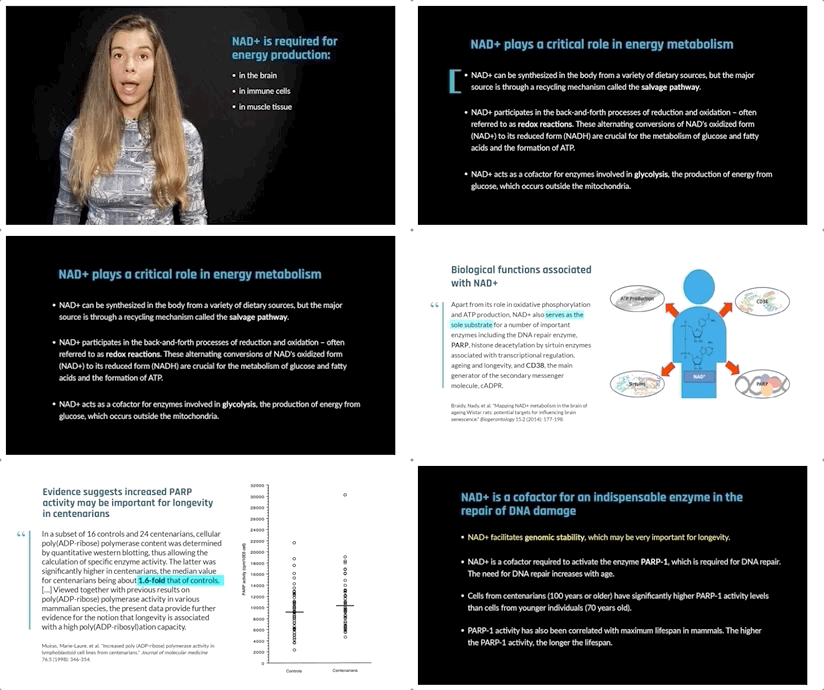
Learn more about the advantages of a premium membership by clicking below.
Hear new content from Rhonda on The Aliquot, our member's only podcast
Listen in on our regularly curated interview segments called "Aliquots" released every week on our premium podcast The Aliquot. Aliquots come in two flavors: features and mashups.
- Hours of deep dive on topics like fasting, sauna, child development surfaced from our enormous collection of members-only Q&A episodes.
- Important conversational highlights from our interviews with extra commentary and value. Short but salient.