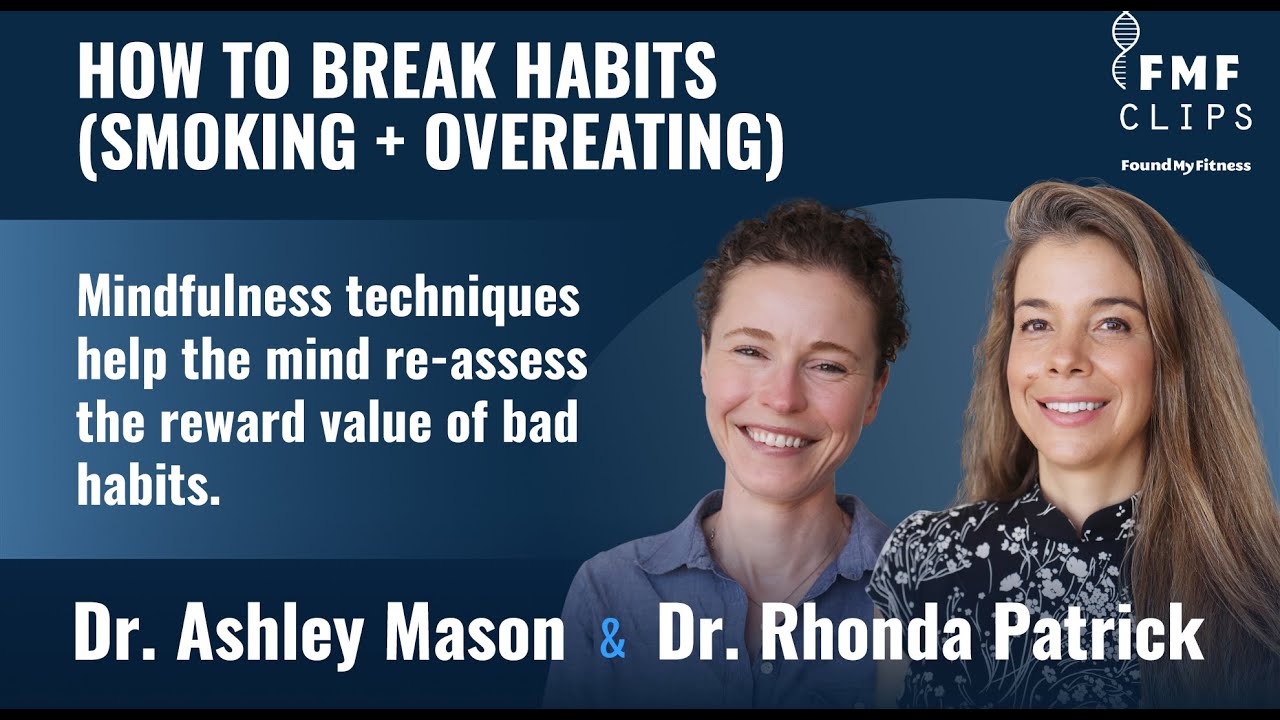
How Exercise and Nutrition Support Cognitive Function
The BDNF Protocol Guide
An essential checklist for cognitive longevity — filled with specific exercise, heat stress, and omega-3 protocols for boosting BDNF. Enter your email, and we'll deliver it straight to your inbox.
You'll also receive updates from Rhonda & FoundMyFitness
In this clip from Dr. Rhonda Patrick's appearance on Modern Wisdom, she puts exercise first among practical ways to support cognition. A year-long randomized trial in older adults found that aerobic exercise increased anterior hippocampal volume by about 2%, while the stretching control group declined. Memory and brain-derived neurotrophic factor also tracked with the change, connecting regular aerobic work with a brain region central to learning and memory. [1]
Dr. Patrick then turns to lower-effort nutrition tools. Across the COSMOS cognitive studies, a daily multivitamin produced modest average benefits in global cognition and episodic memory among older adults. Small blueberry trials have also reported improvements in selected executive-function measures, making berries a practical food-based source of polyphenols rather than a stand-alone cognitive treatment. [2] [3]
Cocoa flavanols are another possible vascular tool, but human cognition results are mixed. Small trials have reported task-specific benefits, while larger or longer trials have found no overall cognitive improvement. This supports cocoa as a food-derived source of flavanols, not a proven cognitive treatment. [4] [5]
Dr. Patrick also discusses lutein and zeaxanthin from kale, egg yolks, and supplements. These carotenoids accumulate in the retina and brain. A small one-year randomized trial in older adults appeared to buffer decline on a verbal-learning task and increased activation in selected frontal regions; the result needs replication and does not establish broad cognitive enhancement. [6]
Choline is especially relevant during pregnancy because intake supports fetal brain development. In a small controlled feeding follow-up, children whose mothers received 930 rather than 480 milligrams per day during the third trimester performed better on a sustained-attention task at age seven. The sample included only 20 children, so the finding supports adequate prenatal choline and further study, not a universal high-dose intelligence claim. [7]
Together, vigorous exercise, nutrient sufficiency, berries, cocoa flavanols, carotenoid-rich foods, choline, and marine omega-3s form a layered approach. The largest and most consistent benefits still come from repeatable daily habits, while supplement choices depend on diet, life stage, and evidence strength.
This clip is excerpted, with permission, from Dr. Rhonda Patrick's appearance on Modern Wisdom. Thank you to Modern Wisdom for allowing us to share it.
- ^ Erickson, Kirk I.; Voss, Michelle W.; Prakash, Ruchika Shaurya; Basak, Chandramallika; Szabo-Reed, Amanda N.; Chaddock, Laura, et al. (2011). Exercise Training Increases Size Of Hippocampus And Improves Memory Proceedings Of The National Academy Of Sciences 108, 7.
- ^ Vyas, Chirag M; Manson, JoAnn E; Sesso, Howard D; Cook, Nancy R; Rist, Pamela M; Weinberg, Alison, et al. (2024). Effect Of Multivitamin-Mineral Supplementation Versus Placebo On Cognitive Function: Results From The Clinic Subcohort Of The COcoa Supplement And Multivitamin Outcomes Study (COSMOS) Randomized Clinical Trial And Meta-Analysis Of 3 Cognitive Studies Within COSMOS The American Journal Of Clinical Nutrition , .
- ^ Miller MG; Hamilton DA; Joseph JA; Shukitt-Hale B (2018). Dietary blueberry improves cognition among older adults in a randomized, double-blind, placebo-controlled trial. Eur J Nutr 57, 3.
- ^ Mastroiacovo, Daniela; Kwik-Uribe, Catherine; Grassi, Davide; Necozione, Stefano; Raffaele, Angelo; Pistacchio, Luana, et al. (2014). Cocoa Flavanol Consumption Improves Cognitive Function, Blood Pressure Control, And Metabolic Profile In Elderly Subjects: The Cocoa, Cognition, And Aging (CoCoA) Study—a Randomized Controlled Trial The American Journal Of Clinical Nutrition 101, 3.
- ^ Vyas, Chirag M; Manson, JoAnn E.; Sesso, Howard D.; Rist, Pamela M.; Weinberg, Alison; Kim, Eunjung, et al. (2024). Effect Of Cocoa Extract Supplementation On Cognitive Function: Results From The Clinic Subcohort Of The COSMOS Trial The American Journal Of Clinical Nutrition 119, 1.
- ^ Lindbergh CA; Renzi-Hammond LM; Hammond BR; Terry DP; Mewborn CM; Puente AN, et al. (2018). Lutein and Zeaxanthin Influence Brain Function in Older Adults: A Randomized Controlled Trial. J Int Neuropsychol Soc 24, 1.
- ^ Bahnfleth CL; Strupp BJ; Caudill MA; Canfield RL (2022). Prenatal choline supplementation improves child sustained attention: A 7-year follow-up of a randomized controlled feeding trial. FASEB J 36, 1.
Chris Williamson: What are the most important things to consider when it comes to improving cognitive function? A lot of people want better focus. They want to be more productive. They want to improve their mood. They want to do all of those things. Like, what are the big movers when we think cognitive function?
Dr. Rhonda Patrick: So there's what I like to think of as there's definitely big movers. There's things that require effort and there's like lower hanging fruit, right? So this is things that like you could take a supplement perhaps. And I would say the big movers are the ones that of course are going to require more effort. Like, that's always how it is, right? And it's pretty clear now.
I don't think— I think it's pretty scientific consensus that exercise, and particularly vigorous exercise, is one of the best ways that you can get a cognitive enhancement, you know, memory, executive function, processing speed. So there've been studies that have been done in older adults, in middle-aged adults, in children, like across the lifespan, and it's just undeniable that getting your heart rate up, getting your heart rate up and blood flow up and sweating is going to make you smarter and feel better. It's going to make you both. So, there was even one study that was done in older adults, and this was a classic study that I just remember I've talked about it for years, but other studies have repeated it since then. But, it was 2011 or 2012 published in PNAS.
And these researchers took these older adults and they put 'em on a year-long intervention exercise program. And there was a lot of more vigorous-intensity. So, they're getting up to about 80% of max heart rate, 75, 80% of max heart rate. And for 1 year, they did this intervention. And after that year, they had a 2% increase in their hippocampal volume. So, hippocampus is a part of your brain that's highly involved in learning and memory, and they had increased it by like 2%. So, people that in that age group lose between 1 to 2% of their hippocampal volume per year. So, they essentially countered that loss, that age-related atrophy they're experiencing each year.
And so, part of the reason that happens is when you're doing a vigorous type of exercise, you are increasing brain-derived neurotrophic factor (BDNF), and that is responsible for growing new neurons in the hippocampus. It's responsible for neuroplasticity. So, that's the ability of your brain to adapt and change to the changing environment, which is what older adults don't do very well. Right. Your brain's much more plastic when it's younger. Like, you can adapt to things. That's why that saying, it's hard to teach an old dog new tricks, right? I mean, that's kind of where it comes from. So, BDNF plays a role in that. So, you want more BDNF, like, you, and exercise, and particularly vigorous exercise.
If you're working your muscles so hard that they can't get oxygen to them fast enough, and that's why I say vigorous, then they're forced to basically make energy without oxygen. And, that happens by just using glucose. And then you make lactate as a byproduct. And lactate is what is signaling and increasing that BDNF. And lactate's really, I mean, you can measure it. There's things out there that you can buy and measure it, but I don't think you need to. I think you can just measure your heart rate. And if you're doing a vigorous-intensity exercise, 10 minutes, that's all it took was 10 minutes to have improvements in cognition, executive function, processing speed. So even just a 10-minute workout. Like I did one before I came here. Like, that's like, that's my thing.
I do, you know, it's like, I want, I want to be on top of my game. So you just can do a 10-minute, you know, workout. It could be high-intensity interval training where you're shifting between periods of vigorous exercise and then kind of resting a little bit. And then, so you do these intervals, or it could just be like, I'm going to do a 20-minute, like, run and then I'm going to go, you know, I'm going to do it. So— Exercise. Exercise is the number one, I would say, big mover. As you said, it also requires the most effort. The other things, and this is where I kind of like, I'm smiling because there was very recently a new study, one of three very large randomized placebo-controlled trials where they're giving one group a placebo and another group a multivitamin.
Okay, this is a multivitamin, which is the micronutrients I've been talking about, magnesium, B vitamins, folate, vitamin K. It's just stuff people aren't getting enough of. They're not getting enough from their diets. And they gave older adults, so these were people that were 65 and older, and there was 3 different trials of this study. It was called the COSMOS trial, and there's about 5,000 participants in total. And the evidence was clear that just giving them a multivitamin improved cognition, and it slowed brain aging, which was, it was estimated to slow brain aging by about 2 years.
And This is, it's so, it's, it's funny because 10 years ago I was like doing, I was out there podcasting, you know, talking on podcasts about huge studies that were coming out saying enough is enough. Multivitamins are a waste of money. Don't buy them. And they were saying the exact opposite and they were terrible studies and I tore them apart. Um, but here we are 10 years later, complete opposite. Full circle, baby. Full circle. What's the easiest thing you can do? Like, does that mean a young person can take a multivitamin and it's gonna immediately make them, you know, probably not. At 28, probably not. But it's insurance. Yeah, it's something that you can start now, and certainly older adults, it made a difference. So, that's one.
Another one is, again, I mentioned that there's other, these phytochemicals in plants that are beneficial. They're in vegetables and they're in fruits. So, blueberries, blueberry extract, or even the equivalent of 1 cup of blueberries, this has been done, like the equivalent of 1 cup of blueberries improves cognition, executive function, it improves memory, also processing speed. So that's something like if you're like, you know, fast reaction time, I guess it's more relevant for like maybe someone who's athletic, but, you know, fine motor coordination, things like that. Multiple studies showing this. I mean, there's been meta-analyses showing it. This is across the lifespan.
There's been studies in kids, there's been studies in middle-aged adults, and there's been studies in older adults, and it's clear. Blueberries make you smarter and they make you feel better. At least they make me feel better. So—
Chris Williamson: Blueberries are the king of fruits. I think, I mean, it's between blueberries, raspberries, and pineapple, I think, for like the top spot in my world of fruits.
Dr. Rhonda Patrick: Blueberries. Yeah? No, blueberries are, so they have something in them called anthocyanins, and it's what gives the blueberries their like pigmentation. Raspberries have them too. Blueberries are very concentrated in them. They also have, so anthocyanins are a type of polyphenol, They're actually a flavonoid. They're a type of polyphenol. Polyphenols are a wide class of phytochemicals.
And phytochemicals, there's a lot of them, lots of different types of them, and they really are beneficial in humans. And like I said, there's randomized controlled trials comparing giving this to a placebo, and if it was bad for you, then it would be clear, right? It's good for you.
Chris Williamson: Mm-hmm.
Dr. Rhonda Patrick: So, blueberries are at the top of the list for that, for improving cognitive function. Low-hanging fruit. How easy is it to eat a cup of blueberries a day? It's literally hard to not eat a cup of blueberries. It's hard not to, yeah. So, that would be another one. I think another one on my list would be similar to that would be cocoa polyphenols.
So, from dark chocolate, they have another type of polyphenol called catechins, and the best one, so there've been studies, lots of studies on this, and it's mixed on this. So, some studies have shown benefits. They increase blood flow to the brain. They increase vascular flow, so you can get an immediate effect where if you increase blood flow to the brain, which is what exercise does, right? But we're talking low-hanging fruits, easy to do, take a pill. That would be something to do. It's improved cognition, executive function, and there's a type called CocoaVia, and I have no affiliation with them, but they've published their— they have studies published with their proprietary blend, which is, again, one of the highest concentrated, I would say, cocoa flavanols out there, the catechins.
Consumer Labs tested them, and I've seen, I've seen the data. It's, it's very clear they're very high in, in, they just outcompete all the other brands out there, and they also have the lowest contaminants. So they're really a good but expensive way to get those cocoa flavanols, which are really good. And then the other one would be for cognition would be lutein, which I mentioned earlier. It's in egg yolks, not very concentrated. It's in kale, very highly concentrated in kale, almost 24 milligrams in three kale leaves. And I say three kale leaves, 'cause that's what I put in my smoothie.
Chris Williamson: Mm-hmm.
Dr. Rhonda Patrick: So, I've calculated it. But, um, so there's 24 milligrams of lutein. So, lutein is a type of carotenoid, like beta-carotene, like lycopene in tomatoes. You've heard of those things before.
Well, lutein is in that same category. It is a carotenoid. It accumulates in the rods and the cones of your eye. It protects against singlet oxygen from blue light, like this light we're looking at, and also the sunshine when you go outside that damages our eyes. It causes macular degeneration. And so, lutein and zeaxanthin are carotenoids. They're in greens, and they protect against that, but they also accumulate in the brain. And, there have been a variety of studies. So, there's been observational studies correlating plasma levels of lutein and zeaxanthin with certain cognitive scores. So, like crystallized intelligence, older adults that have lutein and zeaxanthin higher levels have more crystallized intelligence.
So, that's the ability to use all the information you learned over a lifetime and, like, use it. There's been randomized controlled trials looking at giving 8 milligrams of lutein. Now, I said 24 is in 3 kale. So, they give 8 milligrams of lutein and something like 2.3 milligrams of zeaxanthin to older adults, and it improves neural efficiency. So, this is the ability to basically, your neurons can function with less energy, which is nice. So, that obviously improves cognitive function, because it's a very energy-demanding process. So, lutein is another one.
Chris Williamson: You haven't mentioned choline.
Dr. Rhonda Patrick: Yeah, I know it's in eggs. Choline, yeah. Cholinergics, generally very important for brain function. It is, yeah. It's important for brain, and there's been studies, actually, with pregnant women.
If you give pregnant women about 500 milligrams of choline per day, their children score better on the intelligence test.
Chris Williamson: Really?
Dr. Rhonda Patrick: Yes. So, I learned about this, of course, when I was pregnant, and I was like, well, it was actually before I was pregnant, but I was like figuring out like what I'm gonna do, like what do I need? And that's why I ate so many eggs during pregnancy, because I also supplemented.
Chris Williamson: But now you've got like Mastermind babies.
Dr. Rhonda Patrick: I do.
Chris Williamson: Yeah, wow.
Dr. Rhonda Patrick: But so choline's also important, yeah, for sure, brain function. But that comes down to, again, trying to get everything you need from your food. And then omega-3s, there's been so many randomized controlled trials on omega-3s improving cognition, especially when it has to be 2 grams or more.
That's where you'll get the mixed data. If it's like, oh, we gave them 500 milligrams, it wasn't enough. So the studies that were consistently showing improvements in cognitive function are at least 2 grams a day of the omega-3s. That's my sort of, I think, low-hanging fruit for cognitive function, things you can do.
A class of flavonoid pigments that give many fruits and vegetables red, purple, or blue colors. Blueberries are a dietary source. Anthocyanins are metabolized into multiple compounds after ingestion.
Hear new content from Rhonda on The Aliquot, our member's only podcast
Listen in on our regularly curated interview segments called "Aliquots" released every week on our premium podcast The Aliquot. Aliquots come in two flavors: features and mashups.
- Hours of deep dive on topics like fasting, sauna, child development surfaced from our enormous collection of members-only Q&A episodes.
- Important conversational highlights from our interviews with extra commentary and value. Short but salient.
Brain News
- Human longevity was associated with decreased levels of genes involved in neural overactivity.
- Noninvasive stimulation of facial lymphatic vessels doubles cerebrospinal fluid outflow, enhancing the glymphatic system's clearance of brain waste, even in aged mice.
- Flashing light at a specific frequency altered brain activity in a way that reduces levels of brain amyloid-beta plaques (linked to Alzheimer's).