How Vitamin D, Magnesium, and Vitamin K Work Together
The Omega-3 Supplementation Guide
A blueprint for choosing the right fish oil supplement — filled with specific recommendations, guidelines for interpreting testing data, and dosage protocols.
You'll also receive updates from Rhonda & FoundMyFitness
In this clip from Dr. Rhonda Patrick's appearance on The Knowledge Project, she explains why vitamin D status depends on more than food intake. UVB exposure varies with season, latitude, skin pigmentation, sunscreen use, age, and time spent outdoors. Body composition also matters: a human study found lower vitamin D bioavailability after UV exposure and an oral dose in adults with obesity. Measuring 25-hydroxyvitamin D helps place these factors in context. [1]
When sunlight is insufficient, Dr. Patrick favors vitamin D3 over vitamin D2 and stresses that dose should match the person rather than follow a universal rule. A randomized trial found that vitamin D2 and D3 produced different 25-hydroxyvitamin D responses depending on dose, schedule, sex, and time. She also explains why excessive, unmonitored supplementation can raise calcium and create avoidable risk. [2]
Magnesium supports the enzymes involved in vitamin D metabolism, while vitamin K-dependent proteins help direct calcium handling. In a randomized trial, magnesium supplementation changed vitamin D metabolites in a manner that depended on baseline vitamin D status. Dr. Patrick uses this nutrient interaction to emphasize testing, food quality, and balanced supplementation instead of treating vitamin D as an isolated input. [3]
This clip is excerpted, with permission, from Dr. Rhonda Patrick's appearance on The Knowledge Project. Thank you to The Knowledge Project for allowing us to share it.
- ^ 10966885
- ^ Hammami, Muhammad; Yusuf, Ahmed (2017). Differential Effects Of Vitamin D2 And D3 Supplements On 25-Hydroxyvitamin D Level Are Dose, Sex, And Time Dependent: A Randomized Controlled Trial BMC Endocrine Disorders 17, 1.
- ^ Dai, Qi; Zhu, Xiangzhu; Manson, JoAnn E; Song, Yiqing; Li, Xingnan; Franke, Adrian A, et al. (2018). Magnesium Status And Supplementation Influence Vitamin D Status And Metabolism: Results From A Randomized Trial The American Journal Of Clinical Nutrition 108, 6.
So vitamin D, we didn't, you know, people might be wondering, you're talking about all these important micronutrients, why aren't we talking about vitamin D? Well, food is not a great source of it. Like, you can find, like, it is fortified in some fatty foods. Unfortunately, it's fortified with the wrong form. It's fortified with D2 rather than D3, which is what we make in our skin from the sun. So vitamin D is, the primary source of it is, as you mentioned, it's from the sun, and specifically, it's UVB radiation from the sun. And why do I point that out? Because that is really important because UVB radiation only occurs during certain times of the year.
So, you know, winter, early spring, no UVB radiation is happening, especially in regions— I mean, I wouldn't say no. I'm saying in regions where you're more northern in latitude, something like above, like, the 37th parallel or something like that if you're looking on, like, a map. So, for example, in Canada, like, you know, you're not making vitamin D a good, you know, 4 or 5 months out of the year. It's very challenging to make a lot of vitamin D from being out in the sun. Summertime, you know, different, lots of UVB radiation, right? Same thing is like, well, you're not laying out in the sun to get a tan in December because tanning is like, if you're tanning, you're also making some vitamin D. That's the same process, right? The UVB radiation is causing the same thing.
So, you need to be in the sun, and you need to be at a certain time of year depending on where you live. It all— there's lots of things. And, you mentioned sunscreen as well. There's a lot of factors that are involved in, you know, the ability to produce vitamin D3 in the skin from the UVB radiation. And, that has to do with sunscreen. So, anything that blocks out UVB radiation is going to block out the ability to make vitamin D. Melanin, the pigmentation that is like a sunscreen, it's natural sunscreen in people that some people have, like, in some regions of the world that are certainly more equatorial. That is also a natural sunscreen.
It blocks out UVB radiation, which is why your body responds when you're in the sun, your body tans because it's like, oh, next time I'm in the sun, I need to protect myself. It's an adaptation, right? Oh, yeah. So the other thing that regulates the production of vitamin D3 from the sun is age. So the older you get, the worse— the less, I would say, efficient your body is at making vitamin D3 from the sun. So, for example, a 70-year-old makes, like, 4 times less than their 20-year-old former self. And then, bioavailability of vitamin D3 is important as well, and that's regulated by body mass and weight. So, so, so you make vitamin D3 in your skin, but it gets released into your bloodstream, and then it's converted into another form that is actually not a vitamin, it's a steroid hormone.
So vitamin D is actually much more important. It's not just a vitamin, it's actually a hormone that our body needs. And body— so basically, the more body fat you have, the less bioavailable vitamin D3 is. And so you actually need more vitamin D3 the more body weight— the more body fat that you have. So this hormone is extremely important because it is regulating about 5% of the human genome, the protein-coding human genome. So it's a lot— it's doing a lot of things. And you can imagine— so what it does, there's actually a little sequence inside of our DNA in, you know, it's a little repeat sequence that vitamin D recognizes. And it— like this whole complex of vitamin D and a receptor goes down and binds that little sequence of DNA and it turns on a gene or it turns off a gene.
And it does it in a very coordinated manner. And when you don't have enough vitamin D, that stuff all goes wrong, and so lots of things can happen. And because of sunscreen, because of our modern-day lifestyles, we're inside technology, we're on our computers, less farming, less agricultural work out in the sun, we're indoors. The majority of people are not getting enough vitamin D3, and so something around 70% of the U.S. population is insufficient in vitamin D3. So that is defined as having blood levels of vitamin D less than 30 nanograms per milliliter. And then another percentage of the population is deficient, so they'd be less than 20 nanograms per milliliter. But we've been told, like, not to go outside.
We've been told to, you know, layer up the sunscreen. We've been— I mean, are these things getting in the way of vitamin D? Are they helping us? What— How do we make sense of all this? If you have, you know, fair skin and you're going out in the sun a lot, then you can increase your risk for DNA damage. And, you know, skin cancer is one. Like, for example, Australia. So, you know, fair-skinned people— Australia is like— the melanoma cancer is, like, through the roof in Australia. And melanoma is, like, the worst type of skin cancer to get. So, you know, there's a lot of fair-skinned people living there, and Australia is very close to the equator. You know, there's definitely many months out of the year where you're just lots and lots of UVB radiation.
But people that were sort of native to that region had darker skin, they had more melanin. And so the solution to people that are more fair-skinned living in Australia is actually sunscreen and a hat and a vitamin D3 supplement. Because, you know, like these people that are fair-skinned in Australia migrated from like a region like, you know, Britain, right, where it was not like— it's much further from the equator. And so their fair skin was an adaptation to help them make more D3 from a little bit of sun, right, that they get during the summer and, you know, spring and stuff. So, yeah, the question is, where do you find the balance, right? Like how much sun exposure is enough? And do I need to supplement? And do I have to wear sunscreen?
And I think that all depends on a variety of factors. It isn't like a one-size-fits-all. It's like, okay, well, where do you live? Do you live, you know, in Southern California, like where I do? Do you live in Australia? Do you live in Canada? Where do you live? Like, how much exposure to the sun are you getting? You know, so those are all factors to keep in mind. And then just measuring vitamin D levels. Where am I at? Then you can go, okay, well, clearly, I don't wear sunscreen. I don't go out in the sun a lot because I'm indoor work— I work inside a lot. So, you know, even without the sunscreen, I'm still not, you know, getting enough vitamin D3. So you have to kind of measure something. So is there a difference?
Like, if I go out and buy a vitamin D3 supplement, is there a difference between that and the sun? And then do I want to take that with anything? I noticed, I think Athletic Greens includes vitamin K with that. Is that for Is that for the bioavailability? No, it's not for the bioavailability. But let's address your questions because they're really great questions. Differences between sun exposure and supplemental form. Again, vitamin D3 supplemental form, which is key, because the vitamin D— there is a plant form of vitamin D that's made in, like, mushrooms, for example. It's called vitamin D2. And that's that is different than vitamin D3.
And in fact, there's been some preliminary work showing that it may even inhibit some of the vitamin D3 in conversion into the steroid hormone, which is important. So so the differences between vitamin D3 from the sun versus supplemental yes, there's differences. So like you know, let's let's say you're you're like in like sub-Saharan Africa where you're like so close to the equator and you're just you know you can make vitamin D you know three from the sun and you're out in the sun. Let's say you're like a San hunter-gatherer or something out there all the time.
There's been studies that have measured the levels of, you know, people that are like Aboriginal to these equatorial regions, like Bushmen in sub-Saharan Africa, and their natural vitamin D levels are something like anywhere between 80 to 100 nanograms per mL, but they don't really go above that. And the reason is because your body senses like the vitamin D levels, and when you're still being exposed to the sun, instead of converting it into like vitamin D3, it like converts it into this other metabolite. So it's like, it's like, okay, we're putting the brakes on this, we're not going to do anymore. Right?
If you're taking a supplement, and you don't measure anything, like you can, let's say you're taking like an insane number, like, so there's, there's upper limits that have been sort of identified as the safe amount to supplement with vitamin D3 every day. So like the Institute of Medicine in the United States has set that as 4,000 IUs a day. That doesn't mean you can't go above that. That's just the safe, you know, upper limit where you're not going to have any toxicity effects. Like, that's safe. And but, like, let's say you're taking, like, 100,000 IUs a day, like, way over 4,000, right? I mean, and you don't measure anything. Well, I mean, you're just taking it and taking it.
So, those natural mechanisms aren't going to kick in in the skin that, like, they do when you're being exposed to a lot of UV radiation and your body's like, oh, I have enough vitamin D3, so I'm going to, you know, stop. So you can oversupplement with vitamin D3. It is fat-soluble, and it can be toxic. However, it is not— it's challenging to do. Like, you would have to take something like 100,000 IUs, you know, or something a day for, like, a year. You'd have to take— so there's been studies done, and, like, you can take 10,000 IUs a day, even 50,000 IUs a day, and the biggest effect is vitamin D3 can— you can make your calcium more bioavailable. So we're talking about bioavailability of other minerals.
Calcium is much more bioavailable in the presence of vitamin D. So you absorb about 40% more calcium from your diet if you have adequate levels of vitamin D and the hormone, steroid hormone, right? So one concern is, well, if I have a lot of vitamin D and I'm taking calcium, then maybe I'm going to get hypercalcemia, right? Too much calcium in the bloodstream. And that's the major concern. There are studies that have shown it's exceedingly high doses that you have to do for a long time to get that.
But that is the concern with taking too much vitamin D3 is that you're going to get too much calcium in your blood, which can have acute toxicity effects, but also long-term effects with calcification of, you know, your arteries and your vascular system because calcium can form a precipitate really easy. And so, you know, that's the concern. And you mentioned your Athletic Greens. So they put vitamin K2 in there, which is so I mentioned vitamin K1, which is found in leafy greens, and it's involved in blood coagulation. So clotting. It was— when you take in your greens, you make— you're getting the vitamin K1, it goes to the liver, and it activates all those coagulation proteins, blood for blood clotting.
When you get enough of that from the greens, it stays in circulation, and it does exactly what vitamin K2 does, which is activates proteins that are involved in shuttling calcium out of your vascular system and bringing it to your bones, bringing it to your muscle where you want calcium to be. And not in your vascular system where it can form a precipitate and then a plaque, right? So there's been sort of this push in the— I think in not a push, but like an awareness, I guess, is a better word, awareness in the health sphere that, you know, if you're going to be absorbing more calcium with having, you know, adequate vitamin D, that you also want to make sure that calcium that you're absorbing is going where it's supposed to, and that's where the K2 comes into hand.
But like I said, K1 does the same thing. Especially when you're getting enough of it. And it doesn't take much for blood coagulation. So, but I want to mention one other thing because you did say bioavailability, and it's related, and it has to do with magnesium. Because magnesium is a— we were talking about it's a cofactor for enzymes like DNA repair. I didn't talk about a really important one. It's actually a cofactor for both enzymes that convert vitamin D3 into the circulating form of vitamin D that we go and we measure. It's called 25-hydroxyvitamin D, and then eventually into the active steroid hormone, which is 1,25-dihydroxyvitamin D, but we'll just call it the active steroid hormone.
And so, there's been studies showing that people that don't get enough magnesium, even if they're getting enough vitamin D, even if they're supplementing with it, they won't convert it into the steroid hormone. And so, you're not going to get the important effects that vitamin D3— the whole point of vitamin D3 is to get converted into the steroid hormone. It's a hormone. It's a hormone that we need. So if you're not getting that magnesium, that's a problem. And it also comes down to a lot of conflicting studies in the scientific literature. Because, as I mentioned, half of the US population doesn't get enough magnesium.
And so if you did, you get a random sampling of the population, and you say, okay, we're going to take this group and give them a vitamin D supplement, and then we're going to take this group and give them a placebo, but you don't even consider their magnesium status, you're going to just know from the get-go half of the people are not going to have enough, and that will affect their ability to form the steroid hormone. And so, it really plays a role, in my opinion, in this, the conflicting data with the vitamin D3 supplementation studies, which is kind of all over the place. And that's a completely different episode. But I just thought because you mentioned bioavailability, and again, if you're putting— Yeah, totally.
Yeah, if you're putting like— so, something like Athletic Greens does have magnesium in it, I think. But also, if you're doing greens, right, that's like a really good source of magnesium as well. So you want to make sure you have your magnesium covered, especially for the vitamin D as well, because they work together. You need them both.
Get email updates with the latest curated healthspan research
Support our work
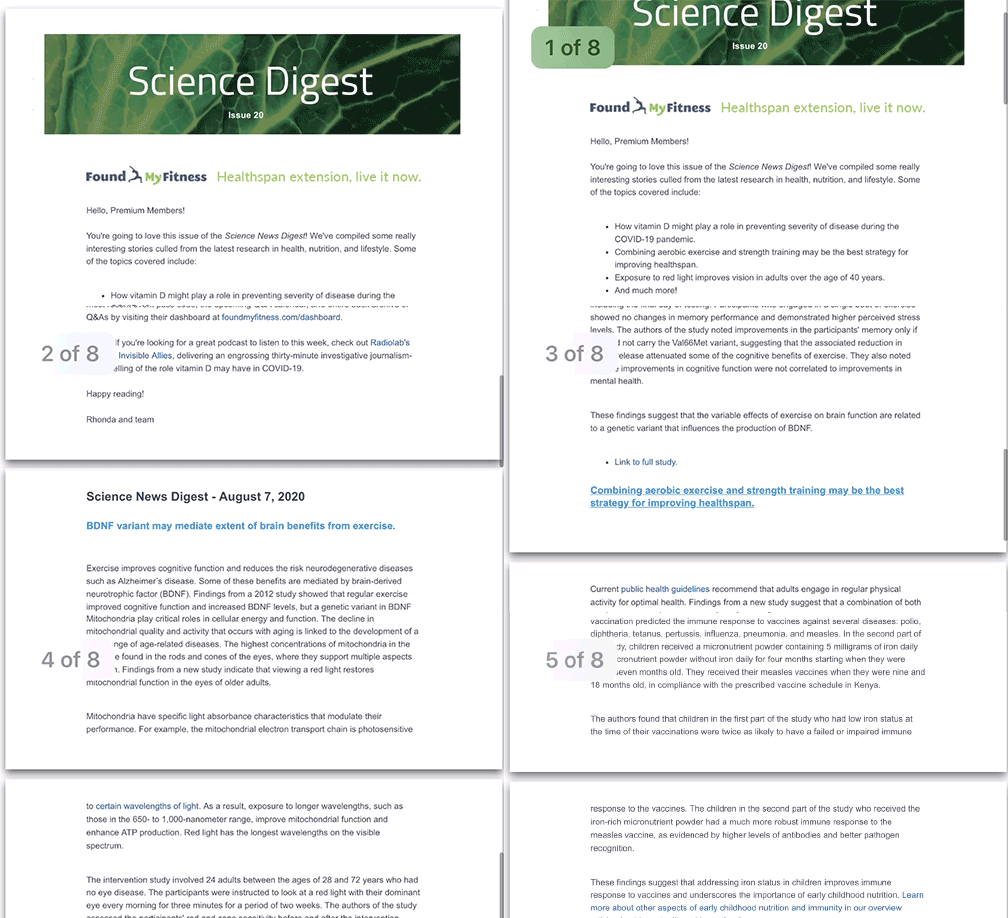
Every other week premium members receive a special edition newsletter that summarizes all of the latest healthspan research.
Vitamin d News
- Check out the Vitamin D Infographic I was privileged to be able to do in collaboration with FMF!
- Low magnesium levels impair vitamin D metabolism.
- Supplementing with 4,000 IU of vitamin D per day for 16 weeks reversed epigenetic aging by 1.85 years in overweight and obese African Americans
- Berries have a compound called pterostilbene that works with vitamin D to improve immune function against infection