What a VO2 Max Test Reveals About Aerobic Fitness
Get the full length version of this episode as a podcast.
This episode will make a great companion for a long drive.
The BDNF Protocol Guide
An essential checklist for cognitive longevity — filled with specific exercise, heat stress, and omega-3 protocols for boosting BDNF. Enter your email, and we'll deliver it straight to your inbox.
You'll also receive updates from Rhonda & FoundMyFitness
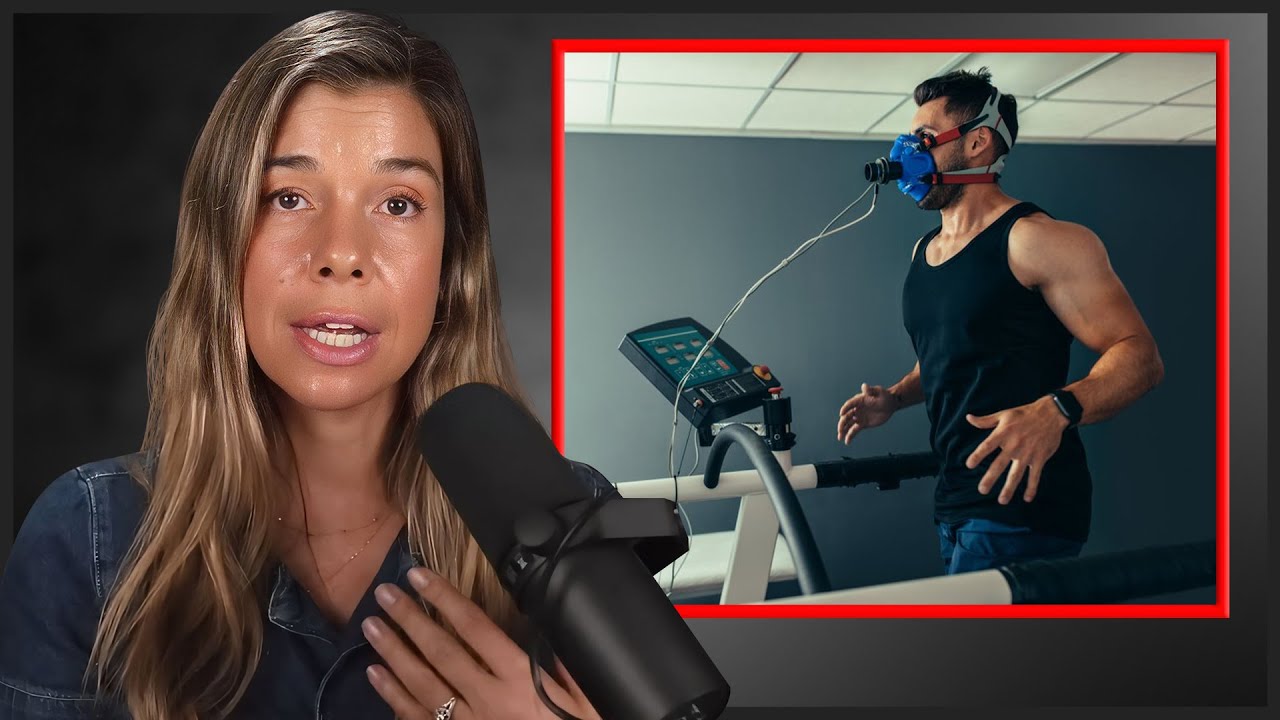
In this clip from the FoundMyFitness interview with Dr. Peter Attia, Dr. Rhonda Patrick asks what happens during a VO2 max test. Dr. Attia recommends using the exercise mode a person trains with, such as a bike or treadmill, and describes the tight mask, calibrated oxygen and carbon dioxide sensors, and progressively harder workload used to measure the response to graded exercise.
The test produces more than one headline number. Dr. Attia explains how oxygen consumption, carbon dioxide production, heart rate, and wattage can be used to follow respiratory exchange and estimate the changing balance between fat and carbohydrate oxidation. He recommends asking for the raw data so peak fat oxidation and the intensity at which it occurs can be reviewed alongside VO2 max.
VO2 max expresses peak oxygen consumption relative to body weight and provides a useful marker of cardiorespiratory fitness. In a cohort of 122,007 adults referred for treadmill testing, higher measured fitness was associated with lower long-term mortality, including among people with elite performance. The association supports fitness assessment while remaining distinct from proof that one test result causes a specific lifespan outcome. [1]
- ^ Mandsager, Kyle; Harb, Serge; Cremer, Paul; Phelan, Dermot; Nissen, Steven E.; Jaber, Wael (2018). Association Of Cardiorespiratory Fitness With Long-term Mortality Among Adults Undergoing Exercise Treadmill Testing JAMA Network Open 1, 6.
Dr. Peter Attia: Have you done a VO2 max test yet?
Dr. Rhonda Patrick: I haven't.
Dr. Rhonda Patrick: Okay, so can you just go to any doctor, or do you have to go? Doctors don't do it?
Dr. Peter Attia: No, you typically go to, well, when I did, when I lived in San Diego, I used to do them with my coach. So he would do them. In Austin, we send people to UT. Like we just send people to the university and get them done. It's a very inexpensive test, like $100 or something like that, right? So they're gonna have you do it in one of two ways, which is a bike or a treadmill. And I always tell patients, do it in the way you train, because there's a, you know, there's a— you don't want to take a cyclist and make them do the running test or vice versa. So it sounds like you're doing most of your work on a Peloton, so you would do it on a bike.
Dr. Rhonda Patrick: Okay.
Dr. Peter Attia: Because you're going to sit on a bike and they're going to put a mask on you, and it's super uncomfortable. The mask has to be incredibly tight. It can't have any interference from the outside world in terms of air that you're breathing can't escape, and no air from the outside can get to you. There are 2 gas sensors on the outside of the mask, one for O2, one for CO2. This is the bread and butter of this whole device. If those sensors aren't calibrated correctly or they don't work, the test is meaningless. And like 1 out of 10 times they fail. So you got to make sure whenever you're doing this test, the person, the tech who does it has calibrated this thing and knows what to look for if the calibration fails during the test. Uh, we just had a patient do one recently, the test failed.
Dr. Peter Attia: So, um, you're gonna be put on a bike and it’s going to be an ergometer, which means unlike the Peloton, where you set the resistance and how— like, let's say you have the resistance at 50. Well, that doesn't determine the wattage by itself. How fast you pedal also determines the wattage. That's different here. Here, the computer is telling the bike how many watts to put out. So the harder, the faster you pedal, the less the resistance will be.
Dr. Rhonda Patrick: Okay.
Dr. Peter Attia: Okay, but it’s fixed wattage. So they might say, look, Rhonda, we're going to start you out at 50 watts, nice little warm-up. We're going to have you spend, you know, 5 minutes here and then like 3— every 3 minutes we're going to go up, you know, 25 watts or something like that.
Dr. Peter Attia: And they're, you know, within about 15 minutes you're gonna be in crunch time. And at that point they're probably going to increase the wattage every minute, and you're gonna— you're in the— the pain train has left the station. Like, this is unpleasant, and you have to keep your RPMs high. The test is usually aborted if you can't keep your RPM above about 50 or 60. So as you're training, keep that in mind. These are all the things that you don't want to fail the test because you didn't know the test. Right. You know what I mean?
Dr. Rhonda Patrick: Right.
Dr. Peter Attia: Let the physiology be the place you fail. So make sure when you're riding that Peloton, you're in that, you're really comfortable in that 80 to 100 zone of RPM.
Dr. Rhonda Patrick: And so what is the tech looking for?
Dr. Peter Attia: So the tech is looking at a bunch of data.
Dr. Peter Attia: So what they're looking for is VO2 and VCO2. Those are the things that are being measured. They know your heart rate at every moment in time. They know how many watts you're generating, because they're— you're generating by definition everything they're sending you. And then they're measuring VO2, so oxygen consumption, and VCO2, carbon dioxide production. They also at every moment in time see the ratio of VCO2 to VO2. That's called respiratory quotient, or RQ. It's also known as RER. That ratio in any moment in time tells you how much fat you're oxidizing versus how much glucose. When that ratio is 0.7, you are 100% fat oxidizing. When that ratio is 0.85, it's about 50/50. When that ratio is 1 and above, you're all carbohydrate.
Dr. Peter Attia: What you'll want to see when you do the test is you won't want the report, the summary. You will also want the raw data, which is pages and pages of a spreadsheet, and you'll kind of go through and you can see how these things change. So when I used to do my tests, I used to plot my own data. I would just get the spreadsheet and I would make the fuel partitioning curve. So what I would draw would be a— what I would have Excel plot for me is on the x-axis I would have wattage, because I cared more by wattage than by heart rate. So you have either wattage or heart rate on the x-axis, and on the y-axis I'd have a double y-axis, and the y-axis would be either calories or preferably grams per minute. And I would have carbohydrate oxidation and fat oxidation.
Dr. Peter Attia: So fat oxidation goes down as the test starts, so it usually has an early peak and then comes down as intensity goes up, and carbohydrate oxidation just rises monotonically. And there's where those 2 cross. Some people call that your anaerobic threshold, but that's where your respiratory quotient is equal. And if you, if you've done this in calories, if you do it in grams per minute, it won't be because obviously there's way more calories in fat than glucose. So one of the other metrics we care very deeply about in our patients is what is your peak fat oxidation and where does it occur? And we plot that. So we, we plot their VO2 max, we plot their zone 2, and we plot fat oxidation. And not surprisingly, there, there's a family of curves that we put the patients on.
Dr. Peter Attia: So we say, this is what someone with type 2 diabetes looks like, this is their fat oxidation curve. This is what a world-class Tour de France cyclist looks like— they couldn't be further apart. And this is everything in between. And where do you stack up? So what you want is the highest amount of fat oxidation, and you want to be able to sustain that for as long as possible. Now, if you do this on somebody who is heavily carbohydrate restricted, you will get an artifact of the test because their resting RQ is very, very low. Okay. And so it's not clear what the implications of that are other than we typically will feed people carbohydrates before they do the test, like in the days leading up.
Dr. Rhonda Patrick: But their VO2 max won’t be affected?
Dr. Peter Attia: It doesn’t affect their VO2 max, no, because the VO2 max is literally taking the peak VO2 that they achieve and dividing it by their weight in kilos.
Dr. Rhonda Patrick: What VO2 max do you aim for? And if you can recall, I know that JAMA 2018 paper, which was probably one of the most convincing studies that VO2 max is like one of the best metrics of health and longevity. There was an even bigger paper that came out. That JAMA paper had 120,000 subjects in it. There was a JACC paper that came out a year ago that had almost a million subjects in it. And it showed the exact same findings. So the findings, if I recall, was that—
Dr. Peter Attia: Both of them are in the book. I think I have figures from both of them in the exercises.
Dr. Rhonda Patrick: You had the numbers in there? Okay.
Dr. Rhonda Patrick: And so that was like the top, I just remember it was like the top percentile. I mean, they had like 80% lower—
Dr. Peter Attia: Yeah, if you compared the top, the difference in risk between someone in the bottom 25 percentile of VO2 max to the top 2.5% had a hazard ratio of 5, meaning it's four times greater all-cause mortality if you're in the bottom 25% versus the top 2%.
Dr. Rhonda Patrick: Okay, so if I want that number, do you know it? I mean, what’s the top?
Dr. Peter Attia: Yeah, are you 30 to 40?
Dr. Rhonda Patrick: I’ll be 45.
Dr. Peter Attia: Okay, so you're right in the middle of the 40 to 50. I would guess, but the table is in my book, so I can tell you that right now. I would guess that it's about— it's in the high 40s. Okay. Yeah. So roughly, probably like 46, 47, 48 milligrams— sorry, milliliters per minute per kilogram. That probably has more to do, but—
Hear new content from Rhonda on The Aliquot, our member's only podcast

Listen in on our regularly curated interview segments called "Aliquots" released every week on our premium podcast The Aliquot. Aliquots come in two flavors: features and mashups.
- Hours of deep dive on topics like fasting, sauna, child development surfaced from our enormous collection of members-only Q&A episodes.
- Important conversational highlights from our interviews with extra commentary and value. Short but salient.
Aerobic News
- Cardiorespiratory fitness may be a far greater predictor of gut microbiota diversity than either body fat percentage or general physical activity
- A combined aerobic-resistance training regimen proves equally effective for cardiovascular health as aerobic alone.
- 30 minutes of moderate-intensity aerobic exercise (64.9% of VO2 max) three times a week stabilized choline concentrations in the brain.