How to Identify Zone 2 During Cardio
Get the full length version of this episode as a podcast.
This episode will make a great companion for a long drive.

The BDNF Protocol Guide
An essential checklist for cognitive longevity — filled with specific exercise, heat stress, and omega-3 protocols for boosting BDNF. Enter your email, and we'll deliver it straight to your inbox.
You'll also receive updates from Rhonda & FoundMyFitness
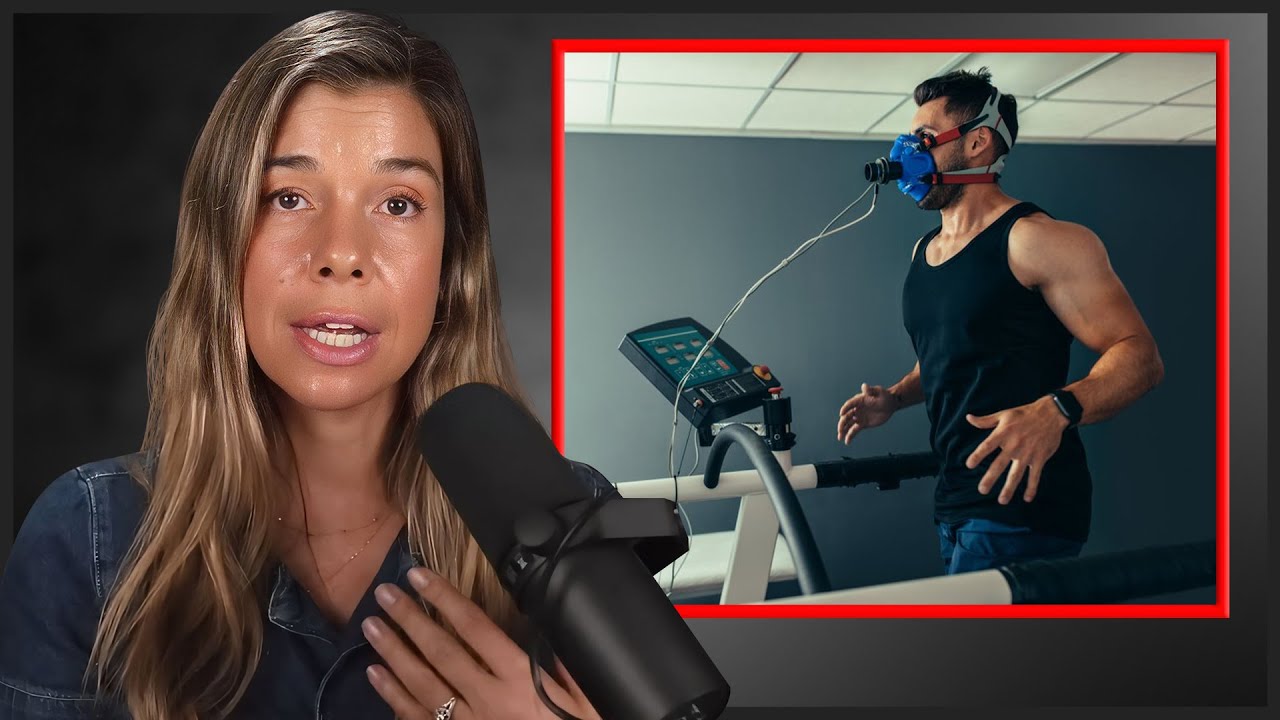
In this clip from the FoundMyFitness interview with Dr. Peter Attia, he explains how he identifies Zone 2 during steady aerobic training. Blood lactate can provide a direct metabolic signal, while heart rate, perceived exertion, breathing, and the talk test offer practical estimates.
Dr. Attia says checking lactate during every cycling session is his own data-heavy practice, not something most people need to do. For most people, he favors rate of perceived exertion and the talk test, with heart-rate formulas used only as starting points. He notes that fitness and elevated resting lactate can change how these measures should be interpreted.
For the specific lactate test discussed in the clip, Dr. Attia says his practice waits 30 to 45 minutes for a steady state before measuring. He frames lactate testing as useful when he wants objective data about factors such as metformin or statins, while saying beginners can usually approximate Zone 2 from perceived exertion.
Dr. Rhonda Patrick: When you're using Zone 2 lactate-threshold training to measure mitochondrial function, you can buy a lactate meter from Nova Biomedical or something like that—
Dr. Peter Attia: It's like a yellow-and-purple one.
Dr. Rhonda Patrick: I got it per your recommendation. But for people listening who want to get one, when you talk to an exercise physiologist and say “lactate threshold,” they kind of know—
Dr. Peter Attia: They're going to push you up. Lactate threshold is a different number.
Dr. Rhonda Patrick: Right? So this is lower. How do people know? Let's say they have a Peloton at home, and they want to do a Zone 2 test. Can you somehow use a percent of max heart rate as a proxy to know?
Dr. Peter Attia: Yeah, there are lots of different ways to estimate this. And to be clear, I'm one of the very few people who checks his lactate every day he's on his bike, which is four days a week for me. And I'm also doing it while using all the other metrics that I'll explain in a moment, mostly just in a never-ending quest to have as much data as possible to understand: when is lactate the best predictor? When is RPE the best predictor? When is heart rate the best predictor? When is absolute wattage the best predictor? There's a lot of stuff going on here. So the first thing I always say to people, namely my patients, when they say, I don't want to get that lactate meter, I don't want to be poking myself in the finger—
Dr. Peter Attia: I'm like, great, don't. You don't have to. There are other ways that you can pretty much approximate your Zone 2 output. The only reason I brought up lactate testing is that it is the gold standard and the most objective way to do this. Therefore, if I'm trying to really understand the impact of, say, metformin or a statin, that's what I want to do. But let's put that aside for a moment and answer the relevant question: how does someone exercise in this zone? I think the most important tool for virtually anybody is rate of perceived exertion. I think that will almost never let you down. In fact, I would argue that for a really out-of-shape individual, rate of perceived exertion is even better than lactate.
Dr. Peter Attia: And the reason for that is, if you take somebody who has, for example, type 2 diabetes, their resting lactate may already be at two. So in those patients, we never use lactate until they reach a certain level of fitness. We only use rate of perceived exertion, and we provide heart-rate guidance. So here's two ways to think about it. For RPE, rate of perceived exertion, we give people the talk test. When you are in Zone 2, you should be able to speak to somebody, but it should be uncomfortable and not something you want to do. If you can't speak in a full sentence, you're not in Zone 2 anymore. You're north of Zone 2.
Dr. Peter Attia: If you can speak the way you and I are speaking now, you're not working hard enough. You're too far below it. So there is that sweet spot where, if you're on that Peloton and the phone rings and you answer it, the person knows you're exercising, and you're going to let them do most of the talking. But if they ask you a question, you can answer in a full sentence, though you're not that comfortable. That's the single most important thing people need to understand about it. As far as heart-rate guidance, Phil Maffetone uses a test that I think is a pretty good starting place: 180 minus your age. Now, the fitter you are, the less relevant that becomes.
Dr. Peter Attia: So I'm 51, which would put me at 130, but I can tell you my Zone 2 is above 130. So if you're fitter, you may add five to 10 to that. I use another app that checks my HRV every single morning and predicts my Zone 2 as a result of my HRV. Every day, I'm looking at the heart rate predicted by the app, which can vary by as much as 10 beats per minute based on how much I slept, the quality of my sleep, how sore I am, a subjective measurement of how much I want to train that day, and my HRV. It's called Morpheus. I have no affiliation with it or anything like that.
Dr. Peter Attia: So basically, this morning I got up, my HRV was—I don't even remember—78 milliseconds. I slept seven hours and 15 minutes, had good-quality sleep, wasn't sore, and felt good. So I actually had a pretty high target today. My target today was a heart rate of 141. That's about as high as it will predict me to be on a day when everything is good. On a day when everything sucks, it might tell me as low as 129. Usually it's predicting about 136, 137, or 138. And that's generally aligning with where my lactate is, which generally puts me at a lactate of about 1.9. On top of that, I'm paying attention to the wattage, so I kind of know where to be. But again, for somebody just starting out, RPE is all you need to know. One hundred eighty minus your age is good. And if a person is fit enough that they truly know their maximum heart rate, we tell them to start somewhere between 75% and 80% of that number.
Dr. Rhonda Patrick: Great recommendations. If a person is specifically trying to do this functional mitochondrial test, how long should they be in that Zone 2 before they can measure their lactate?
Dr. Peter Attia: We like to see people there for 30 to 45 minutes before we do it. Yeah. So, a true steady state.
Dr. Rhonda Patrick: Awesome.
Hear new content from Rhonda on The Aliquot, our member's only podcast

Listen in on our regularly curated interview segments called "Aliquots" released every week on our premium podcast The Aliquot. Aliquots come in two flavors: features and mashups.
- Hours of deep dive on topics like fasting, sauna, child development surfaced from our enormous collection of members-only Q&A episodes.
- Important conversational highlights from our interviews with extra commentary and value. Short but salient.
Aerobic News
- Cardiorespiratory fitness may be a far greater predictor of gut microbiota diversity than either body fat percentage or general physical activity
- A combined aerobic-resistance training regimen proves equally effective for cardiovascular health as aerobic alone.
- 30 minutes of moderate-intensity aerobic exercise (64.9% of VO2 max) three times a week stabilized choline concentrations in the brain.