How Beta-Alanine Delays Fatigue During High-Intensity Exercise
Get the full length version of this episode as a podcast.
This episode will make a great companion for a long drive.
The Omega-3 Supplementation Guide
A blueprint for choosing the right fish oil supplement — filled with specific recommendations, guidelines for interpreting testing data, and dosage protocols.
You'll also receive updates from Rhonda & FoundMyFitness
In this clip from his FoundMyFitness interview with Dr. Rhonda Patrick, Dr. Andy Galpin explains how beta-alanine increases muscle carnosine. Carnosine helps buffer hydrogen ions that accumulate during hard exercise, which can delay fatigue during efforts that rely heavily on anaerobic glycolysis. Because carnosine must build over time, beta-alanine works as a chronic loading supplement rather than an acute pre-workout stimulant.
Evidence reviewed by the International Society of Sports Nutrition supports about 4 to 6 grams per day for at least two to four weeks, with the clearest performance benefit during hard efforts lasting roughly one to four minutes. Dividing the daily dose can reduce paresthesia, the temporary tingling that some people feel after a larger serving. [1]
Dr. Galpin also compares beta-alanine with sodium bicarbonate, an acute extracellular buffer used before selected high-intensity events. A position stand supports performance benefits across efforts lasting about 30 seconds to 12 minutes, while emphasizing individualized dosing because gastrointestinal symptoms are common. This distinction helps athletes match chronic carnosine loading or acute buffering to the demands of a specific workout. [2]
- ^ Trexler, Eric T.; Smith-Ryan, Abbie E.; Stout, Jeffery R.; Hoffman, Jay R.; Wilborn, Colin D.; Sale, Craig, et al. (2015). International Society Of Sports Nutrition Position Stand: Beta-Alanine Journal Of The International Society Of Sports Nutrition 12, 1.
- ^ Grgic, Jozo; Pedišić, Željko; Saunders, Bryan; Artioli, Guilherme Giannini; Schoenfeld, Brad J.; McKenna, Michael J, et al. (2021). International Society Of Sports Nutrition Position Stand: Sodium Bicarbonate And Exercise Performance Applied Spatial Analysis And Policy 18, 1.
Dr. Rhonda Patrick: You mentioned the beta-alanine, and I don't know if sodium bicarbonate's in there, but beta-alanine, I'm sort of interested in. I've never really heard of it until I heard you talk about it. I didn't know anything about the fatigue buffers, what it's doing. So how does it work? Tell us a little bit about it.
Dr. Andy Galpin: It's been around for a really long time. Really simple strategy with this one. So enzymes work in a certain pH range. If you come too acidic inside of a muscle, we have a hard time running any metabolic process, aerobic, anaerobic, strength, it doesn't really matter, right? Contracting muscle power, we start running into acidic environment, we start running into problems.
Dr. Andy Galpin: So enter then a whole cascade of supplements designed to buffer fatigue, which is a way to say, like, let's keep you within that acidic range. Now, you can do this by starting off more alkaline, or you can just do this by putting intermediaries in there that say, like, we're just going to keep you within that certain range so you don't get too high. beta-alanine was a great stop on that because we're looking at intracellular carnosine. That's what we're trying to do, right? So he's like saying, hey, this is our limiting factor. beta-alanine being the amino acid limiting factor. So if we can give you more of that, you can build up more carnosine, then we can buffer more effectively. And it works. There's a good amount of research on it.
Dr. Andy Galpin: It works for the things that you would anticipate it working for. Doesn't do much for maximal strength. Doesn't do much for speed or power. Doesn't do a lot for long duration. Endurance, though again you can see some positive benefits there. Where it mostly works are things of really high-intensity, and by that I mean cardiovascular intensity, right? So high-intensity strength training again I just said not super relevant because you're doing two reps. Acidic prob is not the problem there. So beta-alanine is something that you would take chronically. You will feel an acute effect. certainly at somewhat of a higher dose, but you need 3 to 5 weeks for this to build up intracellularly before it makes a difference.
Dr. Andy Galpin: And so, much like caffeine or creatine rather, unlike caffeine, this takes a while for you to dose it. So, you can do a bunch of things to mitigate that, but you will see a pretty classic—
Dr. Rhonda Patrick: CrossFit would be a great example.
Dr. Andy Galpin: Mm-hmm. You couldn't basically couldn't engineer a supplement better for acute or for CrossFit performance outside of beta-alanine. And as I mentioned, it's been around a really long time. It's just an amino acid. It's not a stimulant. It won't affect energy. You could take it right now and again, like you wouldn't notice, you wouldn't be like, oh, I'm fired up and ready to go. You wouldn't feel anything different, but you would just feel the burn is not as bad as you're training.
Dr. Rhonda Patrick: What would be the optimal dose?
Dr. Andy Galpin: Man, I'm blanking on dosage right now, to be honest with you.
Dr. Rhonda Patrick: Okay. So, we can look that up, but I did read that there's some kind of tingling effect. Oh, yeah. So, can you mitigate that by—
Dr. Andy Galpin: Yeah. Back in the day, we would say this is a niacin dump, but that doesn't seem to be the case. There's actually a couple of papers that came out. It seems to be something to do with sensory input. So there, there's some sort of sensory receptors that are being clicked on and tingled, and it kind of feels like a fire. It feels like you're itching. Feels like you rolled around in grass a bunch, right? Don't tell anybody this. We would, we would give people beta-alanine a bunch, like our friends, as a joke when they're like not paying attention.
Dr. Andy Galpin: So you like put some, like we were younger, and so you're like sitting there doing work, whatever. All of a sudden you just like start itching everywhere. You're like, what the fuck? We would do this a bunch. I did this to my wife. One time actually, and she was like, like, what is going on? She's like, something's like, yeah.
Dr. Rhonda Patrick: But that's like a higher dose, right?
Dr. Andy Galpin: Not even like a moderate dose. You'll feel that.
Dr. Rhonda Patrick: Really? Yeah. Can you just, can you—
Dr. Andy Galpin: It'll desensitize super fast. So it's really like not something you're going to continue feeling once you— You can also just back dosage down. Like you just go down a tiny bit and you'll find that level of like, okay, I feel fine. And as soon as you start training, it typically goes away. So 30, 45 minutes before or so.
Dr. Andy Galpin: You take it, you'll start feeling those like itchy kind of crawly feels a little bit. So generally, as soon as you start training, it goes away. If that's still bothering you, just lower the dosage. What we'll do a lot of the times, because it's not an acute stimulant, is we'll just split the dosage up throughout the day. Half in the morning, half at night. Couple grams in the morning, couple grams at night. Like that, that is a general place it will go. So like if the 4 grams is like killing you or you don't like it or 3 is better, then again, split them up throughout the day and they won't have any effect. So we will do that. You will develop a little bit of a tolerance to that though. So this is one of the cases where we actually want to build that dose over time.
Dr. Andy Galpin: So when we get within like 8 weeks of competition, we will start strategically increasing that dosage to get that as high as we possibly can, where other things we don't have to worry about dosage going up.
Dr. Rhonda Patrick: What should you— is it like a cycling kind of thing where you cycle it?
Dr. Andy Galpin: You don't have to cycle it because there's no feedback loop here. It's just an amino acid. Okay. So there's no, like creatine, like there's no, you're not shutting down any endogenous process by doing it, but we will tend to bring it away just for a, if we don't have a particular purpose with supplements, we don't take them. It's like for that purpose alone, we're like, okay, great. We finished, we competed, we did something, we're pulling it back down.
Dr. Andy Galpin: So for the people who are not in competitive sports, we will tend to just use it when we have a bigger priority. where we're training really hard. And so we use it in 6 to 10 weeks. And then if you want to like come off of it, but you don't have to cycle it. We have some people that are on it permanently and they just don't come off of it. I haven't seen anything to suggest that you need to pull it away if you don't want. And it's pretty safe. You said it's been, been well studied and super well studied. Um, I haven't seen outside of the acute tingling, I can't say I've seen any like side effects that have been documented that are a problem. So again, it's amino acids, like pretty, pretty straightforward.
Dr. Rhonda Patrick: Um, any other supplements?
Dr. Rhonda Patrick: Well, you mentioned, um, uh, quickly, I think it's probably worth sodium bicarbonate.
Dr. Andy Galpin: Yeah. Okay. Same idea, different mechanism, but same idea as beta-alanine. So sodium bicarbonate, you're making yourself more alkaline, right? That's all you're doing. So if you want, if you don't like beta-alanine or don't want to use it or something like that, you can go the sodium bicarbonate route. That is like, you can get that at the cheapest price possible. Baking soda, right? You can literally do that. We have done that many, many, many times. Just take baking soda and put it in water and drink it. Again, many, many years ago.
Dr. Andy Galpin: It's a little bit off color, but when we would have to run these studies with sodium bicarbonate, we would have to do it really close to the toilet because this will have a very pronounced acute GI effect on you. And it's like there was many times of wheeling over carts when you have like a, an IV in somebody or something, you're like, get 'em over to the toilet. Not a good situation. So because of that, most people have modified the delivery mechanisms of sodium bicarbonate, but it does work pretty well. Mm-hmm. If you're concerned about that, you're like, that is the least appealing thing I've ever heard in a podcast in my life. You can just use creams. Um, Momentous makes PR lotion. That's exactly what PR lotion is. It's just a sodium bicarbonate cream. So this is local.
Dr. Andy Galpin: So if you're using your arms today, you can put it on your arms and it has nothing that you don't have to put it through your GI tract at all. You can put it on your quad or whatever you're doing. Um, so that is the best workaround.
Dr. Rhonda Patrick: And that, that improves your, your high-intensity performance.
Dr. Andy Galpin: Yeah. Sodium. You're also, you're putting sodium directly intracellular as well as it'll get into, um, it'll get into blood flow.
Dr. Rhonda Patrick: But does this, doesn't have to, this doesn't take weeks like beta-alanine. It's an acute effect.
Dr. Andy Galpin: Yep.
Dr. Rhonda Patrick: So you rub it on right before you take it, right before
Dr. Andy Galpin: 30 to 60 minutes before training would be, uh, what you're looking for.
Dr. Andy Galpin: It takes some time to get in and get into tissue, but yeah, this is an acute effect and this is definitely something I would generally only use on training days where beta-alanine you could take and probably should take on non-training days. 'Cause it takes a while for that storage to come up. Um, creatine, same thing. If you're gonna use a sodium bicarbonate or equivalent, this is only like a pre-workout strategy.
Get email updates with the latest curated healthspan research
Support our work
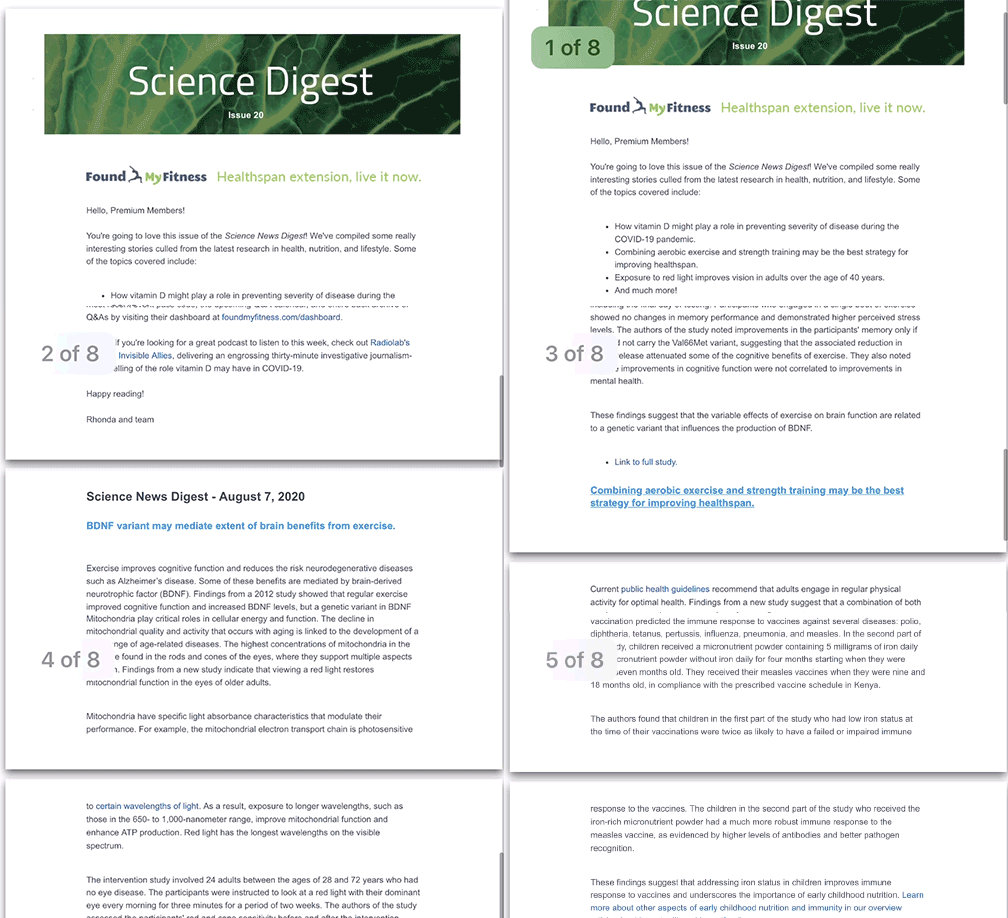
Every other week premium members receive a special edition newsletter that summarizes all of the latest healthspan research.
Supplements News
- Omega-3 fatty acid supplementation benefits people with depression.
- Alpha-lipoic acid supplements promote weight loss in obese people who are otherwise healthy.
- Study reveals a sixfold decrease in C-reactive protein levels among obese women who took omega-3s during pregnancy.
- Curcumin reduces pain associated with osteoarthritis of the knee.