How to Fill Common Nutrient Gaps
The Omega-3 Supplementation Guide
A blueprint for choosing the right fish oil supplement — filled with specific recommendations, guidelines for interpreting testing data, and dosage protocols.
You'll also receive updates from Rhonda & FoundMyFitness
In this clip from Dr. Rhonda Patrick's appearance on Mayim Bialik's Breakdown, she discusses supplements that may address common nutrient gaps. A national survey analysis estimated severe vitamin D deficiency in 2.6% of US adults, moderate deficiency in 22%, and insufficiency in 40.9%, with prevalence changing according to the threshold used. Testing can help match intake to an individual's starting status. [1]
Dr. Patrick also highlights omega-3 status. In the Framingham Offspring cohort, red-blood-cell fatty-acid patterns, including the omega-3 index, predicted mortality. A pooled analysis of 17 prospective cohorts likewise associated higher circulating marine omega-3 levels with lower total and cause-specific mortality, supporting omega-3 status as a useful nutrition biomarker. [2] [3]
Other supplements address different needs. Across three COSMOS cognitive substudies, a daily multivitamin produced a modest average benefit in global cognition and episodic memory among older adults. In the observational VITAL cohort, lower magnesium intake was associated with higher pancreatic-cancer incidence. Together, these findings support identifying a defined nutrient gap, population, dose, and outcome before choosing a supplement. [4] [5]
Choline remains part of Dr. Patrick's list even though the conversation initially frames it as a top-three question. She highlights its roles in brain health and homocysteine metabolism. Product quality matters for omega-3 supplements because these fats oxidize readily; she favors products with third-party testing for oxidation and labeled EPA and DHA content, with algal oil as a vegan option. Magnesium can irritate the gut and cause diarrhea in a large bolus, so she describes smaller divided doses and tolerable forms rather than assuming more is better.
This clip is excerpted, with permission, from Dr. Rhonda Patrick's appearance on Mayim Bialik's Breakdown. Thank you to Mayim Bialik's Breakdown for allowing us to share it.
- ^ Cui, Aiyong; Xiao, Peilun; Ma, Yuzhuo; Fan, Zhiqiang; Zhou, Fengjin; Zheng, Jiang, et al. (2022). Prevalence, Trend, And Predictor Analyses Of Vitamin D Deficiency In The US Population, 2001–2018 Frontiers In Nutrition 9, .
- ^ Tintle, Nathan; Harris, William; Vasan, Ramachandran S; Sala-Vila, Aleix; McBurney, M I (2021). Using An Erythrocyte Fatty Acid Fingerprint To Predict Risk Of All-Cause Mortality: The Framingham Offspring Cohort The American Journal Of Clinical Nutrition 114, 4.
- ^ The Fatty Acids And Outcomes Research Consortium Force; Tintle, Nathan; Küpers, Leanne K; Laakso, Markku; Imamura, Fumiaki; Sun, Qi, et al. (2021). Blood N-3 Fatty Acid Levels And Total And Cause-Specific Mortality From 17 Prospective Studies Nature Communications 12, 1.
- ^ Vyas, Chirag M; Manson, JoAnn E; Sesso, Howard D; Cook, Nancy R; Rist, Pamela M; Weinberg, Alison, et al. (2024). Effect Of Multivitamin-Mineral Supplementation Versus Placebo On Cognitive Function: Results From The Clinic Subcohort Of The COcoa Supplement And Multivitamin Outcomes Study (COSMOS) Randomized Clinical Trial And Meta-Analysis Of 3 Cognitive Studies Within COSMOS The American Journal Of Clinical Nutrition , .
- ^ Dibaba, Daniel; Xun, Pengcheng; He, Ka; Yokota, Kuninobu; White, Emily (2015). Magnesium Intake And Incidence Of Pancreatic Cancer: The VITamins And Lifestyle Study British Journal Of Cancer 113, 11.
Mayim Bialik: I'd like to know, what are your top 3, and then what are your top 5? Meaning 3 and then 2 more.
Dr. Rhonda Patrick: So, I think the top 3 supplements, and again, the reason the supplements are important is to really fill a nutritional gap, but not only nutritional gap, just our micronutrient gap, and I'd say the top of that list would be vitamin D, and that's really important because it's not something that you're going to get from your diet. Less than 10% of vitamin D that we get in our bodies comes from our diet, right? We're making it from UVB radiation from the sun, and the problem is, is that 70% of us are not making enough because we're not going in the sun.
Mayim Bialik: Well, that's problem number one. We're not going in the sun anymore like we used to. We're inside. It gives you cancer. I don't wanna go.
Dr. Rhonda Patrick: It gives, yeah, there's skin cancer, right? I mean, so when you are in the sun, you have sunscreen, right? You're blocking out the very thing that can make vitamin D. There's a simple solution. That solution is a vitamin D supplement. Why is it my top of the list? Because vitamin D is actually a hormone. It's a steroid hormone. It is controlling over 5% of our protein-encoding human genome. And essentially what that means is it's getting into the nucleus of your cell where all your DNA is, binding DNA, turning genes on, turning them off in the way they're supposed to be. I mentioned that orchestra analogy a few minutes ago. It's essentially like if all your genes are not being turned on and off at the right moment, then things are out of whack. Like, you don't want all your neurotransmitters on when you're sleeping at night, right? Like, you want 'em on in the day when you're awake and alert. So, there's a lot of coordination there, and vitamin D plays a role in that. And so, not being— not having enough vitamin D isn't just not having enough vitamin, it's not having a hormone, right, that's controlling a lot in our bodies. And so, the solution is, and there's all these studies that have shown it accelerates the way you age.
Mayim Bialik: Mm-hmm.
Dr. Rhonda Patrick: Dementia risk goes up, all this stuff, right? So, the solution is a vitamin D supplement, which really is one of the cheapest supplements you can buy. It's like 10 cents a pill for a vitamin D supplement. I mean, back 10 years ago when I was saying this, it was 1 cent a pill, so it is going up in price.
Mayim Bialik: Yeah.
Dr. Rhonda Patrick: But so, most people want to have blood levels around 40 to 60 nanograms per milliliter. That's the sweet spot, but really, you just want to be above 30 nanograms per mL, and if you're below 20, then you're deficient. pretty bad. So typically around 2,000 to 4,000 IUs a day, depending on the season, can get you to that good range, and you have to get a blood test.
Mayim Bialik: Mm-hmm.
Dr. Rhonda Patrick: That would be the top— the top supplement. The next one would be an omega-3 supplement, and I think, you know, 80% to 90% of the US population is not meeting the omega-3 requirements in terms of EPA and DHA. That's about 250 milligrams a day, and the reason they're not meeting those requirements is because One, they're not eating fish, and if they're vegetarian, they're not supplementing with the right things like microalgae oil. So, the EPA and DHA are hugely important for, I mean, brain function, mental health, cognitive aging, but cardiovascular health as well. And there's been a lot of work by my colleague, Dr. Bill Harris, showing that people that have a high omega-3 index, so you can measure that in red blood cells, If you have a high omega-3 index of 8%, you have a 5-year increased life expectancy compared to people with a low omega-3 index of 4%. People in the US have an average of about 5%, so they're about on the low range, 5-year increased life expectancy. Now, the thing that's really mind-blowing, this is from the Framingham cohort, and what was really mind-blowing about this study was that Bill and his colleagues then sort of took that data and said, okay, let's look at smokers versus nonsmokers with the omega-3 index. And what they found was that having a low omega-3 index was like smoking in terms of mortality risk.
Mayim Bialik: Yeah, so people with a low omega-3 index but did not smoke had the same mortality risk as smokers with a high omega-3 index.
Dr. Rhonda Patrick: I mean, when I say same, I mean, if you were to look at this paper, at the graph of their life expectancy, they're perfectly overlaid.
Mayim Bialik: Wow.
Dr. Rhonda Patrick: Perfectly overlaid. And so, all the smokers out there are like, yes, I'm going to take omega-3, but that's not the point I'm making here, right?
Mayim Bialik: Right.
Dr. Rhonda Patrick: The point I'm making here is that not getting those important nutrients I talked about—
Mayim Bialik: It's as deleterious.
Dr. Rhonda Patrick: As smoking.
Mayim Bialik: Right. Right,
Dr. Rhonda Patrick: and everyone knows to avoid smoking, but nobody's thinking about avoiding omega-3. There was a study out of Harvard, and I always talk about this study. It was published forever ago, like 2010 or something, and it identified not getting the marine sources of omega-3, so DHA and EPA, as one of the top 6 preventable causes of death.
Mayim Bialik: Wow.
Dr. Rhonda Patrick: Up there with hypertension, type 2 diabetes, smoking, there you go, and consuming trans fats were up there, but, you know, so no one's thinking about not getting enough omega-3, and again, there's a solution. Not everyone's going to be eating fish. There are fish oil supplements, omega-3, you know, high-quality supplements out there, but there's also algae oil as well. That's the vegan alternative.
Mayim Bialik: Right.
Dr. Rhonda Patrick: I have a free guide that I put together on how to choose that. It's called, it's basically like all the top omega-3 supplements that are not oxidized and have the right amount of concentration of the stuff that's in there that they should, people can find that at FMFomega3guide.com. But essentially, you can go and analyze all the data yourself. You can go to these third-party testing sites, like the International Fish Oil Standards site, which is what we did. They have tons and tons of data on there, and you can kind of go through it and look for the quality supplements that have a low oxidation and a high concentration. And so, I think that's Essentially, like, I've got like 8 or so that I've listed that are really good quality for both vegan and, you know, people that are taking fish oil as well.
Mayim Bialik: This is a little bit in the weeds, but what's happening in the oxidation? Like, people are like, a supplement is a supplement, but clearly not.
Dr. Rhonda Patrick: So, polyunsaturated fatty acid, which is what omega-3s are, it's also what omega-6s are, is— I mean, they oxidize at lightning speed. I mean, it's— you— so, in fact, that's one of the reasons why you need so much vitamin E. The more The more polyunsaturated fatty acid you take in, the more your vitamin E requirement goes up as well. But when you eat oxidized fat, it's basically like generating an inflammatory signal in your body is what it's doing. It's an inflammatory signal 'cause it's not right. It's like an oxidized, your immune system recognizes it as like a foreign object, so it activates inflammation. So you wanna avoid, if you can, eating and consuming oxidized fat. And so that's what, with fish oil, you have to be very fastidious about the way you isolate it and stuff. And so—
Mayim Bialik: So it's in the manufacturing process?
Dr. Rhonda Patrick: Yeah, manufacturing. But also when you get it, you should store it in the refrigerator. If you buy it in bulk, I store mine in the freezer. Doesn't harm it at all. It's actually great. So you store it in the freezer, and then when I'm ready to get my new bottle, I thaw it out and take it because cold stops oxidation, right? That's essentially what's happening. So that would be number 2. And then I would say the 3rd, supplement that's at the top of my list would, it's a race between a multivitamin and magnesium. And so, I think I'll defer to the multivitamin on this one because it is covering the vitamin K base, the vitamin E base, the calcium, the vitamin C, all those other ones that are also important. So, I think that would be my top 3.
Mayim Bialik: Okay.
Dr. Rhonda Patrick: And then, the top 5 after the multivitamin would be magnesium.
Mayim Bialik: Okay.
Dr. Rhonda Patrick: And that is also something that half the US population is not getting enough of. Essentially, it's at the center of a chlorophyll molecule, so anything green is high in magnesium. People aren't eating their greens. We've already established that with vitamin K. They're not eating their greens, right?
Mayim Bialik: What happens when you're deficient in magnesium?
Dr. Rhonda Patrick: Well, it depends on what kind of deficiency we're talking about. If you're severely deficient, you start to get muscle spasms. That's one of the, I would say, more clinical symptoms, but when you're just kind of suboptimal, like half the US population is, when you're just not getting that RDA requirement, which for women is about 320 milligrams a day, for men it's 420. If you're physically active, that requirement goes up even more because you're sweating and losing magnesium through your sweat.
Mayim Bialik: Mm-hmm.
Dr. Rhonda Patrick: But for those people, I mean, maybe you're getting some muscle cramps. If that's something that's happening, then you really probably should be taking in more magnesium, but insidious damage, that insidious damage is happening. Magnesium is a cofactor for many important enzymes, 300 different enzymes. DNA repair is one of them. And if you can't repair damage to your DNA, then you increase the risk of getting cancer. And so, what happens is DNA damage isn't a problem for 5 years. It's not a problem for 10 years. It's not a problem for 15 or 20 or 30. It starts to become a problem 40, 50, 60 years later, right? Then cancer rears its ugly head. And so, it's not something that you're really going to pay attention to. until it's too late. And so magnesium is— it's in— and there are studies that have looked at this. So people that take, you know, for every 100 milligram decrease in magnesium intake, they have a 24% increased pancreatic cancer risk. And then people with the highest quartile of magnesium have a 50% lower cancer-related mortality compared to people in the lowest.
Mayim Bialik: Wow.
Dr. Rhonda Patrick: Yeah, 50%. And then there's studies showing supplementation is beneficial as well. And with respect to the supplementation, I tend to think you really should try to get as much magnesium from your diet as you can because leafy greens are so good and there's so many different micronutrients that are in them that you're, you're getting, like the vitamin K and the calcium and the vitamin C. But, um, if you are going to supplement, then you want to probably take smaller doses of it.
Mayim Bialik: Can it—
Dr. Rhonda Patrick: it can be an irritant on the gut, so you don't take a big bolus of magnesium. It can cause like muscle spasm, like your, your muscles and your, your intestinal system to kind of spasm and can cause diarrhea and things like that. So, you want to take lower doses, maybe like 150 milligram, 300 milligram doses, and you want to take a salt form. So, I would say magnesium malate, magnesium citrate are good forms, but also magnesium glycinate, which is what I take, is a good form.
Mayim Bialik: People like these for sleep also, magnesium. Like, this is one of these things.
Dr. Rhonda Patrick: Yeah, for sleep as well and stress. I mean, when you're stressed, your body pulls on magnesium as well.
Mayim Bialik: There are so many different forms of magnesium. How do you decide what to prioritize? Do you take all of them? Like, how do people approach it?
Dr. Rhonda Patrick: I like the magnesium glycinate because you're also getting glycine in there. Glycinate. So magnesium is bound with glycine. It's very bioavailable, which is what you want. And it does sort of help with calmness. Glycine's like an inhibitory neurotransmitter, right? So I take it before bed as well. And it could be the placebo effect, which is a very valid, real thing. And I love it. But You know, it does seem to help with sleep as well.
Mayim Bialik: And, are you missing if you're not taking the other ones? Do we need all of them or does glycinate work?
Dr. Rhonda Patrick: Glycinate works. If you're taking magnesium threonate, that's kind of a brain-specific form of magnesium. And, I would say in that regard, then you definitely want to make sure you're getting other forms of magnesium for the DNA repair aspect that I was talking about. Also, magnesium is important for bone health, like 60% of magnesium stored in bone, and it's one of those things that if you're having inadequate levels of magnesium, as 50% of the US population, your body will pull from your bones, because it has to really maintain very tight levels of magnesium in the plasma, very important, and so you'll pull from your bones, and by the time you're an older adult, you've lost half your magnesium stores, which affects your bone mineral density and bone health, right?
Mayim Bialik: Mm-hmm. So those things all sort of converge together, as well.
Dr. Rhonda Patrick: So, yeah, I mean, I think magnesium threonate, which is something people do like for their brain, they're taking— it's like a— it's— there's some evidence showing that it can cross the blood-brain barrier better and get into the brain better, and therefore, it has beneficial effects in the brain, like energy production, and it seems to be, you know, important for preventing perhaps cognitive decline as well. So, if you're taking that form, I would say that you want to make sure you're also getting enough magnesium for the DNA repair. and other enzymes as well that are not in the brain. Number 5, choline, because it's— I used to supplement with it more, and I think I'm gonna bring it back after like kind of diving into it recently again, because it really is important for brain health, you know, for preventing the oxidized— I mean, not oxidized, that's vitamin E— for preventing the homocysteine. The homocysteine is really important. I mean, that's another thing that a lot of people aren't measuring. So, I think that would be my number 5.
Mayim Bialik: Where does vitamin E fall in, 'cause of the importance of it?
Dr. Rhonda Patrick: The vitamin E RDA is in the multivitamin.
Mayim Bialik: Multivitamin. Okay.
Dr. Rhonda Patrick: And I do eat a lot of almonds. Like, that's my go-to. Like, it's not time for dinner yet, but I've, you know, it's been many hours. It's almonds, raw almonds.
Mayim Bialik: Not to get too in the weeds here in our own way, you mentioned nuts and seeds. So, I'm a vegan person. He's a vegan-friendly, health nut biohacker, we eat so many nuts and seeds. Like, I'm a walnut person. I prefer walnuts, but we put cashews in our smoothies. I'm trying to get all branches of the vitamins through all the different nuts. But it's work. It's like if you're on the go, it's, it's like you have to pack.
Get email updates with the latest curated healthspan research
Support our work
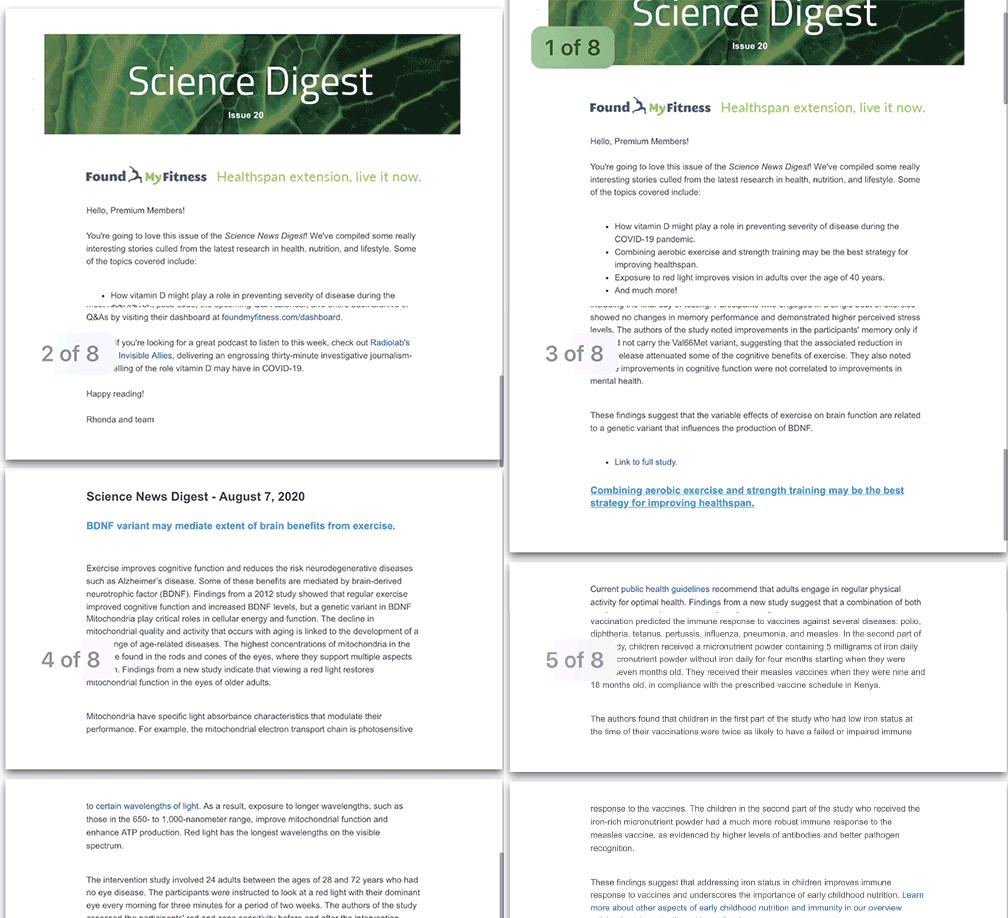
Every other week premium members receive a special edition newsletter that summarizes all of the latest healthspan research.
Supplements News
- Omega-3 fatty acid supplementation benefits people with depression.
- Alpha-lipoic acid supplements promote weight loss in obese people who are otherwise healthy.
- Study reveals a sixfold decrease in C-reactive protein levels among obese women who took omega-3s during pregnancy.
- Curcumin reduces pain associated with osteoarthritis of the knee.