How Protein and Resistance Training Protect Aging Muscle
The Omega-3 Supplementation Guide
A blueprint for choosing the right fish oil supplement — filled with specific recommendations, guidelines for interpreting testing data, and dosage protocols.
You'll also receive updates from Rhonda & FoundMyFitness
In this clip from Dr. Rhonda Patrick's appearance on The Peter Attia Drive, she and Dr. Peter Attia explain why protein needs can rise with age. The PROT-AGE Study Group recommends at least 1.0 to 1.2 grams of protein per kilogram of body weight per day for most adults over 65 to help maintain lean mass and physical function. [1]
Longitudinal evidence connects higher protein intake with better muscle and frailty outcomes. In older adults from the Health ABC cohort, those in the highest protein-intake quintile lost about 40% less lean mass over three years than those in the lowest quintile. In a large cohort of older women, a 20% increase in calibrated protein intake was associated with a 32% lower risk of incident frailty. [2] [3]
Physical inactivity can compound age-related muscle loss by reducing the muscle protein synthesis response to food. Two weeks of one-leg immobilization in older men markedly lowered both fasting and post-meal muscle protein synthesis, while resistance exercise can help preserve anabolic sensitivity. Together, adequate protein and regular resistance training address complementary parts of muscle maintenance. [4] [5]
This clip is excerpted, with permission, from Dr. Rhonda Patrick's appearance on The Peter Attia Drive. Thank you to Peter Attia MD for allowing us to share it.
- ^ Bauer J; Biolo G; Cederholm T; Cesari M; Cruz-Jentoft AJ; Morley JE, et al. (2013). Evidence-based recommendations for optimal dietary protein intake in older people: a position paper from the PROT-AGE Study Group. J Am Med Dir Assoc 14, 8.
- ^ Houston DK; Nicklas BJ; Ding J; Harris TB; Tylavsky FA; Newman AB, et al. (2008). Dietary protein intake is associated with lean mass change in older, community-dwelling adults: the Health, Aging, and Body Composition (Health ABC) Study. Am J Clin Nutr 87, 1.
- ^ Beasley JM; LaCroix AZ; Neuhouser ML; Huang Y; Tinker L; Woods N, et al. (2010). Protein intake and incident frailty in the Women's Health Initiative observational study. J Am Geriatr Soc 58, 6.
- ^ Dideriksen K; Reitelseder S; Boesen AP; Zillmer M; Agergaard J; Kjaer M, et al. (2024). Lower basal and postprandial muscle protein synthesis after 2 weeks single-leg immobilization in older men: No protective effect of anti-inflammatory medication. Physiol Rep 12, 4.
- ^ Devries MC; Breen L; Von Allmen M; MacDonald MJ; Moore DR; Offord EA, et al. (2015). Low-load resistance training during step-reduction attenuates declines in muscle mass and strength and enhances anabolic sensitivity in older men. Physiol Rep 3, 8.
Dr. Peter Attia: Here's an interesting question, Rhonda. We know the rates at which skeletal muscle mass declines by decade in an aging population. Is there any way to estimate what percentage of that decay is driven by insufficient amino acid consumption versus other factors? Other factors would be anabolic resistance associated with aging, anabolic resistance associated with sedentary behavior, and a lack of sufficient resistance training. Many factors explain why a person loses muscle mass as they go from 50 to 60 to 70. It would be interesting to consider how much is explained by the fact that they are barely meeting the minimum nitrogen requirement and, in many cases, falling below it.
Dr. Rhonda Patrick: I don't know that there's a direct way to determine that. Older adults are more susceptible to anabolic resistance, where muscle tissue is not as sensitive to amino acids, mostly because physical inactivity increases with age. But studies have shown that when older adults consume 1.2 grams of protein per kilogram of body weight per day, it nearly eliminates some of the age-related muscle loss that occurs.
That supports what you were saying. If older adults increase protein intake by 50 percent, to what many experts agree should be the new RDA of 1.2 grams per kilogram per day, they prevent a lot of age-related muscle loss. We also know that older women who consume 1.2 grams per kilogram per day are 30 percent less likely to experience frailty in old age. That is good evidence that increasing protein intake by 50 percent is important for muscle health during aging and helps get us out of a net negative state.
Dr. Peter Attia: Step one is to move the floor from 0.8 to 1.2.
Dr. Rhonda Patrick: Yes, with the floor being the minimum amount of protein we need each day. This is not the optimal amount. We'll get into optimal intake. This is just the new RDA.
You mentioned anabolic resistance, which is another important point. It compounds the fact that we're already not consuming enough protein to be in positive protein balance. Anabolic resistance occurs when muscle tissue becomes less sensitive to amino acids, so muscle protein synthesis does not occur to the same extent as it does when you're younger. I think there is now a consensus that anabolic resistance is driven less by aging itself and more by:
Dr. Peter Attia: Inactivity.
Dr. Rhonda Patrick: Inactivity, yes.
Dr. Peter Attia: Yeah. Dr. Luc van Loon shared an elegant experiment when he was on the podcast. They took young subjects, put a cast on one leg, and left the other leg uncast. The casted leg did nothing, while the other leg continued to exercise with single-leg extensions, curls, and similar movements.
After the immobilization period, they used stable isotopes to measure muscle protein synthesis. The uncasted leg was normal, while the casted leg showed significant anabolic resistance. To me, that is the clearest demonstration that inactivity is the main culprit. There is probably an age-related component when all other factors are equal, but I suspect inactivity plays a larger role than aging itself.
Dr. Rhonda Patrick: I completely agree. There was also another study in older adults.
Dr. Peter Attia: Maybe we should explain what anabolic resistance is. It's worth understanding why this idea matters.
Dr. Rhonda Patrick: When we eat protein, we break it down into amino acids. Leucine is the primary anabolic amino acid. Amino acids such as leucine enter muscle tissue and provide a signal to increase muscle protein synthesis. You're making more protein in the muscle, which in turn increases muscle hypertrophy. The other major signal is mechanical force from resistance training and working the muscles.
As we get older, our muscles can become less sensitive to amino acids. The leucine transporter is one mechanism, but I think there are others. In a study that compared younger adults with adults age 65 and older, both groups received the same protein dose. The younger adults had twice as much muscle protein synthesis. For the older adults to reach the same level, they had to double the amount of protein. The muscle tissue was less sensitive to amino acids, so they needed more protein to get more amino acids into it.
There is substantial evidence that physical activity is a major driver here, including Dr. Luc van Loon's study. Older adults who engage in resistance training have the same anabolic response to the same amount of protein as younger adults.
Dr. Peter Attia: The activity makes up for it.
Dr. Rhonda Patrick: It does. A 65- or 70-year-old man who engages in resistance training is likely not experiencing much anabolic resistance. There may be a little, but not much. You don't necessarily have to experience it as you age if you are physically active and training. That is the bottom line and the most important public-health message: you should be training.
Dr. Peter Attia: Think about the impact that physical training has on insulin resistance as well. It is a different mechanism, probably tied more to fatty acid accumulation within muscle and other factors, but the most effective remedy is physical activity. It has been demonstrated so conclusively that nobody really talks about it. It is taken for granted.
Dr. Rhonda Patrick: That's a good point. If we're talking about the general population, surveys show that about 32 percent of adults engage in resistance training.
Dr. Peter Attia: How much?
Dr. Rhonda Patrick: Thirty-two percent.
Dr. Peter Attia: Both young and old?
Dr. Rhonda Patrick: If you look only at older adults, it's 22 percent. Most older adults and most people overall are not engaging in resistance training. Physical-activity numbers look somewhat similar.
Putting in effort is harder. It's easier to put something in your mouth, which is why pills are so popular. People gravitate toward the easier action of eating or taking something rather than putting in the effort. That is unfortunate, but it is a reality.
That brings us back to why the RDA is too low. Older and younger adults think they are getting enough protein, but this matters even more for older adults. Younger people have a little more room. Older adults are already not getting enough protein, anabolic resistance is setting in, and most are not active or doing resistance training. These compounding factors take away muscle each year. Before long, you're frail and have sarcopenia.
Dr. Peter Attia: My patients are indoctrinated into this, but I'm surprised more people don't talk about it. You do, but the medical system doesn't talk enough about frailty and sarcopenia.
I worry that even when I wrote Outlive, I did not emphasize it enough. I discussed the four horsemen: cardiovascular and cerebrovascular disease, cancer, neurodegenerative and dementing diseases, and metabolic disease. Those are the main threats to lifespan. Frailty is not as large a threat to lifespan, although the risk of falls and mortality is enormous once you're over 75.
When you think about quality of life, which most people care about at least as much as length of life, frailty wins the day. Along with cognitive health and minimizing cognitive decline, frailty seems to determine the quality of your final decade. We have great tools in training and nutrition that can offset it.
It is surprising because most people have witnessed frailty and sarcopenia in their parents and grandparents. We've seen how it goes, yet we either don't think it will happen to us or it seems abstract because it is years away. What is your take on this challenge?
Dr. Rhonda Patrick: I agree that frailty risk is at least as important, especially when you witness it in family members. I think it appears to be incremental. There may be a fall, a planned surgery, a hip replacement, or a knee replacement. A parent or grandparent is inactive for several weeks and loses a lot of muscle mass.
A younger person can regain that muscle more easily. It is not the same for an older adult. Even with resistance training afterward, they may not regain all the muscle they lost. These events occur over time. There is a planned surgery, then a fall, another surgery, COVID, the flu, or another illness. They keep coming.
Eventually, a person reaches what is called the disability threshold. All of a sudden, a parent can barely walk, and it seems to have happened overnight. But the evidence was building over the prior five years during periods of inactivity. People don't follow the timeline that led to the catabolic crisis. Several events caused substantial muscle loss, mobility declined, and anabolic resistance compounded the problem. They haven't looked at the timeline and recognized that A plus B plus C led to this point.
Get email updates with the latest curated healthspan research
Support our work
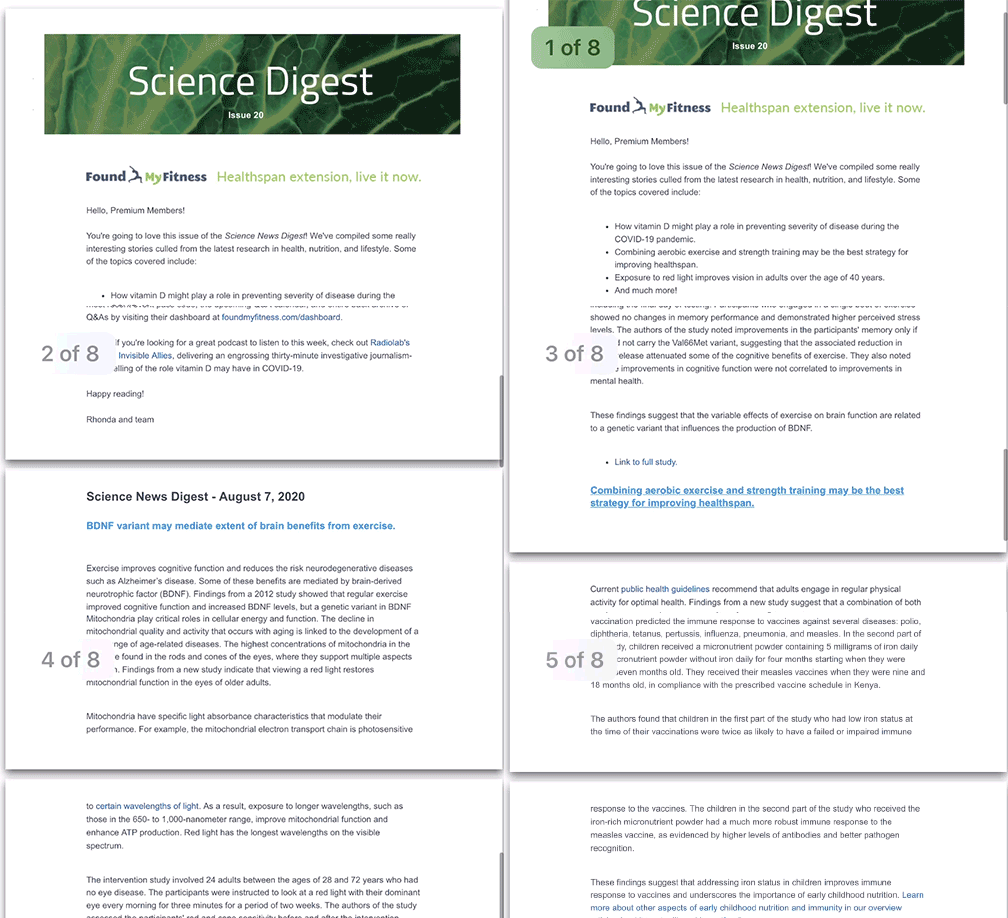
Every other week premium members receive a special edition newsletter that summarizes all of the latest healthspan research.