How Micronutrient Gaps Affect Brain Health
The BDNF Protocol Guide
An essential checklist for cognitive longevity — filled with specific exercise, heat stress, and omega-3 protocols for boosting BDNF. Enter your email, and we'll deliver it straight to your inbox.
You'll also receive updates from Rhonda & FoundMyFitness
In this clip from Dr. Rhonda Patrick's appearance on The Dr. Hyman Show, she explains why adequate micronutrient intake supports the brain as well as the rest of the body. Across three randomized COSMOS cognitive studies, a daily multivitamin produced modest average improvements in global cognition and episodic memory in older adults. The global-cognition effect was statistically comparable with about two years less cognitive aging. [1]
Dr. Patrick also discusses vitamin D and potassium as nutrients that are commonly worth assessing. Vitamin D status varies with sun exposure, diet, skin pigmentation, age, and body composition, while potassium-rich foods help support blood-pressure regulation. A dose-response meta-analysis of randomized trials found that increased potassium intake lowered blood pressure most clearly in people with hypertension. [2] [3]
Omega-3 fatty acids add another nutrition pathway relevant to the brain. A meta-analysis of double-blind randomized trials found that EPA-predominant formulations reduced depressive symptoms in selected clinical populations, with results that depended on formulation, dose, and diagnosis. Together, these findings support a food-first pattern plus targeted testing and supplementation when intake or measured status is low. [4]
This clip is excerpted, with permission, from Dr. Rhonda Patrick's appearance on The Dr. Hyman Show. Thank you to Dr. Mark Hyman for allowing us to share it.
- ^ Vyas, Chirag M; Manson, JoAnn E; Sesso, Howard D; Cook, Nancy R; Rist, Pamela M; Weinberg, Alison, et al. (2024). Effect Of Multivitamin-Mineral Supplementation Versus Placebo On Cognitive Function: Results From The Clinic Subcohort Of The COcoa Supplement And Multivitamin Outcomes Study (COSMOS) Randomized Clinical Trial And Meta-Analysis Of 3 Cognitive Studies Within COSMOS The American Journal Of Clinical Nutrition , .
- ^ Cui, Aiyong; Xiao, Peilun; Ma, Yuzhuo; Fan, Zhiqiang; Zhou, Fengjin; Zheng, Jiang, et al. (2022). Prevalence, Trend, And Predictor Analyses Of Vitamin D Deficiency In The US Population, 2001–2018 Frontiers In Nutrition 9, .
- ^ Filippini, Tommaso; Naska, Androniki; Kasdagli, Maria-Iosifina; Torres, Duarte; Lopes, Carla; Carvalho, Catarina, et al. (2020). Potassium Intake And Blood Pressure: A Dose‐Response Meta‐Analysis Of Randomized Controlled Trials Journal Of The American Heart Association 9, 12.
- ^ Liao, Yuhua; Xie, Bo; Zhang, Huimin; He, Qian; Guo, Lan; Subramanieapillai, Mehala, et al. (2019). Efficacy Of Omega-3 PUFAs In Depression: A Meta-Analysis Translational Psychiatry 9, 1.
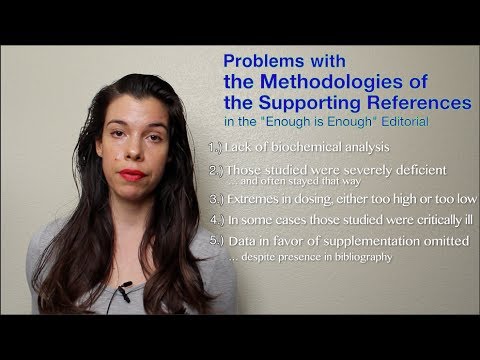
Dr. Mark Hyman: You know, I think like it was about 10 years ago, there was a huge study in the Annals of Internal Medicine and it was called Enough Is Enough: Vitamins and Mineral Supplements Not Only Don't Do Anything, They May Be Harmful.
Dr. Rhonda Patrick: Yeah, I think that was— do you remember that study? Yeah, it was about 10 years ago. Yeah. And, you know, I, I was— I just dug in and it was a meta-analysis and I went and looked at all those studies and I found that all these flaws again come back to the actual studies that they made their conclusions from. So they do a review and they go, we're going to look at all these studies and we're going to make a summary, and that's called a meta-analysis.
Dr. Mark Hyman: And then from that, you didn't just take their conclusions, you actually went and looked at the data itself from the original studies.
Dr. Rhonda Patrick: Exactly. Yeah. And, um, I put out a video about it like years and years ago, and it, it, again, all these flaws that we just talked about were there. And, um, here we are 10 years later, and the COSMOS trials were just published, right? So this is another meta-analysis of a couple randomized controlled trials where older adults were given a multivitamin. They had about 20 or so essential vitamins, essential minerals, omega-3 fatty acids, vitamin D, right? Magnesium. This was all present in this multivitamin, and they were given it for 2 years. Yeah. What the study found, these are randomized controlled trials, placebo controlled, right?
Dr. Rhonda Patrick: The multivitamin actually did improve brain aging. So people taking the multivitamin mineral supplement were less likely to experience cognitive dysfunction, memory loss. And in fact, they experienced an improvement in their brain aging that was equivalent to reversing 2 years of brain aging.
Dr. Mark Hyman: Wow. Okay.
Dr. Rhonda Patrick: Yeah. Randomized controlled trial. Here we are 10 years later. Yeah.
Dr. Mark Hyman: And there's many, many other studies that show the value of nutrients in many, many different conditions, right?
Dr. Rhonda Patrick: Exactly. Yeah. I, you know, I think that it comes down to, yes, you should try to get your micronutrients from diet. However, taking, you know, a multivitamin supplement, taking vitamin D, taking omega-3s, like these are insurance, right?
Dr. Rhonda Patrick: This is insurance to make sure you're getting your optimum levels.
Dr. Mark Hyman: But it's the insufficiency.
Dr. Rhonda Patrick: And with vitamin D, it's a really big one because it is converted into a steroid hormone. So this is something that is going into the nucleus of our cell and binding and interacting with DNA. It has a little sequence of DNA called a vitamin D response element.
Dr. Mark Hyman: Hmm.
Dr. Rhonda Patrick: It's so important. It's encoded in our DNA, right?
Dr. Mark Hyman: Yeah.
Dr. Rhonda Patrick: So, to not have enough vitamin D, so 70% of the US population doesn't meet the sufficient levels of vitamin D, which is about 30 nanograms per mL.
Dr. Mark Hyman: 70%? 30? Which would be—
Dr. Rhonda Patrick: And then if you add it up to 45 or 50, it's probably like 80 plus, 90%.
Dr. Mark Hyman: Right, right.
Dr. Rhonda Patrick: Yeah.
Dr. Rhonda Patrick: So, and, and so that would be, there have been studies looking at all-cause mortality and vitamin D levels. Of course, this is, again, observational, lots of meta-analyses out there, even dating back for like 30 years. And it seems as though having at least 40 nanograms per mL seems to be a sweet spot, you know, 40 to 60 is a really good place to be where you're having a good level of vitamin D.
Dr. Mark Hyman: Yeah.
Dr. Rhonda Patrick: But again, it's a steroid hormone. It's regulating over 5% of the protein-encoding human genome. That's like thousands of genes.
Dr. Mark Hyman: Yeah.
Dr. Rhonda Patrick: You know, everything from immune function, it plays an important role in preventing autoimmunity.
Dr. Mark Hyman: Yeah.
Dr. Rhonda Patrick: Brain function. It regulates genes that are important for converting tryptophan into serotonin.
Dr. Mark Hyman: Yeah.
Dr. Rhonda Patrick: Serotonin is an important neurotransmitter that regulates mood, cognitive function, impulse control, you know, so vitamin D—
Dr. Mark Hyman: Maybe I need more of that then.
Dr. Rhonda Patrick: Well, and the problem is, is that, you know, vitamin D, typically you make it from UVB radiation exposure from the sun. Yeah. We're all told to shield ourselves from the sun and sunblock. And so, we live indoors, work indoors, and yeah, it's a problem. I mean, we're all running around half-naked hunting and gathering. We got a lot of vitamin D. And we ate— and we're coastal areas and we ate fish, small fish like herring and certain things that they're higher in vitamin D. Or if you're foraging mushrooms, you're high in vitamin D. So, there's ways in which our historical population got it, the Paleolithic ancestors, but we don't get that.
Dr. Rhonda Patrick: Right, exactly. We don't. I do think, so people will, the simple solution is a vitamin D supplement, right? And so, about 4,000 IUs a day will generally get someone from a deficient range, which is 20 nanograms per mL, up to a sufficient range.
Dr. Mark Hyman: Okay, but you're just talking about 10 times what's normally in a multivitamin, or what doctors will recommend, 10 times.
Dr. Rhonda Patrick: I am, I am, because you, yeah, you really do. It's about 1,000 IUs of vitamin D will raise blood levels between 5 to 10 nanograms per mL. But we have genes, we have different variations of our genes that are able to do this. And this, again, comes down to these clinical studies showing that nothing happens—
Dr. Mark Hyman: We're all different.
Dr. Rhonda Patrick: We're all different. And so, some people actually have to take a much higher dose, right?
Dr. Rhonda Patrick: Because they have genes that aren't converting vitamin D3 into 25-hydroxyvitamin D, which is the circulating form of vitamin D, or into the steroid hormone, 1,25-dihydroxyvitamin D.
Dr. Mark Hyman: And so, maybe you can kind of take us down that list a little deeper.
Dr. Rhonda Patrick: So, we've got to get omega-3s, we've got to get vitamin D, we've got to get magnesium. And literally, we could spend a podcast on each nutrient and probably 10 podcasts on each nutrient, but we're just going to go through so people understand these are the things that are non-negotiables that you've got to have and that you've got to test, you've got to measure and figure out whether your levels are okay because the average physician or practitioner isn't going to do it.
Dr. Mark Hyman: And they don't know how to do it and they don't get taught this in medical school. And I'm working on trying to change that in Washington, but it's kind of a travesty, 'cause it's like staring us in the face that we have this epidemic of micronutrient deficiencies or insufficiencies, and they're not being addressed. And often worse, we're being told not to fix them.
Dr. Rhonda Patrick: Yeah, so the vitamin D, magnesium, omega-3 we talked about, right? Believe it or not, a lot of people, I don't remember the exact percentage, but quite a bit of people are not getting enough vitamin C, something like 30 or 40%, 40% or something like that, are not getting enough vitamin C.
Dr. Mark Hyman: Yeah, I heard that 10% are deficient at the level that would cause scurvy in America. That's unbelievable.
Dr. Mark Hyman: Just not eating any vegetables or fruits, 'cause vitamin C is also in vegetables, not just in fruits.
Dr. Rhonda Patrick: Calcium is another one. So, I mean, these are things that can be tested for and measured. Another one is vitamin E. People are not getting enough vitamin E. Again, that's also found in things like avocados, nuts, whole grains. And then potassium is a big one because It's so important for the sodium-potassium pump, which plays a role in blood pressure. And so when you're talking about too much sodium and not enough potassium, it's really exacerbating that not getting enough potassium aspect, right? Because that ratio is so important. And so not only are, I think it's something like 96% of the US population doesn't meet the adequate intake for potassium. It's essentially everyone.
Dr. Mark Hyman: And our potassium intake as hunter-gatherers should be 10 to 1, potassium to sodium. Now it's the other way around.
Dr. Rhonda Patrick: It's the other way around, exactly.
Dr. Mark Hyman: And so, there's all sorts of problems with blood pressure, and, gosh, it's like even like 30% of individuals aged 20 to 39 have hypertension. These are young adults with hypertension. And we now know that hypertension isn't just a risk for cardiovascular disease, it's a risk for dementia and Alzheimer's disease, particularly if you start earlier, right? If you're like a younger person, so like it's cumulative exposure to hypertension.
Dr. Rhonda Patrick: It's important because you have to get blood flow to your brain, and you've got all these tiny, like 90% of the brain vasculature surrounding the brain is made of these tiny, tiny blood vessels that are smaller than the size of a hair in terms of diameter, and they have to get blood flow to them, so exercise helps that, but hypertension exacerbates the lack of blood flow going to those blood vessels, and what happens is they're so tiny, they start to sort of constrict,
Dr. Mark Hyman: Yeah.
Dr. Rhonda Patrick: And sort of fall off. And you can get mini strokes.
Dr. Rhonda Patrick: Mini strokes, but also neurons don't get the nutrients and the oxygen they need, and so then you start to lose neurons, right? And you get brain atrophy.
Dr. Rhonda Patrick: And so there's this connection between hypertension and dementia, and I'm talking about potassium here because potassium does play an important role in—
Dr. Mark Hyman: Regulating blood pressure.
Dr. Rhonda Patrick: Yeah, right. So does magnesium, though, too. So does magnesium, so does magnesium. It's the relaxation mineral. And then exercise, of course, is one of the, best things that you can do. So, you know, one of the last papers that Bruce published, his second to last paper, was called Longevity Vitamins. And, yeah, and, you know, it was about these vitamins like vitamin D and magnesium and omega-3, taurine, or some other like essential amino acids that play a role in the way we age and slowing age-related decline. Yeah.
Dr. Rhonda Patrick: And, you know, there was just a recent study that came out on vitamin D, sufficient levels of vitamin D. People that supplemented with vitamin D were 40% less likely to have have dementia. Yeah. You know, so the, the reality is, is that—
Dr. Mark Hyman: I mean, vitamins don't just create expensive urine.
Dr. Rhonda Patrick: They, they don't. They don't. They're, you know, these micronutrients are running everything in our body. Yeah. And when you have insufficient levels of them, you're not gonna necessarily see it, although you probably feel it. You know, like—
Dr. Mark Hyman: You might have symptoms, but you don't attach it to that.
Dr. Rhonda Patrick: Right. You don't attach it to that, but it's causing this insidious damage, right? This insidious DNA damage, a little bit of oxidative stress, a little bit of inflammation. Or just, I get sick all the time.
Dr. Mark Hyman: 'Cause my vitamin D's low.
Dr. Rhonda Patrick: Right. Or you're getting sick.
Dr. Mark Hyman: Or my muscles ache, you know, 'cause vitamin D's low. Or, you know, I have muscle cramps 'cause my magnesium's low, right?
Dr. Rhonda Patrick: So, or I have depression because my, you know, methylation vitamins are low. Like, people have symptoms, they just don't correlate it with the nutrient deficiencies. Depression is interesting. There's a pretty classic study that no one ever talks about where healthy individuals were injected with lipopolysaccharide. So, for those listening, this is a component of your bacterial outer cell membranes. It's present in our colon because we have about, I don't know how many trillions of bacteria, like so many bacteria in there, right?
Dr. Mark Hyman: A lot of—
Dr. Rhonda Patrick: 40, 50 trillion. Okay, 40 or 50 trillion.
Dr. Rhonda Patrick: There's about a gram of lipopolysaccharide in our gut because those bacteria do die off.
Dr. Mark Hyman: And these are bacterial toxins. This is what pisses off your immune system to no end.
Dr. Rhonda Patrick: It does, and when we have gut permeability, lots of things that cause that, it releases— Right, also known as leaky gut, it leaches the LPS into our bloodstream. Well, this study took healthy individuals and injected them with an amount of LPS that would be equivalent to something that you could get from intestinal permeability, and it caused depressive symptoms in these individuals. Okay, one, that links inflammation to depression, right? 100%.
Dr. Rhonda Patrick: 2, if those individuals were given EPA, so this is one of the omega-3 fatty acids, it does play a major role in dampening inflammation through a variety of mechanisms like resolvins and maresins and the SPMs. These are all molecules that are resolving inflammation very quickly. They did not experience those depressive symptoms if they were injected with the LPS.
Dr. Mark Hyman: If they got omega-3s.
Dr. Rhonda Patrick: If they have the omega-3s. So it comes down to, again, you know—
Dr. Mark Hyman: And omega-3s have been shown to actually help with depression.
Dr. Rhonda Patrick: They have.
Dr. Mark Hyman: And ADD.
Dr. Rhonda Patrick: They have, yeah, but depression, specifically EPA seems to be very important for depression, and I think that's because there's a really big inflammatory component to depression.
Attend Monthly Q&As with Rhonda
Support our work

The FoundMyFitness Q&A happens monthly for premium members. Attend live or listen in our exclusive member-only podcast The Aliquot.
Micronutrients News
- Vitamin D, iron, and protein may improve hair growth and thickness while sugar-sweetened beverages and alcohol may worsen hair loss.
- Copper-rich diets can boost cognitive performance by up to 25% in older adults.
- Regular intake of vitamin K1, found in leafy greens and plant oils, reduces risk of atherosclerotic disease-related events by 29% and related deaths by 43% among older women.
- Nearly half of people with type 2 diabetes have multiple micronutrient deficiencies—the most common being vitamin D.
- Lower levels of active B12 linked to slower visual processing and cognitive decline, suggesting current guidelines may not adequately ensure brain health.