How Creatine Supports Strength, Training, and Recovery
Get the full length version of this episode as a podcast.
This episode will make a great companion for a long drive.
The Omega-3 Supplementation Guide
A blueprint for choosing the right fish oil supplement — filled with specific recommendations, guidelines for interpreting testing data, and dosage protocols.
You'll also receive updates from Rhonda & FoundMyFitness
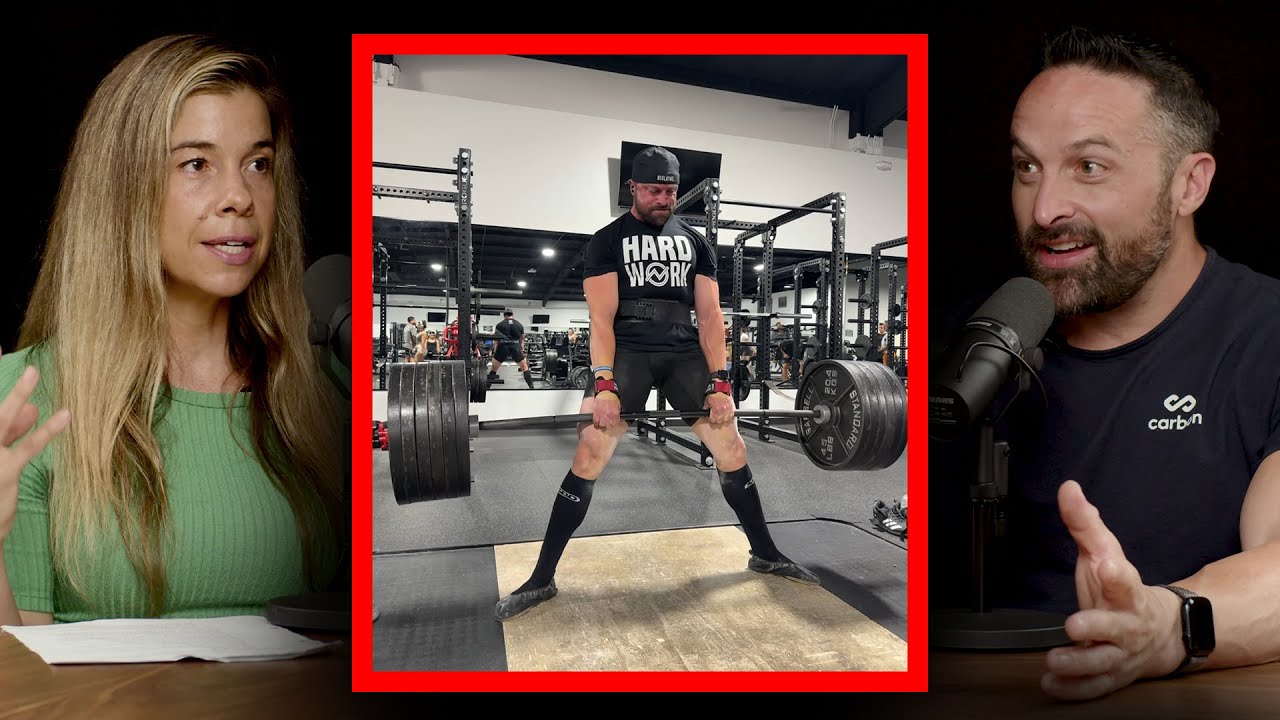
In this clip from his FoundMyFitness interview with Dr. Rhonda Patrick, Dr. Darren Candow explains why creatine is useful for repeated high-intensity muscle contractions. Supplemental creatine expands the phosphocreatine pool that rapidly restores ATP during lifting, sprinting, and interval work. That extra capacity can support more repetitions, greater training volume, and stronger adaptations over time.
A large body of sports-nutrition research supports creatine monohydrate for increasing intramuscular creatine, high-intensity exercise performance, strength, and training adaptations. The International Society of Sports Nutrition also describes evidence for recovery and rehabilitation applications, while emphasizing creatine monohydrate as the most studied form. [1]
Dr. Candow distinguishes chronic supplementation from an acute stimulant. Creatine works by building tissue stores, so consistent daily intake matters more than taking it immediately before a specific workout. Dr. Patrick and Dr. Candow also discuss its value during aging, when preserving training quality and muscle becomes increasingly important for function and independence.
- ^ Kreider, Richard; Almada, Anthony L; Kalman, Douglas S.; Antonio, Jose; Ziegenfuss, Tim N.; Wildman, Robert, et al. (2017). International Society Of Sports Nutrition Position Stand: Safety And Efficacy Of Creatine Supplementation In Exercise, Sport, And Medicine Journal Of The International Society Of Sports Nutrition 14, 1.
Dr. Rhonda Patrick: Well, let's talk about the resistance training and improving performance, muscle health. I mean, why, why are people— why is it so popular?
Dr. Darren Candow: Well, because it works from a muscle performance perspective. So it really— it basically increases the ability to produce ATP or maintain it during an exercise session. So, for example, when you're doing, you know, a squat or leg press or even running, you're doing muscle contractions and phosphocreatine, which is what we're going to be talking about today from creatine supplementation, it really maintains ATP or adenosine diphosphate. So if you have more ATP longer, you can exercise at a higher capacity, a higher intensity, and that delays the utilization of other energy systems that might be a bit slower.
So anybody involved in high-explosive anaerobic type of sports, weightlifting, high-intensity interval training, for example, probably would experience some benefits from creatine supplementation. And how is it going to benefit you? Is it going to improve your training volume? Is it going to make you stronger? All the above. So it definitely seems to increase training volume. So that's either the load by the reps, by the set, or exercise capacity from a cardiovascular perspective. It definitely— if you were to choose one thing why creatine has been so effective, it's improving muscle strength. You could also encompass that with endurance and power. It also improves lean body mass. So here's a big discrepancy that a lot of the viewers might not know.
When we measure lean body mass in the labs, we're technically measuring blood, connective tissue, soft tissue. So we're not directly measuring muscle mass. We need to do a lot more research on that. But in general, about 50% of the value of lean body mass we consider muscle. So it has some small favorable effects. There's been some studies with QCT as well as ultrasound, but you can get an increase in lean body mass, regional muscle thickness, muscle performance. But probably the area that most people don't realize is the recovery aspects. It really seems to have some anti-catabolic effects, potentially anti-inflammatory effects. And that's interesting because it's from the aerobic community.
For the longest time, we never thought creatine was for endurance or aerobic-type athletes. And the best lines of evidence from a recovery aspect come from long-duration aerobic exercise— a marathon, ultramarathon, a triathlon. It seems to reduce cytokines. So those are markers of inflammation. So, there's a whole gamut of mechanisms. There's about 10 what we consider anabolic factors, and then there's probably just as many as an anti-catabolic effect. So, it has a plethora of benefits, which I'm sure we'll talk more about in detail today.
Dr. Rhonda Patrick: Yeah. So, you— okay, to go back, you just gave a total information dump, which is awesome. Let's go back first to the explosive power you were talking about.
It seems to really help benefit in that explosive power, like you're talking about doing a squat.
Dr. Darren Candow: Yes.
Dr. Rhonda Patrick: I don't know, maybe the first few seconds of an interval, something where you're going, you know, using all that power.
Dr. Darren Candow: Yeah.
Dr. Rhonda Patrick: Is, is it— is creatine benefiting? Benefiting? Is that how it's benefiting, increasing the training volume, or is there something else that's happening?
Dr. Darren Candow: Yeah, in 2 ways. So it really seems to maximize either the recruitment or the ability of type 2 muscle fibers. And when we talk about aging, unfortunately, those are the ones we're losing as we get older. But it really seems to work in the 2nd, 3rd, and 4th set.
So for example, if you were to do 4 sets of leg press compared to placebo, you may not notice any difference in the first set because we think we have enough ATP or phosphocreatine stores in our muscle. But when it comes to set 2, 3, and 4, that's where creatine really comes to the rescue. The individual or group can do more repetitions, and then over time they can actually do a greater volume. We think with weeks of training, if you're doing more volume, you can actually get greater physiological adaptations. So when we look at all the meta-analysis, when you compare creatine and weight training to creatine placebo and weight training, there is a greater increase in lean body mass, muscle size, as well as muscle performance.
So creatine, there is something there from a mechanistic standpoint to allow that. And we think muscle fiber recruitment, primarily type 2 muscle fibers, is one of the main reasons.
Dr. Rhonda Patrick: Does it affect the recovery time in between sets?
Dr. Darren Candow: Excellent question. It does. It really speeds it up. So on average, if you were to totally wipe out your normal creatine stores, it takes about 3 to 5 minutes for your mitochondria to recover However, creatine really, really speeds up that recovery, which is great for the average person. They don't have a lot of time to work out. They can't wait around for 3 to 5 minutes in between a really intense set. So, it really speeds up the recovery. Not only does it speed up the recovery after every set, but in between contractions as well.
So, over time, the individual could probably have a really intense, great workout in less time total and get actually more favorable effects.
Dr. Rhonda Patrick: And, I think this is really important. We're talking about here, I mean, we were talking about squats, these explosive types of power types of training. Right. And this is a really important field because, you know, you often hear about people talking about the loss of muscle mass as we age. You talked about losing type 2 types of muscle fibers more readily than the type 1. So, these are the types of muscle fibers involved in that explosive type of power type, you know, exercise.
And, you know, people don't think about how power decreases with age, how, you know, strength decreases with age, and how that affects our quality of life, how it affects our physical independence, our fall risk. Right, right. And so, I think just focusing on this type of training, I mean, the creatine is the icing on the cake, right? Yeah. But just focusing on doing these types of multi-joint compound types of lifts, which is something that I, in the past, I would say year, a good year now, a solid year of doing CrossFit type of training where I'm doing strength training, I'm doing resistance training, strength training, and high-intensival interval training, that's including you know, the types of stuff that I'm used to doing, biking and rowing, but also adding in, you know, doing, doing some drop sets with, with, you know, front squats with the barbell and things like that.
Dr. Darren Candow: It's super important. So this velocity or power training or variety training, first we've got to get people to move and then allowing them to give some type of benefit to their training program. So creatine is probably the one that will be number one when people select it, even probably more than caffeine nowadays from an exercise training capacity. So it should be considered. It can have a lot of substantial beneficial effects. And as we get older, after about the 4th decade, unfortunately, we start to lose these type 2 muscle fibers. And so exercise has to be foundational. And if anything else can be beneficial— protein, creatine— I'm all for it. And I think most people hopefully will be as well.
Dr. Rhonda Patrick: Yeah.
So the improvements in the muscle strength presumably are coming because you're Increasing your training volume, right? Is that— or is there a direct effect on strength?
Dr. Darren Candow: Yeah, there's actually a neurophysiological recruitment. So now creatine has been touted as a new neurotransmitter. So this is quite interesting. It actually seems to release a lot of things from a neuromuscular, uh, uh, perspective. But the biggest thing is the ability to recruit not only type 1 but these type 2 muscle fibers as well. And then of course, if we're having greater muscle or motor unit recruitment, we can potentially lift longer, heavier, and over time get sort of more of an increase in strength.
The other big thing from a cellular perspective is that creatine causes calcium to come back in a little vesicle in our muscles. If you've taken high school biology or university, this will be your nightmare. But I remember everybody talking about the sarcoplasmic reticulum, and it's an area that just releases calcium to allow our muscles to contract. And creatine speeds up the uptake of calcium. So some of the evidence out of Europe has shown that it increases relaxation time or the ability of the proteins in your muscle to grab hold of each other to contract. So there's a cellular aspect there explaining why we think we get an increase in muscle performance. I say strength, but endurance and power are all lumped in there as well.
So endurance is the ability to perform repetitions to fatigue or power, move an object as fast as you can. They're all vitally important, but we think strength is overall, from a global perspective, number one. It's probably the main reason a lot of older adults are placed in long-term care facilities. If they have a reduction in strength, they can't live independently. So that's why, again, resistance training or weight-bearing exercise, as you mentioned, CrossFit, whichever it is, foundational. I'm from Canada, so shoveling the driveway in the winter counts because anything that's a load against you is really beneficial to the body. I think people underestimate the benefits of moving. And then if anything can be taken in this form, creatine, it'd be very, very beneficial.
Dr. Rhonda Patrick: Yeah.
Get email updates with the latest curated healthspan research
Support our work

Every other week premium members receive a special edition newsletter that summarizes all of the latest healthspan research.
Creatine News
- Gut bacteria may help creatine reach the brain and support its antidepressant effects.
- Creatine supplementation does not influence hair growth or hormone levels even after three months of usage, undermining theories of its potential link to hair loss.
- Creatine improved bench-press strength and increased lean mass even without structured exercise in middle-aged adults.
- Creatine strengthened cancer-fighting immune cell activity and reduced tumor growth in a mouse melanoma model.