How Sauna Use Can Complement Exercise Training
Get the full length version of this episode as a podcast.
This episode will make a great companion for a long drive.

The Omega-3 Supplementation Guide
A blueprint for choosing the right fish oil supplement — filled with specific recommendations, guidelines for interpreting testing data, and dosage protocols.
You'll also receive updates from Rhonda & FoundMyFitness
In this clip from How to Train According to the Experts, Dr. Rhonda Patrick and Brady Holmer discuss sauna bathing as a complement to aerobic and resistance training. Brady Holmer describes using a 20- to 30-minute sauna after runs to extend cardiovascular strain and build heat acclimation, while Dr. Patrick connects the practice with cardiovascular and recovery research.
In an eight-week randomized trial, sedentary adults with cardiovascular risk factors completed exercise alone, exercise plus a 15-minute post-exercise sauna, or usual activity. Exercise plus sauna produced a larger improvement in cardiorespiratory fitness and greater reductions in systolic blood pressure and total cholesterol than exercise alone. [1]
Dr. Patrick also discusses heat during periods of reduced loading and after resistance training. A controlled human immobilization study found that repeated heat therapy reduced muscle atrophy and helped preserve plantar-flexor strength. [2] She contrasts this emerging use of heat with repeated immediate cold-water immersion after lifting, which attenuated long-term strength and muscle adaptation in a controlled training study. [3]
Dr. Patrick and Brady Holmer also distinguish trials from long-term observational evidence. In a prospective cohort of 2,277 Finnish men, higher cardiorespiratory fitness and sauna bathing three to seven times per week were jointly associated with lower cardiovascular and all-cause mortality than low fitness and less frequent sauna use. The study cannot prove that sauna frequency caused longer life, and its male Finnish population limits generalization. [4]
- ^ Lee E; Kolunsarka I; Kostensalo J; Ahtiainen JP; Haapala EA; Willeit P, et al. (2022). Effects of regular sauna bathing in conjunction with exercise on cardiovascular function: a multi-arm, randomized controlled trial. Am J Physiol Regul Integr Comp Physiol 323, 3.
- ^ Labidi, Mariem; Alhammoud, Marine; Mtibaa, Khouloud; Ihsan, Mohammed; Deldicque, Louise; Nasir, Nada, et al. (2024). The Effects Of Heat Therapy During Immobilization And Rehabilitation On Muscle Atrophy And Strength Loss At Return To Sports In Healthy Humans Orthopaedic Journal Of Sports Medicine 12, 10.
- ^ Roberts LA; Raastad T; Markworth JF; Figueiredo VC; Egner IM; Shield A, et al. (2015). Post-exercise cold water immersion attenuates acute anabolic signalling and long-term adaptations in muscle to strength training. J Physiol 593, 18.
- ^ Kunutsor SK; Khan H; Laukkanen T; Laukkanen JA (2018). Joint associations of sauna bathing and cardiorespiratory fitness on cardiovascular and all-cause mortality risk: a long-term prospective cohort study. Ann Med 50, 2.
Dr. Rhonda Patrick: So starting with deliberate heat exposure, drawing from some of the leading experts in this area of sauna research, Dr. Jari Laukkanen being one of the world's experts on how the sauna is affecting cardiovascular health. I've had him on the podcast many years ago and he has published just numerous studies on how the sauna affects cardiorespiratory fitness, how it's affecting blood pressure, cardiac compliance, arterial compliance, just a lot of different cardiovascular health parameters. And his research has shown in a couple different ways. So there's been observational data showing people that exercise and use the sauna have a lower all-cause mortality than people that exercise and don't use the sauna.
But he's also done some interventional studies where he's taken two groups of people and put them on an exercise protocol, aerobic exercise on a stationary bike. And then only half of that group then went into a sauna after the exercise. And he measured cardiorespiratory fitness and found that people that use the sauna in addition to aerobic exercise improve their cardiorespiratory fitness even more than people that only did the exercise. And there were other cardiometabolic parameters that were also improved. Cholesterol was improved, blood pressure was improved more as well. So it seems as though adding the sauna in addition to an exercise routine is another way to improve some cardiometabolic endpoints and also cardiorespiratory fitness.
There's also some endurance benefits as well. Something that I've, I've talked about before on the podcast. In fact, you, Brady, use the sauna in your exercise protocol.
Brady Holmer: I do. And you know, a lot of that has to do with some of the research that you've talked about in that Dr. Laukkanen has published. So I informed kind of my strategy based on this. Not only, you know, the studies show that you can improve your VO2 max, you know, additionally by using the sauna, but it also improves your exercise performance, not only in the heat, you know, which kind of makes sense. You're using the sauna, you're becoming more heat acclimated, but it also improves your performance just in normal weather or like not hot weather, I guess, as you would call it. So I integrate that in my training.
Not only just do I like the sauna for the cardiovascular benefits and the brain benefits, you know, after reading these studies, kind of hearing you talk about it, I think, you know, it makes sense to use it. So about 3 times per week, 2 to 3 times per week, I'll try to get into the sauna immediately or within 5 to 10 minutes of finishing one of my runs. So I'll, you know, do my run from the gym. I don't have a sauna at home, but I have one at the gym that I use and I'll finish my run. I'll get right into the sauna for another 20 to 30 minutes. Those seem to be the protocols used in many of the studies. They do typically a 20-minute sauna bath afterwards.
So I'll get right in there, try, try to keep it so that my heart rate is like staying a little bit elevated from the end of the run into the sauna. So I think of it as a way to sort of extend that cardio session a little bit, that endurance training session. Because when you're in the sauna, you know, my, the heart rate might not be as high as it was when I was running 130, 140, 150 beats per minute, but it'll be 110 maybe at the, at the end of the sauna. So I use that as a strategy. Again, one, cuz it feels good and I just like it, but two, to gain maybe some additional benefits to that endurance exercise training session.
Dr. Rhonda Patrick: I do the same. I get in the sauna after both aerobic exercise training as well as doing my strength training, resistance training exercise.
You know, and a lot of the data that Dr. Laukonen has published has been observational data looking at people that are routinely using the sauna and the effects of that on cardiovascular-related mortality, all-cause mortality. And it seems as though like the minimum effective dose to get some benefits is really 2 times a week of sauna use. If you get up to 4 times a week, then you're really getting maximum benefits of 4 to 7 times a week. People are getting reductions up to 50% in their cardiovascular-related mortality, 40% related to reductions in their all-cause mortality. And this sauna doesn't have to be so hot. I mean, this isn't like the 200-something degree temperatures that you often hear people cite that they're using. In fact, I think that's a little bit too hot.
I mean, these people are using 100, on average, 175 degrees Fahrenheit. Often there is a little bit of a humidity, you know, 30, up to 30% humidity as well, but they're in there for about 20 minutes. And so, So I find it, it, it is nice to get in and get into the sauna after a workout and extend that sort of aerobic exercise mimicking capacity a little bit further. Another area that using deliberate heat exposure could be beneficial is combining it with resistance training or even using it during perhaps an injury when you're not able to work out. And I would say a lot of this evidence is preliminary. And more needs to be done. But going off the preliminary evidence and just knowing that there's benefits for cardiovascular health as well, why wouldn't you?
There has been at least some preliminary evidence in one small study that people that got in the sauna after the resistance training protocol increased signaling molecules that are involved, anabolic signaling molecules that are involved in muscle hypertrophy. There's also been another trial in humans that underwent, I mean, it was these experiments that are done where they're, they immobilize a muscle for a period of time and they look at after that, right? Disuse atrophy is, is what it's, it's called. And it seems as though heat exposure, at least at the local level in this, in this regard for this study, people that had the heat exposure were about almost 40% less likely to, to lose their, they lost 40% less of their muscle mass, which is quite a bit.
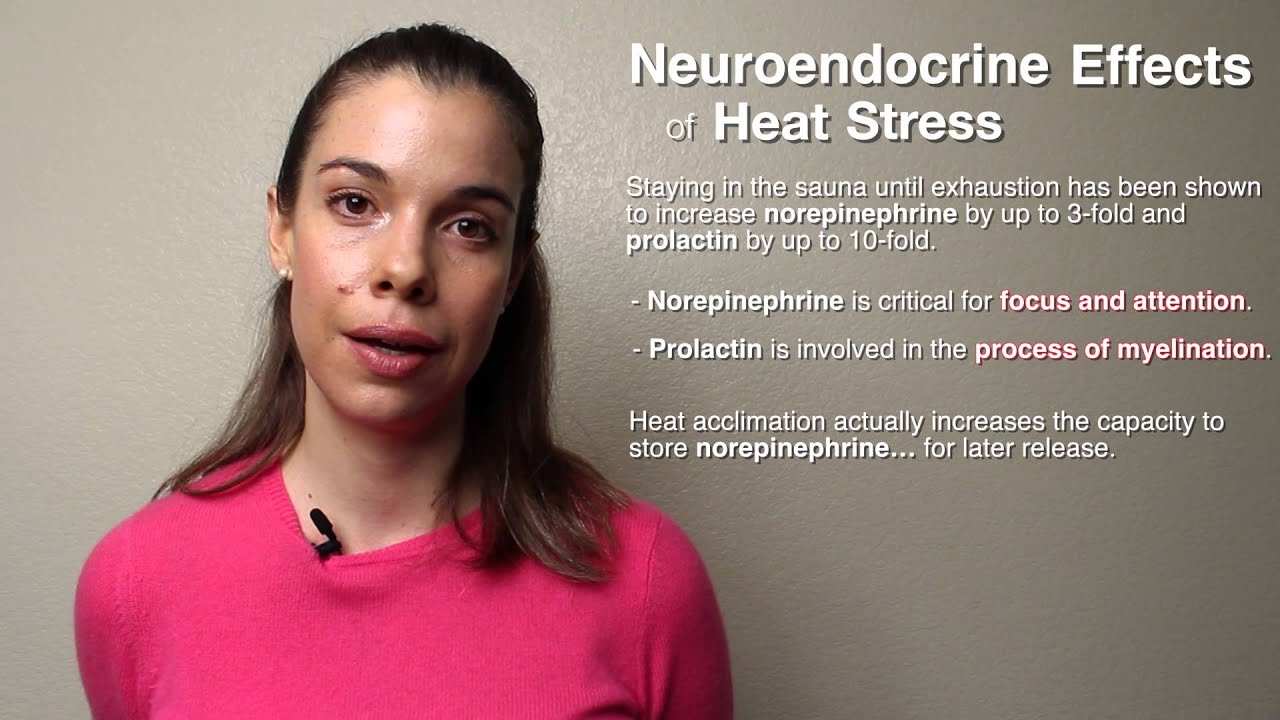
So a lot of potential reasons there. Heat shock proteins have been shown to be activated. A lot of disuse atrophy studies done in, in animal models with heat exposure. And then you're getting a variety of endocrine effects as well. Growth hormone is elevated when you get in the sauna and that can have aspects for recovery as well. So, there's a lot of reasons to, to combine deliberate heat exposure with also resistance training workout. And I would say that is not the case for deliberate cold exposure.
Brady Holmer: Yeah. And in fact, I think a lot of the evidence would suggest the opposite lately where getting in cold immediately after resistance exercise in particular seems to blunt some of the hypertrophic benefits.
There's a lot of press about those studies now where it's like avoid the cold after your resistance training workout. So yeah, it makes sense to really embrace the heat, not only for recovery, but for the anabolic potential, the endurance exercise benefits. I think, you know, the, the anabolic potential is interesting because, you know, I, I don't know if there, again, if there are any studies out there showing greater hypertrophy after using heat, but like you said, with the heat shock protein, all the mechanisms kind of make sense.
And so there was recently like a review paper that just came out that we'll need to probably read and maybe write about on that because I think it's, heat is becoming kind of embraced and yeah, again, the cold, maybe not something to do around your resistance exercise sessions.
Dr. Rhonda Patrick: Right. And I, and Dr. Luc van Loon, who was a, a guest on the podcast as well, had done some, he has done some research on that and in fact showed that doing deliberate cold exposure, like a cold bath immediately after resistance training workout does blunt hypertrophy. I mean, so that's the—
Brady Holmer: Yeah.
Dr. Rhonda Patrick: Muscle, muscle protein synthesis all goes down if you get in the cold right afterwards. So something to avoid, probably.
Supporting our work
If you enjoy the fruits of
 , you can participate in helping us to keep improving it. Creating a premium subscription does just that! Plus, we throw in occasional member perks and, more importantly, churn out the best possible content without concerning ourselves with the wishes of any dark overlords.
Sauna News
- A single Finnish sauna session temporarily increased circulating white blood cells.
- Hot water immersion more than doubles core body temperature rise compared to traditional saunas, potentially boosting vasodilation, cardiac output, and immune activity.
- Regular infrared sauna use increases blood vessel density in aged muscles by 33%, though muscle size, strength, and protein synthesis remain unchanged.
- Post-exercise hot tubs and saunas show minimal, inconsistent benefits in exercise performance enhancement, despite potential physiological effects.
- Post-exercise infrared sauna use contributes to a 25% increase in jump height and a 6.8% peak power boost in female athletes—a potential tool for enhancing power production.