How Heat Exposure May Support Brain Health and Mood
Get the full length version of this episode as a podcast.
This episode will make a great companion for a long drive.

The Omega-3 Supplementation Guide
A blueprint for choosing the right fish oil supplement — filled with specific recommendations, guidelines for interpreting testing data, and dosage protocols.
You'll also receive updates from Rhonda & FoundMyFitness
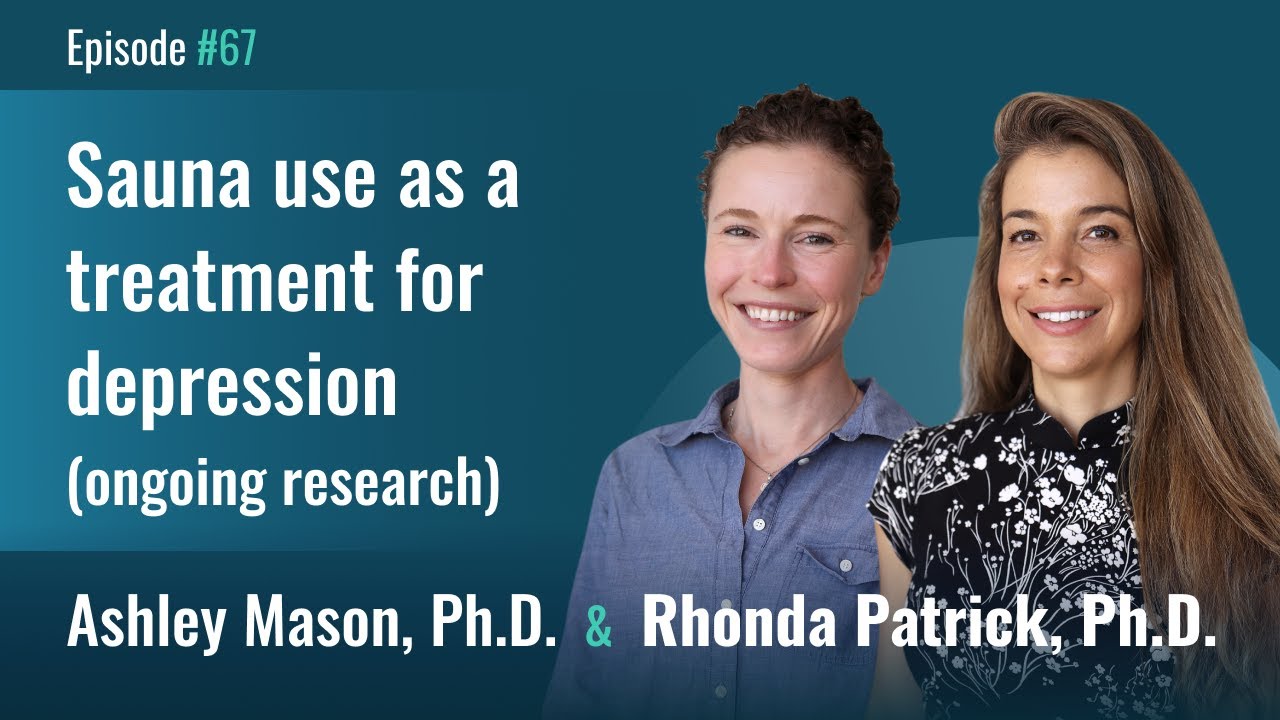
In this clip from Dr. Rhonda Patrick's appearance on MedCram, Kyle Allred asks how sauna use might relate to dementia and mood. Dr. Patrick begins with a prospective Finnish cohort in which men reporting four to seven sauna sessions per week had lower dementia and Alzheimer's disease incidence than men reporting one session. The study is observational, male-only, and cannot prove that sauna caused the lower risk. [1]
Dr. Patrick explores heat shock proteins as one possible mechanism. Heat stress activates proteins that help maintain protein structure and clear damaged proteins, and animal models suggest that this system can limit amyloid aggregation. She also describes dynorphin and endorphin signaling as a hypothesis for the improved stress tolerance she personally noticed after sauna use. These mechanistic ideas are plausible but remain distinct from demonstrated dementia prevention in humans.
The strongest mood evidence discussed is controlled whole-body hyperthermia rather than ordinary sauna bathing. In a small randomized sham-controlled trial of adults with major depressive disorder, one hyperthermia session reduced depression scores over six weeks compared with sham treatment. The result supports further study of heat-based treatment, but it does not establish a sauna prescription or replace standard mental-health care. [2]
This clip is excerpted, with permission, from Dr. Rhonda Patrick's appearance on MedCram. Thank you to MedCram for allowing us to share it.
- ^ 27932366
- ^ Janssen CW; Lowry CA; Mehl MR; Allen JJ; Kelly KL; Gartner DE, et al. (2016). Whole-Body Hyperthermia for the Treatment of Major Depressive Disorder: A Randomized Clinical Trial. JAMA Psychiatry 73, 8.
Kyle Allred: Well, shifting gears to—you mentioned the mental and potential benefits that protect against neurodegenerative diseases like dementia or Alzheimer's. That's really, you know, once I saw the research on that, that's something that keeps me using the sauna regularly even if I don't feel like it or even if I don't have time is that potential significant reduction in dementia risk. So, could you talk a little bit more about that research and, yeah, what's known about protection from neurodegenerative diseases?
Dr. Rhonda Patrick: Research on sauna use, specifically Alzheimer's disease and dementia, is limited to observational data, in which case sauna use is associated with a much lower risk. So, like I said, the risk was around 60% to 66% lower if people were using the sauna 4 to 7 times a week. Now, why that is is a very interesting question. It probably comes down to cardiovascular health, right? So if you're basically in better cardiovascular health, you're going to have increased blood flow to the brain. And that's, you know, known to help protect against dementia. But there's also some evidence, and this kind of gets into some of the molecular details with sauna use and something I'm extremely interested in is heat shock proteins. And heat shock proteins, as their name implies, are activated by heat stress. And sauna robustly activates them. There's been some studies looking at people that have sat in about a 163°F sauna for 30 minutes.
They're able to activate their heat shock proteins about 50% over their baseline levels. So what are heat shock proteins and why do we even care about them? Well, heat shock proteins are stress-response proteins, and we can talk a little bit more about what that means later. But essentially what they do is they help proteins inside of—
Kyle Allred: Uh-huh.
Dr. Rhonda Patrick: Your cells. They help keep their 3-dimensional structure. So every protein in your body has a 3-dimensional structure, and that's important for its function.
Kyle Allred: Yeah.
Dr. Rhonda Patrick: And these proteins in our body that are doing everything, all the work inside of our cells, they don't stay around forever. They eventually get chewed up and degraded, which you can think of as being discarded in a garbage can.
And so, sometimes, you know, that doesn't happen properly and as we age, it definitely starts to go awry. And so, heat shock proteins kind of help prevent that from happening. So, they help prevent proteins from becoming disorganized and destructured, because when they become that way, they tend to aggregate, and they can form aggregates, and these aggregates can then form plaques, and these plaques can form in places like the vascular system, or they can form in places like the brain. So probably the classical example of plaques in the brain are amyloid beta-42 plaques that are associated with Alzheimer's disease.
So there has been a whole host of evidence in animal studies that have found that elevated levels of heat shock proteins can protect against the formation of amyloid beta plaques, and they can help prevent an Alzheimer's disease-like disease in animals. So there's been a lot of evidence of that, and that, I think, is one interesting angle because saunas are well known to activate heat shock proteins, and once they're activated, they stay activated for about 48 hours. I mean, they're elevated for a while. And, you know, when you're talking about someone who's doing it 4 to 7 times a week, we don't have empirical evidence looking at a person and measuring their heat shock proteins each day. But—
Kyle Allred: Yeah.
Dr. Rhonda Patrick: You know, one could imagine that you would see that heat shock proteins are way elevated over what their normal baseline levels are. And so what you're having is almost this constitutive activation of this family of proteins that essentially help prevent plaques from forming, among other things.
Kyle Allred: Yeah.
Dr. Rhonda Patrick: So I think that's a really interesting angle as well with respect to neurodegenerative disease. And in fact, one of my first experiments when I was an early researcher at the Salk Institute for Biological Studies in La Jolla, I was doing some research on nematode worms, C. elegans, where we were injecting them with amyloid beta-42, the peptide fragment that's known to be associated with Alzheimer's disease causing these plaques in the brain.
We're injecting them into these worms and into their muscle tissue and it causes the worms to become paralyzed because they have all these protein aggregates in their muscle and they can't move anymore. And it's a really distinct phenotype. You look at them under a microscope and they're just— they're still, but they kind of just move their nose around and feed, but they can't move. And so I did these experiments where I would boost up their heat shock proteins and like it totally corrected that. Like these worms, even though they had— even though we were giving them amyloid beta-42, it totally prevented the paralysis because the amyloid beta-42 wasn't forming these aggregates.
So, I always kind of go back to that original study that I had done with my own hands and it kind of gave me this aha moment. I'm like, wow, these heat shock proteins are doing something cool.
Kyle Allred: Is that how you actually got interested in sauna use in the first place from that research?
Dr. Rhonda Patrick: It's how I got interested in some of the molecular aspects of sauna use. I would say that the real way I became interested in the sauna, and this will take us into other brain function aspects, if you're okay with that.
Kyle Allred: Sure.
Dr. Rhonda Patrick: So when I was in graduate school, I lived across the street from a YMCA, and I used to go use the sauna almost every day before I would go into the lab and do my experiments.
And as any graduate student or budding young scientist or even senior scientist will tell you, experiments fail. They fail all the time. And it's very stressful. It's very hard. So graduate school can be very hard because you're constantly being just bombarded down. It's like you're being hit like, well, that didn't work. Well, that didn't work. Well, there goes 6 months of work, you know, and it's a very stressful time. And what I started to notice was that using the sauna before going into the lab, my ability to handle stress was noticeably better. Like, I was much more capable of handling stress. My anxiety was much lower. I mean, it was very, very noticeable for me, to the point where I was like, something's going on here. I don't know what it is, but it's something.
And so I started diving into the literature, you know, way back then in like 2009, you know. So that's where I kind of got into the sauna and the effects on the brain. And actually in the publication that we published last year, I kind of riffed a little bit on some— I would say it's still more of a hypothesis than anything in terms of the reason for that. You know, when you're in the sauna, you're dumping a bunch of endorphins, much like exercise. So it's sort of the same effect. So endorphins are those feel-good opioids that your brain is producing. The counter to that feel-good endorphin is the— it's called dynorphin, the endogenous counter to it. Dynorphin is that chemical in your brain that is responsible for making you feel dysphoria, not so good.
So the kind of feeling you get when you're really hot, you're sitting in a sauna and you're like, not feeling good, like, this is hot. You know, or when you're going for your long-distance run and it's that feeling of you just don't feel good, but you have to push past it, right? You push past it. So, dynorphin is something that's produced during that period, and dynorphin is actually involved in cooling the body. So, I think that's partly why your brain is making it when you're elevating your core body temperature. And the interesting thing about dynorphin is that although it's responsible for the dysphoric feeling—
Kyle Allred: Uh-huh.
Dr. Rhonda Patrick: It binds to a receptor in our brain called the kappa opioid receptor. When it binds to that receptor, it ends up doing this whole feedback loop and this is like the beauty of biology and the feedback loop is that those feel-good endorphins that we make bind to another type of receptor called the mu opioid receptor and this is the same type of receptor that morphine and opioids also bind to that help make people feel good. They help with pain and stuff. Well, when dynorphin binds to the kappa opioid receptor, that dysphoric signal changes the mu opioid receptor. It basically makes the mu opioid receptors more sensitive to endorphins for a longer period of time.
And so, you know, I sort of have this hypothesis that like when you get in the sauna and you, you know, you push past that like, this feels terrible, it's hot, oh, it's hard, you know, you push past it a little bit, you get done with it, and then the endorphins that you make a day later or 2 days later or 5 days later from laughing at a joke or for giving your loved one a hug or whatever it is that's making you release these endorphins, you're going to feel them better because they're more sensitive. So that was a bit of a tangent, but that's sort of what got me interested in using the sauna.
And as you mentioned and alluded to earlier, there's actually a lot of empirical evidence that has now come out since that time looking at the effects of sauna use on mental health and specifically depression. So Dr. Ashley Mason right now, who I'm collaborating with, is looking at sauna use in people with depression that have not been able to manage it with different types of standard of care treatments. And so, she's going off of work from her former mentor, Dr. Charles Raison, who found that basically elevating a person's core body temperature about 1 to 2 degrees was able to give people an antidepressant effect that lasted up to 6 weeks with a single use. And this was compared to a sham control.
They used this device that basically made people feel like they were getting a little bit hot, but it wasn't hot enough. So it was a really great placebo control because people thought they were actually getting the treatment. Placebo controls are very important, particularly with depression studies, because a placebo response is a very real response. So that was a seminal study looking at, you know, just a single session of sauna use and how it had a very robust antidepressant effect that lasted 6 weeks in these depressed patients compared to placebo control.
Ashley Mason is following up on this and she's using an infrared sauna, and she's also elevating the core body temperature, you know, 1 to 2 degrees, and instead of 1 session, she's now doing up to 8 sessions. And we're looking at a variety of biomarkers to understand why that is, including whether there are changes in the immune system. There is some preliminary evidence to suggest there are. You know, there have been quite a few observational studies looking at sauna use and how sauna use is associated with lower biomarkers of like C-reactive protein. So these are markers of inflammation. Inflammation plays a major role in depression as well. Sauna use also can increase IL-10, which is an anti-inflammatory. So that's also been shown in an intervention study.
People who used the sauna had their blood drawn before and after, and there was some evidence that IL-10 was elevated after sauna use. This suggests that immune changes may occur in a positive direction, much like with exercise. Exercise also increases IL-6, a cytokine that is called a myokine when released from muscle. It can promote inflammation, but it can also produce a powerful anti-inflammatory response. This is an example of hormesis; there is a hormetic aspect to it. So that's also very interesting as well.
Kyle Allred: Yeah. And with those depression studies and the hypothesis for why sauna use— wow, I mean, it's amazing, one sauna use can have potentially a 6-week benefit for patients that are having depression. Could part of the hypothesis be that they're— because you mentioned our endorphins and our internal opiate system and how sauna use can sensitize those receptors so the opiates, our own opiates inside of our body, work better. Is that one of the hypotheses too of why this can help patients who are depressed?
Dr. Rhonda Patrick: It is. It is. And we're trying to figure out how to measure that. Like, there's some tricks and stuff, and so we're trying to find some collaborators.
And actually, we do have some collaborators that are potentially going to help us kind of figure out how we can test whether or not that is playing a role. It's certainly something I think is playing a role for sure. I think there's multiple things at play here, and I think that one of them is the change in the opioid system in the brain. For sure. But you can't measure opioid receptors and sensitivity and upregulation like you can in an animal, right? Like in people, like, that's not, you know, we're not there yet with our technology. So that would be something that would be really cool. But there are some other things that can be measured in plasma.
Supporting our work
If you enjoy the fruits of
 , you can participate in helping us to keep improving it. Creating a premium subscription does just that! Plus, we throw in occasional member perks and, more importantly, churn out the best possible content without concerning ourselves with the wishes of any dark overlords.
Sauna News
- Platelet-derived 'exerkines' produced during exercise promote neurogenesis, boosting brain health and cognition.
- Infrared sauna use reduces frailty in older adults.
- Hsp70 shown to preserve locomotor function and reduce cell death through a stable binding to toxic amyloid-beta42, blocking ability to attack neurons