How Beetroot and Citrulline Affect Exercise Performance
Get the full length version of this episode as a podcast.
This episode will make a great companion for a long drive.
The Omega-3 Supplementation Guide
A blueprint for choosing the right fish oil supplement — filled with specific recommendations, guidelines for interpreting testing data, and dosage protocols.
You'll also receive updates from Rhonda & FoundMyFitness
In this clip from his FoundMyFitness interview with Dr. Rhonda Patrick, Dr. Andy Galpin compares three routes used to support nitric oxide: nitrate-rich beetroot, L-citrulline, and L-arginine. Greater nitric oxide availability can increase blood flow and reduce the oxygen cost of some exercise, which explains why these products are most often used for endurance and repeated high-intensity work.
The broader trial literature supports a small, context-dependent performance benefit from dietary nitrate. A meta-analysis of 123 randomized trials found that nitrate improved exercise performance most consistently when supplied through beetroot juice or a high-nitrate diet, especially for efforts lasting two to ten minutes. Responses varied with fitness, dose, timing, sex, and the oral bacteria needed to convert nitrate. [1]
Dr. Galpin favors beetroot in many practical settings, while noting that powders travel better and juice may preserve more food compounds. Citrulline can feel more pronounced for some people, whereas arginine has lower bioavailability and has fallen out of favor. He recommends treating dose, gastrointestinal tolerance, blood pressure, and medication use as individual factors rather than assuming that any nitric oxide product produces an instant or universal boost.
- ^ Silva, Kaio Vinicius C; Costa, Breno Duarte; Gomes, Aline Corado; Saunders, Bryan; Mota, João Felipe (2022). Factors That Moderate The Effect Of Nitrate Ingestion On Exercise Performance In Adults: A Systematic Review With Meta-Analyses And Meta-Regressions Advances In Nutrition 13, 5.
Dr. Rhonda Patrick: You mentioned the beta-alanine. I want to get to that in a minute, but, um, before, because we're kind of talking about performance enhancement, there's this whole category of these blood flow enhancers.
Dr. Andy Galpin: Oh yeah. Oh yeah.
Dr. Rhonda Patrick: And there's like, so the beetroot juice, beetroot extract, and then there's the citrulline and arginine.
Dr. Andy Galpin: Yeah.
Dr. Rhonda Patrick: Um, so I'd heard of the beetroot juice and, and, you know, the, these nitric oxide boosters, but the, the citrulline and arginine are something that I haven't really— I mean, arginine I know about for, for blood pressure, but not for this performance enhancement. So I'm wondering, um, endurance type of exercise or high-rep type of exercise. I mean, is this something that actually can make a difference in someone that's already well-trained?
Is it like not well-trained people? How much? Yeah. Talk about what it's doing.
Dr. Andy Galpin: Sure. There's actually a lot of research, right? Andy Jones, uh, has done so much stuff here. He's done a ton of work on it. And then there's a lot, like you're talking about a solid decade or more in lots of populations, lots of different stuff. So it is really well studied. It's funny you bring it up because it gets no love. Like people don't talk about it that much, despite it's not a small amount of research here. If you want to especially stack up like rhodiola to beetroot, like you have a mountain to go on with beetroot juice and you have a pebble like on rhodiola. We like it. We use it a lot. We use, I've used a ton of different forms over the years. It's great because it is not a stimulant.
So you can take it in the evenings and it doesn't compromise sleep at all. We will all use it a lot for our individuals who are either exercising at night or training multiple times per day, and their stimulants come in the morning, but they still have high fatigue. And so they want to use it in the evening. So that is our common use case. You see it a lot in the endurance world, particularly the steady-state endurance world. So cycling, swimming, running, things like that. You're talking about nitric oxide. This is a vasodilator. You're going to open up blood flow. You will feel it. If I were to put you in that blind test right now and I gave you any of those forms you mentioned, you will be like, whoa, something just happened. There's no blinding to those studies.
Dr. Rhonda Patrick: But it sounds like if it's increasing blood flow, it should make you cognitively more sharp as well.
Dr. Andy Galpin: It will. Yeah. I don't like—
Dr. Rhonda Patrick: Now we're talking beetroot juice or we're talking citrulline or arginine?
Dr. Andy Galpin: You're going to have the same answer for basically all the above. Okay. There, there will be noticeable effects. There are differences between all 3 of those. If you were to take literally beetroot juice and concentrate it into like a 3-ounce shot, you could see the same stuff here. Most of the time with like citrulline and arginine though, you're getting really high concentrations. I don't know typical dosage of those off the top of my head, to be honest. But what you're gonna normally see there is a very pronounced stimulant effect.
Like it's not gonna be caffeine, but you're gonna be like, whoop, especially citrulline. Like, you're gonna see that right now. You will see, if you go to the gym and you take any of those forms, particularly, like, the arginines have fallen out of favor. Like, they're not as popular anymore for a host of reasons. But even the beetroot stuff, like, you will see a pump, a physical pump. Like, you will see—
Dr. Rhonda Patrick: I was reading about that.
Dr. Andy Galpin: Yeah, yeah, yeah, that's not fake at all.
Dr. Rhonda Patrick: What's better, beetroot juice or beetroot extract?
Dr. Andy Galpin: I mean, I typically go for the low sugar.
Dr. Rhonda Patrick: Which would be the extract.
Dr. Andy Galpin: Yep. But, um, does it matter? Um, does it matter? We use extract more. You could make a compelling argument though that juice is better. You could do that.
So it kind of depends on multiple parts of that equation. We use the powder though for a bunch of different reasons. A lot of them are practical. A lot of them are travel related, right? You, you don't want to take a whole bunch of juice with you on your airplane and you're flying all around to different places and you're just like, all right, I can take the powdered supplement. It lasts longer, shelf stable. Um, if we're talking about like antioxidant polyphenol properties, well, we know we're losing them in the powder. Like we're probably losing some of that relative to the juice. Okay. But then we're going to backfill that with whole foods and other things there. So, um, lots of research on both of those. I would say a lot of people would say would prefer juice.
I would say is, I think is a fair thing to say, but, uh, I'm not fully against powders. Well, if you're going for the powder, um, what kind of dose can you, do you have to take it? How, how soon before exercise can you take it chronically? Is it going to stop working? Can I start taking it before my podcast? I mean, like, how does this work? You can, if you put a scoop in there right now, you would, uh, you would know that you did it. There's no question. So you can take it. Um, you're talking about, I don't know, 5 minutes to take effect. Like it happens fast, like really like, like caffeine, like you're going to have a pretty acute effect of it and it will last. I think you can think of it like caffeine. It will last probably 3 hours-ish. Some people are going to metabolize it faster.
Some people are slower. So it is not a, it's not a short-lasting thing. It'll be there for quite some time. Um, so if you're going to use it for performance benefits, whether that's in the podcast room or in the weight room or dealing with the assembly at your kid's school or whatever thing you got to get through, uh, yeah, right before would be the time to go about it. Um, we will sometimes use it hours before exercise. When we have high fatigue, high motivation issues, right? So you start having these associations. Let's say, for example, we have somebody training at 4 o'clock in the afternoon. And at 2 o'clock, this is when we start having problems with, am I going to train today? Am I not? Or whatever. All right, let's give them a little hit right there.
And we don't want to go to caffeine. We don't want to go to other stimulants like that. So we'll simply use it as an afternoon pick-me-up. If you will, for even on a non-exercising day, if, if we're trying, especially if we're trying to get caffeine out of somebody's equation or lower it in the amount in the afternoon. So we use it and that is just simply like a, okay, motivation's back up. I'm feeling good again. And I'm ready to go. You'll feel it.
Dr. Rhonda Patrick: Can you use it with caffeine? In other words, like, okay, so what are the downsides? Do you, I mean, it affects blood pressure presumably, right? I think I remember reading studies about that years ago on at least beetroot. This is nitric oxide, right?
Dr. Andy Galpin: Right.
So this is your primary health concern is going to be anything related to blood pressure. So you handle those equations. Our downside, GI. Like, GI distress is going to 100% be there.
Dr. Rhonda Patrick: With beetroot or with citrulline?
Dr. Andy Galpin: All the above, particularly the beetroot, though, right? The juice there. If you eat beets and you forget, and then you go to the bathroom, so that's the part where you're like, oh, people can freak out when they forget that they took it or they don't know why. So you, you can have things like that, but as long as they're not GI issues, um, very minimal concerns outside of if you have, again, medical conditions that you gotta pay attention to.
Dr. Rhonda Patrick: Do you have a preference to citrulline versus beetroot?
Dr. Andy Galpin: We, uh, beetroot.
Dr. Rhonda Patrick: Why?
Dr. Andy Galpin: Yeah, generally we're gonna be there.
The issues we, uh, issues is a strong word. The slight things we've had to consider with citrulline is power. Like, is it too powerful for some people? They're just way like, whoa, like this is too much for me. I don't like it. I don't feel it. So you can titrate those dosages down. The other, again, issue is the wrong word. Issue is too strong. But the other like little bit of like, we've had is why can't I just get this out of close, something closer to whole food? Okay. So if that is your preference, then we can go back up a little bit to beet or beetroot juice. But that's not a strong argument. Yeah.
Dr. Rhonda Patrick: What about just baking some beets? Would you get a similar effect or would it not be concentrated enough?
Dr. Andy Galpin: Probably like 15 years ago, I had a friend who, you know, actually you met before, who did this and he would blend beets like in a blender.
Dr. Rhonda Patrick: In a smoothie or something?
Dr. Andy Galpin: Or like, you could call it a smoothie, but he would like juice it and blend it and he would do a combination. It was probably like 8 to 10 whole beets he would consume pre-workout. And he did it about 3 times, I think. And 2 of the 3 times he just threw up everywhere.
Dr. Rhonda Patrick: And then he's like red blood.
Dr. Andy Galpin: You can. It's a dosage issue though. Like, right? Will you get a small benefit? I can't. Like, I've never personally felt like a blood flow benefit from eating a bunch of beets personally. Some people say that they do, but you wouldn't get the dosage. That's why they're juiced. That's why they're concentrated.
Dr. Rhonda Patrick: Now you said arginine has fallen out of favor. Why? Why is that?
Dr. Andy Galpin: Okay. Like you're probably pretty aware of nitric oxide metabolism. You can't just consume nitric oxide, nitrite, or nitrate. Immediately, you're toast, right? So then the argument is, oh, can we go back up the chain? Like, can we go up to arginine? Can we go back up the thing? And so the first stop on that train was arginine. And then the issue you're going to fall out there, which is almost always the case with supplementation, was bioavailability. Like, how can we just get enough of it? And that one just seemed to fail. Uh, well, just, it seemed to get better once we started going there. And then there's other concerns, uh, cold sores and things like that that started popping up that people were like not super stoked about. And so citrulline seems to be the better approach right now. That's the short version.
Dr. Rhonda Patrick: Okay, got it.
Get email updates with the latest curated healthspan research
Support our work
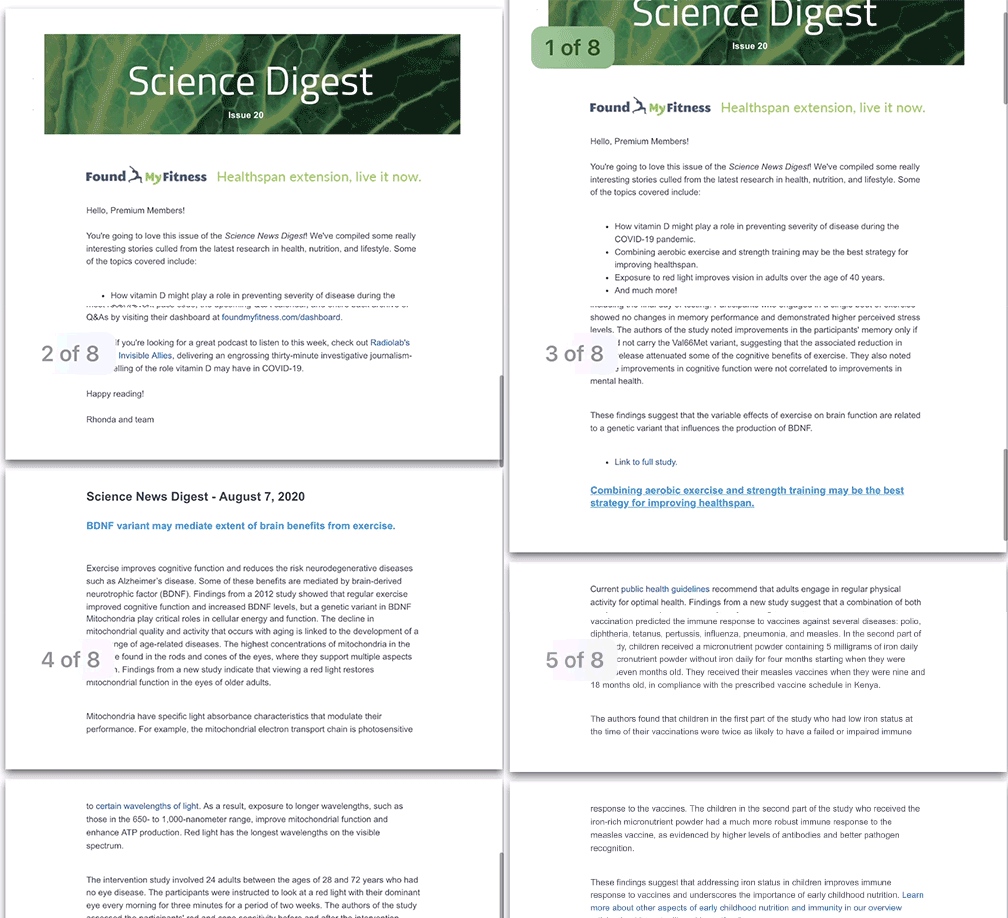
Every other week premium members receive a special edition newsletter that summarizes all of the latest healthspan research.
Supplements News
- Omega-3 fatty acid supplementation benefits people with depression.
- Alpha-lipoic acid supplements promote weight loss in obese people who are otherwise healthy.
- Study reveals a sixfold decrease in C-reactive protein levels among obese women who took omega-3s during pregnancy.
- Curcumin reduces pain associated with osteoarthritis of the knee.