How Ultra-Processed Foods Promote Overeating
The BDNF Protocol Guide
An essential checklist for cognitive longevity — filled with specific exercise, heat stress, and omega-3 protocols for boosting BDNF. Enter your email, and we'll deliver it straight to your inbox.
You'll also receive updates from Rhonda & FoundMyFitness
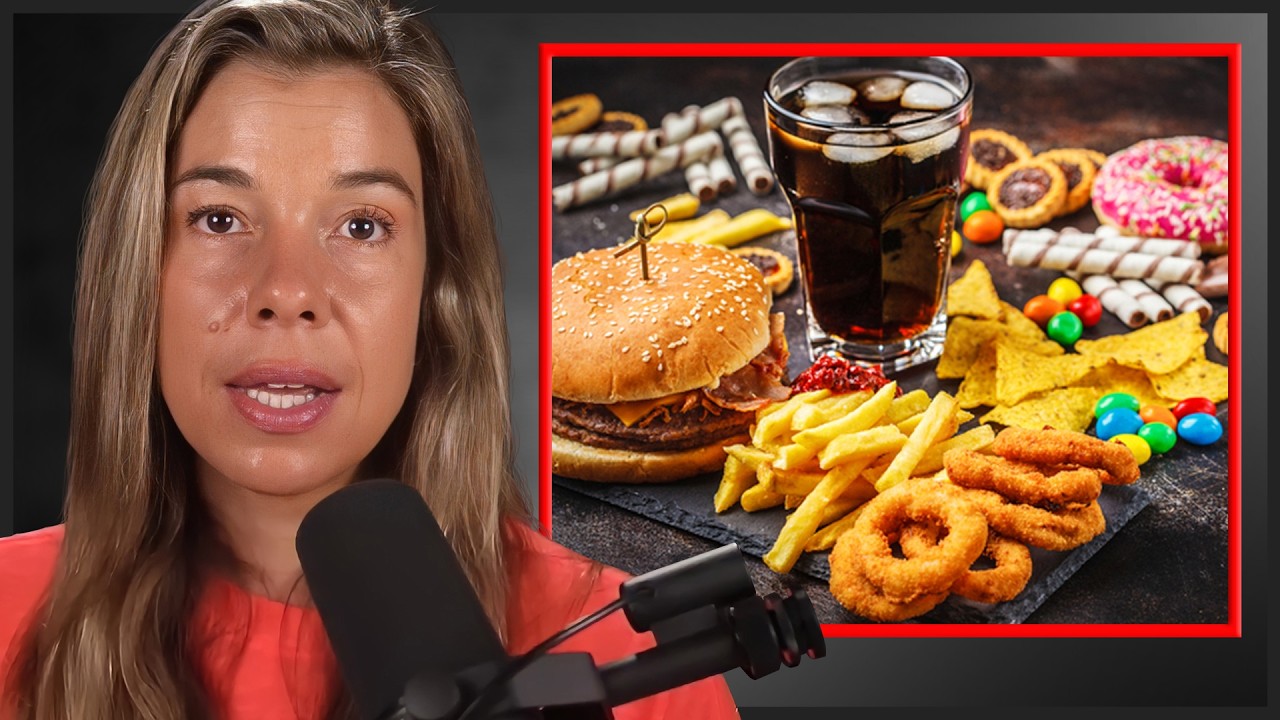
In this clip from Dr. Rhonda Patrick's appearance on Modern Wisdom, she explains why ultra-processed foods can make it easier to overeat. These products often combine refined carbohydrates, added fat, low protein density, little intact fiber, and a texture that encourages faster eating. The result is food that delivers energy quickly while doing less to satisfy appetite.
Dr. Patrick highlights a controlled inpatient crossover trial in which 20 adults ate either an ultra-processed or unprocessed diet for two weeks before switching diets. Participants consumed about 500 more calories per day and gained about two pounds during the ultra-processed phase, while they lost about two pounds during the unprocessed phase. The trial shows that the tested food pattern directly changed intake and short-term weight. [1]
She also connects this eating pattern with added sugar, weaker satiety, and the possibility that people continue eating to meet protein needs. Choosing foods with intact structure, adequate protein, and naturally occurring fiber can make appetite easier to regulate. Dr. Patrick presents that shift as a practical way to lower passive calorie intake without relying on constant willpower.
Added sugar without an intact fiber matrix can produce a faster intestinal and metabolic exposure. Dr. Patrick links repeated high intake with gut permeability and inflammatory signaling. In a short intervention in 29 healthy young men, a daily sugar-sweetened beverage increased fasting glucose, C-reactive protein, and atherogenic LDL features within three weeks; this was a biomarker study, not a cancer trial. [2]
Obesity and chronic inflammation are associated with higher risk for several cancers, and insulin, sex-hormone, and immune pathways provide plausible links. These lines of evidence do not prove that sugar directly causes a specific cancer or that removing one food prevents cancer. The practical conclusion is to reduce routine ultra-processed food and added-sugar exposure while improving body composition through a sustainable dietary pattern and activity.
This clip is excerpted, with permission, from Dr. Rhonda Patrick's appearance on Modern Wisdom. Thank you to Modern Wisdom for allowing us to share it.
- ^ Ahmed M. Gharib; Alexis Ayuketah; Amber B. Courville; Ciarán G. Forde; Elise Costa; Hongyi Cai, et al. (2019). Ultra-Processed Diets Cause Excess Calorie Intake And Weight Gain: An Inpatient Randomized Controlled Trial Of Ad Libitum Food Intake Cell Metabolism 30, 1.
- ^ Aeberli I; Gerber PA; Hochuli M; Kohler S; Haile SR; Gouni-Berthold I, et al. (2011). Low to moderate sugar-sweetened beverage consumption impairs glucose and lipid metabolism and promotes inflammation in healthy young men: a randomized controlled trial. Am J Clin Nutr 94, 2.
Chris Williamson: What about the concerns with added sugar?
Dr. Rhonda Patrick: Exactly. Yeah. So we talked about, there's a lot of chemicals in foods and there's, it's 10,000 chemicals. So you can figure out how many of those may be detrimental to health. I would say one of the biggest problems with ultra-processed foods is the added sugar. And when we say added sugar, we mean not sugar. Like if you, if you're eating an apple, right, it's got like natural sugar in that. That's, bound to a fiber matrix. We're talking about adding table sugar like sucrose, glucose, and fructose, 50% mixture of each into it. Foods have tons and tons of added sugar. Processed food, ultra-processed foods have tons and tons of added sugar. And, that's part of the hyperpalatability of them. It's what makes them taste good.
There's a lot of downstream problems with the added sugar on the brain, on overeating. So, there was actually a really good study that was published a couple years ago out of the NIH from Kevin Hall's lab. And, he took the same group of people and gave them either an ultra-processed foods diet or a whole foods diet. And, he gave the same group the same diet. So, the same people had each diet with a washout period and then they measured a bunch of things, right? So, you're not looking at a lot of individual variability here, right? It's called a crossover trial design. So he gave these— so what happened is these 2 groups, so the whole foods versus the ultra-processed, right? Same number of calories in the food, same number of— same amount of sodium, same amount of energy density.
There were not similar amounts of added sugar. So the ultra-processed foods had like 50% more added sugar. Fiber was the same, but only because they gave the ultra-processed food group drinks with like Metamucil or something, right? Like they had to give them fiber because essentially processed foods have no fiber, right? And then protein was mostly similar. There was a little bit more in the whole foods group than the ultra-processed foods group. But the study basically gave these people like, again, equivalent amounts of like calories and stuff. And so the total sugars were the same. So, the fruits and stuff had sugar, but it was the added sugar that was different, right?
Chris Williamson: Mm-hmm.
Dr. Rhonda Patrick: He gave these people these meals that they came into like a metabolic ward to eat, and they were basically given 60 minutes to eat their meal. So, they could eat as much as they wanted or as little as they wanted. So, they didn't like make them eat a certain amount. The point was to see if they were going to overconsume, overeat, right? Well, it turns out when they were eating the ultra-processed foods, people on average ate 500 calories more than eating the whole foods diet. So this was 500 calories more per week. And so they ended up gaining 2 pounds more on— well, they actually gained 2 pounds if they were eating ultra-processed foods and they lost 2 pounds if they were eating whole foods. And this was—
Chris Williamson: From zero.
Dr. Rhonda Patrick: From their baseline.
Chris Williamson: From their baseline.
Dr. Rhonda Patrick: Yeah.
And this was for the 2-week that the trial happened. So, if you think about it, that's a pound per week they were gaining. That's 4 pounds a month. So, 4 times 12 is 48. That's 48 pounds a year.
Chris Williamson: It couldn't have been 500 calories a week if they gained a pound.
Dr. Rhonda Patrick: Sorry, it was 500 calories per 2 weeks. Yes.
Chris Williamson: No, that also can't be right.
Dr. Rhonda Patrick: 500 calories—
Chris Williamson: Per meal.
Dr. Rhonda Patrick: Sorry. Yes. They were eating 500 calories more per meal, but they were gaining 2 pounds more per 2 weeks or 1 pound per week. Yes.
Chris Williamson: So, it was a 3,500 surplus per week.
Dr. Rhonda Patrick: Yes, exactly.
Chris Williamson: 'Cause it was 500 per meal.
Dr. Rhonda Patrick: Yep. Right. So, they were eating, you know, overeating. And the question is, why were they overeating? Right. And there's probably a lot of reasons for that. You know, one is they weren't having, they weren't being satiated.
So, refined added sugar basically disrupts hormones. It disrupts the hormones that are involved in satiation, like leptin, ghrelin's a hunger hormone. So, those things were being disrupted in those individuals. And, the question is, is if you're eating a refined sugar diet, if you're eating a lot of ultra-processed foods, you're probably eating more of the foods, right? Why is that? Well, you're not being satiated for one. Two, even though there was less protein in the ultra-processed foods, it seemed as though people were eating more almost to get their protein needs.
Chris Williamson: Oh, that's so interesting.
Dr. Rhonda Patrick: Yeah. Have you heard of the protein leverage hypothesis?
Chris Williamson: No.
Dr. Rhonda Patrick: It was Stephen Simpson, I think was the, one of the main scientists involved in this hypothesis.
And essentially what it is, is that your body like needs a certain amount of protein per day to like maintain physiological functions. And So, he hypothesized that no matter what, if you were eating foods that were low in protein, you were going to overeat because you had to maintain this amount of protein that your body really needs, right? And so, him and some of his colleagues have done some randomized controlled trials sort of proving this hypothesis where it's like you can give people lower protein, same everything else, but they will overconsume if they have the lower protein just to kind of get up to that. So, that's another possibility. Again, if you're eating a lot of ultra-processed foods, they're low in protein. Protein is satiating for one, right?
That's also something to consider. But, it does seem as though there's like— it's interesting, there might be this protein leverage hypothesis that might be partly explaining some of this as well because it's like your body's wanting to meet the protein needs for just maintaining a lot of different physiological functions that—
Chris Williamson: How legitimate are the links to cancer when it comes to ultra-processed foods and sugar?
Dr. Rhonda Patrick: There's a lot of ways to get there. So, I'll give you, obviously, when you talk to a scientist, the most robust evidence is, well, we need a randomized controlled trial. We need to prove causation, right? Well, you're never going to get that because it takes decades for cancer to rear its ugly head. And that's too expensive of trial.
But, the evidence that we do have, for one, people that are obese tend to eat more added sugar. I mean, that's a fact that obese people are eating added sugar.
Chris Williamson: As a proportion?
Dr. Rhonda Patrick: Yes. Yeah, exactly. Because they'll eat more of everything overall. They're eating more ultra-processed foods, which are higher in added sugar, don't have a fiber matrix. The way sugar is metabolized when it's packaged in with fruit is very different than added sugar in ultra-processed foods, which has no fiber matrix. And so, what happens when it has a fiber matrix is it slows the metabolism of it. It really slows it down. It's not this big bolus. For one, your gut isn't seeing a big bolus of it, which causes— it actually causes intestinal permeability, and that causes—
Chris Williamson: Interesting.
Dr. Rhonda Patrick: Inflammatory molecules to leach into your bloodstream. Inflammation is a major driver of aging, cancer. It causes damage to DNA. So, all those things happen, right? And, there have been studies that have shown that men, young men that consume, it's like 20 ounces of a sugar-sweetened beverage a day for 3 weeks.
Chris Williamson: Okay.
Dr. Rhonda Patrick: And, these are healthy young men. They're consuming like, like a big, like Coke, right? Something like that. After 3 weeks, their inflammatory biomarkers go up like 100%, like 100%. So that's causing inflammation in healthy, just healthy young men.
Chris Williamson: Mm-hmm.
Dr. Rhonda Patrick: Again, inflammation is something that is involved in driving cancer. We know that obesity is very intimately linked to cancers. There's like 13 different cancers that obesity is known to play a role in.
There's just a lot of evidence that lifestyle factors like eating ultra-processed foods, like being overweight, obese, like these are factors that can dramatically reduce cancer incidence if they are, you know, reduced. If you reduce your ultra-processed foods, if you reduce your added sugar and lose weight, like these are things that are, that are known.
Attend Monthly Q&As with Rhonda
Support our work

The FoundMyFitness Q&A happens monthly for premium members. Attend live or listen in our exclusive member-only podcast The Aliquot.