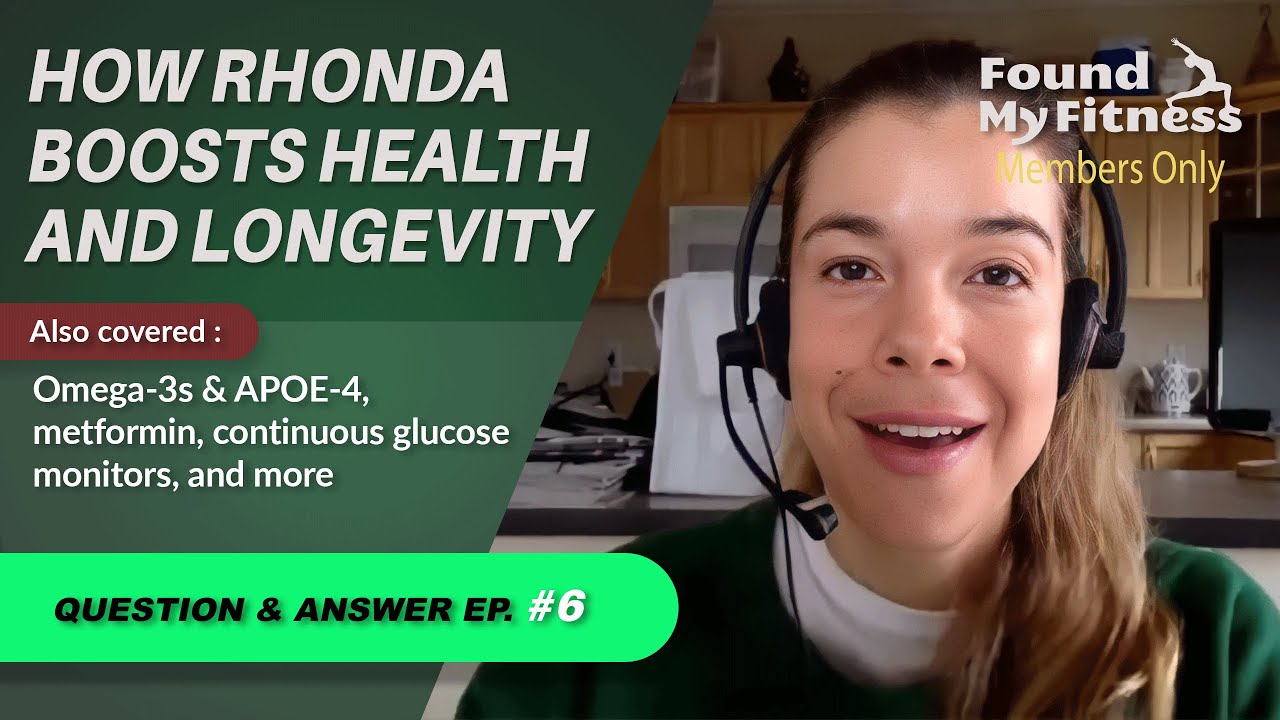
How Behavioral Tools Fit Into ADHD Treatment
Get the full length version of this episode as a podcast.
This episode will make a great companion for a long drive.
The Omega-3 Supplementation Guide
A blueprint for choosing the right fish oil supplement — filled with specific recommendations, guidelines for interpreting testing data, and dosage protocols.
You'll also receive updates from Rhonda & FoundMyFitness
In this clip from his FoundMyFitness interview with Dr. Rhonda Patrick, Dr. Andrew Huberman explains that ADHD medications and behavioral tools can both influence catecholamine systems involved in attention. Sleep, exercise, nutrition, reduced phone distraction, and structured rest can support the same broader system without matching the dose or predictability of prescription stimulants. He presents these tools as useful foundations and adjuncts, not automatic replacements for clinical care.
Dr. Rhonda Patrick raises a diagnostic concern: younger children may be judged against older classmates whose self-regulation is more mature. In a large US study, August-born children in states with a September 1 school-entry cutoff had higher rates of ADHD diagnosis and treatment than September-born children. Developmental context therefore belongs in a careful assessment without dismissing genuine ADHD. [1]
Treatment still needs to fit the person. Dr. Huberman acknowledges that medication can substantially help children and adults, while Dr. Patrick emphasizes movement and the learning environment. A Cochrane review found that cognitive behavioral interventions can improve adult ADHD symptoms, although certainty varied across comparisons. Dr. Huberman and Dr. Patrick favor multiple evidence-based entry points guided by symptoms, function, and qualified care. [2]
- ^ Layton, Timothy J.; Barnett, Michael L; Hicks, Tanner R.; Jena, Anupam B. (2018). Attention Deficit–Hyperactivity Disorder And Month Of School Enrollment New England Journal Of Medicine 379, 22.
- ^ Lopez, Pablo Luis; Torrente, Fernando; Ciapponi, Agustín; Lischinsky, Alicia Graciela; Cetkovich-Bakmas, Marcelo; Rojas, Juan Ignacio, et al. (2018). Cognitive-behavioural Interventions For Attention Deficit Hyperactivity Disorder (ADHD) In Adults The Cochrane Database Of Systematic Reviews 2018, 3.
Dr. Rhonda Patrick: There's a dopamine connection to being predisposed to being an alcoholic. So I don't remember which one it was, if one of the dopamine receptor ones or another one. There's a handful of them, I would say 5, that are known that affect likelihood to be ADHD, to have substance abuse disorders, alcoholism. I mean, all this makes sense, right?
Dr. Andrew Huberman: Yeah.
Dr. Rhonda Patrick: Everything that we were talking about, to being able to deal with stress and anxiety. And so I'm very interested in that interaction with the genetics and also like, okay, well, if you have ADHD, so these things that we've been talking about in the podcast, in the episode, limiting the phone to like 1 hour a day and doing NSDR, non-sleep deep rest, and exercise, and a cold shower or cold plunge if you have it, and all these things can help even people with ADHD?
Dr. Andrew Huberman: Yeah, they tap into the dopamine and norepinephrine system. And I also want to acknowledge that a lot of the prescription drugs for ADHD can really help people, children and adults. I did 2 episodes on dopamine and focus and ADHD. The first one was mainly focused on behavioral, nutritional, supplementation-based approaches. And I would say about 50% of the comments were, Love, love, love this, thank you. The other 50% were, I hate this, what about all the drugs that are really valuable for it? So we did a second episode, as we were originally planning to do, on Adderall, Vyvanse, Ritalin, Desoxyn, which is actually methamphetamine, prescription methamphetamine. These things are prescribed to try and help people with ADHD and other attentional issues.
And the response was exactly inverse, 50% of people saying, this is fantastic, thank you. Parents thanking us for doing that, because a lot of them were living in kind of quiet shame about the fact that they were giving these drugs to their kids, but observing that their kids were feeling better and doing better and performing better. And so, and then the other 50% were saying, this is all terrible, we're putting kids on speed. And so, again, I don't come to any of this with any kind of judgment. I think it's highly individual, but what it all comes back down to are these neuromodulators, right? And the various circuits involved.
It's the catecholamines in both cases, whether or not it's a cold plunge or whether or not it's, Adderall, it's not the same route to it, it's not the same level, it's not the same predictability, so I'm not trying to equate those 2 things, but they all funnel into the same mechanistic system. So we shouldn't be surprised at all that, yes, there are behaviors, there are things to avoid, there are prescription drugs, and yes, there are supplement-based compounds that tap into these pathways, Mucuna pruriens, for instance.
Dr. Rhonda Patrick: What do you think of that?
Dr. Andrew Huberman: It's L-dopa. L-dopa is a precursor to dopamine, and so if people— Now, it's true, supplements are not as regulated, as we both know. Sourcing becomes an issue. I've tried Mucuna pruriens. I don't have ADHD, but I've tried it.
It gives you a clear state shift. I mean, you're taking L-dopa. It produced a pretty big crash for me afterwards, and I'm like, I never want to try that again. But I think people are very individual. I think getting the baseline things right, sleep, stress modulation, exercise, nutrition, look, there's absolutely no way that that can't serve a person, young or old, for the better. And so that should be the place to start. But in many situations where there is clinical urgency to get a kid focusing so that they don't fall behind in school, I'm of the mind that, yeah, it makes perfect sense for parents to safely explore some of the pharmaceutical approaches. But if they don't work, they also need other places to turn.
And while they're doing that exploration of what's going to really work best for this kid or this adult, one would hope they're doing all the things to bolster that system, that catecholamine system, with great sleep, NSDR, maybe cold plunges, exercise, nutrition, et cetera, so that the whole system doesn't crash while they're doing it. And, you know, that's really what I believe. I can't speak for you, but I really think that your work and my work is really what we're trying to do, is trying to get all of that information out to people for people to look at, evaluate, and make decisions for the best situation in their hands. And does that mean that certain drugs are being overprescribed? No, they are in some cases.
And in some cases, they are being underprescribed, and somebody's really tortured by their inability to focus, and they could do well with some low dose of some particular drug. And then we say, well, are we creating, excuse me, a generation of addicts? They're going to depend on these things? Maybe. But maybe it's also encouraging the kind of neuroplasticity in the attentional systems that that's going to allow them to be able to focus without these compounds.
Dr. Rhonda Patrick: I think my concern is who is diagnosing it. Like, I read a study when I was trying to decide, like, okay, like, my son was born in, like, it was like in the summer, right? And so all parents are kind of faced with this. Do I start kindergarten? When do I start kindergarten, right?
Dr. Andrew Huberman: I'm a September baby, so I'm always the youngest in my class.
Dr. Rhonda Patrick: Right, and so that was exactly what I was looking into. I was looking into reading what's out there in published data, and I read a couple of studies where teachers, so children that were, boys that were born in July and August were 3 times more likely to be diagnosed with ADHD than boys that were not born in July and August. So they were the youngest, they were gonna be the youngest in their class. There's nothing about being born in July and August that makes a child susceptible to ADHD, let's be real, right? So it has to be the early struggle with keeping up with kids that are cognitively more mature.
Teachers are comparing younger kids, school readiness for boys is not the same as a girl, for one, and then on top of that, you add youth, where they're younger, and so you have a child that can't sit still and focus, and then is distracting and fidgety and all those things, and then all of a sudden, you have this, I think your child has ADHD, and then you go down this sort of path, and so, you know, my concern with that 1 in 9 number that I cited, and I was like, one in nine. That's nuts.
Dr. Andrew Huberman: Yeah.
Dr. Rhonda Patrick: Is that real? Is that real? Or like, are we just like, do we have a system where we're putting kids in this environment that they're not meant to be in, in the way, at least in the way that we're doing it?
And then now all of a sudden we're creating this situation where like, oh, well, some kids, these girls can sit nicely and follow directions. It's really easy. And they can sit for hours and hours and hours. But you know what? A lot of kids can't do that. Do they have ADHD? I don't know. Maybe they don't. Maybe they just need to get out and move around more. Some kids do have ADHD, absolutely.
Dr. Andrew Huberman: Mm-hmm.
Dr. Rhonda Patrick: Definitely, you know, and there's a spectrum, right? It's not just, you know, it's a spectrum. But yeah, I think my take on, you're talking about people's feedback and the 50% are like, oh, yeah. And I know exactly what you mean, but I do think part of it is the diagnosis and do they really have ADHD and what, like maybe we all kind of have it somewhat because of our modern life now, right?
Dr. Andrew Huberman: Or the capacity for it. I mean, what you're really talking about in that age difference in the late, the July, August kids, is that, you know, you look at a group of young kids and some are moving spontaneously and looking around a lot, and some can sit still, and it's top-down suppression from the forebrain. You know, the prefrontal cortex does many, many things, but one of its main roles, as was described to me by a really brilliant neurosurgeon, actually the head neurosurgeon at Neuralink, Matt McDougall, is the prefrontal cortex's job is to send a signal to other circuits of the brain—
Dr. Rhonda Patrick: The amygdala.
Dr. Andrew Huberman: —to say, shh, to quiet that down. And that comes online, meaning it matures very slowly in the early years of life. It's when kids learn to defer gratification, like the marshmallow test. And there are other things too, of course. It's when kids learn contextual rules, when to say please and thank you, when to run around and be crazy, and when to try and sit still. Kids are developing that at different rates. It's developing at different rates in them.
Now, we know one thing about ADHD, which is interesting, at least one thing, which is that it does not mean a total lack of capacity to focus, because oftentimes a kid with ADHD, you put them in front of something they really enjoy, like a puzzle or a video game or a particular doll game or whatever, and they are rapt with attention. And that tells us right there that the circuits work, but that the threshold for their activation is somehow altered, and it's clearly engaged in one context, but less easily engaged in other contexts. Now, let's face it, we're all like that. If something's really exciting and interesting to you, it fully engages you. If it doesn't, it's not going to.
And I do think that these circuits, even once they develop, they can be unpeeled a bit through lack of reading, lack of focus, lack of time in conversation like this, directed conversation. I often feel that podcasting, whether or not it's a solo episode or an episode like this, one of the great pleasures of it is that, you know, we're engaging face-to-face in a conversation. We haven't looked at our phones once. That's exceedingly rare if we were at a restaurant or cafe or out in the world. So I think we can all train up and we train down these circuits. And much of what we call schooling early in life is training these circuits. Some kids can benefit from pharmacological assistance. Some likely don't. Some adults can benefit from pharmacologic assistance.
In fact, I've talked to a number of psychiatrists that have said that oftentimes adults who, they don't abuse, but they heavily use stimulants like caffeine, and they require a lot of caffeine in order to focus, might be a low-grade ADHD. I'm not diagnosing anyone. I'm not a clinician, but I find that interesting. Are they seeking the same catecholamine stimulation that one would get from, let's say, low-dose modafinil or from Vyvanse or Adderall? And in which case, which one would you go with?
Dr. Rhonda Patrick: Would you say maybe a little Nicorette or something like that?
Dr. Andrew Huberman: Again, I'm moving away from the nicotine thing. I think that experiment's over for me because of the concern about the vasoconstriction. So to be clear, I'm not going to stay with it.
But, you know, all the behaviors, all the supplements, all the nutrition, all the prescription drugs, are not haphazard. They center back to these core mechanisms. Today, we've mainly been talking about the catecholamine system, dopamine in particular, but these other systems as well. And so it all makes perfect sense why these ADHD-like patterns emerge, and it also makes sense why certain treatments would work. And what I love is that the behavioral stuff is quite potent in its ability to tap into these systems. Is it the same as taking X number of milligrams of Adderall or Vyvanse? No. But it certainly gives people at least an additional line of entry to explore.
And given that these things are low cost or zero cost, typically zero cost, there's just a little bit of time investment, and that they also do other healthy things for us, I think, you know, I think it's great. And I love how the health space is emerging around this. I think the conversation is going to get better, not worse, for all of this stuff, as long as we're not on our phones too damn much.
Supporting our work
If you enjoy the fruits of
 , you can participate in helping us to keep improving it. Creating a premium subscription does just that! Plus, we throw in occasional member perks and, more importantly, churn out the best possible content without concerning ourselves with the wishes of any dark overlords.
Adhd News
- Diet plays key role in ADHD symptoms in children
- Aerobic exercise before school helped children with ADHD and was able to improve attention & scholastic performance.
- Children with ADHD performed better on classroom work if they were sitting on activity balls or exercise bikes.
- Artificial colors or a sodium benzoate preservative (or both) equal to typical dietary intakes resulted in increased hyperactivity in 3-year-old.
- BDNF variant may mediate degree of brain benefits from exercise.