How Dopamine Drives Motivation and Reward Pursuit
Get the full length version of this episode as a podcast.
This episode will make a great companion for a long drive.

The Omega-3 Supplementation Guide
A blueprint for choosing the right fish oil supplement — filled with specific recommendations, guidelines for interpreting testing data, and dosage protocols.
You'll also receive updates from Rhonda & FoundMyFitness
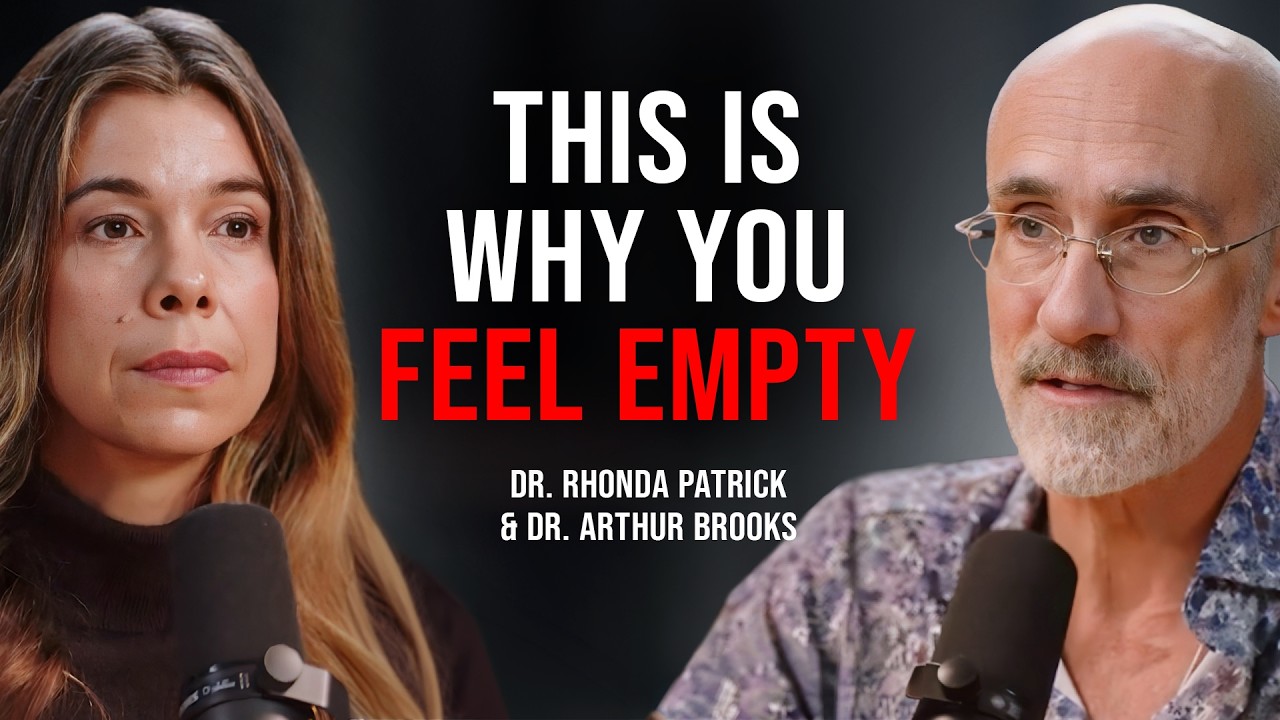
In this clip from his FoundMyFitness interview with Dr. Rhonda Patrick, Dr. Andrew Huberman describes dopamine as a neuromodulator for movement as well as motivation. Severe depletion is central to Parkinsonian movement impairment, while ordinary fluctuations do not diagnose Parkinson disease.
Dopamine works with norepinephrine and other neuromodulators to mobilize effort. Reward-prediction-error experiments show responses shifting from reward to predictive cues. [1] Animal effort tasks distinguish wanting or working from simply liking a reward.
Digital feeds, bright color, novelty, and stimulants can make rewards feel immediate and effortless. Dr. Huberman contrasts these with effortful pursuits, but this is a conceptual analogy rather than evidence that screens or color produce drug-equivalent dopamine changes.
Large peaks can be followed by reduced drive while signaling recovers. Recovery depends on dose, repetition, sleep, stress, and baseline state. Post-event fatigue can also reflect sustained arousal and norepinephrine, not a single measurable dopamine “crash.”
- ^ Glimcher, Paul W. (2011). Understanding Dopamine And Reinforcement Learning: The Dopamine Reward Prediction Error Hypothesis Proceedings Of The National Academy Of Sciences 108, supplement_3.
Dr. Andrew Huberman: Dopamine, super interesting neuromodulator. A neuromodulator, not a neurotransmitter. I'm not being overly nitpicky there. The word modulator is key, because if you want to understand dopamine, it's important to understand that it basically adjusts the activity of a lot of different circuits, meaning it's less involved, in most cases, in very local communication, between neurons, it can be, than it is changing, say, you know, how much the reward and motivation circuits are ramped up versus the circuitries in the brain that are involved in feelings of satisfaction. So you can think of dopamine, because it's a neuromodulator, as kind of generating playlists, if you will, of certain genres of neural circuit function, okay?
And that's distinctly different than a neurotransmitter like glutamate or GABA, which can also do the things I just described, but are most often associated with, like, local communication between neurons. To use a different analogy, if we were to drop a million microphones into a stadium filled with people, each microphone listening to the specific conversation between 2 or 3 people, then we could say the speech between those people. What's going on there is more like what neurotransmitters are responsible for, local communication.
Whereas if we were to have, let's say, 10 or 15 microphones grabbing from a bunch of different conversations and even shaping those conversations by virtue of, you know, pinging those conversations with certain keywords like excited, motivation, et cetera, well, that's more akin to what dopamine is doing. It's working at a broader scale to change the way that the circuitries in our brain work. So when I say neuromodulator, that's why. When it comes to understanding what dopamine does specifically, it's important that we note that it does different things in different parts of the brain and body. So there isn't one singular function. Dopamine is, in fact, expressed in the eye. It's involved in adaptation to light.
So that's a function that most people don't associate with dopamine, but it performs that role there. It modulates the activity of retinal neurons so that under different luminance conditions, brightness or darkness, the eye can still make sense of the visual world. As you go into the brain further, what you find is that dopamine is expressed in neurons that are exquisitely tied to our ability to move, okay? Most notably in a brain area called the ventral tegmentum, which just means the floor of the midbrain, which is called the substantia nigra because the neurons there are dark, and those neurons are critically important for generating smooth movements.
Those are the neurons that degenerate in Parkinson's, and that's why you see an elevated resting tremor and difficulty initiating movement in people with Parkinson's. In fact, most of the treatments for Parkinson's center around trying to replace that dopamine or those dopamine neurons. And then as you move into the classic reward system of the ventral tegmental area, nucleus accumbens, these are all just names of brain areas that are associated with reward, motivation, and pursuit. And most people associate dopamine with a sense of reward. We hear about dopamine hits. The idea that, okay, I'm thirsty, I take a sip of my tea, and I get a dopamine hit. That's the idea.
Now, in reality, dopamine is more closely tied to motivational states, the pursuit of rewards, and those rewards could be in the form of something that you get or a punishing thing that you remove. This is important. The removal of a painful stimulus or, say, agitation, or moving from a state of being too cold to being comfortable or too hot to being comfortably cool, also will release dopamine. So dopamine isn't really tethered to any one thing. It's a currency that is involved in generating movement, that's not coincidental, and is involved in motivation and pursuit of particular rewards, and those rewards are contextual. In an environment where it's exceedingly cold, finding warmth is the reward.
In an environment where it's exceedingly hot, you're hiking in the Joshua Tree Desert, you've run out of water, and it's really, really warm, getting into that cool shower is going to feel fantastically good. And dopamine is, no doubt released under both conditions, but dopamine is released en route to goals when we think, or to rewards, when we believe that we are on the right path to those goals. And this is critical, and this is why we say it's involved in motivation. There's a classic experiment that I think summarizes the specific role of dopamine and disambiguates it from the reward properties of dopamine, because it does have reward properties, best. And the experiment is essentially the following. You take 2 groups of rats. One group of rats has an intact dopamine system.
The neurons are alive and thriving in this reward system and other areas of the brain. And you give them access to a lever press or some other small amount of work that then generates a food reward, like a Froot Loop or something. Rats and mice love these kinds of things, as we know. As do humans, for all the wrong reasons, but real ones nonetheless. Those animals will work, they'll lever press, they'll even work through a maze, they'll do a number of different things. Some will even cross a shock plate to get to food if they're hungry enough. And the intact dopamine system helps them do that. It's motivation-based reward pursuit. A second group of rats has a specific category of dopamine neurons ablated, neurochemically ablated.
And that particular category of neurons are the neurons that are responsible for what we classically think of as reward, this ventral tegmental area accumbens pathway that we can talk about. And those animals will not motivate to get the reward. However, if the reward is accessible to them, they'll eat those Froot Loops all day. In other words, it appears that dopamine is required not for the sense of pleasure or reward, not for the reinforcing properties of food or other reinforcers, warmth when it's cold, cool when it's too hot, et cetera, but rather the desire and especially the ability to convert desire into a physical movement, or in some cases, a cognitive movement. We could talk about what that would look like, cognitive effort, reach a particular goal.
So what that experiment illustrates, and by the way, this has been observed in a naturalistic type experiment where people with Parkinson's have fewer dopamine neurons, not just in substantia nigra, but elsewhere, as evidence that dopamine is most critically involved in motivation and pursuit of goals, not pleasure itself.
Dr. Rhonda Patrick: So, you've talked a lot about this dopamine wave-pool and understanding like how our dopamine levels are fluctuating throughout the day. So this dopamine dynamics, can you talk a little bit about that, like the peaks and the troughs and our baseline levels and how that does influence our motivation for pursuing goals or in some cases maybe rewards in general and how that just affects our performance?
Dr. Andrew Huberman: Yeah. Absolutely. Before I do, I'll just mention that the dopamine wave-pool analogy is one that I borrowed from Dr. Kyle Gillett, who's a medical doctor who's been on my podcast and focuses mainly on things related to obesity and hormone stuff. He was the one that initially coined that phrase. I like it very much because it embodies a number of key features of the dopamine circuitry at large, not just one circuit, but how dopamine works generally psychologically and physiologically. It's the following. First of all, dopamine is a depletable but replenishable resource.
In other words, unless the dopamine neurons are destroyed, like in a case like Parkinson's, or rare exposure to neurochemicals that are involved in certain pesticides, and that's not a dig on certain pesticides per se, but there's a history there of people taking certain compounds in and destruction of dopamine neurons. Those particular cases aside, most of us have dopamine neurons that can readily release dopamine and do so at what I would call a tonic level. It's kind of what we could just refer to as a baseline level of dopamine neurons firing in the background, just firing off action potentials, electrical signals, releasing dopamine into the various circuits that they're trying to modulate.
Then there are what we can call, for sake of this conversation, dopamine peaks and dopamine troughs, which are increases in dopamine release that ride on top of that baseline and that influence that baseline. Let's go back to the wave-pool. In the wave-pool analogy, you start with a certain amount of water in this wave-pool, and then you start generating waves of different amplitudes. If the waves are of a particular size, well, then they rise and subside, rise and subside, and you don't actually deplete the total amount of water in this pool, okay? The baseline level doesn't change despite the fact that you have these peaks and troughs. If you get enough movement in that pool, you get big waves, some starts to splash out, and the total amount drops.
In other words, the baseline level of dopamine has dropped, or in this analogy, it's dropped. So I like the wave-pool analogy because even though it doesn't embody all of the dynamics of dopamine, it embodies many of them that we can relate to. For instance, if we take the extremes of things that cause massive amounts of dopamine release, these are typically illicit drugs, things like methamphetamine, thousandfold increase in dopamine release, you know, cocaine, the combination of different highly reinforcing dopamine-related activities or drugs. So methamphetamine plus sex, right? This is common in certain addictions, right? Yeah. People will take stimulants like methamphetamine, they will also engage in sexual activity. Now you're getting way up past 1,000.
It's not always additive, but it often can be additive or even synergistic. What happens under those conditions? Well, neurons in the, let's just call it the motivation and reward pathway, are releasing massive amounts of dopamine, sometimes to the extent that the readily releasable pool of vesicles, or sometimes called vesicles in the US, the little spheres filled with neuromodulator dopamine, actually get depleted, and the neurons need to manufacture more, and that takes time before more can be created. There can also be neurotoxicity where the neurons actually are killed off, although that's in more extreme cases.
So what we're talking about here are drugs of abuse, like methamphetamine, cocaine, combination of dopamine-releasing activities, sometimes drugs, sometimes sex, sometimes video games in excess, plus maybe compounds like Adderall, Vyvanse, et cetera, clearly increased dopamine release. And then what happens is some hours later or days later, depending on the frequency of the activity, the reservoir, the pool, has essentially lowered its overall level. So now in order to generate waves of equivalent size or even smaller size, you need a lot more, let's say, movement. What is that movement? Well, typically that's the pursuit of more reinforcing stimuli, but guess what? With dopamine depleted, that becomes harder to generate. And so hopefully I've created a picture here.
This is obviously a kind of cartoon picture of dopamine dynamics. It's not quantitative in any way, but what it essentially says is big dopamine peaks lead to lots of dopamine release. And then what we know is that the dopamine levels that follow those peaks drop below baseline. And if the peaks are high enough, they will deplete that baseline. But remember, we said that the dopamine pool is depletable, but replenishable. How is it replenishable? With time and with either lower or no dopamine peaks. So if we step back from real life and we look at it and we can say, okay, if I pick up my phone and I'm scrolling on Instagram, highly reinforcing behavior. I mean, videos and images are so powerful to us.
I mean, a few years ago, there was a hack that I think Tim Ferriss put out on his podcast. If you shift your phone to black and white mode, grayscale, I mean, all that stuff becomes far less reinforcing. You kind of don't want to look at the thing. You shift it back to full color, and it's like, whoa, it's just so much more compelling. So you're scrolling, you're seeing things, and yeah, if you see something that you really, really like, maybe an animal video that you really like, in my case, then sure, there's very likely to be some dopamine release. Is it going to deplete the baseline of dopamine? Unlikely, but if you engage in that activity for many, many hours, you could imagine that it might. We don't have exact data on this.
Certainly if you're combining any kind of stimulants that tap into the dopamine system, this is going to happen. Certainly if you're engaging in drugs of abuse or just a lot of, you know, exciting, high amplitude activity, it makes other things seem more boring because actually relative to what was going on neurochemically, it is more boring. The brain doesn't have a sense of exciting and boring. It doesn't have a sense of motivated, amotivated in the subjective sense. It has a correlation between the activity of these dopamine circuits and other circuits, but certainly these dopamine circuits, and some subjective feeling of either desire to engage, AKA movement, or lack of desire to engage, such as, you know, just kind of apathy and just feeling like, hey, there's nothing here for me, but here I am continuing to engage in this activity over and over.
And we know that with most all drugs of abuse, but certainly with anything that releases dopamine, there's nothing quite like the first time. And that these circuits actually learn. They can become reinforced in the sense that they build up strength between particular synapses and things of that sort, so that we continue to, in a seemingly logical way, go back to the original behaviors, trying again and again, hitting that lever, hitting that lever, trying to get back to that similar state. And just like a slot machine, every once in a while, we get what we're looking for, and the whole thing is further reinforced. Now, that's all painting a very sinister and kind of dark picture, image of the dopamine system.
And I want to be clear that this wave-pool analogy doesn't have any valence to it, positive or negative. It's just one analogy for how the system works. In a different frame, if you understand that you have some baseline level of motivation, desire to move cognitively, physically, and you understand a bit about how these dopamine peaks and troughs work, well, then you can work with it. I believe you actually can leverage it so that things like procrastination become less likely, so that you can engage in social media in a meaningful and positive way, but then know, okay, I'm going to put it away now and I'm going to need to take some of that elevated arousal that I feel and put it towards some other, you know, enriching activities.
There's nothing good or bad about dopamine, and we shouldn't fear it. It's really about understanding the underlying dynamics, and that if we've taken ourselves to a place where we are just depleted, where that baseline, the level of water in that wave-pool is way down because we've had these huge waves, huge waves, huge waves, well, then we need to be patient. We just need to wait and expect that at some point pleasure and motivation will return, but that we need to wait a period of time as opposed to what most people do, which is to go pursue things to get them out of that somewhat subdued state.
Dr. Rhonda Patrick: So I have a few questions. First, a big thanks to Dr. Gillett for that amazing analogy.
Dr. Andrew Huberman: I love it too.
Dr. Rhonda Patrick: It really makes it a lot easier to understand this, how this dopamine system's like working in a general sense at least. Maintaining the steady baseline levels, it sounded like it's not so easy to deplete the baseline unless you're really going after something that's either a substance that could really sort of increase your dopamine in combination maybe with other enjoyable things as well. Is the effort that you're putting in, so like you are preparing for a long-term, like let's say you're preparing for a wedding or something big, a party, and you put in all this effort and planning for a month, and then you have the party and it's fun, it's great, everyone has a great time, it's a fun party, and the party's over, and then you feel kind of depressed.
Like, do events— like, can you deplete your baseline levels just from, like, putting in, like, having an event like that, or is that effort that I put in kind of going to shield me from— the drop in those baseline levels?
Dr. Andrew Huberman: Yeah, well, the simple answer is the latter, that dopamine that follows effort is generally good for us. One would hope that effort is in service to our own goodness and the goodness of others, but that's generally true. Large amplitude peaks in dopamine that don't require effort are dangerous. Drugs of abuse do this, one pill, one shot, and you've got a thousandfold increase in dopamine release, that's scary, because that's not the way the system was designed to work under normal conditions, right?
These are drugs that might mimic certain compounds in nature, but let's face it, these circuits that we're talking about evolved for the pursuit of particular rewarding activities, mainly centered around food, and reproduction, okay? And keeping us safe, avoiding extremes of temperature, et cetera. So I think the critical thing is that, well, in the example you gave, you know, a lot of effort put toward planning a wedding and then hopefully a wonderful wedding, that is all goodness. That is all goodness in the sense that there's going to be dopamine released as one is making plans, see the invitations, you like the invitations, maybe there's a dispute, you resolve the dispute, which, by the way, remember the removal of a negative stimulus, also dopamine, great.
Back on track, we are doing all this, and then wedding goes fantastically well, maybe one glitch, okay, great, and you have the photos and the memories, all of that is great. If the next day, or in the days following, people feel a bit of a low, a bit of a postpartum-type low, that could be related to a drop in the dopamine level. More likely, it's fatigue. It's also anticipation itself breeds this own kind of letdown once something follows. I mean, this is the nature of, you know, true clinical postpartum depression, where, you know, post-childbirth, this is a real clinical syndrome, as we know, that sometimes people deal with, unfortunately, and needs to be taken really seriously.
But in the kind of more popular use of the word postpartum depression, where, you know, post-wedding, post-graduation, it's the shift in arousal state from anticipation and higher arousal, what's next, I'm excited about what's next, what's going to happen, to I don't know what's going to happen, what now? It's the what now? Kind of circuitry.
Get email updates with the latest curated healthspan research
Support our work

Every other week premium members receive a special edition newsletter that summarizes all of the latest healthspan research.
Dopamine News
- Refined sugar increases dopamine & activates brain's reward center similar to drugs like tobacco, cocaine & morphine.
- A gene variant found that makes you 6-times more sensitive to placebo & increases dopamine in prefrontal cortex 3-4x.
- A low dose of lithium (a naturally occurring element) can reduce involuntary movements associated with Parkinson's disease & increases dopamine.
- Cold water immersion at 14°C increased metabolic rate by 350%, norepinephrine by 530% & dopamine by 250%.