#80 How Heat Therapy Improves Slow Wave Sleep
This episode is available in a convenient podcast format.
These episodes make great companion listening for a long drive.

The BDNF Protocol Guide
An essential checklist for cognitive longevity — filled with specific exercise, heat stress, and omega-3 protocols for boosting BDNF. Enter your email, and we'll deliver it straight to your inbox.
You'll also receive updates from Rhonda & FoundMyFitness
Heat therapy, such as using a sauna or soaking in a hot bath, may significantly improve your slow-wave sleep. This video delves into the fascinating intersection between exercise and passive body heating and elucidates how high energy expenditure exercise and heat exposure share nuanced mechanisms in sleep regulation.
In this short episode, I discuss the health benefits and practical implications of how heat therapy improves sleep quality, including...
-
Increasing pre-sleep tiredness
-
Effects of exercise
-
How the immune system regulates sleep
-
Hormonal effects of heat
-
Overlap in the brain (thermoregulation vs. sleep)
The surprising role of the immune system
The immune system plays a surprising role in regulating sleep through somnogenic cytokines, such as immune factors IL-1B and TNF-alpha, released in response to heat stress and exercise.
The interconnected nature of thermoregulation and sleep
Understanding how thermoregulation affects our sleep and vice versa is vital for a more comprehensive view of sleep health. The interconnected nature of thermoregulation and sleep, particularly in the brain, highlights the importance of overlapping sleep regulation and heat loss processes. Critical to these processes are heat-sensing neurons in the preoptic area of the hypothalamus, a region known to play a crucial role in sleep regulation.
The intricate, bidirectional relationship between growth hormone and slow-wave sleep
Most daily growth hormone secretion occurs during the initial phase of slow-wave sleep. Stimulants of slow-wave sleep, such as heat exposure, can enhance growth hormone secretion, establishing a robust connection between growth hormone and sleep regulation.
Heat's effects on growth hormone vary – from doubling after two 20-minute 80°C sauna sessions to soaring sixteen-fold after two one-hour sessions at the same temperature.
Translating sleep insights into practical steps
These findings highlight the possibility of using heat therapy or vigorous exercise to influence slow-wave sleep, drawing on the interplay between body temperature regulation, immunity, physical activity, and hormones. By better understanding these relationships and effectively leveraging them, we can enhance sleep quality and overall health and well-being.
Scientific research has identified many sauna and hot bath protocols
- Example sauna protocol: 20 minutes in a 176°F sauna, 1-2 hours before bedtime
- Example hot tub/bath protocol: 104.9°F for 20-30 minutes, 1-2 hours before bedtime
- Timing may also be essential to allow for cooling down afterward.
- Early evening, a couple of hours before bed, is probably optimal.
-
Introduction
-
Increasing pre-sleep tiredness
-
Effects of exercise
-
How the immune system regulates sleep
-
What heat and exercise have in common
-
Hormonal effects of heat
-
Growth hormone
-
Prolactin and sleep onset
-
Effect of sexual activity
-
Overlap in the brain (thermoregulation vs. sleep)
-
Heat protocols and tactics
Hello everyone. Dr. Rhonda Patrick here. Today, we're embarking on a deep dive into a fascinating aspect of sleep health, the potential enhancement of sleep quality through heat exposure. It's been my personal experience that heat exposure along with appropriate cooldown has helped me with aspects of my sleep. I'd like to share with you a little bit about why I think that happens and some of the complex cellular and molecular mechanisms involved, which should equally apply to hot baths, saunas, and to some degree exercise. These include the release of ATP, increased adenosine levels, and the signaling of sleep-regulating cytokines. In other words, aspects of our immune system that can promote sleepiness.
Now, you might already be aware of the importance of early bright light exposure in resetting our circadian clock and the value of avoiding blue light exposure at night for optimizing sleep. These are significant elements in the realm of sleep hygiene. But today I'd like to temporarily skirt past those fundamentals and focus on another intriguing avenue, the potential of passive body heating. What if the simple act of raising your body temperature through taking a warm bath or using the hot tub before bed or spending time in the sauna could significantly improve sleep quality? This isn't just an enticing theory. There's some scientific research supporting this.
Passive body heating, in other words, raising your body temperature without exerting yourself through physical activity, has been shown to facilitate sleep onset. Likewise, taking a warm bath before sleep increased the proportion of slow-wave sleep, the deep restorative phase of our sleep cycle that is important for staving off neurodegenerative diseases like Alzheimer's disease. For our older population where sleep issues are very common, passive body heating could be an invaluable tool. A systematic review found that passive body heating can aid in sleep initiation and maintenance in the elderly, offering a non-pharmaceutical approach to combating sleep disturbances. So let's dive into heating. So, you know, there's heating, elevating core body temperature via exercise.
There's also elevating core body temperature Through different heat modalities like hot baths and saunas, for example. But heating via exercise stimulates ATP release and increases adenosine and signaling of sleep-regulating cytokines. So these include TNF-alpha, IL-1. These are released from the periphery or from astrocytes in the brain. So let's talk about ATP release. So exercise increases the demand for energy in the body, right? Yeah. That leads to the production and release of adenosine triphosphate. That's ATP, the major energy currency in the body. So ATP is a molecule that stores and provides energy for all the cellular processes, including muscle contractions. Adenosine. So as ATP is being used or utilized during exercise, it breaks down into adenosine.
And adenosine is a neuromodulator that plays a role in promoting sleep. So accumulation of adenosine in the brain, particularly in the basal forebrain, is associated with increased sleep pressure that causes you to feel drowsy, sleepy, and it promotes the transition from wakefulness to sleep. Sort of as a side note, caffeine is binding to adenosine receptors and essentially blunting the effect of adenosine, any adenosine that's still left over in the morning, from binding to those receptors and causing you to feel sleepy. And it's one of the reasons why you get that acute alertness effect from drinking caffeine, because you're not then feeling that effect of adenosine, the impact of adenosine binding to those receptors.
So sleep-regulating cytokines I mentioned, also exercise stimulates the production of certain cytokines such as tumor necrosis factor alpha, that's also known as TNF-alpha, or interleukin-1 or IL-1. These are actually somnogenic cytokines. They're involved in sleep regulation. These cytokines are released from the periphery or from astrocytes, which are a type of glial cell in the brain, and they act on specific brain regions to promote sleep. Whole-body hyperthermia, a therapeutic technique that involves increasing the body temperature to a level similar to moderate to high fever, generally through use of infrared saunas and warm blankets, has also been shown to increase the production of somnogenic cytokines.
TNF-alpha and IL-1 have both been shown to increase non-rapid eye movement sleep, non-REM sleep, which, you know, could be referring to deep restorative phases of sleep. So in short summary of that So, this section, you know, heating the body, particularly through exercise, which does stimulate the utilization, the release and utilization of ATP, which then breaks down into adenosine, and then that increases the signaling of the sleep-regulating cytokines as well, like TNF-alpha, IL-1. These factors contribute to promoting feelings of drowsiness via the adenosine, the somnogenic cytokines. They facilitate the transition from wakefulness to sleep. So they potentially then improve overall sleep quality, you know, and, you know, also the deep sleep as well.
But it is important to know that exercising too close to bedtime might have the opposite effect due to the increased— the acute effects of the increased alertness and the increases in core body temperature Without being able to cool down before going to bed. So it's generally, I think, recommended to engage in exercise earlier in the day or just not right before bedtime. So you want to at least do it a couple of hours before bedtime to allow the body to cool down, to promote more restful sleep, to allow the alertness in your brain to kind of calm down as well. Of course, like any exercise is better than none. But when we're talking about it in the context of sleep, it is better to try to not do it literally like right before you're going to go to bed. So the effects of heat and exercise.
Let's talk about some very interesting effects that we've definitely discussed in the past. Growth hormone and prolactin are— they're 2 key hormones that are important in the regulation of slow-wave activity. Okay. The relationship between growth hormone and sleep appears to be bidirectional. On the one hand, the majority of daily growth hormone secretion occurs in the initial phase of slow-wave sleep. On the other hand, growth hormone and its releasing hormone, growth hormone-releasing hormone, have also been shown to promote sleep, particularly slow-wave sleep. Regular sauna use is probably one of the most powerful stimuli that increases both growth hormone and prolactin.
So growth hormone, the effects of sauna use on growth hormone levels really depend on many factors including duration, temperature, and frequency. So for instance, 2 20-minute sauna sessions at 80 degrees Celsius with 30 minutes of cooling period in between can double growth hormone levels basically from their baseline. On the other hand, 2 15-minute sauna sessions at about 100 degrees Celsius, dry heat, separated by a 30-minute cooling period can cause a 5-fold increase in growth hormone levels. So there's also a really remarkable effect when you do sort of repeated sauna use. So repeated sauna use, for example, you do 1— you do 2 1-hour sauna sessions at 80 degrees Celsius. This is very, very high. for 7 days in a row, that leads to a 16-fold increase in growth hormone levels in men.
That's not something— it's kind of just as a proof of principle example of how there is a dose-dependent effect of heat stress on growth hormone. And that's something, again, that is temperature and duration dependent. I don't necessarily think it's good to do that much heat stress. That's pretty intense. But I just wanted to highlight the effect that sauna use does have on growth hormone levels. The heightened growth hormone levels typically last a few, I would say more like a couple hours after sauna use. They released after about 2 hours, they start to go down close to baseline levels. It's also kind of interesting that combining exercise with heat stress or sauna use may also increase growth hormone levels even further than when you just use, for example, sauna alone.
And mostly it probably has to do with, again, your elevations in core body temperature are going even higher than one alone, right? The release of prolactin alongside growth hormone is one of the classic responses to heat stress. Prolactin is a hormone produced in the pituitary gland that is known for its role in lactation in women, but it also has various other functions. One of these is its role in the regulation of sleep. Prolactin has been found to increase during sleep and particularly during REM sleep. It's also been suggested that it may help to promote slow-wave sleep, the deepest phase of non-REM sleep. So in one study, intravenous administration of prolactin in humans was found to increase slow-wave sleep.
Moreover, some research has suggested that sleep disturbances such as insomnia can occur in conditions with prolactin deficiency. Prolactin in one study, men that used the sauna, they were in the sauna for an 80-degree Celsius sauna. until they felt exhausted, they had a tenfold increase in prolactin levels. In another study, women who did a 20-minute dry sauna twice a week had a 510% increase in prolactin levels after each sauna session. And similar to growth hormone, prolactin levels lasted for a couple of hours. There are some other lifestyle factors in addition to Sauna use, potentially even hot baths, again, something that is going to elevate core body temperature. Exercise is one. So exercise can also increase both growth hormone and prolactin.
I don't know the exact quantitative numbers and how much, but they also do increase it. And then sexual activity is another one that also increases both prolactin. So Yeah. The effects of growth hormone and prolactin also, again, affect slow-wave deep sleep. And so, the idea is that doing these activities a couple of hours— so, you want to make sure you're not doing, again, right before bed because you want to allow your body time to cool down. And if you get in the sauna literally Yeah. Like right before bed, you might still be really hot and you won't cool down unless you then, you know, perhaps get into a cold plunge or do a cold shower to cool down. But doing it like, you know, a couple of hours before bedtime seems like a good time. It's typically when I do my hot tubs.
I do a lot of hot tubs in the evening and I do them a couple of hours before I go to bed. That's all, I think, super interesting stuff that we haven't talked about before. Heating activates warm-sensitive neurons in the hypothalamus that promote slow-wave activity in response to increased core body temperature and skin temperature. Yet again, another potential mechanism behind why sauna use, why hot baths, and even exercise, which elevates core body temperature, may promote slow-wave deep sleep. And then exercise combined with body cooling and warm baths combined, you know, with body cooling also, you know, may help, again, to promote slow-wave activity in deep sleep.
There are a variety of sauna and hot tub or hot bath protocols that could be derived from the scientific literature on sauna use and longevity and potential effects on sleep. An example of a sauna protocol could be 20 minutes in a at least 176 degree Fahrenheit sauna, at least one to two hours before bed, allowing the body enough time to cool down before sleep. That may vary in terms of the time it takes someone to cool down before sleep. But what if you don't have a sauna or even a thermometer? An example of a hot tub or a hot bath protocol would be a temperature of around 140. 104 degrees Fahrenheit for 20 to 30 minutes with as much of the body from shoulders down submerged as possible.
For hot baths, you may need to add more hot water throughout to keep the water temperature at around 104. So in that case, the thermometer may be helpful to monitor the temperature. For me personally, I have a pretty good sense of how hot I feel when I'm in the sauna for 20 minutes. So by knowing that, I can sort of also make an approximate approximation with how I feel in a hot bath. So again, timing may be important by allowing the body enough time to cool down, ideally a couple hours before sleep. Some of you may enjoy a cool shower afterwards, which may also help cool the body down.
To tie this all together, passive body heating, whether through a hot bath or a hot tub or a sauna or through physical activity, may be a really useful way to improve sleep quality, especially slow-wave sleep. Rather than being a substitute for good sleep hygiene, it potentially adds a whole new dimension to it. Learn more on the fundamentals of sleep hygiene by listening to my interviews with experts, Dr. Matthew Walker, Dr. Dan Parti, and Dr. Ashley Mason in episodes 45, 8, and 67. I'll add a link to those in the description. You can listen to them here on YouTube or get them on Apple Podcasts or Spotify. Several segments of this episode were taken from a recent live question and answer session. I host one of these every single month exclusively for my premium members.
Being a premium member not only gets you access to these Q&A sessions where you can ask questions directly, but also a myriad of other benefits. You'll get access to a members-only podcast called The Aliquot, a twice-monthly science digest, and a stockpile of over 100 member episodes of various types spanning many, many hours. So if you're not a member yet, I encourage you to consider joining our premium community by heading over to foundmyfitness.com and clicking become a member. Thank you so much for your support. And as always, thank you for tuning in. Don't forget to hit the like button, share this video with someone who might find it useful, and I'll see you in the next episode.
Attend Monthly Q&As with Rhonda
Support our work
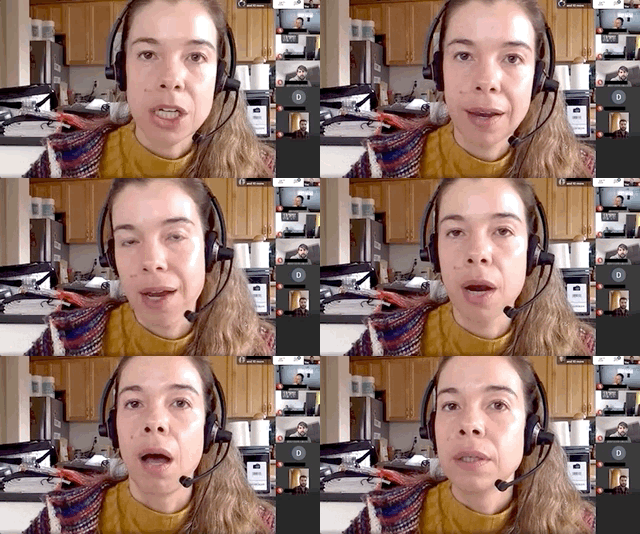
The FoundMyFitness Q&A happens monthly for premium members. Attend live or listen in our exclusive member-only podcast The Aliquot.
Sleep News
- Keeping everyday activities on a regular schedule was linked to less pain and fewer depressive symptoms in older adults.
- Cutting sleep by 80 minutes per night increased body weight and waist circumference in adults with cardiometabolic risk factors.
- Regular sleep timing may be just as important as sleep duration for long-term health.
- A single 14-gram dose of creatine helped preserve cognitive performance after a sleepless night.
- Magnesium and potassium supplementation may ease insomnia severity in people with diabetes.