How Nicotinamide Riboside Raises NAD
Get the full length version of this episode as a podcast.
This episode will make a great companion for a long drive.
The Omega-3 Supplementation Guide
A blueprint for choosing the right fish oil supplement — filled with specific recommendations, guidelines for interpreting testing data, and dosage protocols.
You'll also receive updates from Rhonda & FoundMyFitness
Nicotinamide riboside is a vitamin B3 form that cells can use to make nicotinamide adenine dinucleotide, or NAD. In this FoundMyFitness conversation, Dr. Charles Brenner explains how NR enters NAD synthesis. Dr. Brenner is Chief Scientific Advisor to Niagen Bioscience. He explains why the route from a swallowed precursor to cellular NAD is more complex than simply choosing the molecule that appears closest in a pathway. In an eight-week randomized trial of 140 overweight adults, 100, 300, and 1,000 milligrams of NR per day increased whole-blood NAD by 22, 51, and 142 percent, respectively. [1]
Human trials show that NR can raise circulating NAD metabolites, but clinical outcomes depend on the population and endpoint. A 12-week randomized trial in 40 obese, insulin-resistant men tested 2,000 milligrams per day and did not establish a broad improvement in insulin sensitivity or other metabolic outcomes. In a small trial of 30 people with stable heart failure, 1,000 milligrams twice daily approximately doubled whole-blood NAD and appeared tolerable while supporting further study rather than proving treatment benefit. [2] [3]
Nicotinamide, NR, NMN, oral NAD, and intravenous NAD are related but not interchangeable. Nicotinamide has separate evidence in selected high-risk skin-cancer populations, summarized in a systematic review, while NR has the more developed oral human pharmacokinetic literature discussed here. Claims that NMN cannot enter any cell, that oral NAD cannot have any effect, or that intravenous delivery is clinically superior remain too categorical for current evidence. Product identity, dose, medical conditions, and the difference between raising a blood biomarker and improving health outcomes all matter. [4]
- ^ Conze D; Brenner C; Kruger CL (2019). Safety and Metabolism of Long-term Administration of NIAGEN (Nicotinamide Riboside Chloride) in a Randomized, Double-Blind, Placebo-controlled Clinical Trial of Healthy Overweight Adults. Sci Rep 9, 1.
- ^ Dollerup OL; Christensen B; Svart M; Schmidt MS; Sulek K; Ringgaard S, et al. (2018). A randomized placebo-controlled clinical trial of nicotinamide riboside in obese men: safety, insulin-sensitivity, and lipid-mobilizing effects. Am J Clin Nutr 108, 2.
- ^ Wang DD; Airhart SE; Zhou B; Shireman LM; Jiang S; Melendez Rodriguez C, et al. (2022). Safety and Tolerability of Nicotinamide Riboside in Heart Failure With Reduced Ejection Fraction. JACC Basic Transl Sci 7, 12.
- ^ Mainville, Laurence; Smilga, Anne-Sophie; Fortin, Paul R. (2022). Effect Of Nicotinamide In Skin Cancer And Actinic Keratoses Chemoprophylaxis, And Adverse Effects Related To Nicotinamide: A Systematic Review And Meta-Analysis Journal Of Cutaneous Medicine And Surgery 26, 3.
Dr. Rhonda Patrick: Can you please tell people and explain to them the question I know that's in their minds which is why can't I just supplement with NAD? Why do I have to take this precursor like nicotinamide riboside? So maybe you could talk about why that is and also maybe just touch on nicotinamide riboside versus nicotinamide mononucleotide. That's another precursor.
Dr. Charles Brenner: Yes. The issue is phosphates. Compounds with phosphates don't get into cells. The biggest piece of NAD that can get into a cell is a nucleoside. After NR enters a cell, nicotinamide riboside kinase phosphorylates it by adding a phosphate group. Then another enzyme adds what is called an adenylyl group. At that point, it is a dinucleotide with two phosphates. Nicotinic acid does not have phosphates. Nicotinamide does not have phosphates. Both are considered NAD precursor vitamins. The problem with nicotinic acid is that high doses cause flushing. If you're trying to take enough nicotinic acid to boost NAD, you're probably going to feel an uncomfortable hot-flash-type experience. That said, some cardiologists recommend it for lipid regulation, and it has a long history of human use. Nicotinamide has been in the food supply for a long time, usually at a low dose. It is in many multivitamins. We know it is very safe. We know that it is cancer-preventive, and it was tested in Australia, where there is a very high incidence of skin cancer. The incidence is high enough to do a prospective preventive clinical trial to see whether nicotinamide supplementation lowers the risk of skin cancer, and it does. Nicotinamide has a substantial safety record.
Dr. Rhonda Patrick: Do you think that has to do with DNA damage repair?
Dr. Charles Brenner: Yes. Nicotinamide riboside is a particularly direct NAD precursor in the sense that the NR kinase pathway gets upregulated in a lot of conditions of metabolic stress. In the failing heart and in a damaged neuron, nicotinamide riboside kinase 1 and 2 genes become upregulated. This may help explain why NR works in many mouse models in which nicotinamide does not work. For example, in heart-failure experiments nicotinamide can't actually boost the NAD in the failing heart because the failing heart is overexpressing a gene called NMRK2 nicotinamide riboside kinase 2. The failing heart is looking for the whole nucleoside in order to boost its NAD system.
Dr. Rhonda Patrick: It's not that it's necessarily easier for nicotinamide riboside to get there.
Dr. Charles Brenner: You asked about NAD and NMN, right? NAD does not enter cells intact when taken orally. This led people to start injecting it.
Dr. Rhonda Patrick: Let's discuss NAD IV drips.
Dr. Charles Brenner: Have you talked to anyone who has done it? Did they tell you how painful it is?
Dr. Rhonda Patrick: No. They talked about how great they felt and how they had energy.
Dr. Charles Brenner: It's delivered over a several hour period in which people can experience an innate immune response because NAD can't get into cells. Neither can NMN get into cells. These compounds break down into NR or something smaller, right? NAD probably breaks down into NMN first and then to NR and NR, nicotinamide, and nicotinic acid can then enter cells.
Dr. Rhonda Patrick: So this is the mechanism for the NAD drips that we're talking about. Right.
Dr. Charles Brenner: Right. There is now Niagen Plus, a drip-grade nicotinamide riboside that can be delivered in an IV without pain. The clinical data behind oral Niagen is much more extensive than the data for IV delivery. That said, some mouse experiments show that intravenous NR reaches different tissues more extensively than oral NR. Why is that? The biodistribution question is pharmacokinetics: you can get higher levels and potentially deliver more NR to the heart or other tissues through IV. I think we will have more disease-relevant data from IV delivery in the future. There is much more data today, in January 2026, on oral NR. We know it is safe. We know it boosts NAD. IV is a developing product, but it is now available to the clinical research community as well.
Dr. Rhonda Patrick: To summarize, I know that you can actually go online and buy an NAD oral supplement. That is not going to work, right?
Dr. Charles Brenner: It will break down. Roughly 40 percent of the molecular weight of NAD is NR. It will be digested and presumably deliver some small fraction of the total molecular weight as an NAD booster.
For NAD itself, you can argue whether NMN is a precursor. It is a precursor of NR, which is a precursor to cellular NAD. But again, NMN breaks down to NR. NR then enters cells and becomes NMN and NAD again.
Dr. Rhonda Patrick: I thought NR got broken down to NMN.
Dr. Charles Brenner: No. NR gets phosphorylated and converted into NMN. NMN has a phosphate on it. As a chemist, why would you add a phosphate to NR to produce NMN when NMN has to be degraded down to NR in order to get into cells. It's popular. It was popularized by a number of researchers and the question with NMN is whether you can get pure, safety-tested material. There are reports that 17 out of 20 products labeled as NMN do not contain NMN or do not meet their label claims.
Dr. Rhonda Patrick: Some people that are listening are familiar with both NR and NMN. For others, this is the first time they are hearing about all this but they do know about NAD. Many people think NMN is one step closer to producing NAD that's in the cell. Yes in the cell. That is a common idea. So why wouldn't I just supplement with the closer part of this process?
Dr. Charles Brenner: It doesn't work that way. Why doesn't it work that way? Well, it doesn't work because the NMN has a phosphate group that precludes its transport into the cell. In the 1980s, there were people that were developing nucleotides and bases as anti-cancer and antiviral drugs. In fact, three of them got a Nobel Prize. Gertrude Elion, George Hitchings, and James Black received the Nobel Prize. I worked at Research Triangle Park in North Carolina. The idea was that if you make something that resembles a nucleotide that it can go into cells and be converted into a toxic nucleotide and it can do things like block viral replication. Like you've heard of AZT, right? HIV drug. So AZT is a nucleoside. You make a nucleoside, it gets taken up into cells and then inside the cell AZT gets converted into AZT triphosphate and then that is an inhibitor of reverse transcriptase. Nicotinamide riboside is not toxic. It's an NAD booster. So it's a direct precursor of NAD. The NR can get into cells. It can be phosphorylated and converted into its final nucleotide form. NMN can't because NMN already has a phosphate. That phosphate has to be put on inside of cells. If someone is able to find a safe, pure form of NMN, which might be available at a drug company that is making and testing NMN, you could have access to that. Most of us wouldn't have access to that. But if you could find a safe form of NMN and take it orally, that NMN is being converted back to NR before it gets into cells.
Dr. Rhonda Patrick: That was the long answer to the question. It is essentially being converted back into NR. So why not just take NR?
Dr. Charles Brenner: Well, NR is the most safety-tested NAD booster on the market.
Dr. Rhonda Patrick: This is helpful. At least people have an idea now.
Get email updates with the latest curated healthspan research
Support our work
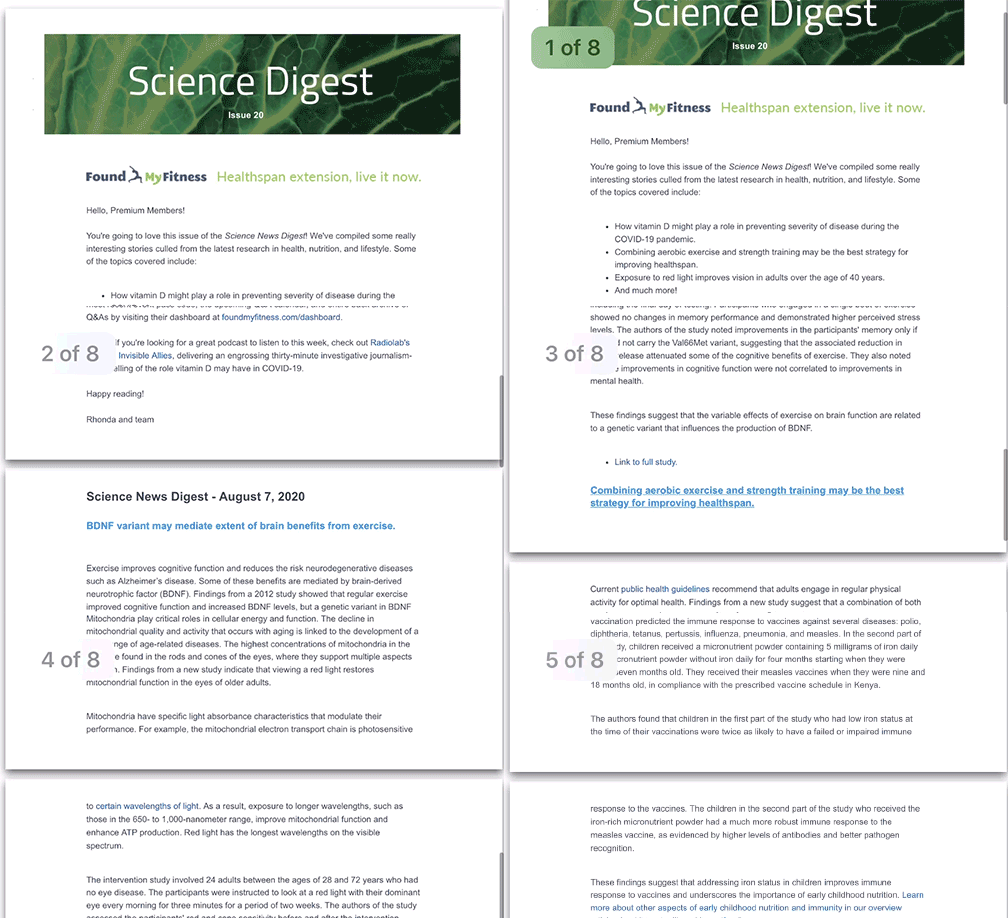
Every other week premium members receive a special edition newsletter that summarizes all of the latest healthspan research.
Nad+ News
- NAD precursor supplementation strategies are less effective than exercise training in staving off muscle and systemic aging.
- One year of nicotinamide riboside supplementation did not improve symptoms in early Parkinson's disease.
- Omega-3 fatty acid supplementation benefits people with depression.
- Human longevity was associated with decreased levels of genes involved in neural overactivity.