How Sulforaphane Activates Cellular Defense Pathways
Enter your email to get our 15-page guide to sprouting broccoli and learn about the science of chemoprotective compount sulforaphane.
Broccoli sprouts are concentrated sources of sulforaphane, a type of isothiocyanate. Damaging broccoli sprouts – when chewing, chopping, or freezing – triggers an enzymatic reaction in the tiny plants that produces sulforaphane.
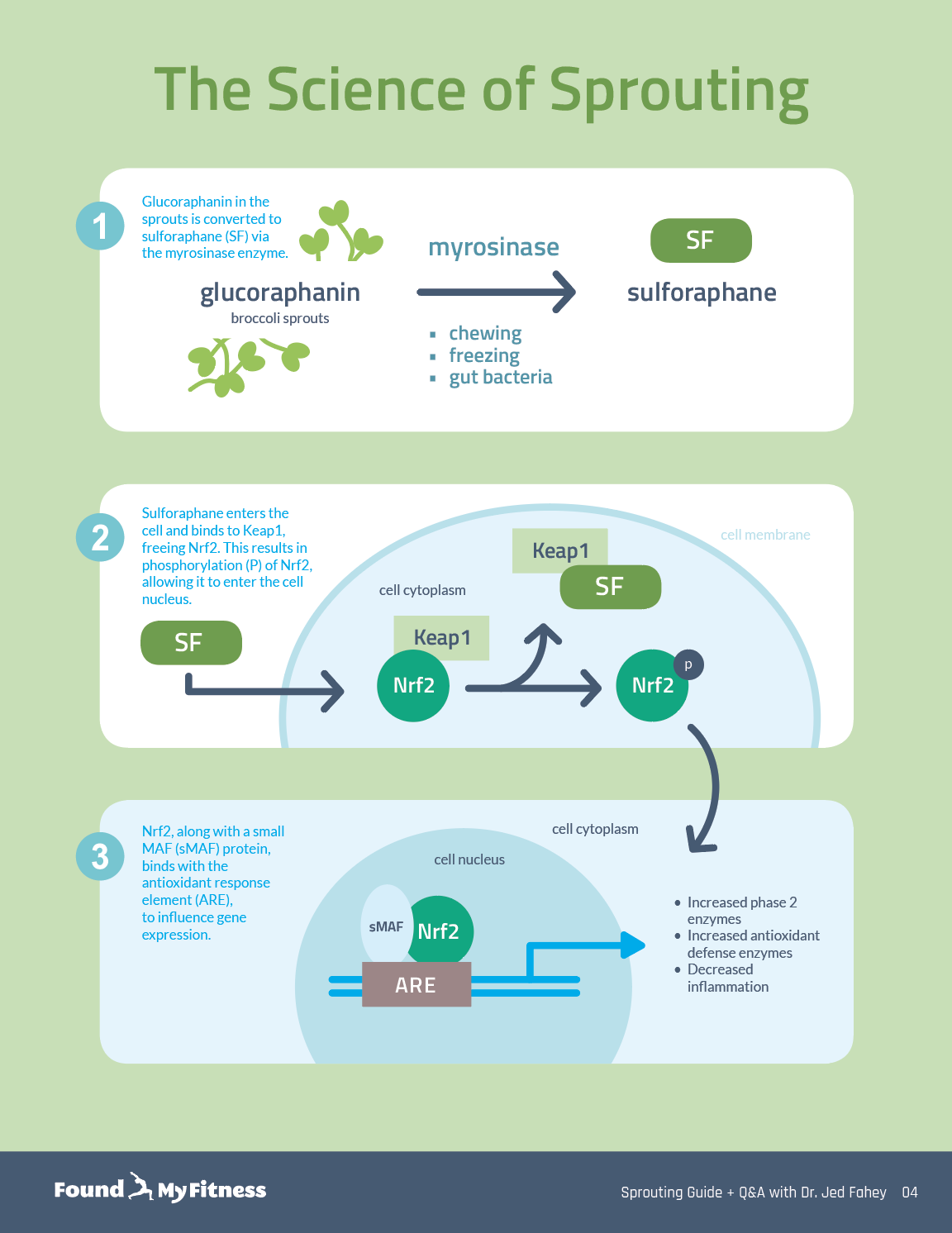
Broccoli sprouts store glucoraphanin, the precursor to sulforaphane, rather than large amounts of preformed sulforaphane. Crushing or chewing brings glucoraphanin together with the enzyme myrosinase and produces sulforaphane. In this clip from Dr. Rhonda Patrick's presentation at the Vibrant Wellness Longevity Summit, she explains how sulforaphane activates NRF2-regulated cellular defense pathways. A small human pilot linked a broccoli-sprout extract with higher glutathione in blood and selected brain regions. [1]
Human exposure studies have tested this pathway with measurable pollutant metabolites. In a 12-week randomized trial of 291 adults living in a region of China with substantial air pollution, a broccoli-sprout beverage increased urinary excretion of a benzene metabolite by 61 percent and an acrolein metabolite by 23 percent. A later 170-person dose-ranging trial found that urinary sulforaphane metabolites increased with the administered dose, while conversion from glucoraphanin varied substantially among participants. [2] [3]
Whole-food studies provide another line of evidence. In an eight-week randomized crossover trial, 85 grams of watercress per day reduced basal DNA damage in lymphocytes by 17 percent and oxidative purine damage by 23.9 percent. In young smokers, 250 grams of broccoli per day for ten days reduced oxidized DNA by 41 percent and increased resistance to hydrogen-peroxide-induced DNA damage by 23 percent. Broccoli sprouts, lightly cooked broccoli, and myrosinase-rich mustard-seed powder are practical ways to support sulforaphane formation, while supplement composition and conversion can vary. [4] [5]
This clip is excerpted, with permission, from Dr. Rhonda Patrick's presentation at the Vibrant Wellness Longevity Summit. Thank you to Vibrant Wellness for allowing us to share it.
- ^ Sedlak TW; Nucifora LG; Koga M; Shaffer LS; Higgs C; Tanaka T, et al. (2018). Sulforaphane Augments Glutathione and Influences Brain Metabolites in Human Subjects: A Clinical Pilot Study. Mol Neuropsychiatry 3, 4.
- ^ Egner PA; Chen JG; Zarth AT; Ng DK; Wang JB; Kensler KH, et al. (2014). Rapid and sustainable detoxication of airborne pollutants by broccoli sprout beverage: results of a randomized clinical trial in China. Cancer Prev Res (Phila) 7, 8.
- ^ Johnson, Jamie; Egner, Patricia; Ng, Derek; Zhu, Jian; Wang, Jin-Bing; Xue, Xue-Feng, et al. (2019). Dose-dependent Detoxication Of The Airborne Pollutant Benzene In A Randomized Trial Of Broccoli Sprout Beverage In Qidong, China The American Journal Of Clinical Nutrition 110, 3.
- ^ Gill CI; Haldar S; Boyd LA; Bennett R; Whiteford J; Butler M, et al. (2007). Watercress supplementation in diet reduces lymphocyte DNA damage and alters blood antioxidant status in healthy adults. Am J Clin Nutr 85, 2.
- ^ Riso P; Martini D; Møller P; Loft S; Bonacina G; Moro M, et al. (2010). DNA damage and repair activity after broccoli intake in young healthy smokers. Mutagenesis 25, 6.
Broccoli sprouts have about 100 times more sulforaphane than mature broccoli. I am saying sulforaphane, but that is not entirely accurate because sulforaphane is not produced in the plant until the plant is crushed or bitten. If a little insect lands on a broccoli plant and bites it, the plant converts glucoraphanin, the precursor to sulforaphane, into sulforaphane with an enzyme called myrosinase.
Broccoli sprouts actually have 100 times more glucoraphanin than mature broccoli. Young plants need to survive long enough to spread their seeds, which helps explain why younger plants sometimes have higher levels of these phytochemicals.
Why do I care about sulforaphane? Sulforaphane is the most potent dietary activator of a very important antioxidant, anti-inflammatory, and detoxification pathway called NRF2. NRF2 is a transcription factor, which means it can bind to many genes and activate or deactivate them, somewhat like vitamin D does.
Sulforaphane moves NRF2 out of its inactive state. When NRF2 is active, it activates phase 2 detoxification enzymes. These are enzymes that help our bodies handle the toxic exposures we encounter daily, including air pollution, wildfire smoke, cigarette smoke, fungus, and chemicals from plastics. You want those detoxification enzymes active.
NRF2 also deactivates phase 1 biotransformation enzymes. These enzymes can take a procarcinogen and convert it into a carcinogen, so you do not want them active. NRF2 turns them down. Procarcinogens include the blackened material on heavily grilled steak, which contains heterocyclic amines and similar compounds. NRF2 turns down enzymes that can convert those compounds into carcinogens. Studies have found that people who char their meat but eat more cruciferous vegetables offset some of the increased cancer risk.
NRF2 is also one of the most potent activators of antioxidant systems. Glutathione is one of the body's important antioxidant systems and has much greater antioxidant potential than vitamin E or vitamin C. Glutathione is the brain's major antioxidant. Studies have found that people who take a broccoli extract containing sulforaphane increase their plasma glutathione. Functional MRI has also shown increased glutathione in the brain. Sulforaphane is a major activator of this pathway.
Human studies also show that sulforaphane can reduce DNA damage. People who ate about 85 grams of watercress, a cruciferous vegetable, for eight weeks had 17 percent less DNA damage in their blood cells. They also had about 24 percent fewer oxidative DNA lesions. Oxidative lesions can eventually lead to double-strand breaks. Double-strand breaks are very difficult to repair and are the most harmful type of DNA damage. Eventually, they can produce mutations in regions of genes that could become oncogenic, or cancer-causing.
In another study, smokers, who have high levels of oxidative damage, ate 250 grams of broccoli per day for ten days. It lowered their oxidative DNA lesions by about 41 percent and increased their resistance to oxidative stress by about 23 percent.
Another study gave people 300 grams of Brussels sprouts per day for three weeks. That is enough to give me too much gas, but it lowered their oxidative DNA damage by almost 30 percent. Simply eating these cruciferous vegetables reduced baseline DNA damage.
That matters because DNA damage accumulates over time. It is an insidious type of damage that we cannot see in the mirror. You can see redness when a sunburn causes damage and inflammation, but you cannot see DNA damage. It is happening all the time, even in healthy people, as a byproduct of normal metabolism and immune activation. Any way to dampen that process is valuable.
There are also detoxification studies from China. I recently returned from Beijing, where the air feels heavy when you breathe it. Air pollution is a major issue there. In a couple of studies, people received about 40 micromoles of sulforaphane per day in the form of a broccoli sprout extract.
In one study, sulforaphane increased the excretion of benzene, a known carcinogen found in air pollution and cigarette smoke, by 60 percent. The effect occurred within 24 hours and continued throughout the study. Acrolein excretion also increased. Acrolein is found in air pollution and in some cooked foods. Again, this reflects the detoxification process.
Other studies have examined men with low-grade prostate cancer. They received about 60 milligrams of sulforaphane per day for about six months. It slowed the doubling time of the PSA biomarker by 86 percent after six months, a profound effect on this marker of prostate health. Other work has found that topical sulforaphane can prevent some UV-related damage and inflammation.
There are also many preclinical studies. Researchers give sulforaphane to mice, inject the mice with human solid-tumor samples, and examine tumor growth and metastasis. In an animal model of prostate cancer, sulforaphane reduced metastasis by up to 63 percent.
In a breast-cancer model, researchers injected breast-cancer stem cells into mice. Sulforaphane decreased the cancer stem-cell population by up to 80 percent and reduced tumor growth by more than 50 percent. In a colon-cancer model, it reduced precancerous lesions by about 44 percent. These are only three examples. There are many animal studies and many mechanisms involved.
The bottom line is that we should either eat cruciferous vegetables and broccoli sprouts or supplement with sulforaphane. Broccoli sprouts are the best dietary source. To get about 55 micromoles of sulforaphane, you would need about 45 to 100 grams of fresh sprouts.
If you choose broccoli, remember that cooking partly inactivates myrosinase, the enzyme that converts glucoraphanin into sulforaphane. Lightly cook the broccoli and add the enzyme back. I add mustard-seed powder to my broccoli because mustard is also in the cruciferous family and contains myrosinase. You are adding back the enzyme needed to convert the broccoli's glucoraphanin into sulforaphane. Studies show that this can increase glucoraphanin bioavailability by about fourfold. It works and is a useful little hack.
Supplements are another option, and I take one as well. Stabilized formulations are available. There is a lot of noise in the supplement market, so look for a quality supplement.
Hear new content from Rhonda on The Aliquot, our member's only podcast
Listen in on our regularly curated interview segments called "Aliquots" released every week on our premium podcast The Aliquot. Aliquots come in two flavors: features and mashups.
- Hours of deep dive on topics like fasting, sauna, child development surfaced from our enormous collection of members-only Q&A episodes.
- Important conversational highlights from our interviews with extra commentary and value. Short but salient.
Sulforaphane News
- Another pilot clinical study finds sulforaphane increased blood glutathione levels and increased levels in brain.
- Sulforaphane (beneficial compound in broccoli) found to help with symptoms of autism. Improvements in various dimensions like social interaction.
- Sulforaphane extends lifespan and healthspan in worms via insulin and insulin-like growth factor-1 signaling.
- Consumption of broccoli sprouts during late gestation & lactation confers protection against developmental delay induced by maternal inflammation.
- Every 1 percent drop in body weight slows brain aging by nearly nine months, highlighting the substantial, and often overlooked, neuroprotective benef