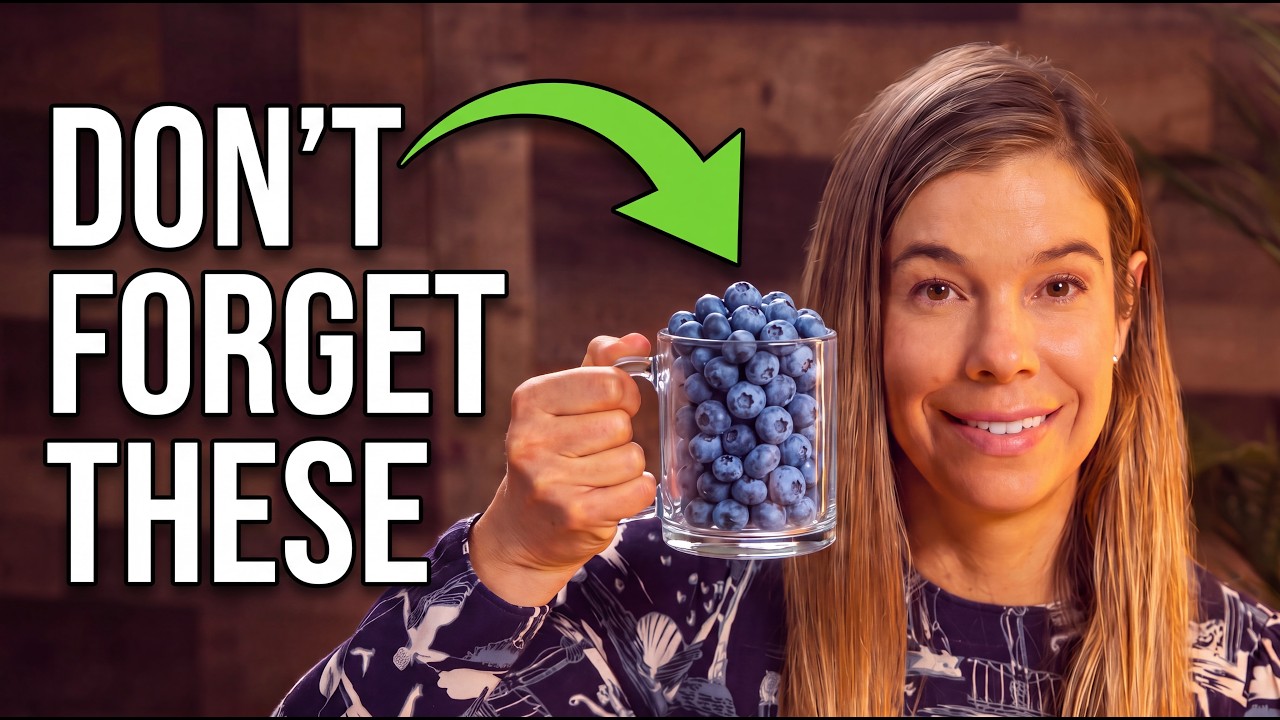
How to Support Memory as You Age
The Omega-3 Supplementation Guide
A blueprint for choosing the right fish oil supplement — filled with specific recommendations, guidelines for interpreting testing data, and dosage protocols.
You'll also receive updates from Rhonda & FoundMyFitness
Memory changes can have several causes, including sleep problems, nutrient deficiencies, medication effects, and vascular or metabolic conditions. In this clip from Q&A #86, Dr. Rhonda Patrick explains why identifying those contributors comes before choosing a supplement. She places exercise at the center of her approach because it influences brain blood flow, cellular defenses, and the processes that support learning. In a randomized trial of 120 older adults, one year of aerobic training increased anterior hippocampal volume by about 2 percent, alongside improvements in spatial memory. [1]
Dr. Patrick also emphasizes regular sleep, mentally challenging activities, social contact, and meals built around minimally processed foods. She discusses blueberries, cocoa flavanols, omega-3 fats, and adequate vitamin and mineral intake as ways to support brain health. In the COSMOS research program, daily multivitamin-mineral supplementation produced small improvements in global cognition and episodic memory among older adults. A combined analysis of three nonoverlapping cognitive substudies estimated that the global-cognition difference corresponded to roughly two years of age-related change. [2]
Emerging approaches target the brain's energy supply and antioxidant defenses. Dr. Patrick discusses creatine, sulforaphane, and ketones, while distinguishing these possibilities from the everyday foundations of exercise, sleep, and nutrition. In a pilot study, 20 people with Alzheimer's disease took 20 grams of creatine monohydrate daily for eight weeks. Brain creatine increased by approximately 11 percent, and several cognitive measures improved. The study had no placebo group, so these findings support further controlled trials. Dr. Patrick also stresses medical clearance before introducing sauna use in an older person who is not accustomed to heat. [3]
- ^ Erickson, Kirk I.; Voss, Michelle W.; Prakash, Ruchika Shaurya; Basak, Chandramallika; Szabo-Reed, Amanda N.; Chaddock, Laura, et al. (2011). Exercise Training Increases Size Of Hippocampus And Improves Memory Proceedings Of The National Academy Of Sciences 108, 7.
- ^ Vyas, Chirag M; Manson, JoAnn E; Sesso, Howard D; Cook, Nancy R; Rist, Pamela M; Weinberg, Alison, et al. (2024). Effect Of Multivitamin-Mineral Supplementation Versus Placebo On Cognitive Function: Results From The Clinic Subcohort Of The COcoa Supplement And Multivitamin Outcomes Study (COSMOS) Randomized Clinical Trial And Meta-Analysis Of 3 Cognitive Studies Within COSMOS The American Journal Of Clinical Nutrition , .
- ^ Smith, Aaron N.; Choi, In-Young; Lee, Phil; Sullivan, Debra K.; Burns, Jeffrey M.; Swerdlow, Russell H., et al. (2025). Creatine Monohydrate Pilot In Alzheimer's: Feasibility, Brain Creatine, And Cognition Alzheimer's & Dementia: Translational Research & Clinical Interventions 11, 2.
Okay, this was a deeper dive question submitted by Ricardo. Ricardo says, "My mother is 84 and beginning to show signs of short-medium-term memory loss. Could you please give a rundown again of what interventions could help slow or improve progression?" Obviously, I can't diagnose or give medical advice, so you first and foremost have to have her doctor evaluate what's causing the memory changes. You want to know if it's something that's treatable that's involved or if it's mild cognitive impairment or whether there's like an underlying neurodegenerative disease, right? Those are very important.
There are factors that have been shown to contribute to memory problems. So, for example, low B12, thyroid problems, any types of you know, there's a lot of different types of medication side effects. Older adults that get on antibiotics can have memory problems. So, a lot of things can contribute to memory problems. Sleep problems, right? Insomnia, sleep apnea, these also can contribute to memory problems. So, important to kind of rule those things out. High blood pressure, high blood sugar, these things affect vascular health. Metabolic health is very intimately linked with cognitive function as well.
It really can influence how quickly someone declines, you know, cognitively. So, I think very important to have all these things just consider all those things, right? The metabolic health, the blood pressure, and then sleep and some of the other things that could be also contributing because there's lots of things that can contribute to memory problems. The number one thing that I would emphasize is exercise. I mean, exercise affects everything. It's affecting blood flow to the brain. It's affecting metabolites getting to the brain. It's affecting antioxidant responses in the brain. It's affecting anti-inflammatory responses in the brain.
It's changing hundreds and hundreds of molecules in the in the in the bloodstream, which is affecting the brain. So, I think physical exercise and physical activity is really one of the best things that you could do. And there's a study that I often talk about that was in older adults. It was a year-long randomized controlled trial compared to a sham control, which was stretching group. These individuals were doing brisk walking 30 minutes a day. Sorry, 30 minutes for three times a week. So, an hour and a half a week. Brisk walking.
And after a year of doing this, they essentially reversed their brain atrophy. Like they stopped losing brain mass. When you're an older adult, you start to lose about 1% per year. And not only were they not losing that, they gained brain volume back. And they improved their cognition and cognitive function and learning and memory and all those things. So, exercise is at the is at the top. And again, it In these older adults, they were doing brisk walk walking. So, they were getting about 60 to 70%. 60 to 65 actually, I'd say.
More than 65% of their maximum heart rate. You know, so it wasn't like super intense, but it was more than just lightly gently walking around. Like they were They were brisk. The other option is a sauna, but I'd say for an 84-year-old that a medical clearance from a doctor is essential because it is a stress on the vascular system and is a stress on the heart. It does trigger a lot of the physiological responses that moderate intensity exercise can elicit. And we do know that there are at least observational studies linking regular sauna use with lower risk of dementia and Alzheimer's disease.
But it is a stress on the body. And someone who's 84 and never done sauna is not adapted. And it definitely needs to be something that a doctor says is okay. And then sleep is another major one. So, making sure that they're having a consistent sleep time, a consistent wake time, getting bright light exposure in the morning, dimming their light at night, not having a lot of exposure at night, avoiding caffeine later in the afternoon, all the things that we know that can disrupt sleep. That's also very important, so focusing on sleep.
Perhaps apnea's involved, cognitive behavioral therapy for insomnia might have to be an option. There are options out there that do work for improving sleep. And then I think another thing is very important is that novelty and having mental engagement in the brain. And this is something that's extremely important as you start to get into older adulthood because oftentimes people are retired. They're not engaging their brain the same way they did when they were perhaps working. So, it's important to have them try to challenge themselves, whether it's doing puzzles or whatever it is, something that, you know, reading, you know, non-fiction as well.
I mean, just being able to engage their brain and help support neuroplasticity. So, that is also very important. Exercise does neuroplasticity, but also novelty, like exposing your brain to novel things, new things, instead of just sitting in your house watching TV and doing the same thing every day. So, you want to have that novelty cuz that's important for neuroplasticity and that helps the brain's ability to strengthen, reorganize neural connections in response to learning and experience. That way you can improve your learning. When it comes to nutrition, I like to really just There's a lot of diets out there and we as researchers tend to go to these diets because there's publications on them and we can rattle them all off.
There's the MIND diet, the DASH diet, the Mediterranean diet. All these diets have been shown them to improve and support brain health, slow brain aging in some way, shape, or form, whether it's observational data correlating them or it's a small short randomized control trial. These diets have been shown to work. With that said, I really come down to let's make this simple. Let's make this simple. What are we talking about with these diets here? Often time we're talking about not eating ultra-processed foods. We're eating whole foods. We're eating foods that are from vegetables and fruits and nuts and you know, lean meats chicken fish.
This is what we're talking about. And so I almost think it's easier rather than having to go what's the MIND diet? What's the DASH diet? What's the Well, the DASH diet lowering sodium. So if hypertension is something that's contributing to cognitive problems lowering sodium intake does help certain individuals improve their vascular system and their blood flow. There's also other again foods that I've talked about blueberries being one that helps that is helped improve selected cognitive memory function in older adults. Flavanols like epicatechins and catechins found in cacao like cocoa via is one that's been used in multiple studies showing that improves cognitive function, blood flow to the brain as well as reducing oxidative stress, omega-3 fatty acids.
These are really important part of your cell membranes your neurons, the supporting cells around the brain cells. It's making up the blood-brain barrier. I mean, just everything. It also helps regulate and resolve inflammation. Inflammation can contribute to memory problems. I talked I've talked about multivitamins. A simple multivitamin for 3 years reduced global brain aging by about 2 years and episodic brain aging by almost 5 years. I mean, little things that you can do, small improvements in overall cognitive function. Getting adequate vitamin D. I mean, again, people that are taking vitamin D supplements have 40% lower risk of dementia and people with lower vitamin D have a 50 to 80% higher risk of dementia.
So just making sure you're covering the basics, right? Getting that stuff. There's some emerging research on creatine. This is something to consider particularly in people that have a stressed brain. What is a stressed brain? A stressed brain could be Alzheimer's disease. In fact, there's a couple of pilot studies showing that people with Alzheimer's disease that have taken 20 g of creatine monohydrate daily for about 2 months did not only improve their brain creatine levels, but they also improved several measures of cognitive function. There was not a placebo group in that study, so we do need to have more higher quality studies there, but there's also other studies showing sleep deprivation is another type of stress on the brain.
Brain aging, in my opinion, is a type of stress. So, there is an argument, I don't know that this is going to be the magic bullet, but it there is an argument that maybe it'll help, possibly. And so, you know, that's another thing to consider. Exogenous ketones may help a little bit, although that's hard to It's hard to do every day, and it's I think it's just it's hard to make a habit of it because they taste terrible, they're expensive. You know, I think there's other things that we can try before doing that.
Another one would be something perhaps like sulforaphane. Sulforaphane has been shown to increase glutathione levels in the plasma in the brain in two different trials. Glutathione is one of the major antioxidant systems in the brain, and so, you know, presumably, now don't confuse what I'm saying here. I'm just connecting dots saying we know that it increases glutathione in the brain, we know that's very important for reducing oxidative stress. Oxidative stress in the brain does amplify cognitive problems as well as cause them if we're talking about over decades. So, it is another factor to consider.
And then, I would say last but not least, just making sure regular social engagement is a priority. There's many studies out there that have found greater social engagement, more frequent social contact are associated with lower risk of dementia. Obviously, these are observational, but social interaction does provide somewhat of mental stimulation, and it provides that novelty I was talking about. When you are socializing with other people, they're going to expose you to new things rather than you doing the same thing in your routine that you do every day alone or with the same person, you know, you want to you want to have some of that exposure to the novelty.
It's really important for neuroplasticity.
Supporting our work
If you enjoy the fruits of
 , you can participate in helping us to keep improving it. Creating a premium subscription does just that! Plus, we throw in occasional member perks and, more importantly, churn out the best possible content without concerning ourselves with the wishes of any dark overlords.
Memory News
- Anabolic steroid use associated with a 39% reduction in prospective memory & a 28% reduction in retrospective memory.
- Platelet-derived 'exerkines' produced during exercise promote neurogenesis, boosting brain health and cognition.
- Using magnets to stimulate brain activity via transcranial magnetic stimulation boosts memory recall by 20-25%.