How Vigorous Exercise Improves VO2 Max and Heart Function
The Omega-3 Supplementation Guide
A blueprint for choosing the right fish oil supplement — filled with specific recommendations, guidelines for interpreting testing data, and dosage protocols.
You'll also receive updates from Rhonda & FoundMyFitness
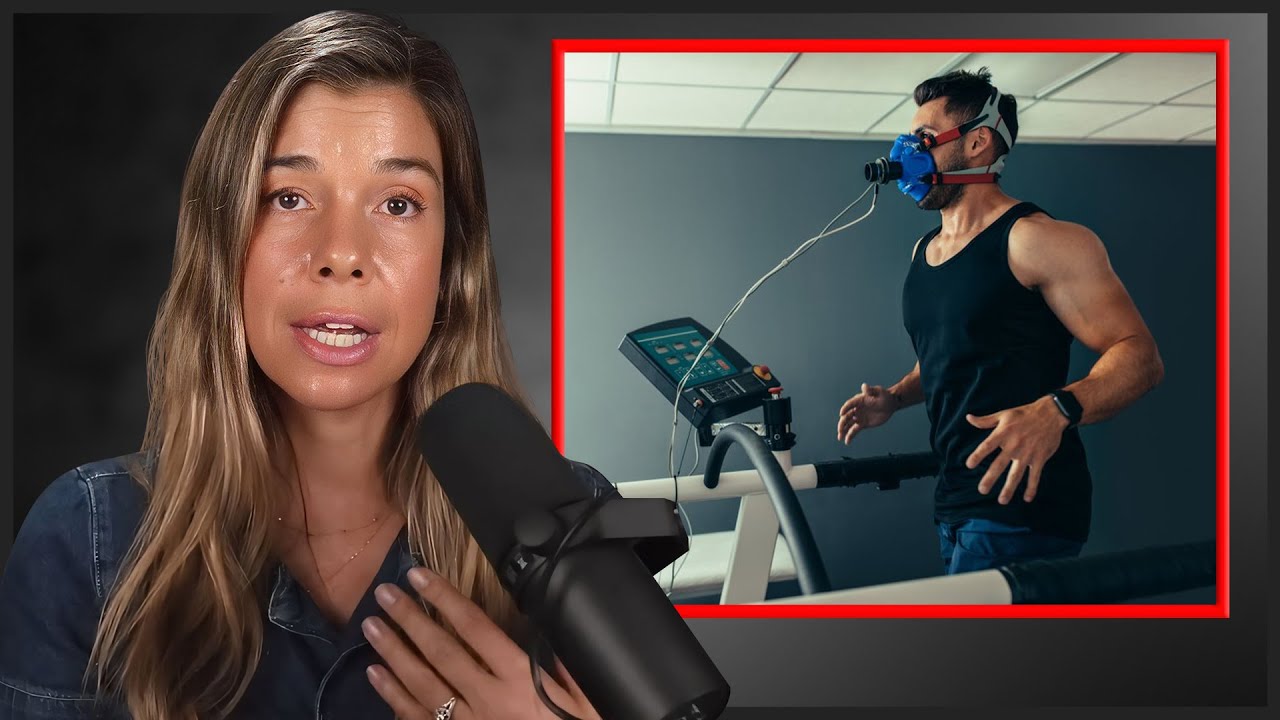
In this clip from Dr. Rhonda Patrick's appearance on The Tim Ferriss Show, she describes VO2 max as a practical measure of cardiorespiratory fitness and explains why vigorous intervals can create a stronger cardiovascular training stimulus. Large observational studies consistently connect higher fitness with longer survival, including a 46-year cohort in which men with the highest estimated fitness lived about five years longer than men in the lowest group. [1] [2]
Dr. Patrick walks through several interval formats, including the Norwegian 4x4, one-minute repetitions, and shorter sprint intervals. The shared goal is to alternate hard work with recovery so the heart and muscles adapt to transporting and using oxygen. In a clinical referral cohort of more than 122,000 adults, lower treadmill fitness was strongly associated with higher long-term mortality, reinforcing the value of building fitness progressively. [3]
She also reviews a two-year randomized trial in healthy, sedentary adults around age 53. The progressive program combined moderate exercise, vigorous intervals, and resistance work, raised VO2 max by 18%, and reduced left-ventricular stiffness, while the control group did not change. The findings show that structured midlife training can improve heart function, with intensity scaled to the person's starting capacity. [4]
This clip is excerpted, with permission, from Dr. Rhonda Patrick's appearance on The Tim Ferriss Show. Thank you to The Tim Ferriss Show for allowing us to share it.
- ^ Clausen JSR; Marott JL; Holtermann A; Gyntelberg F; Jensen MT (2018). Midlife Cardiorespiratory Fitness and the Long-Term Risk of Mortality: 46 Years of Follow-Up. J Am Coll Cardiol 72, 9.
- ^ Imboden MT; Harber MP; Whaley MH; Finch WH; Bishop DL; Kaminsky LA (2018). Cardiorespiratory Fitness and Mortality in Healthy Men and Women. J Am Coll Cardiol 72, 19.
- ^ Mandsager, Kyle; Harb, Serge; Cremer, Paul; Phelan, Dermot; Nissen, Steven E.; Jaber, Wael (2018). Association Of Cardiorespiratory Fitness With Long-term Mortality Among Adults Undergoing Exercise Treadmill Testing JAMA Network Open 1, 6.
- ^ Howden, Erin J.; Sarma, Satyam; Lawley, Justin S; Opondo, Mildred; Cornwell, William; Stoller, Douglas, et al. (2018). Reversing The Cardiac Effects Of Sedentary Aging In Middle Age—A Randomized Controlled Trial Circulation 137, 15.
Tim Ferriss: So, I have to click on this. What type of exercise reduces heart aging by 20 years? Do you want to start there or do you want to start with VO2 max?
Dr. Rhonda Patrick: We can start with VO2 max maybe because they kind of bleed into each other.
Tim Ferriss: Great. Let's do it.
Dr. Rhonda Patrick: So, people might be, going, what is VO2 max? It's essentially a cardiorespiratory fitness. It's measured or calculated by VO2 max, which is essentially the maximum amount of oxygen you can take up during maximal exercise. And what's so fascinating about that is it's a really important predictor of longevity. So there have now been enough studies that have come out looking at the cardiorespiratory fitness in the sense of VO2 max and how people with a higher cardiorespiratory fitness have a 5-year increased life expectancy compared to people with a low cardiorespiratory fitness. In fact, if you have a low cardiorespiratory fitness and you go anywhere above that, like from low to low normal, it's associated with a two-year increased life expectancy. And people with a low cardiorespiratory fitness actually have a higher all-cause mortality that's comparable or worse than people with known diseases like type 2 diabetes or cardiovascular disease or smokers for example. So in other words, being sedentary is a disease and we need to think about it as a disease and we should be trying to train to improve our VO2 max and that is something that should be in our minds. And I say this because like just having this conversation that you and I are having right now, it takes about 11 milliliters of oxygen per minute per kilogram body weight just to have this conversation. Now, to sit still and just breathe, it takes about 3 ml of oxygen per minute per kilogram body weight. And that's important because as we're aging, we're sort of heading towards this cliff of VO2 max. Our VO2 max goes down as we age, just naturally. Even if you're training and doing everything, it goes down.
Tim Ferriss: Yeah.
Dr. Rhonda Patrick: And once you get to that cliff, everything becomes a maximal effort. Like you talking, you're out of breath. carrying groceries to your car from the store, you're just out of breath. Everything is a maximal effort and you don't want to be there. So you want to like start from a higher up point so that when you're going down that cliff is much further away and that's where the training comes in because you want to sort of you want to find a training program that's going to improve that cardiorespiratory fitness.
Tim Ferriss: Right and that's where you talked about zone 2 training and that's the kind of what I would call moderate intensity exercise so.
Dr. Rhonda Patrick: You're able to use the talk test. I like the talk test because heart rate depends on the person's fitness level. But, on average, people aren't at 75% or 80% of their maximum heart rate. They're generally below that. Some people may actually be above that, but the talk test is great because you can have a conversation. You're breathy. You don't want to have a conversation, but you can. We know that when people do that moderate-intensity training, following the standard physical activity guideline of about two and a half hours a week for two months, 40% of them still can't improve their VO2 max.
Tim Ferriss: Yeah. Just different gears.
Dr. Rhonda Patrick: Well, unless they actually add in high-intensity interval training.
Tim Ferriss: Yep.
Dr. Rhonda Patrick: And that's where I get into this. I think people should be doing vigorous-intensity exercise. That's the type of exercise where you're unable to talk, right? You can't have a conversation because you're going harder. Your heart rate is about 80% to 85% of your maximum heart rate.
That type of exercise has been shown to improve VO2 max, especially if you're doing sort of what's called high-intensity interval training, as you've talked about this a lot as well, but you're doing sort of these intervals of going more vigorous intensity exercise and then you have recovery periods where your heart rate goes down. So, there's been a variety of different protocols out there that have been shown to improve the VO2 max if you do them.
Generally speaking, what's happening is you're putting a stronger stress on your cardiovascular system. So, on your muscular system, even on your brain. So, the adaptations are greater and that one of those adaptations is increasing your stroke volume. So, being able to like basically transport oxygen to tissues faster.
And that's an adaptation that happens when you're going at a harder when you're training at a harder intensity.
Tim Ferriss: What do you do personally? What's your HIIT look like?
Dr. Rhonda Patrick: Three days a week, I do some sort of CrossFit training that also involves high-intensity interval training. The high-intensity intervals will be on a rowing machine, a stationary or assault bike, a SkiErg, or a jump rope. I also do longer intervals, such as the Norwegian 4x4, on a stationary bike or rowing machine. I go as hard as I can maintain for four minutes. This is obviously not an all-out, 30-second sprint. I'm working as hard as I can while maintaining that intensity for four minutes. Then you recover for three minutes and repeat it four times. In a variation I sometimes do with my husband, I recover for four minutes because we're switching on the rower. So I sometimes take a slightly longer recovery. The Norwegian 4x4, where you work as hard as you can maintain for four minutes, recover for three minutes, and repeat it four times, has been shown to be one of the best ways to improve VO2 max. You can also do one minute on and one minute off, repeated 10 times. It's more like a 20-minute workout. That has also been shown to improve VO2 max. Even doing something like 20 seconds on and 10 seconds off, like a Tabata, has been shown to improve it. I do all of these and vary them depending on the week. Most of my exercise is high-intensity interval and CrossFit training. It's more dynamic and includes strength training, but it's higher intensity. Then I do two or sometimes three 30-minute runs a week. That's more of my zone 2 work.
Tim Ferriss: Okay. So the heart aging, right?
Dr. Rhonda Patrick: Yeah. This gets into why randomized controlled trials are important, because an intervention can establish more causation. This study was done by Ben Levine at UT Southwestern in Dallas. To me, it's a seminal, groundbreaking study that isn't talked about enough. He's a phenomenal cardiovascular exercise physiologist who trained with some of the biggest giants in the field. He and his lab enrolled sedentary 50-year-olds. They were middle-aged and sedentary but otherwise healthy. They didn't have cardiovascular disease, type 2 diabetes, hypertension, or other diseases besides being sedentary, which I think is a disease. He wanted to see how a long, two-year training protocol would affect the aging of their hearts. As we age, our hearts typically shrink and get stiffer. That affects not only our cardiorespiratory fitness and ability to exercise but also our cardiovascular disease risk. The reason our hearts get stiffer comes down, in part, to glucose. More glucose in the vascular system forms advanced glycation end products through a chemical reaction. This glycation stiffens the collagen surrounding the myocardium and pericardium. You get a stiffer heart that can't respond well to stress. You want your heart to be plastic, malleable, and flexible. You don't want it to be stiff.
Tim Ferriss: Doesn't sound good.
Dr. Rhonda Patrick: Just like you don't want your blood vessels to be stiff. What he wanted to do was see if he could change the structure, the trajectory of these aging hearts. And so, he put him on a 2-year training program, which involved the Norwegian 4x4, by the way. And when you start someone out that's, not physically active and you want them to do the Norwegian 4x4, when you have them doing their interval, their 4-minute interval, and this speaks to you as well, or anyone, you don't have to necessarily go as hard as you can the whole 4 minutes. You just have to be working hard that interval.
Tim Ferriss: Yeah, you do have to last four minutes, right? So.
Dr. Rhonda Patrick: You have to last four minutes. And so, some people even start off they're just briskly walking because that's hard for them, right?
Tim Ferriss: Yeah. Totally.
Dr. Rhonda Patrick: It's all tailored to the individual. Some people get intimidated and think, "There's no way I could ever do that." But these people did it. They started with the Norwegian 4x4 and also did a variety of other exercises, including moderate- and vigorous-intensity exercise and resistance training. The control group did yoga and flexibility training. By the end of the two years, the exercise group was working out about five hours a week. At one point, they were doing two Norwegian 4x4 sessions a week, and then they went down to one. Over two years, they were getting a lot of exercise, about five hours a week. At the end of those two years, the structural changes in their hearts, including stiffness and shrinkage, were reversed. Their hearts grew and became more flexible. The reversal amounted to 20 years less aging. Their hearts looked more like those of 30-year-olds than 50-year-olds, which is pretty incredible.
Tim Ferriss: Yeah, that is amazing.
Dr. Rhonda Patrick: Yeah, it's amazing. And I think it's also like, well, you think 50 it's too late to start exercising. Well, it's not too late.
Tim Ferriss: You can be in your 90s and get benefits. I think that's another really important sort of take-home with that story is that, you can reverse your aging of your heart by 20 years if you really put in the effort.
Dr. Rhonda Patrick: Five hours a week is about what I do. About five or six hours a week, it's a lot of work. I didn't always do that, but I've decided as I started to get into my mid-40s, I'm going to spend less time podcasting and more time exercising because this is my health.
Tim Ferriss: Yeah. Foundational for everything else. That's the base of the pyramid.
Dr. Rhonda Patrick: Right?
Supporting our work
If you enjoy the fruits of
 , you can participate in helping us to keep improving it. Creating a premium subscription does just that! Plus, we throw in occasional member perks and, more importantly, churn out the best possible content without concerning ourselves with the wishes of any dark overlords.
Aerobic News
- Cardiorespiratory fitness may be a far greater predictor of gut microbiota diversity than either body fat percentage or general physical activity
- A combined aerobic-resistance training regimen proves equally effective for cardiovascular health as aerobic alone.
- 30 minutes of moderate-intensity aerobic exercise (64.9% of VO2 max) three times a week stabilized choline concentrations in the brain.