How Dr. Rhonda Patrick Chooses Her Most Important Supplements
The BDNF Protocol Guide
An essential checklist for cognitive longevity — filled with specific exercise, heat stress, and omega-3 protocols for boosting BDNF. Enter your email, and we'll deliver it straight to your inbox.
You'll also receive updates from Rhonda & FoundMyFitness
In this clip from Dr. Rhonda Patrick's appearance on The School of Greatness, she explains how she narrows a long supplement routine to three priorities: marine omega-3 fatty acids, vitamin D, and sulforaphane. She treats that list as a personal framework rather than a universal prescription, and she still emphasizes magnesium-rich foods and a high-quality multivitamin when the list expands.
Dr. Patrick gives omega-3 the first position because the Omega-3 Index provides a longer-term measure of EPA and DHA in red blood cells. In the Framingham Offspring cohort, a higher fatty-acid profile that included the Omega-3 Index was associated with lower mortality, with the modeled difference translating to roughly five years of life expectancy. Fish, seafood, and microalgae oil are practical sources of EPA and DHA. [1]
Fish choice changes the contaminant tradeoff. Dr. Patrick favors salmon, sardines, and mackerel because they provide marine omega-3s with relatively low mercury, while large predatory fish such as swordfish can accumulate much more mercury. This is not a claim that all fish is contaminant-free or that omega-3s neutralize mercury exposure; species, serving frequency, pregnancy, and local advisories still matter.
Vitamin D is Dr. Patrick's second priority because sun-derived production varies with age, skin pigmentation, latitude, clothing, and sunscreen use. Her third choice, sulforaphane, is formed from glucoraphanin in cruciferous vegetables and activates NRF2-regulated cellular defense pathways. Human broccoli-sprout trials have shown increased excretion of benzene and acrolein metabolites, which supports this specific chemical-elimination pathway. [2]
This clip is excerpted, with permission, from Dr. Rhonda Patrick's appearance on The School of Greatness. Thank you to The School of Greatness for allowing us to share it.
- ^ Tintle, Nathan; Harris, William; Vasan, Ramachandran S; Sala-Vila, Aleix; McBurney, M I (2021). Using An Erythrocyte Fatty Acid Fingerprint To Predict Risk Of All-Cause Mortality: The Framingham Offspring Cohort The American Journal Of Clinical Nutrition 114, 4.
- ^ Egner PA; Chen JG; Zarth AT; Ng DK; Wang JB; Kensler KH, et al. (2014). Rapid and sustainable detoxication of airborne pollutants by broccoli sprout beverage: results of a randomized clinical trial in China. Cancer Prev Res (Phila) 7, 8.
Dr. Rhonda Patrick: So I do about 2 grams of omega-3. Usually, it's about 2:1 ratio EPA/DHA. Then I do, let's see, so the omega-3, then I do vitamin D. So I take around, I total around 4,000 IUs of vitamin D a day. So I get, like, 2,000 in a vitamin D supplement plus 2,000 in my multivitamin.
Lewis Howes: Mm-hmm.
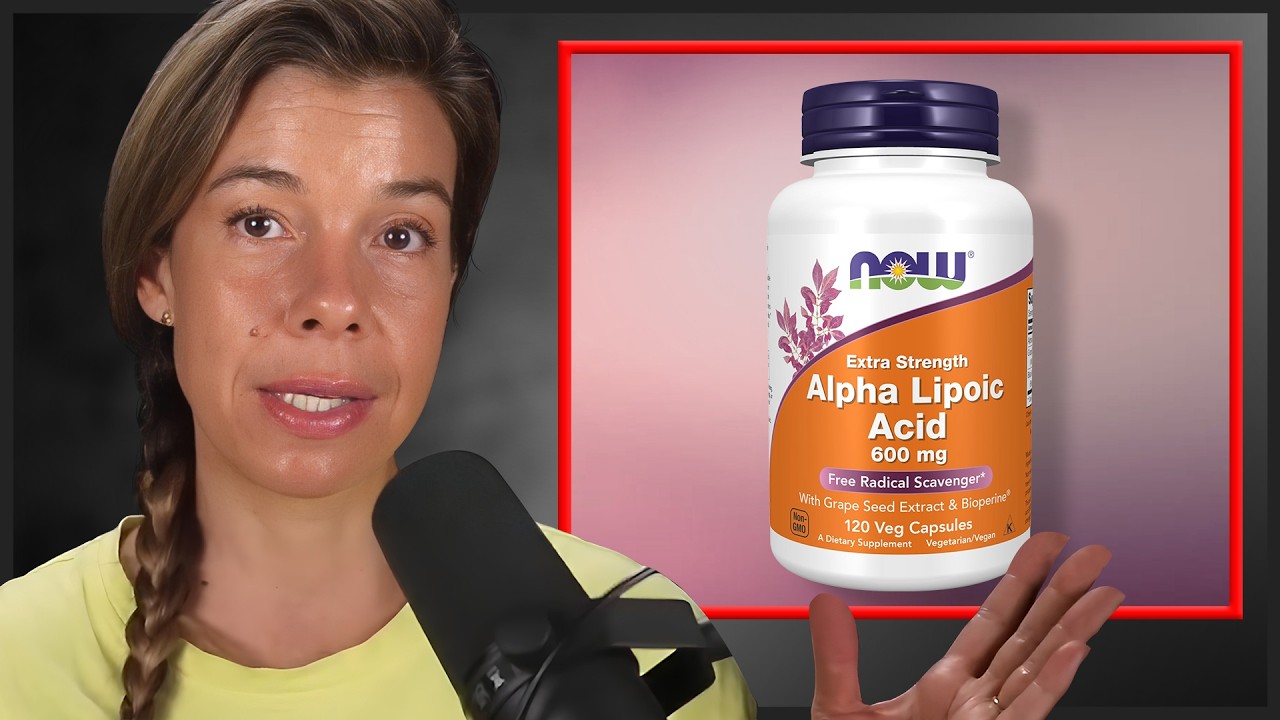
Dr. Rhonda Patrick: So I take a multivitamin as well. And then I take magnesium. And then I take another product called Magnesium, which is, like, a powder I put in my water that I take all my vitamins with. And it's got, like, a mixture of some other magnesium, organic magnesium salts as well. And then I take alpha-lipoic acid.
Lewis Howes: Are you wanting all the perfect stuff? Yeah.
Dr. Rhonda Patrick: Okay. Alpha-lipoic acid, which has been shown to blunt the advanced glycation end products. So it's been shown to lower those in clinical studies.
In fact, people with type 2 diabetes, it's been shown to help improve their AGEs. So I take that. And then I take benfotiamine, another vitamin that's been shown to help with advanced glycation end products. That's an important aspect that I'm focused on. Okay. And that's just a fat-soluble vitamin B1. Take that. And then I take lutein and zeaxanthin for my eyes. I take CoQ10. And then I take— I'm probably going to miss something. I take sulforaphane. Sulforaphane helps detoxify a lot of terrible things that we're exposed to, like plastic chemicals like BPA, but also air pollution factors as well. It activates a very powerful detoxification system in our body. So I take that. And then, um—
Lewis Howes: Where do you think you'd be without taking supplements?
Do you think you'd still be as healthy and optimal as you are, or is it just more of a psychological boost for you?
Dr. Rhonda Patrick: No, no. I mean, so look, I'll tell you The omega-3 one's critical. So there's studies that have now shown that having a low Omega-3 Index is like smoking.
Lewis Howes: Come on. Really? Wow.
Dr. Rhonda Patrick: Yeah. It's like smoking. So omega-3 levels as measured by the Omega-3 Index. So this is like measuring it in your red blood cells. It's a long-term marker of omega-3. It's a beautiful study that was done by Dr. Bill Harris. It was the Framingham cohort, published a few years ago and he looked at people's omega-3 levels, so high or low. High would be 8%, low would be 4%. He's the pioneer of the Omega-3 Index.
And basically, people that were nonsmokers but had a low Omega-3 Index had the same life expectancy as smokers with a high Omega-3 Index.
Lewis Howes: Wow.
Dr. Rhonda Patrick: I mean, if you look at their life expectancy curve, they're overlaid. I mean, it's like, I wish I could pull up the figure. It's mind-blowing.
Lewis Howes: And the only way you can get omega-3, is that from fish?
Dr. Rhonda Patrick: So, no. Yes. Seafood is the major— that's what's going to drive your Omega-3 Index. It needs to be EPA, DHA. That's from the marine sources. ALA, the plant source of omega-3, can be converted into those 2 other omega-3 fatty acids, but very, very inefficiently. And so, really, you need to get the marine source. For people that are vegetarians or vegans, microalgae is the source, so microalgae oil. You have to take a lot of it.
Lewis Howes: Wow.
Dr. Rhonda Patrick: But studies have found that— so people with 4% Omega-3 Index, that's low. That's the— actually, people in the U.S., the average Omega-3 Index is like 5%. If you take 2 grams of omega-3, so supplemental omega-3 per day, For, was it like 3 months or so, then— or 3 or 4 months, then you can go from a 4% low Omega-3 Index to an 8% high Omega-3 Index. And people that have an 8% Omega-3 Index have a five-year difference in life expectancy compared to the people with low.
Lewis Howes: Come on, really?
Dr. Rhonda Patrick: And if you think about Japan, Japan, they have a five-year difference in life expectancy compared to the U.S. on average. They live five—
Lewis Howes: A lot of fish in their diet.
Dr. Rhonda Patrick: Their Omega-3 Index is 10%, ours is 5%. So their average Omega-3 Index is 10%, our average here in the U.S. is 5%.
Lewis Howes: And that's just connected to fish?
Dr. Rhonda Patrick: It's connected to fish intake, right.
Lewis Howes: Wow. But you can't eat too much fish because of mercury, right?
Dr. Rhonda Patrick: Yeah. I mean, it depends on the type of fish you're eating too, right? So, like, the best types of fish to eat would be salmon, mackerel, sardines. Like, these are high omega-3 but low mercury fish. And there's actually even studies showing that the omega-3 fatty acids protect against the mercury to some degree. You don't want to eat swordfish every day. Swordfish is very high. Like, that's a very real thing. If you can get, like, really high mercury levels, then it can be bad. But if you're eating— like, I eat salmon, like, 3 times a week, you know, maybe 4 sometimes.
Lewis Howes: Wow.
Dr. Rhonda Patrick: I eat salmon a lot. But I also take my omega-3 supplements.
Lewis Howes: So it came back to that question is, do you think you could get away from all the supplements?
Dr. Rhonda Patrick: I mean, I do think that there's a few that are really important: omega-3. And vitamin D, you know, you can make it from the sun. It is a— it gets converted into a steroid hormone. Very, very important. Very important. It's a steroid hormone regulating, you know, 5% of the human genome.
Lewis Howes: Wow.
Dr. Rhonda Patrick: So without it, lots of stuff's going wrong. But, you know, there's a lot of things that regulate whether or not you can make vitamin D, right? Where you live, how much melanin you have in your skin, that's a natural sunscreen. If you wear sunscreen or if you have a lot of protective clothing. As you get older, you're 4 times less efficient at making it. So lots of things, right?
So that's where the supplement does help. So I don't, you know, I would say no, I would want those couple of supplements.
Lewis Howes: Do you have a list on your site anywhere of all the supplements you take?
Dr. Rhonda Patrick: I don't have a list on my site. I do talk about it on my membership. I have a lot of Q&As I do once a month.
Lewis Howes: Got you. Something like, you know, having some kind of maybe list because other people have lists of the supplements.
Dr. Rhonda Patrick: Everyone's got a list, right? They're not necessarily right.
Lewis Howes: Really? I want your list then. That's what I want.
Dr. Rhonda Patrick: Yeah. But my list changes a lot. That's the thing.
Lewis Howes: It's like what you took two years ago is different than this year.
Dr. Rhonda Patrick: It is. It changes a lot. Like sometimes I look at my supplements.
Lewis Howes: You need a rolling list, you know? You need an updated list.
Dr. Rhonda Patrick: Yeah.
I think, what do I— like, is this really— like I used to take NAD, like
Lewis Howes: If you could only take 3 supplements a day, and you're only allowed 3 right now, what would you take consistently?
Dr. Rhonda Patrick: I would take omega-3, vitamin D, and sulforaphane.
Lewis Howes: Okay. To simplify it for people. If they're like, I can't take these 30 supplements and I don't know which brands are good, which ones are not good.
Dr. Rhonda Patrick: But I would definitely make sure I'm getting my magnesium from my food because I left that one out. So magnesium. I left that one.
Lewis Howes: Well, if I only had 3.
Dr. Rhonda Patrick: Right, right. But then you'd be focusing on the magnesium-rich foods. I would be getting my leafy greens and my nuts like almonds, they're very high in magnesium, right? Because I want to make sure I'm getting, you know, meeting the RDI.
Lewis Howes: Okay, top 5 supplements. What if you could only get 5 supplements a day? What would those top 5 be?
Dr. Rhonda Patrick: Okay, omega-3, vitamin D, sulforaphane, magnesium, and the multivitamin.
Lewis Howes: Okay. That seems more reasonable. That's the top 5. What is sulforaphane?
Dr. Rhonda Patrick: Yeah, sulforaphane is— it's a compound that is made from a precursor that is found in certain types of cruciferous vegetables. So these are broccoli, cauliflower, Brussels sprouts, cabbage, those types of vegetables. It's really— the precursor is called glucoraphanin, and when you break the plant, like by chewing it or you break the plant wall, the glucoraphanin comes in contact with an enzyme called myrosinase that breaks it down into a compound called sulforaphane. So sulforaphane is really high in broccoli sprouts.
In fact, it's 100 times higher than mature broccoli. Sprouting broccoli is another option. I like broccoli sprouts.
Lewis Howes: Yeah, yeah.
Dr. Rhonda Patrick: Broccoli sprouts is another option. I prefer to just take a supplement that— you have to find a good one. So there's a couple of good ones. Avmacol and Prostaphane.
Lewis Howes: Okay.
Dr. Rhonda Patrick: And BROQ. They're all sort of— those are, like, the high-quality sulforaphane supplements. But sulforaphane activates a pathway in your body called NRF2 that's a major, major activator of a lot of different genes in our body that get rid of toxic compounds like carcinogens. So, like, if you're eating— let's say you're eating bacon, you can be exposed to something called heterocyclic amines, which can cause cancer.
Well, activating NRF2 through sulforaphane can stop your body from getting those terrible heterocyclic amines, right?
Lewis Howes: Wow.
Dr. Rhonda Patrick: So it's very good at detoxifying carcinogens, but also other factors like air pollution, benzene that you breathe in. I'm concerned with plastic chemicals like BPA, BPS. I think it's very good at detoxifying that because it does the same. It activates pathways that are able to take BPA make it water-soluble because you excrete a lot of BPA through your urine. So that's why I think sulforaphane is very important.
Lewis Howes: Okay. Amazing.
Hear new content from Rhonda on The Aliquot, our member's only podcast
Listen in on our regularly curated interview segments called "Aliquots" released every week on our premium podcast The Aliquot. Aliquots come in two flavors: features and mashups.
- Hours of deep dive on topics like fasting, sauna, child development surfaced from our enormous collection of members-only Q&A episodes.
- Important conversational highlights from our interviews with extra commentary and value. Short but salient.
Supplements News
- Omega-3 fatty acid supplementation benefits people with depression.
- Alpha-lipoic acid supplements promote weight loss in obese people who are otherwise healthy.
- Study reveals a sixfold decrease in C-reactive protein levels among obese women who took omega-3s during pregnancy.
- Curcumin reduces pain associated with osteoarthritis of the knee.