Infrared Saunas and the Potential Benefits of Heat Therapy
The BDNF Protocol Guide
An essential checklist for cognitive longevity — filled with specific exercise, heat stress, and omega-3 protocols for boosting BDNF. Enter your email, and we'll deliver it straight to your inbox.
You'll also receive updates from Rhonda & FoundMyFitness
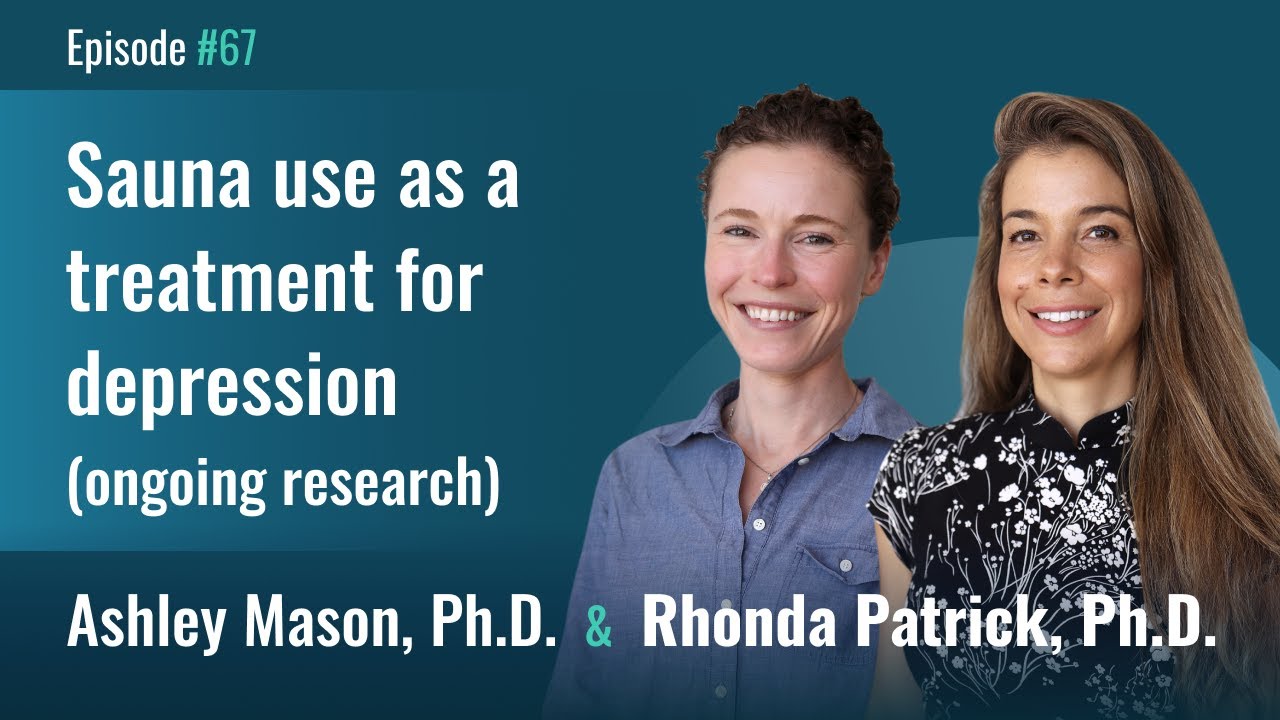
In this clip from Dr. Rhonda Patrick's appearance on The Diary of a CEO, she compares lower-temperature infrared saunas with hotter traditional saunas and describes a UCSF study that combined cognitive behavioral therapy with repeated whole-body hyperthermia. The study enrolled 16 adults with major depressive disorder. Participants received eight weekly CBT sessions and were offered either eight weekly or four every-other-week heat sessions using a head-out far-infrared sauna dome. The supervised sessions heated core body temperature to 38.5°C (101.3°F) and could last up to 140 minutes. This protocol is substantially more intensive than a typical 20- or 30-minute home infrared-sauna session.
Among the 12 participants who completed the final assessment in this single-arm feasibility study, the mean Beck Depression Inventory-II score fell by 15.8 points, and 11 no longer met criteria for major depressive disorder. [1]
An earlier randomized trial found that one session of whole-body hyperthermia reduced Hamilton Depression Rating Scale scores compared with a sham condition over six weeks. Traditional Finnish sauna studies associate frequent sauna use with lower cardiovascular and all-cause mortality in observational cohorts. The practical question is the heat dose, not the label alone. Infrared cabins operate at lower ambient temperatures, and achieving a larger rise in core temperature required prolonged supervised exposure. People with cardiovascular disease, pregnancy, medication-related heat sensitivity, or symptoms during heat exposure should discuss sauna use with a clinician. [2] [3]
This clip is excerpted, with permission, from Dr. Rhonda Patrick's appearance on The Diary of a CEO. Thank you to The Diary of a CEO for allowing us to share it.
- ^ Mason AE; Chowdhary A; Hartogensis W; Siwik CJ; Lupesko-Persky O; Pandya LS, et al. (2024). Feasibility and acceptability of an integrated mind-body intervention for depression: whole-body hyperthermia (WBH) and cognitive behavioral therapy (CBT). Int J Hyperthermia 41, 1.
- ^ Janssen CW; Lowry CA; Mehl MR; Allen JJ; Kelly KL; Gartner DE, et al. (2016). Whole-Body Hyperthermia for the Treatment of Major Depressive Disorder: A Randomized Clinical Trial. JAMA Psychiatry 73, 8.
- ^ 25705824
Steven Bartlett: What about infrared saunas?
Dr. Rhonda Patrick: Infrared saunas or traditional saunas?
Steven Bartlett: The infrared ones.
Dr. Rhonda Patrick: Infrared. So, infrared saunas are a type of sauna that uses infrared wavelengths to heat up the body. They're not very hot. If you look at the ambient temperature in an infrared sauna, it goes up to about 140 degrees Fahrenheit, which is very different from a traditional sauna. Infrared saunas don't have all the same benefits as a traditional hot sauna, something that may go up to 175 or 180 degrees Fahrenheit, unless you stay in that infrared sauna for a very long time, perhaps even twice as long or more than you would in a traditional sauna.
The interesting thing about infrared saunas, I would say, is that a colleague and collaborator of mine, Dr. Ashley Mason, is at UCSF, and she's been doing what's called the heat bed study. It's an infrared sauna that is essentially a head-out heat bed. Your whole body is in this infrared sort of bed, but your head is out of it. She's now done a couple of studies, and the most recent study has been done in people with major depressive disorder. They have depression, and these people are doing an infrared sauna to a pretty extreme degree. She's elevating their core body temperature by around 2 degrees, so they're essentially getting into a somewhat feverish state. To do that, these people are in this infrared sauna for well over an hour. Most people doing infrared saunas are probably staying there for 20 or 30 minutes, so people are getting very, very hot, to the point where their core body temperature is increasing by about one and a half to 2 degrees, right?
She's looking at the effects on depression, and what she has found is kind of amazing. People doing this infrared sauna, this heat bed, and doing cognitive behavioral therapy, CBT, are experiencing a massive antidepressant effect. There's something called the Hamilton scale, which is like a battery of tests that are done to assess depression. Just to give you some basis, if something is considered clinically significant, then you have about a three-point change on that scale. Well, essentially, this infrared sauna plus the cognitive behavioral therapy improved the Hamilton scale assessment by 16 points. These are people who did four or eight rounds of it over the course of either one month or two months. Some people just couldn't finish it because it is pretty intense. You're heating your body up quite a lot, and you're sitting in this infrared sauna for over an hour. It's pretty intense. But the magnitude of the antidepressant effect was stunning.
This all stems back to her mentor, Dr. Charles Raison, and his research, which was essentially like an infrared sauna. Back in 2016, he did this study where he either put people with major depressive disorder in this sort of infrared-sauna-like thing, which elevated their core body temperature again by about 2 degrees, or gave them a sham control. The sham control was kind of hot, and people thought they were getting the treatment, but it was actually a placebo. It was enough for them to think they were getting the treatment, but it wasn't elevating their core body temperature enough. They did one treatment of this, and he showed that the people who did one treatment had an antidepressant effect that lasted six weeks. The sham control group didn't get this effect. It was a beautiful study. Ashley followed on that study and showed that multiple sessions had an even more robust effect.
But I say this because I don't want to say infrared saunas aren't great. However, a lot of benefits have been related to hotter, traditional types of saunas. Finnish saunas, for example, are traditional saunas that are hotter. You're staying in these 175- or 180-degree saunas for about 20 minutes. It's associated with lower cardiovascular-related mortality. If you're doing it four to seven times a week, that's associated with a 60%... sorry, 50% lower cardiovascular-related mortality versus doing it one time a week. For all-cause mortality, it's associated with 40% lower all-cause mortality versus doing it one time a week. So...
Steven Bartlett: What's going on there?
Dr. Rhonda Patrick: Right. Exactly. What's going on there? The really fascinating thing to me about this deliberate heat exposure from a sauna is that it is sort of mimicking moderate-intensity aerobic exercise. This has actually been shown. It's been compared head-to-head with moderate-intensity exercise, like cycling on a stationary bike. A lot of the physiological responses are very similar. Your core body temperature goes up. Your heart rate goes up. When you're exercising, your heart rate goes up. The same thing happens when you're in a hot sauna. Your cardiac output is increased. Your blood flow is increasing. With exercise and heat stress, you're sweating to cool down your body.
It's a way of sort of mimicking moderate-intensity exercise that doesn't really happen in an infrared sauna if you do it for the same amount of time as a hot sauna. Perhaps it would happen if you increased that time, but there are all these benefits from deliberate heat exposure in a sauna that seem not only to mimic cardiovascular exercise but also to add to it. We were talking about cardiorespiratory fitness and how important that is for longevity. Studies have looked at people who exercise on a stationary bike versus people who exercise on a stationary bike and then follow that with a 15-minute sauna. The people who do the 15-minute sauna on top of the exercise have greater improvements in their cardiorespiratory fitness and in their cholesterol and lipid levels. Their blood pressure improvements were also greater. There's this additive effect from adding deliberate heat exposure to exercise that isn't happening with exercise alone.
Again, that's more evidence for using deliberate heat exposure, like a sauna. Hot tubs have also been shown to improve blood pressure. In fact, a study just came out a couple of weeks ago showing that a hot tub is very beneficial for improving blood pressure and produces all the same effects as a sauna, which is kind of exciting because not everyone has a sauna.
Steven Bartlett: I heard that you sometimes rehearse important talks and studies in saunas.
Dr. Rhonda Patrick: Yeah. I mean, this started back when I was in graduate school. I lived across the street from a YMCA, and I used to go to this sauna before I would go into my lab and do experiments. There are a couple of things I noticed. One, I was able to handle stress better: the stress of failed experiments, mentors putting all this pressure on me, all that stuff. If I went to the sauna beforehand, it was like I was more resilient to the stress. That was when I started to look into the effects on the brain, and that's where I also became very interested in depression research, because you're causing, like, brain resilience.
Once I started to realize that this was affecting my mood and my ability to handle stress, I was using the sauna every day. I mean, I was religious about it. It was crazy. I was going in that sauna six to seven days a week. Because I was using it every day, I had to multitask. You only have so much time in the day. I'd start rehearsing my presentations, going through them in my mind while I was sitting in the sauna with these other people from the YMCA who probably thought I was crazy because I was sitting there saying things. But I noticed that I was able to remember things better if I had gone through them in my head with the heat.
I kept doing that for many, many years. Even sometimes when I travel and I'm giving a presentation or a talk, I'll get in the hot bath in my hotel room, lie in the hot bath, and go through my talk in my head. Or I'll look at my notes, and if I forget something, I'll go through it in my head. It wasn't until several years later that I started looking into the science behind that. There's something going on here. What is going on?
I found that there are a lot of physiological changes when you go into the sauna. Growth hormone goes up. In fact, depending on the temperature and duration, growth hormone can go up anywhere from twofold to about 16-fold, like insane levels of growth hormone. But something else that goes up is called IGF-2, and that is associated with improving memory and learning. There have been animal studies on this. I've kind of connected the dots here and thought, maybe that's why. I don't really know why. Sometimes, just a very strong emotional response can sort of help you remember something.
Steven Bartlett: And you are, at the end of the day, causing a very strong stress response when you're getting in the heat.
Dr. Rhonda Patrick: So, I like to use the sauna for a lot of things. It depends on the day. Sometimes I like to do it before bed. I'll do the hot tub or the sauna. It improves my sleep. That has to do with growth hormone. It also has to do with what are called somnogenic cytokines. These are inflammatory molecules that cause sleepiness. Think about when you're sick and you have inflammation going on. When you have an illness, you're very tired and sleepy. You're producing a lot of what are called somnogenic cytokines. These cytokines are inflammatory molecules involved in making you sleepy. Those are also produced when you are undergoing deliberate heat exposure, like a hot tub or a sauna, and that's been shown as well. Sometimes I like to do the sauna at night to relax and help my sleep. Sometimes I like to do it after a workout to extend my workout, like the study I talked about where you're improving your cardiorespiratory fitness as well.
Hear new content from Rhonda on The Aliquot, our member's only podcast

Listen in on our regularly curated interview segments called "Aliquots" released every week on our premium podcast The Aliquot. Aliquots come in two flavors: features and mashups.
- Hours of deep dive on topics like fasting, sauna, child development surfaced from our enormous collection of members-only Q&A episodes.
- Important conversational highlights from our interviews with extra commentary and value. Short but salient.
Sauna News
- Platelet-derived 'exerkines' produced during exercise promote neurogenesis, boosting brain health and cognition.
- Infrared sauna use reduces frailty in older adults.
- Hsp70 shown to preserve locomotor function and reduce cell death through a stable binding to toxic amyloid-beta42, blocking ability to attack neurons